Software
Houzz Logo Print
mirz2000

Eco Friendly Lighting: Why so Ugly?

15 years ago

I am trying to do the right thing here, but why is it that no matter what type of eco friendly bulbs I buy, my house still looks like the inside of a 7-11 when I install them? (even the "soft white")

Any suggestions on eco friendly lighting that won't make me feel like buying an Icee?

Specific brand suggestions very much appreciated...

Comments (16)

  • 15 years ago

    It all has to do with the way our eyes perceive light -- both its "color" (which can be assigned a numerical Kelvin value; higher numbers being more blue and lower numbers more pink/red) and its quality -- and with our brains, which are used to seeing yellowish incandescent light as "real indoor light", and which don't quite follow that natural daylight is much more blue than most incandescent light (which is why "full-spectrum" bulbs can look so bad inside.

    You don't say if there are any restrictions on what qualifies as "eco friendly" lighting. Many people consider halogen bulbs a good source of light, and they do put out more light than a regular incandescent lamp of the same wattage. That might be an option.

    But if "eco friendly" means LEDs or fluorescent, then you're better off with fluorescent, which at least comes with a few different color temperatures ("soft white" typically is closest to the incandenscent we're used to). I also tend to buy well-known brands of CFLs -- I've been happy with Sylvania and Philips. I've seen several (independent) reviews which state that the Home Depot house-brand CFLs are pretty good, but I don't shop at HD and my experience is that big-box stores sell bulbs which often are harsh and not always true to the color quality they claim on the box, so a good HD bulb would be a first for me.

    I also find that fixtures which shade the bulb help do a much better job of imitating fixtures made with incandescent bulbs. I have a soft-white Circline fixture with a translucent white lens over it which casts light very similar to the still-incandescent light next to it. That fixture came from -- hmm, I'll have to dig for the receipt, if I still have it (I should).

    Hope this helps....

  • 15 years ago

    Thanks for the information, Steve! Sylvania are the latest bulbs I picked up (soft white)... still seem greenish to me. I'll try the Home Depot brand next, I suppose.

    In answer to your question, I am not particular about the type of bulb, so long as it is more energy efficient than the standard incandescent bulb... though so far, I am still using incandescent because it looks so much better. Halogen is a good idea; I hadn't thought of that!

    Thanks again.

  • 15 years ago

    Haha! Hilarious post.

    I agree that fixtures with shades are your best bet (glass shades, fabric shades, whatever--as long as the shade tints the light to a more acceptable hue). I'm surprised to hear someone say fluorescents are better than LED, though. LEDs come in so many colors, I'd be surprised if there weren't a good color for everyday indoor lighting.

  • 15 years ago

    LEDs are still in their infancy, and white LEDs still tend to blue more than any other color. They're also an excellent point light source, but not so good if you want an overall glow (unless there's a shade or covering on the LEDs). And, of course, they're $$$$.

    I'm convinced LEDs will get there. And fluorescent definitely has its "issues". But right now, I think fluorescent is a more acceptable choice than LED.

  • 15 years ago

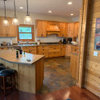
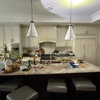
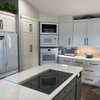
    Well, we love our Cree LEDs, although they were not cheap. I only have cans, no pendants. The electrician put halogen bulbs in when he installed the cans - I did not like those at all. It's true that the color is different with the LEDs, but we went with the 'warm' color and it's better than the halogens. Also, the LEDs are dimable, although they do not dim as much as an incandescent does. They are very bright and we dim them a lot. We snapped a picture when we were part way through swapping the halogens for the Crees, and you can see how the Cree has a nice soft ambient light compared to the halogen, and you can also see the color difference - look against the wall. The one on the left is the LED, right is halogen. Also the one closest to the photographer is LED and the one on the far right is halogen. Finally, DON'T look at the fact that our lights are not centered on the window. There are two bathrooms above the kitchen and so lots of plumbing up there - we were limited on the can placement.

    {{!gwi}}

    I will also add that we have had good luck (color-wise) with the GE Reveal florescent bulbs in other areas of the house. They really made a huge difference in the wall paint color and feel in the room.

    Here is a link to the LEDs we got from Polar-Ray. Polar-Ray was great to work with - very helpful. Cree has come out with a newer, cheaper LED bulb since we bought ours - it might be a good alternative.

    Good luck!

    Here is a link that might be useful: Cree LR6 at Polar-Ray

  • 15 years ago

    I love my Cree LR6 LED can lights. I also picked up some smaller LEDs for our 4" cans that have a regular Edison base (regular screw-ins) that are fine in cans. They are Sylvania ULTRA LED Par 20 36 degree spread floods in the color 3000K or CRI 85. These were $60 each, bought in a box of six bulbs for $360. Their Life L 70 is 50,000 hours. That means that given a large group of identical lamps, it will take 50,000 hours of use for half of them to run down to the point that they are putting out only 70% of the amount of light that they originally gave. LEDs dim gradually and you apparently replace them when they get too dim for you. LEDs are expected to last 5 to 10 years before they need to be replaced and they use only something like 14% or 18% of the amount of electricity used by old incandescent light bulbs.

    I have never understood the attraction of halogens. I do not like the bright spotlight effect that blinds when you are at the wrong angle. This could be a generational thing, though. I may be too old to appreciate them the way younger people seem to do. And they get hot. People in the Kitchens forum have talked about their halogen under counter pucks getting so hot they melt things in the cupboards above them. How can something that puts out that much heat be efficient?

  • 15 years ago

    You shouldn't be going for the 'soft' or 'cool' white. Go for the 'warm'.

    'Daylight' cfls are uncomfortably garish to me, but they are good for SIDs.

    I've seen CFLs that are as near to an exact match to incandescent that my eyes can judge. They are at HD.

    I have an LED light in my hallway next to an incandescent flood. I can't tell the difference between the two. The LED takes about 1/2 sec longer to start up and has a slightly narrower beam, but that's it.

  • 15 years ago

    I have tried every CFL out there, I think. The only one that does a decent job is the Reveal CFL. The rest are unacceptable to my (professional) eye. They are expensive and hard to find in the 100W equivalent, but worth the hunt and the expense. I don't use them everywhere, just where it matters the most.

  • 15 years ago

    Thank you for the suggestions! I am going to have to go on the hunt for some of these things.

    That's true about the heat from the halogen bulbs. I hadn't considered that.

    Pudgybaby: thank you for posting pictures! That does look nice.

    Weedmeister: I didn't see a "warm" option, but I think I have in the past. I will do some checking. The Home Depot near my house seems to have less selection than some others (on a lot of things). Maybe Lowes will be better.

    Amy: thanks for the suggestion! I think I saw the "reveal" bulbs. I will give them a try too.

  • 15 years ago

    I know that if candelabra bulbs disappear, I will not have any chandeliers in my next house. They have put the "flame" shaped bulbs in the few hall chandeliers in my complex (buildings are 1838-1860 on the street) and they look really odd and cast unpleasant light.

    This presents a design dilemma for me, because I am looking at a house from 1810 that was fitted with fairly period appropriate bell jar and lanterny looking things in the hall and stairs in its last restoration (1960ish), and I will have to look for something that hides the bulb but still looks period. (and period reproduction "solar" lamps and Argand lamps --that often had frosted shades---are really pricey :-( )

  • 15 years ago

    Hi all, I wanted to introduce myself quickly since I'm a long time lurker but a new poster on Gardenweb/THS forums. I've really enjoyed using Gardenweb over the last couple years as I've gotten into vegetable gardening, but I'm also the VP of Marketing and Ecommerce at Polar-Ray.com LED Lighting, which makes me a de facto LED enthusiast, and I feel I should contribute in some small way after all the great info I've received by just coming to the boards and perusing. When it comes to LED lighting, my hope is to provide useful information without sounding like I'm trying to always push sales to our company, that is not my main intent. LED lighting is advancing rapidly and my goal is to help educate anyone interested in the technology on what is taking place in the market or to answer any product specific questions on brands or items I'm familiar with.

    So to mirz2000, I would suggest as other posters have that you look for warm white lighting in the 2700-3000K color temperature range. Without specifically knowing what shape or wattage of bulb you are trying to buy/replace it's hard to give brand recommendations, but as pudgybaby stated above (btw, thanks for the nice words!) Cree makes a LR6 (10.5 watt, 650 lumen, 75W equiv.) and CR6 (10.5 watt, 575 lumen, 65W equiv.) six inch downlight in a 2700K color temp that will retrofit into most existing six inch cans. A bulb I'm using a lot at home right now is our LED R30 (3000K, approx. 60 equiv.) bulb which is an Edison based replacement that dims nicely, even on one circuit where I have with just one bulb.

    Thanks for having me and happy holidays to everyone.

  • 15 years ago

    sean,

    I have been looking into LED for a while and will probably make the jump when I do my remodel this summer. I have tested out a bulb from HD, just to see light output, which looks pretty good for even what they had.

    What would be helpful on your site would be to list the Lumens output as well. You recommended the R30 bulb above and your website dies not list that info. Also, while it mentions if a bulb is dimable or not, it would be helpful to know down to what percent. This is the area that I am most interested in. I would rip out and replace all of my bulbs. I use halogen par38's in my bedroom in ligholier recessed trims. I use Par30 (I believe) in other Halo cans and these are halogen bulbs that look like the typical R30 bulbs so I can get the most light output since I was limited to the trim requirements and retrofit style can. Since LED's really put off little to no heat, you can put larger bulbs than normal.

    I have been watching Cree for a while and know they are the leader in LED lighting. The 1000 is very impressive in terms of light output per watt. I hope they are also addressing the ability to dim below 20% as well. I am interested to know where things are going so I have a roadmap to work off of to see if this works for me.

  • 15 years ago

    I work in energy efficiency, and have CFLs in the vast majority of my fixtures.

    One issue I think people have is when they have a room that was painted and decorated under incandescent light. Then they put in fluorescent, and everything looks different, and maybe bad. But when you already have fluorescents, and you are, say, choosing paint color, you look at color samples under fluorescent light, and you choose a color that looks good in that light. Maybe the color is a lot more yellow than what you would have chosen under incandescents, but it will still look fine because it was chosen for those conditions.

    What I'm saying, is that it is a bit of a chicken and egg problem. Which comes first the decorating color choices or the lighting choices? Obviously, most of us don't have the budget to go out and redecorate when we change a light bulb, but the problem with the light should only persist until the next time you paint/redecorate.

    My issues with CFLs have less to do with color, and more to do with them being dim until they warm up (my underheated house hovers around 60 degrees at this time of year).

  • 15 years ago

    Hi todds,

    Unfortunately the answer to your questions are not so cut and dry. Many of the bulbs that we carry have not been tested to LM79 standards as of yet and therefore the exact lumen output of the bulbs, even if one is given by the manufacturer, can be suspect. That is why we try to provide an equivalency rating, done through in house testing, on most of our products.

    On the dimming issue the same thing applies, while companies like Cree give a dimming percentage it may not be exactly that under all circumstances. Different dimmers, the number of bulbs on the circuit, how good the wiring is etc. can all make a difference in how well the lights dim and down to what percentage. For instance, some people may need to use an ELV dimmer when only using one or two LED downlights on a switch whereas four or five on a switch will dim fine with a standard incandescent dimmer. Therefore it's quite difficult to make a claim on dimming percentage when the manufacturer is not specifying the dimming percentage and what dimmers are tested and compatible. The R30 we carry does have a downloadable spec sheet where the dimming percentage is listed as 5% (link included below). As stated above, I can verify that the R30 does dim particularly well.

    Fortunately the market and standards are evolving rapidly. By the middle of next year, new labeling requirements will mandate that bulb packaging carry a label listing lumen output, wattage etc. on the front of the packaging. A paradigm shift will take place as consumers stop thinking about brightness in terms of wattage and start thinking about it in terms of lumen output.

    Hope this helps to clarify some of the issues currently present in the LED market.

    Here is a link that might be useful: R30 LED Light Bulb Spec Sheet

  • 2 years ago
    last modified: 2 years ago

    I hate LED lights! All LEDs, soft white or otherwise, will distort colors in the room because they don't render color perfectly the way incandescents do, and they're harsher on the eyes. Plus, they never last as long as claimed. Their rapid flicker is known to give some people headaches and migraines. Even if you can't see the flickering, your brain can still perceive it, thus giving you a headache.

Sponsored
Mary Shipley Interiors
Average rating: 4.8 out of 5 stars34 Reviews
Columbus OH Premier Interior Designer 10x Best of Houzz