Software
Houzz Logo Print
grow_life

a case for seedling apples

11 years ago

Yes, I'm well aware of genetic variance in malus. I know the tree from the seed I plant is a total roll of the dice for fruit qualities, and in many ways, that is the point of my little project. I'm growing seedling apple trees to be planted in land reclamation areas for wildlife purposes, and possibly some park areas that have lost tremendous amounts of trees lately thanks to lovely imported pests.

Given that these trees are not meant for orchard production, I'm not so worried about performance. I do intend to keep some of them pruned for structure to give them a better chance of producing whatever fruit the good Lord (or blind chance, if that's your thing) has granted them. Their purpose in life is to look pretty in the spring, and feed whatever fancies an apple.

Should I happen to find a decent apple out there, that would be a bonus. I keep seed from apple orchards that do not use crabapples for pollinators, so most of them should be a quality apple crossed to a quality apple which may increase the likelihood of a decent apple. That being said, with the genetic roulette of malus, I'm sure a number of crummy crabs with teensy fruit are going to come up. No biggie, but I'd like to limit them a bit if I can.

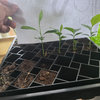
As these seedlings are coming up, I'm finding a potpourri of colors, some of them very dark maroon in the leaves. As an urban forester, I know of lots of purple leaved crabapples, but as a hobby orchardist, I don't know of any purple leaved malus domesticas out there. Should I cull out these as more likely to be "crabish", or just let it ride and maybe get some maroon leaved apple tree with fruit the size of a watermelon with excellent keeping quality 3 years off the tree and is immune to all known pests and diseases?

Comments (24)

  • 11 years ago

    If you are just planting them for wildlife I would just let them grow.

  • 11 years ago

    If I was starting a home apple orchard again, most of my trees would be seedling apples. It is the least expensive option that carries with it many benefits.

    The trees will grow large enough to survive deer pressure without fencing; the chances of getting a fine usable apple are good; the unusable stock can be grafted upon; many seedlings can be planted without monetary investment; a good variety may be discovered.

    Best bet is to use the seeds from apples grown at an orchard in your area.

  • 11 years ago

    I would let it grow and see what you get. Crabapples are the most nutritious of all apples. If you find one that is good to eat and disease free, as well as pretty, you could share it with others. Maybe good for wildlife too.
    John S
    PDX OR

  • 11 years ago

    Seedling apples are definately worth growing.The last row I planted like that left me very pleasantly surprised. I would be most interested in the red colored leaves because they might wind up being a red fleshed apple.

    This post was edited by ClarkinKS on Fri, Dec 26, 14 at 1:38

  • 11 years ago

    Crabs are also good to pollinate others. I grow my own rootstock from seedlings, some of the nicer dark leaves I have kept growing on to see what they turn out like, this one here, [one out of about 10 trees] turned out to be the best red flesh with a nice size.

  • 11 years ago

    "The trees will grow large enough to survive deer pressure without fencing."
    I would think they would be just as tasty to the deer as any expensive apple tree. Around here in northwestern Wisconsin one would still need to provide deer protection until they were a large tree. Or is that what you meant? Northwoodswis

  • 11 years ago

    Yes that is what I meant. Once they grow large enough the fencing can be removed from the seedling trees and the deer won't likely mortally wound them. The bears unfortunately can and will destroy any size tree. I forgot to add that the seedling apples won't likely need staking or trellising either; another bonus.

  • 11 years ago

    Thanks for the advice. I'll be adding deer protection as much as possible. These are going in more urban areas and bears are not usually a problem, but we do have roving 2 legged crazies to account for at times. I have enjoyed many tasty crabapples, but they have been cultivars for the most part. Just wasn't sure about fruit from maroon leaved trees, not having come across them much myself. Good to know some have found them to be tasty. I hadn't really thought about the whole root stock thing, but maybe I'll find one that does better in poor soil and explore that route. Of course, that will be like, 10 years from now. Eh, worth a shot, anyway. The deer will thank me.

  • 11 years ago

    Grow-life...I've grown a lot of seedlings and I too have had many with maroon/reddish foliage. I never thought about the relationship to crab apple, but that is an interesting question. I do know however that you will still see red foliage expressed when young even when a crab was nowhere in the mix (or at least as far as I know). I've hand pollinated and then used those seeds and still had some with the reddish/maroon foliage.
    I've also witnessed that reddish color fade away as the seedling matures (usually after just one year). I'm sure this is a well known and well understood phenomena and the answer is likely online, but maybe hard to find. I'll look into this one day when I get time.
    If I was you, I don't think I'd discard anything just yet. Let them grow out and see what happens.

  • 11 years ago

    grow life...here is a long winded and very deep study of red foliage and red coloration in general in apples.

    http://www.biomedcentral.com/1471-2164/8/212

    It seems though red foliage is often found and associated with crabs, it can also be expressed in seedlings which will produce red skinned apples including those with white flesh.
    At least you don't have to read through the whole study as it is only about red coloration of apple skins, flesh and foliage and their interrelationships. Seems every breeding program these days are just busting to get red coloration throughout.
    I'd love a red fleshed Honeycrisp too!

  • 11 years ago

    Genetic diversity in apples and other things are considered a bad thing by most people today. The truth is growing a diverse gene pool of apples from seed is how we got where we are today with many fantastic varieties. Every seed you plant could be the next honeycrisp. The rejects when grafted over can be whatever you want them to be. Maybe you will wind up grafting them over to one of your successful seedlings. I gained a very long keeper that's delicious, a good sized green apple, and an excellent cider apple out of my last group of wild apples. I'm still waiting on some of them to bear.

  • 11 years ago

    Clark...wasn't it you that posted the photo of the small seedling apples? Was that the cider apple you are speaking of? It was a nice looking little apple. Could you post the photo(s) again in this thread.
    It seems like a good thread for it especially since a lot of the posters here probably didn't see them.

  • 11 years ago

    Appleseed70,
    Yes this is a fantastic cider apple and I have posted pictures of it before. There will be a couple of other seedling apples that will mature this year and I'm excited to know how they are going to turn out. This row of apples was grown from selected wild apple seeds. They were selected for yield, flavor, and size and they have surpassed all of my expectations of them. This apple matures late when nothing else does and keeps well. I still have about 15 gallons of the apples left from the harvest and did not need to put them in cold storage. They are sitting in a room in a box and I look for bad ones from time to time. They are everything I hoped for in an apple.

    This post was edited by ClarkinKS on Thu, Jan 1, 15 at 17:08

  • 11 years ago

    This is great information. I am all for genetic diversity. It is a way to give to future generations.

    Do seedling apples take a long time to bear?

    The photos on this topic are great. Nice looking apples.

  • 11 years ago

    Seedling apples take 5 or more years to bear. For the person with not to much room they might be a bad choice because grafted apples are a sure bet. My main crop is grafted apples but my hobby which I love is seedling apples.

  • 11 years ago

    Not that I'm going to mess around too much with it, but would it be faster to fruit by grafting the 1st year wood from a seedling onto an established tree to see how it is?

  • 11 years ago

    Yes you could get apples in 2-3 years using that technique. If you graft a small peace of seedling apple on a full grown apple tree.

  • 11 years ago

    You could grow out a couple of g11 at the same time and be ready to graft next year http://www.cumminsnursery.com/rootstocks.htm. You would want to stake those I think.

  • 11 years ago

    If that works with apples, maybe it will work with other fruits. I don't want to go off topic, so will stop there - just really nice to have the info. I grow all sorts of fruits from seed, Thinking about crossing Prairie Fire crab with Golden Sentinel or North Pole to see if I can create a red leaf columnar crab. Likely not edible, but who knows.

  • 11 years ago

    Clark does that apple have any red staining in the flesh? Does it have any trace of red in the foliage? Is it sweet enough to eat fresh or mainly a tart cider apple only? Have you tried them in pies?
    I love the small size...I wish more apples were bred to be on the small side.
    Love that photo Clark...for real!
    You are still going to send me some wood from this I hope? I'll send the pre-paid mailer my friend.

    BTW...I think were alike in our fondness for seedling growing and our awareness of the importance of it.

  • 11 years ago

    Not a hint of red on the foliage or fruit though I wish there was. None of my current trees are red fleshed so I just don't have the gene pool for them but I'm looking to change that. It's a very sweet apple but not in an overpowering way. There is a tartness to it but it really is indescribable. Everyone here says it's the best apple they have ever tasted. Sure I don't think there is any law against sending scion wood there but I will check to be sure before I do :0)

  • 11 years ago

    Yeah...we better check first...Maryland is after all a law loving state. The lawmakers are a bit nuts, but it'll be ok I think...lol.

  • 11 years ago

    The only thing I would watch out is for susceptibility to disease... Otherwise - if it's for wildlife - who cares?

    If I saw fireblight, strong susceptibility to CAR, or larger than usual insect attractiveness - I would hack it down....

    But, then again - I am in the hot, humid south east - and disease is our primary enemy....

    I am planning to try out some seedlings myself... I just gotta find the space...

  • 11 years ago

    'Prairifire' is not looking so good these days, I would use another, higher quality (better coloring and resistance) purple crab as a parent.

    One thing about planting numbers of orchard apple seedlings near cultivated areas is that these can act as pest and disease reservoirs.