Software
Houzz Logo Print
hippylove4u_gw

Leaf rollers found!

11 years ago
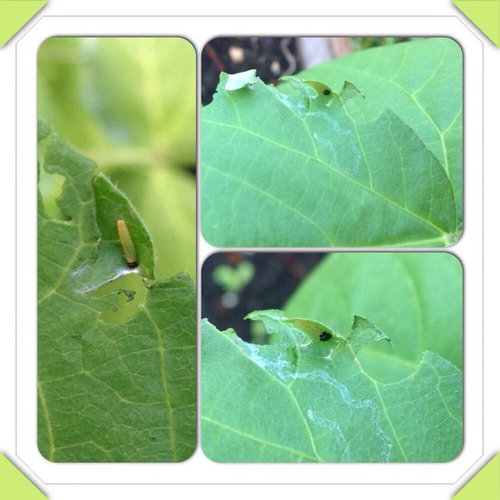
Help! Found what appears to be eggs and caterpillars of leaf rollers on my Scarlett runner bean leaves. How can I organically take care of? Is BT the only way to go Or is there a better more efficient way? These happen to be planted by my butterfly attracting plants so I want to be careful...

Comments (8)

  • 11 years ago

    A few holes in a few leaves will not bother Runner Beans. They grow to 8 feet or so and can cope with a fair amount of damage before it has any effect on the crop. if you really want to get rid of them a blast with the hose will do it. Or wait for the birds to show up.

    I'm curious to know where in the US Runner Beans grow in December?

  • 11 years ago

    Spinosad is another organic bacterial agent that works better than BT in most areas. Alternately from the Green Light brand there is an organic combination spray of pyrethrin and neem oil that is very effective on eggs and common caterpillars.

  • 11 years ago

    Since beans are pollinated by insects anything which kills caterpillars may well kill them too. Pyrethrins are bad news for bees.

  • 11 years ago

    I'd just squish them with my fingers.

  • 11 years ago

    Leaf rollers occasionally appear on my beans, but never in large numbers - the damage is minimal. Chances are that no drastic action will be necessary, other than squishing them as you find them.

    In my garden, wasps seem to keep most caterpillars in check... so I tolerate their nests unless they are in areas where we risk getting stung.

  • 11 years ago

    Pyrethrins kill on contact and breakdown within hours. If you spray in the late afternoon when the bees are going home then there is little danger. Further, bee research shows that local populations of bees are thriving but the managed bees in agriculture are the victims of systemics used in seed coatings and various stages of plant development -- the primary culprit being Imidacloprid.

  • 11 years ago

    Floral-UK, there are a couple of states in the far South which can grow warm weather crops. I'm guessing southern Florida, Louisiana or California.

    I agree with the less extreme measures expressed already. I'm good with using fingers to kill pests and wasps are really great at getting them. I have a daughter who has a severe allergy to wasp stings, so I can't have their nests on the property. But I certainly don't grudge the "trespassers."

    Hermitian, could you supply any links with documentation for what you stated about bees? I'd be interested in reading more.

    George
    Tahlequah, OK

  • 11 years ago

    George,
    I'm a subscriber to agricultural research reports published by the UC (Univ. Calif.) system, and also follow research on bee trauma from other agricultural institutes. I believe the first report I encountered linking Imidacloprid to colony death in managed bees came from UC Davis. Bayer (the manufacturer) has tried to fend this off but further research (I believe in the Midwest) made a direct link between managed colony die-offs and the practice of corn seed pretreated with (among other things) Imidacloprid. Since then other reports have followed.

    Imidacloprid was also used widely elsewhere -- an example is in pet flea collars and flea drops. Those manufacturers (at least the brands I've seen in pet stores) have stopped that practice due to all the bad press.

    Another use is as a systemic to control Asian Citrus Psyllid (ACP) in citrus crops. This insect is the main carrier of Citrus Greening Disease which has nearly destroyed Florida's citrus industry. When ACP was first detected, the USDA required all commercial non-organic growers of Citrus Nursery stock (myself included) to treat with Imidacloprid because it was the only systemic labeled for control of the insect. Since then alternatives have been approved for use. Well if you think the organic farmers were off the hook, it is not the case. Here in California their citrus trees and truckloads of citrus produce are gassed with a synthetic chemical that meets certified organic requirements. This is another example of the discontinuity between consumer perceptions of "organic" and the US regulations governing "certified organic" labeling.

    In the popular press, Imidacloprid gave all Nicotinoids a bad name, and as a result they have been banned in a few European countries. I am currently using the nicotinoid Acetamiprid (Assail 30SG) on my Citrus to control ACP and another nasty pest - Citrus Leafminer. I alternate this with other milder treatments to control the adults.

    One of the alternatives I use is Evergreen EC: a blend of pyrethrin, piperonyl butoxide, and aloe. Those three ingredients all originate in plants (Pyrethrum, Sassafras, Aloe) and are distilled to a known concentration. Evergreen EC is the gentlest licensed treatment I know of for control of insect pests on agricultural-size plantings in warmer climates. For consumers without a pesticide license, the Green Light Brand "Fruit Tree Spray" is available. For surfactant, it uses Neem Oil instead of Aloe.

    This post was edited by Hermitian on Sat, Dec 27, 14 at 16:01