Software
Houzz Logo Print
mommakick

in floor heat

11 years ago

We are in the beginning stages of planning our custom build. Finding the info here to be invaluable and I'm taking lots of notes. A question (the first of many, I'm sure) I have that I wanted some input on:

Is in-floor heating crazy expensive? We have free gas on our property where we will build, but I would love to have floor heat in: the bathrooms, maybe the kitchen if we put down tile, and my dream idea would be to have it in the garage too possibly. Just curious as to cost.

My concern with doing a custom home is that I am going to want all the bells and whistles since this is a home being built on property owned by my husband's family since Andrew Jackson signed the sheepskin deed land granting a parcel to them.....i.e. - we won't be selling it during our lifetime. :)

Thanks for any input. I am planning to post the pics and layout of a home I really love to get input soon and look forward to feedback!

Comments (10)

  • 11 years ago

    Free gas? Amazing!

    IAC, you can consider radiant heat in the whole house if you want...you can go with the kind that is heated by warm water, and you can use your free gas to heat the water. Then all your floors will be warm.

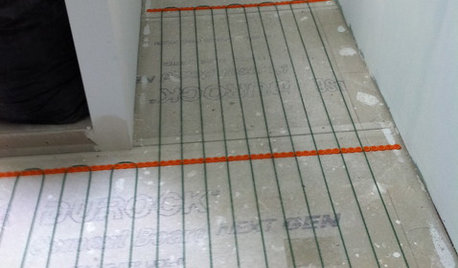
    Electric radiant is not crazy expensive if you are doing only a small bathroom.

  • 11 years ago

    Not sure how accurate these calculators are, but maybe this would give you an idea of the cost. We're hoping to have radiant heat throughout our house too when we finally build. It's one of the few upgrades very high on our want list.

    Here is a link that might be useful: Cost to Install Radiant Heat Calculator

  • 11 years ago

    For small areas electric is $7/sf and is ideal for bathrooms etc.
    Heating and cooling plans is next on my design agenda for the new home. I was toying with the idea myself and was considering install for entire new home but spending $50k on electric radiant floor heating may not be a good choice. With a planned 20KVA solar system, I felt electric was the way to go for the entire floor, almost 7000sf and that is not including basement which I'll finish at a later date.

    Now considering hydronic radiant heat which is around $1/sf plus boiler etc. Water heat source can be a boiler or a geothermal source. Cost varies by number of zones and type of installation. Under joist or in slab or floor. In slab or foor works better due to lower heat loss. Typical 2000sf (one ballpark estimate) 2 zone with a premium boiler is stated as $7700.

  • 11 years ago

    Private gas well, I presume. There are thousands of these in southwest Ontario, which have provided lucky owners free heating for nearly a 100 years. Can't think of why you would consider anything other than radiant. Though you will still likely need ducts for AC.

  • 11 years ago

    Its in homes that have AC that you really have to question full-home radiant heat carefully if its not an all out luxury build. Since heat pumps are used to provide the cooling with humidification, the same appliance can be used to provide heating. The radiant flooring is a redundant mechancial system at this point and a very expensive one at that.

    For most, it would be more efficient and less $ upfront to use the gas as backup to the heat pump or go all-electric with mini splits or other ducted VRF. Free gas certainly changes typical thinking here but it would still be cheaper to use a forced air furnace than install full house radiant. Dont confuse your past "forced air" experiences with homes that have a third party Manual J/professionally sized and installed system. I think they can work as quietly and as comfortably as radiant if not more so.

    Radiant floors have a slower thermostat response than forced air and you really shouldnt be able to feel the heat by touch in new home construction. If you can, it probably indicates a poorly performing thermal envelope that probably does not meet international levels of minimum performance. Of course if you have free gas, there isnt much motivation to conserve resources anyway unless the combustion appliances are installed in a manner that puts Indoor Air Quality at risk.

  • 11 years ago

    Thanks for all the info. Pinebaron's numbers for the water radiant seem reasonable and do-able, but some of the other numbers sounds pretty high. The furnace we put in a few years ago (to replace the original coal-converted furnace from 1920 - LOL) is crazy-loud. You can hear it from almost everywhere on the first floor and I hate it so radiant heat sounds pretty attractive to me. Our old furnace was a gas hog but at least quiet.

  • 11 years ago

    In a warm location, the drawbacks of hydrionic radiant as a heating system (as opposed to the electric floor warming systems) are more numerous than the positives.

  • 11 years ago

    Has the gas been tested or used as fuel in the past? Often gas straight from the well will have additional gasses that are corrosive to metals or are particularly poisonous/toxic. These are removed by the suppliers of natural gas before being piped to customers.

  • 11 years ago

    We are not in a warm climate fortunately (well, fortunately for purposes of *this* question anyway!)

    We currently use the free gas and have for many years, so no concerns about corrosiveness, but thanks for the heads up, bus driver.

  • 11 years ago

    We havent had our system that long, but are happy with it so far. We have a concrete slab floor (its pretty if you put peastone in it. And grind it to see the stones) with pex tubing for hydronic heat from a propane boiler. The heat is set up with different zones so we can set different temps for rooms. We have an indirect water heater tank that is set up as the primary zone that the boiler heats too. Havent had it long enough to give any numbers, but have been told that even though it was more up front that we would be ahead on the back end because its 99% efficient and boilers last a long time. Pretty neat how small of a package it comes in too. Its hard to get any good answers when asking for price since there are so many variables. We plan on staying in our home forever too, so we tried to pick a system that would outlast us, and that we could afford during retirement. It seems like alot of things that go in a house are either "pay now" or "pay later".