Software
Houzz Logo Print
practigal

Induction and power surges

11 years ago

It seems like the greatest danger to most electrical appliances in the kitchen is a sudden surge in power. A surge protector could be very helpful. Is it possible to put a surge protector on a hardwired (probably 220 or 240) induction cooktop?

Comments (34)

  • 11 years ago
    last modified: 11 years ago

    I think some sort of whole-house surge protector would be a good idea these days. I'm going to put it on my list!

    I had a little electrical fire a while back where my induction cooktop was wired into the house and the surge caused by turning the power back on afterward fried just about everything in my house except...my induction cooktop.

  • 11 years ago
    last modified: 11 years ago

    How was that paid for? Was it covered by insurance? Or had the installer made a mistake?

  • 11 years ago
    last modified: 11 years ago

    > ... and the surge caused by turning the power back on afterward fried
    > just about everything in my house except...my induction cooktop.

    When power is restored, a surge current means voltage slowly rises due to loads. Or goes right to the ideal voltage that all appliances want due to near zero load. To have damage means voltage had to increase major above the incoming AC mains. How does that happen? How does a 120 volt source create a higher voltage? It doesn't.

    Other defects (ie open neutral) might explain a higher voltage. Created if cooktop wiring was intially installed incorrectly. That wiring defect would be obvious when incandescent bulbs change intensity as major appliances power cycle. Bulbs that change intensity typically report a wiring defect.

    A circuit breaker did not create that defect. A 'whole house' protector does not avert that resulting anomaly.

    A high voltage surge on power restoration is popular in fiction and parables created by people who even forget concepts taught in school science. A conclusion based in observation is classic junk science. To say why appliances are damaged means information on how electricity works first must be learned. Without a grasp of fundamental concepts, then any conclusion from observation is classic junk science reasoning.

    Numbers on a 'whole house' protector say it (like all protectors) does nothing until 120 volts well exceed 330 volts. Switching power can not create more than 120 volts to appliances. Even that above wiring defect would only create a voltage well less than 240 volts.

    'Whole house' protector, if properly earthed, is for other surges that damage appliances. Nothing inside a residence creates voltages that exceed 330 volts.

    This post was edited by westom on Thu, Dec 25, 14 at 9:30

  • 11 years ago
    last modified: 11 years ago

    Hmm. We need to recall that large arrays of power utility exterior wiring and transformers and balancing capacitors can, due to inductance and capacitance, potentially develop transient ringing when re-energized. A power line has an impedance, and if given a step function of voltage, current will propagate down the line and reflect back if not absorbed. In other words, the VSWR is not 1.0. Usually, re-energization occurs in neighborhood-sized segments, so such ringing is probably too weak for damage anything.

    Conceptually, however, application of power to a power line system where most residences are disconnected or the lines are long to the residence could cause a transient voltage when the current reaches the residence at the end of a long path. I wouldn't want to have to model the entirety of a network segment and analyze all possible results from power restoration to convince myself that it couldn't happen.

    Power restoration is most likely where I live to be restoration of the 4000 Vac connection to some array of transformers providing 240 Vac to a neighborhood, and what initially comes out of each transformer in the first several milliseconds will depend on inductance and capacitance in the transformer along with the apparent impedances of the loads on the transformer.

    High voltages can occur due to lightening hitting electrical lines, or by induction into electrical lines.

    In any case, it is possible to buy transient suppressors that fall into one of three classes: to be wired to the meter ahead of any disconnection means (you won't want to make that a DIY project), to be wired to the mains after the disconnection means (usually to a dual breaker in the panel box being protected), or to be wired to a particular circuit anywhere in the dwelling. So the short answer to the initial question is yes.

    As noted, such a device will most likely be more important for lightening protection than for power re-establishment protection.

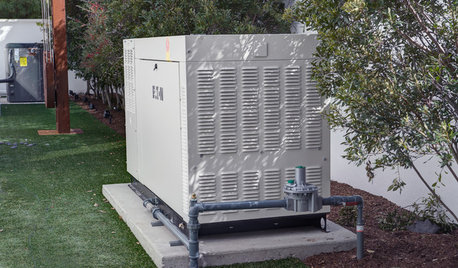
    Alternatively, or perhaps additionally, with an external power generator and automatic transfer switch, the utility power has to be up for some period before the switch will transfer back to utility power and shut down the generator. This will isolate the residence from any restoration transients.

    kas

  • 11 years ago
    last modified: 11 years ago

    Busted...I aced physics until we started the unit on electricity. My circuit did not light up in the lab...but...where my thinking is going is that I have been advised to add surge protectors to ALL electrical appliances to protect their so expensive to replace control boards....the new induction tops are all hardwired not plug ins....I cannot imagine a whole house protector but I can certainly envision surge protectors at many points in the house....Do I understand the above, that it is possible to add a surge protector to a hardwired stove top...correct? Any reason why you would not want to do that...or should not do that? .... And if I should add one...how much should it really cost presuming I make sure the electrician deals with it at the same point the stove top is installed-not on an extra service call...are the units expensive, would this be a big deal to request?

  • 11 years ago
    last modified: 11 years ago

    > Do I understand the above, that it is possible to add a surge protector
    > to a hardwired stove top...correct? Any reason why you would not
    > want to do that...or should not do that?

    Protection that would work on its power cord is already inside each appliance. A surge too tiny to overwhelm that internal protection may also destroy a tinier power cord protector. That failure encourages speculation, "My protector sacrificed itself to save my ...." So naive consumers assume protectors are one shot devices. A surge too tiny to overwhelm internal protection can destroy an undersized plug-in protector.

    Examine specification numbers. Destructive transients might be hundreds of thousands of joules. A plug-in protector may absorb hundreds of joules - near zero protection. Just enough above zero to be hyped as 100% protection to naive consumers.

    A rare and destructive anomaly may overwhelm internal protection. One 'whole house' protector is earthed so that existing protection in all household appliances (hardwired and plug-in) is not overwhelmed.

    Separate a bogus from an informed answer. The fewer who know this stuff also provide numbers and facts that say why. For example, one protector for all appliances must make direct lightning strikes irrelevant. Lightning is typically 20,000 amps. So a minimal 'whole house' protector is 50,000 amps. An effective protector remains functional after many surges; ie over many decades. And costs about $1 per protected appliance.

    An adjacent protector must disconnect protector parts as fast as possible while leaving a transients still connected to an adjacent appliance. Fortunately appliances have effective protection. But sometimes, an adjacent protector may even compromise that protection; make damage easier. In rare cases, that adjacent and undersized protector does not disconnect fast enough. Then fire may result. Downsides that do not exist when using one 'whole house' protector ... that costs about $1 per protected appliance.

    Above is irrelevant to what a 'circuit breaker' supposidly did.

  • 11 years ago
    last modified: 11 years ago

    I don't understand all the tech speak on this thread. What I do understand is power outages, surges and lightning because I have direct experience with each over the past 10 years.

    A surge protector -- depending on capacity -- will dial down a surge, not prevent it completely.

    However, if the house is hit by lightning somehow there are no protection guarantees. We lost TVs, land line phones and a few small appliances one time.

    After that our electrician installed a whole-house surge protector in the main circuit box.

    Earlier this year, we had a lightning storm and even with the whole-house surge protector we got an outage in the kitchen and my home office only. Theoretically, that shouldn't be possible but it happened. That outage blew out a control board in my oven. I could smell it immediately. The oven wasn't on and had survived multiple outages over the years.

    Meanwhile, I had installed surge protectors for every TV and computer in the house.
    Last week, no storm at all. But we had flickering & blinking that often precedes an outage. When I see that I usually run around and turn everything off. But this was sudden. Electricity went off and the back up generator came on.

    No idea what the power company was doing but main went back on within minutes. However, I lost every surge protector in the house. Fried. Additionally, the outlet for the downstairs TV was dead. Even the electrician was shaking his head. I'm just reinstalling new APC protectors this weekend.

    So the long answer is: install a whole house surge protector. Install plug in protectors for important electrics.

    I don't know of any way to protect the major appliances nor does any electrician I've spoken to, including the electricians who service my backup generator.

    The outages have pretty much dissuaded me from switching out the radiant electric top I have to induction. And the tipping point for my recent fridge purchase was based on outage resistance.

  • 11 years ago
    last modified: 11 years ago

    It is unreasonable to expect protection to be absolute; what one gets is reduced probability of damage.

    Lightening won't usually put 50,000 amperes through one's refrigerator, but while moving 50,000 amperes from sky to ground (or vice versa) lightening will induce current and hence voltage into otherwise uninvolved wiring. Further, even if the path to ground is only 0.1 ohms where the lightening hits, the voltage across that 0.1 ohms will be 5000 volts. This means high voltages are made present on the house wiring at the service entrance.

    How much current a transient protector has to sink will depend on many factors, but it doesn't have to deal with the entire 50,000 amps. Auxiliary protectors located even further into the house wiring will have additional inductance and resistance in series with them to further reduce the current they have to pass to ground.

    In any case, the two units I have on two service entry breaker panels are made by Intermatic. Please see the catalog at the link for more information. I think the IG series costs in the vicinity of $100. US.

    kas

    Here is a link that might be useful: Intermatic surge protectors catalog

  • 11 years ago
    last modified: 11 years ago

    Thank you!

  • 11 years ago
    last modified: 11 years ago

    >After that our electrician installed a whole-house surge protector in the
    > main circuit box.
    > Earlier this year, we had a lightning storm and even with the
    > whole-house surge protector we got an outage in the kitchen and
    > my home office only.

    A protector does not do protection. Best protection is a hardwire connected low impedance (ie less than 10 feet) to single point earth ground. But all incoming utility wires cannot connect directly to earth. So do a next best thing. A protector only does what that hardwire does better. Quality of and connection to single point earth ground defines protection. Not a protector.

    For example, trace the path of a bare copper quarter inch ground wire from breaker box to earth. Does that wire go up over a foundation and down to earth? Then it meets code requirements. And has compromised 'whole house' protection. That wire is too long, has too many sharp bends, and is adjacent to other non-grounding wires. IOW its connection to earth has excessive impedance.

    When damage occurs, learn why 'whole house' protection was compromised. Too many mistakenly assume a protector does protection. It never does. A protector is only as effective as its earth ground. Protector is simple science. 'Art' of protection is earthing - where hundreds of thousands of joules harmlessly dissipate.

    All appliances have robust protection. Most surges are made irrelevant by what is already inside appliances. A properly earthed 'whole house' protector does not stop surge currents. And need not do so. A 'whole house' protector, properly earthed, means a rare and destructive surge does not overwhelm protection already inside every appliance.

    Earthing is an 'art'. Humans make mistakes. Damage means finding and correcting that mistake. Proper protection means no damage. But human mistakes and oversight is so easy.

    An adjacent protector does not claim to protect from that type of surge that can result from a human mistake.

    Unfortunately, adjacent protectors can sometimes compromise protection inside an appliance. Plug-in protectors do not protect from surges that typically do damage; that hunt for earth ground destructively via appliances. Each protecion layer is never defined by a protector. Each layer is defined by its earth ground. Plug-in protectors have no earth ground. Are not another layer of protection. Manufacturer will not even discuss it.

    'Whole house' is ‘secondary’ protection. The 'primary' protection layer should also be inspected. A picture demonstrates what to inspect:
    http://www.tvtower.com/fpl.html
    Also inspect what defines your 'secondary' protection layer. Many electricians do not know about low impedance or "single point earth ground" that may explain your damage.

  • 11 years ago
    last modified: 11 years ago

    > No idea what the power company was doing but main went back on within
    > minutes. However, I lost every surge protector in the house. Fried.
    > Additionally, the outlet for the downstairs TV was dead. Even the
    > electrician was shaking his head. I'm just reinstalling new APC
    > protectors this weekend.

    APC protectors did exactly what its specifications claim. It failed on a surge too tiny to damage other appliances. Being undersized gets naive consumers to recommend them. Other and effective protectors connect that current low impedance to earth. And more important, must not fail.

    Undersizing means protector parts must disconnect from a surge as fast as possible. While leaving that surge connected to adjacent appliances. No problem. Protection inside appliances is often more robust. A surge too tiny to damage appliances also destroyed an undersized protector.

    Worse, if protector parts do not disconnect fast enough, then fire may result. Last year, APC (under new management) admitted some APC protectors were so prone to fire as to be removed immediately. Because protector parts did not disconnect fast enough.

    What happens when that APC's hundreds of joules absorbs a surge that is hundreds of thousands of joules? Yes, be concerned.

    This same problem does not exist with properly sized and properly earthed protectors. Then hundreds of thousands of joules are harmlessly absorbed outside by earth. Then a surge current need not hunt for earth destructively inside via undersized protectors and household appliances. Then a protector remains functional.

    Damage was due to a surge current all but invited to go hunting for earth inside and destructively. Find and fix a human mistake. Appreciate a fire risk due to those plug-in protectors. Appreciate the art: single point earth ground.

  • 11 years ago
    last modified: 11 years ago

    westom-- you're essentially saying that my house may not be properly earth grounded, if I understand correctly.

    I have two very experienced electricians who I could consult on this. It's a good point and needs investigation. Whatever is happening here is not usual and I'd like to get it resolved once and for all. Very helpful post. Thanks.

  • 11 years ago
    last modified: 11 years ago

    I have been told that grounding the house was previously commonly done by attaching a wire to your plumbing in some hidden location for instance in a raised foundation house under the house...but changes in plumbing (more plastic) defeated that set up, now you have to drive a big (8ft long) metal stake into the ground and the attachment at your box to the new grounding rod would be very noticeable (at least it is with my friends who have redone theirs)...so is the final takeaway here that proper protection includes correct up to code grounding and wiring, a full house surge protector and local surge protectors?

  • 11 years ago
    last modified: 11 years ago

    For the USA, most communities having code inspectors depend on various versions of NFPA 70 (the National Electrical Code -- NEC) to determine what is and what isn't allowed. At present, as I recall, the requirement is to bond the house grounding conductors to both a copper water pipe entering the home (where available) and to at least one metal stake (grounding rod).

    (What constitutes an adequate ground is defined by a maximum conductance to a test rod, and many in less than wet areas may need more than one rod. I use multiple rods, even though my terrain might be described as normally damp. This is partly because I also bond lightening drains to the grounding system outside the house.)

    There are numerous rules related to equipment and device bonding, bonding in electrical boxes and panels, and bonding at the point of entry. There are related rules for antenna, intercom, and data equipment bonding. However, the NEC is not intended to deal with lightening, but only fire safety and shock hazard. Persons interested in dealing with lightening induced currents and voltages should probably hunt for such information on the web to see how certain household configurations can be problematic and what mitigation techniques are suitable.

    With respect to some earlier comments, if we consider an appliance as an isolated device connected via three or four conductors to a potential source of transient high voltage, then an intermediate device that clamps the differential voltages between the conductors will protect the appliance's internal electronics. There is a potential hazard to persons who might be touching the appliance and a separate ground under these transient conditions. Hence it is important that there be a low impedance between where the clamping is performed and any grounds around the appliance. All this boils down to is a need to ensure that bonding is up to date throughout the house and that paths that lightening or lightening induced currents might take through the house wiring be bypassed as well as is feasible.

    Transzorb(R) like devices are used inside electronics (one hopes) for protection, but these may not have the capability to handle serious lightening-induced spikes. For the larger spikes, devices like those from the previously linked Intermatic have purpose. I'm sure that larger capacity devices exist for industrial use where the line impedances are proportionately lower, but I've never researched them.

    kas

  • 11 years ago
    last modified: 11 years ago

    "so is the final takeaway here that proper protection includes correct up to code grounding and wiring, a full house surge protector and local surge protectors?

    That's what I've taken away from this and my experience supports this. 3 fried surge protectors but no fried electronics is pretty vivid evidence. My neighbor also had a fried surge protector but computer was ok.

    And then there is lightning.

  • 11 years ago
    last modified: 11 years ago

    Well, old saying, ""If it ain't broke, don't mess with it"!!!
    I much prefer fried surge protectors than fried electronics.

    >>>>>>>>>> EXCEPT Unless they have changed the way surge protectors work, they still need to be changed out after X amount of time, or after power surges that did not actually blow the protectors.

    Power surge protectors were rate in Joules, as I recall, A joule would be basically the strength of the power surge and how long it lasted. After the surge protector absorbs so may joules, it is basically worthless.

    Best to read the operators manual on your surge protectors and see what they recommend. It's entikrely possible that since I studied surge protectors, things have changed, but I would not bet my best horse on it!!!

    Gary

  • 11 years ago
    last modified: 11 years ago

    Yes, Gary, they are measured in Joules. And when you do research on them you see that their role is to essential dial down any power that comes through them. Thing is, you don't know how much power is coming through them. Someone explained upthread that there's a limit to what can come in. I didn't quite understand that post as I'm not an engineer.

    We've had repeated outages with the surge protectors in place. Those didn't seem to diminish their functionality at all because this last time, when there was a problem, they did their job. That job was described on wonderfully somewhere as committing suicide so you TV and electronics can survive.

    When they are fried, they smell or buzz. According to what I've read, that's when they need replacing.

  • 11 years ago
    last modified: 11 years ago

    These protectors can become damaged without outward evidence, and in some cases incrementally degraded. The Intermatic panel box protection units that I have include a green LED to indicate degradation and time for replacement.

    1 joule = 1 watt-second

    kas

  • 11 years ago
    last modified: 11 years ago

    Yep, just to be safe, read your OP manual for your particular protector, It could save you a nasty surprise!

    Gary

  • 11 years ago
    last modified: 11 years ago

    > "so is the final takeaway here that proper protection includes correct
    > up to code grounding and wiring, a full house surge protector and
    > local surge protectors?

    Electricians are taught what wire connects to what to meet code. Only for human safety. Your concern is transistor safety. That means both meeting and exceeding code.

    Relevant concepts are rarely taught to electricians and are mostly unknown to consumers who make recommendations. For example, cited was 'low impedance'. Many assume this means thicker wires to lower resistance. But that is irrelevant here. Lower impedance is mostly about a shorter wire; not a thicker one.

    Inspection may say more. Find the bare copper, quarter inch wire that leaves your beaker box. If it goes up over the foundation and down to earth ground, then its impedance is too high. a) Wire too long. b) Sharp bends over the foundation. Better surge protection means that wire goes through a foundation and down to earth ground. To also route separate from other non-grounding wires.

    Water pipe ground is an only earth ground that is insufficient. That for human safety. For transistor safety, solder joints and 90 degree bends further compromises it. And most important, a single point earth ground must connect to every incoming wire - telephone, cable, satellite dish, etc. Otherwise transistor protection has been compromised. Some other earth ground electrode provides what is required.

    Electricians are not taught this since code is only about protecting humans - not transistors.

    Same applies to power strips - local protectors. Without a low impedance connection to earth, those protectors do not even claim to protect from typically destructive surges.

    For example, some claim it works by limiting voltages between wires. Let's add some numbers. A 5000 volt surge is incoming on the AC (black) hot wire. A 330 volt protector exists. So now 5000 volts is on the black wire. And 4670 volts is on the green (safety ground) and white (neutral) wire. Now a surge exceeding 4600 volts has even more paths to find earth ground destructively via an adjacent appliance. Where is the protection?

    Well it need not do protection. You have seen same. A surge current incoming to a local protector is simultaneously outgoing into an adjacent appliance. That surge current, too tiny to overwhelm protection inside an appliance, also destroys a grossly undersized protector. Then naive consumers recommend that protector rationalizing "My protector sacrificed itself to save my computer."

    Nonsense. Superior protection inside a computer saved that computer. A surge, too tiny to damage anything else, also damaged a grossly undersized protector. That protector would also do nothing useful on larger and potentially destructive surges. But it sure is profitable.

    Meanwhile, effective protectors remain function for decades - even after multiple lightning strikes. Only grossly undersized protectors need replacement even X years. Just another reason for undersizing them - you must buy more - increases profits.

    Now be more concerned. To avert a fire, its protectors parts must disconnect as fast as possible. While leaving a surge connected to the adjacent appliance. But what happens if that fuse does not blow (disconnect) fast enough? Then undersized protector parts exceed its manufacturer's Absolute Maximum Parameters. IOW a fire results. Fire is another reason why adjacent (local) protectors created more problems. Should not be located on a rug or behind furniture. And need protection only possible with a 'whole house' protector (if properly earthed).

    We know an adjacent protector is ineffective. It does not have the always required low impedance (ie 'less than 10 foot') connection to earth. It was always that simple.

    A protector is only as effective as its earth ground (which local protectors do not have). Protection is increased by expanding the most critical component in every protection system - its earth ground.

    BTW, a light on an adjacent (local) protector does not and cannot report degradation. That light can only report one type of failure. Reports protector parts disconnected as fast as possible to avert a house fire. That light also reports the protector was grossly undersized - a threat to human life. Yes, be that concerned if any protector fails. Because only a fuse was averting fire.

    Effective protectors remain functional even after direct lightning strikes - as defined by numbers previously posted.

    This post was edited by westom on Tue, Dec 30, 14 at 1:21

  • 11 years ago
    last modified: 11 years ago

    Westhom you are absolutely correct when you say that electricians don't know how to protect the system they only build to code! That's exactly why I am asking the questions. When I asked about surge protection I got blank looks...or lady you don't need overkill looks. Because I need to upgrade the electrical panel and add a 240 line into the kitchen I know that if I fail to ask for the correct items they will give me whatever is currently code (hopefully) and then they'll try to sell me their high profit margin products rather than what I most need for safety.
    As I read through your post I didn't quite understand (i) is the electrical system itself grounded? (ii) if, in addition if there is a whole house surge protector, must there be a second separate ground for the surge protector? (iii) Does a house need more than one ground? If so, what drives the need? is it the climate, the size of the house/distance to the ground or the demand on the panel? (iv) Are cable and phone lines normally grounded? Should they be? Can they use the same ground as for the house's electric? (v) When you say the wire from the box to where the ground connects to the water system is too long... in my case it's about 5-7 feet and includes one bend where it goes through the foundation and that doesn't seem like a very long distance. I know that the new breaker box/system will connect to a ground stake (actually I think it's supposed to connect to two stakes that are at least 6 feet apart) but that first stake will be just slightly closer to the box (3-4 ft) although with no bends.
    I have seen someone else's house with a new ground. There's a great deal of copper at ground level on the outside of the house-I presume that the ground can be touched (or why else would they put it so visibly at the base of the house) or should a small housing be built around it so that it cannot be touched? Or is all of the visible copper supposed to be in some kind of tube? What prevents the copper from weathering?
    I also saw a video on something called bonding. Should the hot water heater and the gas line servicing it be bonded regardless of the type of grounding? Is there anything else that should be bonded?
    Thank you for making this tricky area comprehensible.

  • 11 years ago
    last modified: 11 years ago

    Let me try to take these issues in order, starting with Weston's statement:

    For example, some claim it works by limiting voltages between wires. Let's add some numbers. A 5000 volt surge is incoming on the AC (black) hot wire. A 330 volt protector exists. So now 5000 volts is on the black wire. And 4670 volts is on the green (safety ground) and white (neutral) wire. Now a surge exceeding 4600 volts has even more paths to find earth ground destructively via an adjacent appliance. Where is the protection?

    (Please note that I generally concur with Westom's points in his message above.)

    In this case, we have to ask about the details of the connection between the protective device and the unit being protected. Correctly constructed, the green wire is bonded to both the the ground of the protecting device and the ground of the protected device, and in this scenario, the entire device is momentarily (during the lightening strike) raised in voltage by roughly 5000 volts. Since the maximum voltage between any two points in the input circuitry is 300V, so long as that is acceptable the device is protected.

    This is also true if the device has additional grounding paths. What can be a problem is if the device is not properly bonded to the green wire, but grounded some other way (via a CAT5e cable say), then there can be a large differential voltage within the device that knocks its socks off.

    With respect to Practigal's questions, starting with (i), (ii) and (iv):

    The protective device at the panel is connected (via a dual 15A breaker) to the main power buses in the box, as well as bonded to defined ground in the box. It does not have a separate bonding conductor to the outside. However, a protective device at the meter would tie to the meter grounding point. The white conductors from the house wiring are also bonded (single point ground) to the bonded together green grounding wires in the panel box. The green grounding wire bonding point is connected to the external grounds. These include (a) the usually physically internal but effectively external path to the copper water pipe providing town water, where applicable, (b) copper coated grounding rod outside the house not too far from the service entry meter, (c) the neutral stranded conductor from the power company transformer carried down to the meter via the service entry cable. Also, at this external point should be bonded grounds from any generators, other buildings, other grounding rods, and telephone and cable TV circuits.

    As to (iii), the answer depends. One wants low resistance to ground, and this depends on how well the external grounding rod couples to the conductivity of the ground. Conceivably, but improbably, the dirt could be so dry that the grounding rod (or a multiplicity of grounding rods) provides no safety benefit for house power, but would still provide a path for lightening, which will find a way, spreading out as necessary, to equalize the stored charge between the earth and the cloud it is associated with.

    (v) With respect to low frequency house power safety bonding, bends in the grounding conductor paths are not particularly important. Where bends can be a problem is for lightening pulses, which have high frequency components, and which will see bends as added inductance that increases the voltage across the bends. I would not worry about the conductor to the water pipe, but I would want to see the one from the meter box to the exterior grounding point to be as straight as possible going down to the ground. I would want the one from the internal panel box to the external grounding point to be as straight as is feasible without an extreme approach such as drilling a diagonal hole from box to grounding rod through a concrete foundation.

    All of the grounding conductors, including any copper buses outside, should be normally safe to touch unless they are somehow not properly bonded to everything else you could physically reach at the same time, such as the actual ground, or a metal fence. This is why the grounding rod is used.

    The exception is during a lightening strike, where differential voltages can exist between anything and anything else. The only truly safe place to be is in a Faraday cage (copper room), or otherwise well insulated from the lightening path. (If the transient voltage rise on the wiring is only a few thousand volts, then so long as you are a foot or so away from the wiring during a strike you should be safe. Showering has some risk because voltage at the shower head could conceivably be different than that of the conductive shower water path from drain to sewer.) These cases assume that the lightening has a path to ground involving wiring and piping; a bolt that decides to go through the interior of the house as a path of least resistance will likely be extremely hazardous. Even strikes to nearby trees can kill persons many feet from the tree due to transverse propagation along the ground as the current seeks to equalize all of the distributed charge at the earth's surface.

    Copper exposed to the weather will develop a green oxide coating, although this is less prevalent with compounds such as brass and bronze. Once clamped or otherwise connected, two pieces of copper will retain their low conductivity path, unless cold flow makes the connection loose over time.

    The conductors comprising the house bonding point that ties in with the meter bonding point that goes to the grounding rod should be in suitable protective tubing. Usually PVC conduit is used to resist the weather, but stainless steel conduit is an option, or galvanized rigid pipe can be used depending on weather conditions and potential for timely maintenance when it finally finishes sacrificing its coating.

    There is a wide boundary between meeting code and ideal provision for all possible contingencies. Sometimes the former is expensive enough that few will strive to do more. Practical and practicable are not the same word.

    For best lightening protection where the hazard is deemed to be great, specialists in this field should be consulted. One should expect to have a number of air terminals (lightening rods) on the roof peaks, with conductors following the greatest gradient to ground. Each conductor would terminate on a grounding rod, and all the rods would be linked together via underground conductors. In some cases, additional connected rods would fan out from the first set.

    This protects from house damage from direct strikes, but does not protect from voltage transients on power lines entering the house. This is where the protective devices exercise their function.

    kas

  • 11 years ago
    last modified: 11 years ago

    I am perfectly prepared to accept the science.

    And practigal is wise to explore these issues before a reno.

    This info is late to my party. Meanwhile, $65 for 3 new surge protectors is better than $1500 for 2 new flat screens and another $3K for new iMacs

  • 11 years ago
    last modified: 11 years ago

    I suggest that in addition the iMacs be on uninteruptable power supplies (UPS) from suppliers such as APC, CyberPower, Tripp-Lite, or (for "high-end") Falcon. A few topologies are available, and which is best depends on whether non-sinusoidal generators will be used during power failures, among other factors. Plenty of info is available on the web to provide needed insight.

    kas

  • 11 years ago
    last modified: 11 years ago

    Oh rococogirl....those numbers hurt.....

  • 11 years ago
    last modified: 11 years ago

    What kaseki accurately noted may not be completely obvious. Hopefully this rephrasing will help.

    The electrical system and every other incoming utility must be earthed. However, that means only one incoming wire for AC electric connects directly to earth. That connection is that bare copper wire from the breaker box, through foundation to earth electrodes. They did what is minimally required IF not measuring earth conductivity - two 8 foot electrodes six feet apart.

    Those exist first for human safety. As kaseki notes, a human touching that ground wire or devices connected to it (ie a bathtub, water pipes, dishwasher, stove, all other hardwired appliances, etc) is not electrocuted. "Bonding" is for human safety. All safety grounds must meet at (be bonded to) a common neutral strip inside the breaker box. Bonding is about a low resistance connection; not a low impedance connection.

    Gas pipe is a special case. Some gas utilities want your interior gas pipe bonded. Others do not.

    Although both grounds (safety and earth) interconnect, only earth ground also has additional requirements to perform transistor safety. So earth ground also must have no sharp bends, not be inside metallic conduit, no splices, and a low impedance (ie less than ten feet) connection.

    A grounding wire will be thick enough to 'weather' without failure. However inspection is encouraged. Some bury that wire and put a plastic cap over electrodes. So that a wire connection to electrodes can be inspected while also protected from weather and lawn mowers.

    Important is quality of that earthing electrode. If in sandy soil (or dry as kaseki noted), then that may be insufficient. But in most cases, two copper clad electrodes (they must be more than 8 feet long) are minimally sufficient.

    That electrode must also connect to all other incoming utilities. Cable TV, antenna, and satellite dish coax must make a low impedance connection to that same electrode BEFORE entering. No protector required. A ground block is one means of a direct connection:
    http://files.cablewholesale.com/hires/200-278.jpg or
    http://www.dbsinstall.com/N-images/Whatis/Driploop-1.jpg

    Telephone will not work if earthed directly. So a 'whole house' protector is installed for free by the telco. How it was done over 50 years ago:
    http://www.inwap.com/inwap/chez/Phoneline.jpg
    Today that protector is inside an NID with a typically green or gray wire connected low impedance to that earthing electrode:
    http://www.inetdaemon.com/img/telecom/NID/closed.jpg
    http://www.findaphoneman.com/test%20instructions%20b.htm

    Cable and telephone surge protection (earthing by hardwire or protector) is required by safety codes and other industry standards. But one incoming utility, not required to have protection, is also the most common source of destructive surges - AC electric.

    A 'whole house' protector may be located behind the electric meter or attached to the main beaker box. Three AC wires may be incoming. One (neutral) connects directly to a bare copper quarter inch wire as required by code. Other two must connect to earth via a 'whole house' protector. If any of three do not make that low impedance connection, then all structure protection has been compromised.

    Above summarized how each utility wire connects to earth. Quality of earth ground is also important. A utility demonstrates good, bad, and ugly (preferred, wrong, and right) solutions:
    http://www.duke-energy.com/indiana-business/products/power-quality/tech-tip-08.asp
    One (single point) earth ground must exist (which is completely different from a safety ground in wall receptacles). That utility Tech Tip demonstrates same.

    kaseki also mentions lightning rods. The most critical component of a lightning rod system is its earth ground. Lightning connects as short as possible to earth on a wire so that lightning need not connect to earth destructively via a structure. The most critical component of a 'whole house' system is its earth ground. So that lightning need not connect to earth destructively via appliances. In both cases, the system is only as effective as its earth ground.

  • 11 years ago
    last modified: 11 years ago

    > Meanwhile, $65 for 3 new surge protectors is better than $1500
    > for 2 new flat screens and another $3K for new iMacs

    Assumption concluded 'surge protector means surge protection'. It does not. Adjacent protectors (especially if a 'whole house' solution is not earthed) may simply give a surge even more paths to hunt for earth destructively via TVs and iMacs.

    Protection is always about how a surge hunts for earth. Once inside a house, nothing averts that destructive hunt. Protection means that current must remain outside.

    Please reread what was posted to appreciate what risk remains for your TV, iMac, furnace, clocks, dishwasher, refrigerator, GFCIs, and most important smoke detectors.

    What most needs protection during a surge? Smoke detectors. A properly earthed 'whole house' solution does that and more. A completely different plug-in device (that unfortunately shares a same name) does not.

    A protector and protection are two completely different components of a protection system. As defined by a simple and obvious rule. A protector is only as effective as its earth ground.

    This post was edited by westom on Thu, Jan 1, 15 at 1:58

  • 11 years ago
    last modified: 11 years ago

    Reading this topic over gives me the impression that westom and I are talking over those who didn't become electrical engineers or otherwise study the subject. Specifically, the difference between resistance and impedance is unclear in our writing.

    To put it simply as I can, resistance applies to the lossy part of an electrical restriction (power is dissipated -- apologies to Brit MEs who depreciate 'dissipated' for radiated heat), and is the part that dominates at low frequencies such as those involved in house power. Over a wide range of frequencies this component will remain constant; however, at very high frequencies the current tends to move to the outer skin of the conductor, so resistance can increase due to that effect alone.

    Inductance is a characteristic in which energy is stored in a magnetic field and released, but not dissipated, and becomes significant for simple wires at radio frequencies. Imagine a coil, and consider that a sharp bend in a conductor is a quarter turn of a coil.

    Capacitance is a characteristic in which energy is stored as charge and released, but not dissipated, and can become significant for many types of circuits at radio frequencies, but probably is not significant for the electrical and lightening drain circuits we are addressing here.

    The combination of frequency, inductance, capacitance, and resistance establishes impedance. We don't need to address the formulation here.

    For grounding lightening, the inductive part of the restriction can dominate, so straightish wiring to ground is best.

    While we are on this topic, an important safety factor is the bonding of the grounding wire to the grounding rod. Special burial-rated connector clamps exist for this, but may not survive forever underground. I recently found an auxiliary grounding rod on the other side of my house from the service entry point to have become totally detached from its cables due to clamp disintegration. (That installation was in 1988.) Most will have only one or two such clamps at risk, and I suggest checking them at 5 year intervals. If after 10 years there is no change, then they were properly marked for their environment.

    kas

  • 11 years ago
    last modified: 11 years ago

    Thanks kas for recognizing that non-engineers don't understand the totality of these explanations but get the large picture more or less (at least I believe I do).

    Problem is, my experience has run counter to some of the science. That may be explainable, in my case at any rate, by not actually knowing if the house is properly grounded to earth.

    We had planned to install lightning rods during the reno back in 2003-04 but once the Iraq War began, copper skyrocketed in price and the cost became prohibitive. It's now in the $6-8K range f.ex. Someone also pointed out that the tall trees on the property are most likely to be hit, which has proven true.

    Accordingly, we have been moving the tree line back farther and farther.

    I won't detail the weird electrical incidents we've had over the past 10 years except to say that there have been 4 major incidents now plus two extended power outages during hurricanes Irene and Sandy.

    As a rule, we get routine outages 2-3 times a year. We have a back up generator. So I recognize the difference between a routine outage and weird ones caused by lightning or the one last week that was an outage followed by a surge that fried the supressors -- at my house and my neighbor's. My electrician is having a meeting with the power company to discuss what's been going on and I plan to ask him to check the grounding.

    At this point, I view the surge devices as insurance. Most recently, they paid off.

    If you know of a backup battery that is compatible with Macs I would be extremely grateful for a link. I spent so long on newegg my eyes went twitchy when I last researched them in the past and I still could not figure out what I would be buying. I have a common sense rule which is if I don't understand what I'm buying I don't buy it.

    Also, it's great to have explanations of how the power works and moves. But practically speaking there's a limit to the cost of service calls and continued investments.

  • 11 years ago
    last modified: 11 years ago

    rococogurl:

    If your backup generator is attached to a transfer switch, it should (!) have been supplying power when the surges occurred upon street power restoration, and those should (!) have died out in the 10s of seconds that the transfer switch should (!) have waited before switching power back. Eaton, Millbank, and I think Briggs & Stratton transfer switches do this I believe.

    For a personal computer, one expects that even the most ultimate video card gaming system with a flat panel display would not require a UPS rated higher than 1000 VA (some margin). I use for my main PC an APC RS-1500 Back-UPS, but a significantly smaller unit would work depending on what is attached. Essentially one wants to have the software shut the computer down gracefully when the power fails, or in my case keep the computer up for the 20 seconds or so it takes the generator to start and connect.

    I have an APC XS-1200 for some peripherals, also overkill now that I have the generator. Laser printers are connected to the transient protection circuitry of the UPS units, but do not get power fed to them in a power failure. A third rack-mount unit supplies my switch, router, and NAS.

    Two other units (forget the size, but probably around 500 VA) protect and keep up my two FiOS connections. Yet another unit supplies power to a backup PC. This plethora of UPS means every several years a batch of replacement batteries have to be purchased from Provantage.

    An alternative configuration that I haven't had time to consider much would use a large UPS unit that operates from a bunch of Optima type gel batteries. The output of the UPS would be wired via normal house wiring to all outlets that support PCs and similar sensitive stuff. Total battery cost per kW would be less, I suspect, as competitive gel batteries (also used for powered wheel chairs) are less expensive per unit capacity than arrays of smaller batteries such as APC uses.

    APC's website, and probably those of the other manufacturers I listed farther above, have tools for estimating UPS size needed for various configurations of equipment. If your generator is smallish, it may not supply a very good approximation of a sine wave, so you may want one of the UPS that continuously synthesize a sine wave instead of passing through whatever the power company (in this case you) send to it.

    Additionally, the web contains copies of many articles on this topic written for various magazines as well as the self-serving but not in my experience wrong articles of the UPS manufacturers.

    kas

    Edit: corrected some conflated letters

    This post was edited by kaseki on Fri, Jan 2, 15 at 11:58

  • 11 years ago
    last modified: 11 years ago

    Thanks kas. You are very kind.

  • 11 years ago
    last modified: 11 years ago

    Thank you all for this post has been so helpful. This is just not an easy area to understand.

  • 6 years ago
    last modified: 6 years ago

    The original machine had a base plate of prefabulated amulite, surmounted by a malleable logarithmic casing in such a way that the two main spurving bearings were in a direct line with the panametric fan. The latter consisted simply of six hydrocoptic marzlevanes, so fitted to the ambifacient lunar waneshaft that side fumbling was effectively prevented. The main winding was of the normal lotus-o-deltoid type placed in panendermic semi-boloid slots in the stator, every seventh conductor being connected by a nonreversible tremmie pipe to the differential girdlespring on the "up" end of the grammeters.


  • 6 years ago

    Heh! Nice.

    A contribution from Ferdinand Feghoot's confused second cousin thrice removed, who forgot that there needs to be a pun at the end.