Software
Houzz Logo Print
rchicago

Walnut Veneer Issues

11 years ago
Hi,

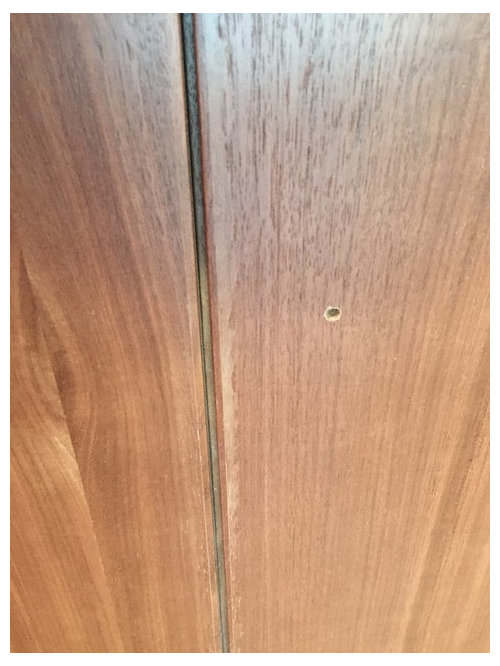
I'd so greatly appreciate your help in identifying the issues with my new veneered walnut kitchen cabinets. It was extremely difficult to take good pictures, but hopefully the images will provide enough detail.

At the edges of the veneer, there appear to be two issues: There's discoloration (light areas) and what may be called "crazing," where the wood looks brittle and the poly looks thin. This isn't everywhere, but is on enough of the cabinet fronts that I'd really like your opinion before I pay the cabinetmaker any more money. I have other veneered cabinets in my home, including in walnut, and none have these issues.

Also, the cabinets, which we've barely started using, aren't durable. You breathe on them and they're scratched and dinged. I planned this kitchen for months and emphasized the importance of durability - and paid for solid wood edgebanding instead of tape or veneer edges - and now I don't know what to do.

Honestly, the durability issues bother me far more than the problems with the edges of the veneer. But I think I may have more recourse with the cabinetmaker with the edges, whereas regarding durability, they may simply say that I'm being too tough on the cabinets.

My sincere thanks for any input on these veneer issues.

Comments (11)

  • 11 years ago

    Here's another pic with issues at the edge of the veneer.

  • 11 years ago

    And a third photo, where some of the brittle white lines are visible. In person, you can see a lot more, but they're just not coming through in photos. Thanks!

  • 11 years ago

    Hi,

    The light colored stuff around the edges is glue that squeezed out and didn't get sanded away. To fix this, your cabinetmaker will have to sand down to bare wood and refinish.

    The light colored line in your last photo is again, glue showing. This is caused by the seam not being tight and the glue shows. No quick remedy for this other than redo.

    Daren

  • 11 years ago

    There appears to be serious issues with the finish that can only get worse in time. Duarability? It doesn't suprise me the finish is easly scratched since there are other problems with finish. Dings I have no opionion on.
    IMO,you can't use anything you are told on the net as leaverage.

  • 11 years ago

    Thanks, Daren. So it sounds like this could be remedied without starting from scratch, they could take the fronts back to the shop, sand, and refinish?

    Klem1, thank you. How do you know that the finish issues wil get worse? Yes, I know that I can't use "internet forums" as leverage. But I am trying to educate myself regarding whether this work is up to industry standards and what my options might be to remedy the situation. Also, what would you suggest as leverage?

    Thanks so much. Really appreciated.

  • 11 years ago

    Improper surface preparation, glue squeeze-out and a too-thin, probably spray-on, coat of poly.
    Your 'cabinet maker' is a hack.
    JMHO

  • 11 years ago

    The areas you point out look to be oxidation of finish. Since all the finish presumiably came from the same batch that is reason to believe condition will eventualy effect most if not all. Make sense? Leverage is used in the context of gaining advantage over your adversary (cabinet maker) and consaquaintly prevailing in conclusion. A contract or agreement that makes clear you are buying satisfactoin,not good intentions and failed attempts is one very good source of leverage.

  • 11 years ago

    lots of glue not sanded off, also places of sanding through the veneer. as thin as that finish coat is, you're going to need 2 more coats, maybe 3. that one coat of finish isn't thick enough to protect itself, much less the veneer. it also makes it look cheap. but regardless of what caused the issues , your guy owes you a better job than that. i don't know what recourse you have to solve this problem other than to reason with him first. point out the problems without getting in his face. it won't cost him more than a couple of hrs to fix. and, if he has any pride in his work, he'll fix it. if not , tell him no more money until you are reasonably satisfied with this issue. judging by the quality of his work , he's going to want that pay check.

  • 11 years ago

    I think what I'm seeing is not so much glue squeeze out that needs more sanding as veneer that's been sanded through in the process of evening the solid edge banding. If that's true more sanding will only make it worse. Solid edge banding on veneer panels is very tricky to get right, a lot of the veneer faces on plywood are only about 1/128th of an inch thick. It takes only a second of inattention with a sander to sand through it. (When I do it I use a plane and card scraper to even up the edges to avoid this problem.) If you're sloppy with the glue you're sunk because you can't really sand the residue away without going through the veneer. That said, someone who wants to get paid for their work should deliver better product than this; just because its tricky doesn't mean it shouldn't be done right-- that's why you hire a pro. .

  • 11 years ago

    Thanks all. I've learned that they used a catalyzed enamel finish.

    And here's a better pic. I think it must be that they sanded the veneer too thinly.

  • 11 years ago

    catalyzed enamel finish? that's a new one. the newer catalyzed lacquers can be re coated before and after a window of time. if so, he can touch up his screw ups and re coat them. and they do need another coat. he's probably going to scream like a spoiled little girl, but the other option is to start over.