Software
Houzz Logo Print
marc83

Kitchen Table Repair

11 years ago
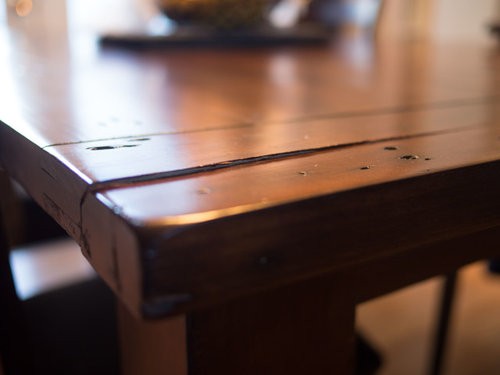
Hi. My kitchen table has a crack in it and I was wondering if you could give me some advice on either repairing the crack or making is somewhat stronger so it doesnt spread. I was thinking you could inject some kind of glue into the crack from the side and then just clamp it at the crack. Any ideas will help. Thanks!

Comments (6)

  • 11 years ago

    Another picture


  • PRO
    11 years ago

    Injecting glue and clamping is certainly an option but first you need to check a couple things.

    1. Is the inside of the break clean or full of dirt and debris? It needs to be clean otherwise the glue will fail.

    2. Try clamping it back without glue to see if you can even get it back where it belongs. Sometimes broken wood fibers get moved out of place and prevent the gap from being closed again. If you can't get it to close properly, you'll have to figure out what's keeping it from closing.


    If you can get it tight and the joint is clean, then regular wood glue may do the trick. If you can't get it tight but it is clean, then slow-set epoxy with thickener additives may work.

    If you want to reinforce the joint, it can be done but requires some skills at woodworking and you haven't specified how much you are capable of doing. After regluing the break and allowing the glue to cure you can remove a 1/16" off the entire edge. Drill 2-3 holes into the edge and through the break and glue dowels into those holes. After the glue cures, flush off the dowels and glue a thin strip of wood onto the edge. That covers the dowels and restores the table to the original size.

    The last thing to do is stain and finish the repair to match the original wood. That's something that not everyone can do unless they've had prior experience.


  • 11 years ago

    Took me a while to get back to this. Looks like the gap cap be closed and would close better even if I used two clamps...One further up the crack. Here are some pics...


    So now what are my options for filling/glueing. Should I just inject some glue in there? What kind of glue? Do they sell injectors for such a task? Thanks

  • PRO
    11 years ago
    last modified: 11 years ago

    So if you put a longer, second clamp across the table would it pull together tight enough to make the seam disappear? If not, you'll need a structural glue like System 3 T-88 epoxy with fillers that can span the gap. It used to be available from Woodcraft and other hobby woodworker stores will stock it. Wood glues have little strength if there is any gap.

    Before reading any further, the below techniques are meant for making furniture useable and good-looking. They aren't advisable for use on valuable antiques since special methods are generally used for those pieces of furniture.

    If the joint is tight, PVA (Elmers or standard wood glue) glue will work.

    What I'd suggest is that you carefully apply furniture paste wax all around the crack but take care not to get any inside the crack. Then take some clean release masking tape and place strips all around the crack. Put some clear packing tape on top of the masking tape. Finally, lay some plastic or clean paper (nothing with ink on it) over the table and tape that to the tape around the crack. Those precautions will prevent damage from glue sticking to the table surface. The masking tape keeps the packing tape from adhering to the finish while the plastic packing tape resists the glue. Wax is just an extra precaution in case the glue slips under the tape.

    At that point, you can place a bead of glue over the crack and press it down with a putty knife. Add more glue and repeat until it seems like the glue won't go down any more. If you have an air-compressor, use an air nozzle to force glue down. This is messy and that's why you need paper and plastic protecting surrounding surfaces.

    Once you spot glue oozing out the bottom of the crack, it's time to clamp if you're using PVA. if using slow-set epoxy like the T-88 mentioned above, let the glue sit for 15 minutes then repeat the application process. Epoxy tends to soak into wood fibers. If after an additional 15 minutes, the epoxy looks like it's not soaking in, go ahead and clamp. If it did soak in, do a third application then clamp.

    Before the glue is 100% cured, the protective tape can be removed. Just don't do it while the glue is still runny.

  • 11 years ago

    Thank you. I will see if I can get the joint tight. If not I will go the epoxy route. Will the clamps not get stuck to the plastic/tape when clamping with the epoxy in place?

  • PRO
    11 years ago

    Try clamping it back without glue to see if you can even get it back
    where it belongs. Sometimes broken wood fibers get moved out of place
    and prevent the gap from being closed again. If you can't get it to
    close properly, you'll have to figure out what's keeping it from
    closing.