Software
Houzz Logo Print
midnightsmum

Weekend Trivia - Saturday

Well, good Saturday morning, Cottagers. It is a brilliantly sunny morning, though it is -17C (I still can't make that degree symbol!!)

Well, in a couple of weeks it will be time to Spring forward!! Clocks are pushed ahead one hour in spring to what's commonly called "daylight saving time," an idea first used in Germany during the First World War with the goal of saving energy. It aims to take advantage of daylight hours in the spring so that people don’t sleep through the first few hours of sunshine. Although the shift of just one hour seems fairly innocuous, the semi-annual clock change has been linked to some surprising effects on things. That has fuelled debate over whether the practise is worthwhile — in a March 2013 telephone survey of 1,000 adults by Rasmussen Reports in the U.S., for example, 45 per cent of people thought it wasn't, and 19 per cent were unsure (the survey had a margin sampling error of plus or minus 3 percentage points).

So, your mission today is to name at least 2 of these effects.

btw, All are welcome to play, we only ask you play by the 'rules'. No googling if you want to play, and if you know the answer, please don't share it too early. Much of the fun is derived from dropping clues along the way. And I will be back with clues later. Players are welcome to drop clues as well.

Nancy.

Comments (15)

  • 11 years ago

    I have to recuse myself. I asked something similar last year at this time or maybe during the fall change back- not sure.

    Have fun all!

    Cynthia

  • 11 years ago

    Well, rats. While I remember discussing this, I don't remember talking about the effects. Pooh. I was cranky enough this morning, without that! Maybe I'll just go back to bed!

    Nancy.

  • 11 years ago

    Oh, no! Don't be cranky. I only remember because I researched it. If I had just been playing, it would not have stayed with me, I'm sure. The others will chime in soon. It gets hard to come up with entirely new questions!

    For the second weekend in a row, I have a memorial service to attend, so I may not be back until much later.

    Cynthia

  • 11 years ago

    Hmmmm, are we talking about negative effects here, or something else, I have a couple of thoughts rolling around in my head. I won't be around for trivia tomorrow morning, Jane (Calamity Jane on our forum) and I are off early to a Seedy Sunday so won't chime in till later.
    Jane is working on a panel for their front door, absolutely awesome I'll ask her if I can post a picture of it. She's still working on it but already it is a work of art.
    Annette

  • 11 years ago

    Yes, these are definitely negative effects. It does make me think that the few hours of sunshine are not worth it. If it were up to me my heart would not be in it.

    I missed the Seedy Saturday in Brockville, it's no fun without someone to share it.

    Nancy.

  • 11 years ago

    Perhaps one is the same as that affecting some regarding going back to work on Mondays?


    What is a Seedy Saturday/Sunday?

  • 11 years ago

    Hmmm, Mondays depress me - not an issue with time changes.

    http://en.wikipedia.org/wiki/Seedy_Sunday This is a link about Seedy Saturday/Sunday. Great local thing, but the one nearest here has been changed up to favour companies that sell seeds. I was discouraged from bringing seeds to swap at they wanted to give those companies an opportunity to sell. Very sad.

    Nancy.

  • 11 years ago

    That is a shame Nancy, although there are a lot of venders selling seed amongst other things at our Seedy Sunday, we also have a table for exchanging seed, this is where I have picked up a few heirloom beans not sold commercially. As to trivia, I was thinking along the lines of sleep patterns being disrupted which in turn can trigger other things. I know when I was in hospital for so long being woke up every couple of hours for whatever really did a number on me, just getting back to normal now, took awhile. Can this actually affect the heart, trigger a heart attack?

    Annette


  • 11 years ago

    Just got home from a busy day & night out and about. Had to be careful of some of the people driving around today.

    I was referring to heart attacks with the Monday comment. Think that there are more heart attacks on Monday mornings. A double dose of lack of sleep on the weekend and stress levels increasing with going back to work.

  • 11 years ago

    Why yes, it can, with devastating results. It also affects everyday activities which are not always considered overly dangerous.

    Nancy.

  • 11 years ago

    Bobbie, you just got 2, I think!!

    Nancy.

  • 11 years ago

    :-)

    Sorry that you were discouraged from bringing seeds to the seed swap! Seems that everything has to be commercialized.

  • 11 years ago

    Well, as I said, a small thing with big consequences. Here are the 6 effects most commonly reported.

    1. A 2012 study by the University of Alabama at Birmingham, reported in Science Daily, found that springing forward by an hour was associated with a 10 per cent increase in the risk of heart attack over the following 48 hours, but it did not pinpoint the reason. The study found a corresponding 10 per cent decrease in heart attack risk over the 48 hours after people "fall back" and gain an extra sleeping hour in the fall. A Swedish study published in the New England Journal of Medicine in 2008 also found a higher incidence of heart attacks — approximately a seven per cent increase — in the first three weekdays after the clocks spring forward, which researchers attributed to a lack of sleep. They also noted a similar decrease in the incidence of heart attacks when the clocks fall back. The information was based on Swedish records collected over a 20-year period. "The most plausible explanation for our findings is the adverse effect of sleep deprivation on cardiovascular health," the researchers wrote.

    1. University of British Columbia sleep expert Stanley Coren said in a statement released this week, "Spring daylight saving time is a period when people lose a little extra time. Looking at different types of accidents, we found a five to seven per cent increase in accident fatalities during the three days following spring daylight saving time."

    Another study, by two researchers at Carnegie Mellon University in Pittsburgh in 2007, found that daylight time has a significant impact on the number of pedestrians killed by vehicles in the immediate aftermath of the time switch in the fall.

    People walking during rush hour in the first few weeks after the clocks fall back in the autumn were more than three times as likely to be fatally struck by cars than before the change. Time of day was a factor in the findings - there was no significant difference in pedestrian accidents at noon, but number rose around 6 p.m. after clocks were moved back an hour. The researchers, who looked at seven years of U.S. traffic statistics, also found there was a decrease in deaths when clocks spring forward. It isn’t the darkness per se that increases the number of deaths in the fall, the researchers suggested. Rather, it's that drivers and pedestrians have spent the previous months getting used to the light conditions, and don’t immediately adjust their behaviour to account for less light during morning rush hour.

    1. Although most people are able to adjust to the biologically earlier schedule after the clocks move ahead in spring, those who suffer from sleep disorders have a much harder time, according to Judith Davidson, an adjunct assistant professor at Queen’s University in Kingston, Ont.

    Much of the treatment of insomnia involves getting people onto a regular sleep schedule, and the time change can throw that off, she said. That can mean several days or even a week of poor sleep for those suffering from insomnia.

    1. Daylight time isn't used everywhere in the world. Saskatchewan and some parts of B.C. don’t use it, for example, nor do Arizona and Hawaii in the U.S. It is unnecessary at or near the equator, because the length of each day remains the same or varies by just a small amount.

    The vast majority of countries in Africa and Asia don’t use daylight saving time.

    5. It can cause time travel!! Apart from messing with sleep cycles, daylight saving can create some downright unusual situations. In 2012, an Ohio man was arrested for drinking and driving twice at the same time on the same day by the same police officer. While it recalls Groundhog Day, the comedy film starring Bill Murray about a man who keeps reliving the same day, it's actually a case of simple math. The Ohio man was arrested at 1:08 a.m. on Nov. 4, 2012, taken to the police station and released a short time later. However, at 2 a.m. that morning, the clocks were set back to 1 a.m. The man was arrested exactly one hour after his initial booking by the same officer, again for drinking and driving. The time was 1:08 a.m. His blood-alcohol level, however, was slightly lower.

    6. It is expensive. There have been a number of attempts to estimate the cost of daylight saving time, factoring in everything from sleep deprivation and related health bills, through to the time lost to the simple act of resetting all the clocks in millions of households twice a year. One such effort, the Chmura Economics & Analytics study entitled Estimating the Economic Loss of Daylight Saving Time for U.S. Metropolitan Statistical Areas, suggests daylight time costs the United States about $434 million per year, based on 2010 population figures.

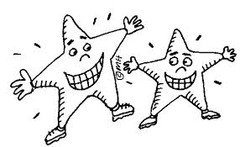
    So, there you go - a silly little question I guess. Bobbie, you got 2 of the effects, increased heart attacks and accidents. For you:

    This star business is a little more complicated. Anyway, thanks to all for playing. Off to see what Cynthia has. See you all next week.

    Nancy

  • 11 years ago

    I love those stars, Nancy! Also, that story about the two arrests at the same time/day is so funny

Sponsored