Software
Houzz Logo Print
greenhavenrdgarden

Table saw for hobby work.

11 years ago
last modified: 11 years ago
I searched this question on here and I did find a few threads about table saws but nothing within the last 5 years or so...

I'm a 38 yr old house wife that takes on some projects myself ocassionally. Up until now I've gotten by with my jig saw, Dremel, circular saw, miter saw and hand saws. I built a cubby last week and even though Home Depot was able to cut down the wood some, I still needed to do cuts that I really wish I had a table saw for. I would also like to buy woods that Home Depot doesn't carry so I can't rely on begging them to do my cuts. I rigged up a jig but it wasn't as easy/accurate as I thought it would be.

I'm taking on bigger projects and I'm ready to purchase a table saw so I can more accurately cut my hardwoods and plywood.

Any recommendation for a hobby-DIYer-crafter? I don't mind spending money for something that I need but I don't want to overspend on a saw I might only use a couple times a year.

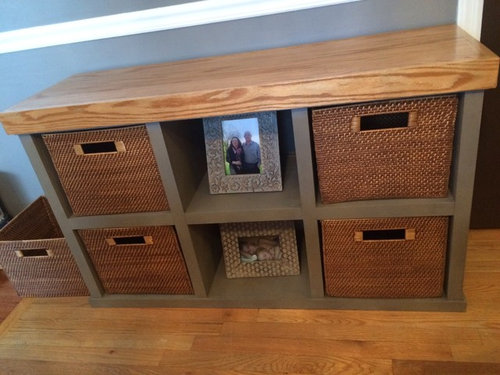
Enclosed is a pic of my cubby, but please don't laugh at my handy work...it was my very first attempt at building anything with my own plans :-)

It's still waiting on iron legs that are being made so we can throw our shoes underneath. This is going by our back door.

Comments (17)

  • 11 years ago

    Look at the This Old House saw review. I have an older Dewalt DW744R saw, and it is some what under powered but gets the job done, get something with a high rpm rating. Thinking of replacing it at some point maybe with the Jet 10" Jobsite table saw.

    saw review

  • PRO
    11 years ago

    If you have the floor space, I would recommend a "contractor saw" type unit, with its own set of legs, cast iron top, and a belt-drive. Every part on a saw like that is serviceable; I have used the same one for 32 years. (college graduation present from my parents) You can find a used one on CL for $300 or less. This is the smallest saw to take virtually all table saw accessories which expands its capacity in every direction.
    If you need to be able to make it disappear, you need one that will break down (in the disassembling sense of the term) and the Dewalt is as good as any. The Makita is very reliable. The Bosch is an extremely nice unit in terms of size and performance. All these models are direct drive, and not serviceable like the contractor saw genre. But, they have a connection for a shop-vac to collect some of the sawdust. You would need a platform of some kind to raise it to a safe and comfortable working height.
    At the bottom of the list is the tiny aluminum saw mounted on legs. The worst of both worlds, small enough to fit in anywhere, but very limited capacity, and not stable. I have one that is mainly used as a table for my sliding chop saw. Hitachi at present makes one of these. Not recommended at all.
    Casey


  • 11 years ago

    big question, many possible answers, depending on your needs, aspirations, shop space, and budget.

    The woodworking world is divided into those who will only consider a Sawstop saw and the rest of us. The SawStop incorporated a safety brake that immediately stops the saw blade if it comes in contact with flesh (they use a hot dog for demos). For a significant number of folks this safety feature overrides all other considerations. It helps that their saws are indeed very nice, albeit not cheap.

    Beyond that, saws break down into small, medium, or large and new or used.

    For most serious woodworkers the center of the shop is a big cabinet saw, typified by a Delta Unisaw, Powermatic 66 (now 2000), or one of the similar saws from Jet or Grizzly. These can be equipped with 50" fences for cutting of whole sheets of plywood. New prices run $1500-3500.

    A "contractors saw" is the medium option, less heavy duty, smaller motors than the cabinet saw. New prices run $750-1500

    Finally there are now many small, lightweight "jobsite saws" from Dewalt, Bosch etc found at the local big box stores. These are great for a small space and when you have to move it around, but are tricky to use with larger material and have neither the accuracy or power that most woodworkers want. These are typically a few hundred dollars.

    A trend I've begun to see is people substituting a track saw for a table saw for cutting down big materials The Festool is the standard, but Dewalt and Grizzly now make less expensive versions.

    For myself, if I had the space, I'd look for a used Unisaw or PM66. You can find them on Craigslist in good shape for around $1000. If space were a concern I'd think hard about a good job site saw (stay away from the junk from Ryobi and the like) plus a track saw for cutting down sheet goods. It really depends on what kind of work you want to be doing. If money is a primary concern there are many Sears Craftsman contractors saws from the '50s that are built like a tank, still work well and can be had for around $100. (Stay away form newer ones!) Save some money for a good blade, though. And if safety is a primary concern, the SawStop is the way to go.

  • 11 years ago

    rwiegand pretty much laid it out and as you can see,there is no single "best" saw for all hobbiests. If you don't have space that can be dedicated to shop space,a portable back yard building is worth considering. 100 square feet is about minium for a serious shop. Putting things on casters so they can be rolled around a garage and into driveway alows space doing double duty. Go on line to "Wood Magazine's web site" to see hundreds of tried and tested shops and tools.

  • 11 years ago
    last modified: 11 years ago

    "I rigged up a jig but it wasn't as easy/accurate as I thought it would be."

    This might do it for slicing plywood: It clamps onto the circular saw.


    Jig for ripping plywood

    For a general hobbyist, a table saw is easier than a ripping guide and circular saw when you are ripping boards (making lengthwise cuts to make them skinnier). What's important is to have a good "infeed" and "outfeed" to support the board before and after the saw's platform. "Featherboards" that mount to the table to keep the board snug to the board fence are extremely helpful, as are those roller things to hold the board flat right before and after the saw's blade.

    The track saws have mixed reviews for ripping boards. I can see where they's be awesome for "sheet goods", but maybe notsogreat if you mostly turn 1x8s into measured widths.

  • PRO
    11 years ago

    Since the topic of tracksaws was brought up, there's a simple, homemade jig that turns a basic circular saw into a tracksaw. There's a jig pictured on a forum post in the link below. Scroll near the bottom of the thread to see the picture.


    Circular Saw Fence/Guide

    Other people have already said all that needs to be said regarding table saws. The only thing I might add is that any new saw should come equipped with a riving knife. I wouldn't get a new one that doesn't have it.


  • 11 years ago

    Agree that getting a riving knife is one of the best arguments in favor of a new saw. Biesemeyer made a trunnion-mounted splitter as an aftermarket accessory for a couple of saws, I have one on my PM66. Not quite as good as riving knife (it tilts with the blade but doesn't change height), but orders of magnitude better than the bad joke of a splitter the factory provided.

  • 11 years ago

    rwiegand did an exhaustive job. Since you did a very nice job with other tools, I assume that you would not be too concerned about table saw danger. I admit that it is a real concern although continual attention is mostly what is required. Therefore, I would suggest the used Sears approach. They are still useful although tilting the saw blade can often be difficult. They can be acquired for even less than $100.


  • 11 years ago

    Both Ridgid-brand saws are good -- the 10-inch mid size table saw ($529), which I used to build all of my kitchen cabinets and even their smaller contractor saw ($399). They get good reviews.

  • PRO
    11 years ago

    Keep yer fingers out of the blade, or buy the Sawstop.

  • 11 years ago
    last modified: 11 years ago

    May I ask a question here..... what would y'all suggest for ripping if your main consideration is accuracy/straightness? Are there any saws (table or panel) in the hobbyist range that are better than others in that regard? Or is it pretty much you get what you pay for?

    Reason I ask... my first woodworking class my cuts were awful and my table turned out crooked and wobbly! Second one was in a tech college with more professional grade (ie expensive) equipment and Im positive that the success of my table in that class had more to do with the equipment (ie a fence that was actually parallel) than my skill level. (Better teacher too, probably)

    BTW op - not laughing at all at your project - not at all! Looks great. Ive become a fan of fir /yellow pine (antique or otherwise) love the wild grain and want to do a table top like that.

  • 11 years ago

    Ripping? A long metal guide, some good clamps for it, and a circular saw with a good blade meant for ripping.

    And good support tables.

  • 11 years ago

    With as many new saws on the market along with used ones,it can be difficult to know what to buy. The very best way for a novice is having an experienced individual keeping an eye out or go with them. Even new saws denifit from a tune up so an experienced person is needed there also.

  • PRO
    11 years ago

    If you're ripping only, the Festool track saw with guide is as accurate as any table saw, much less expensive, and the dust collection is superior.

  • 11 years ago

    Well, a Festool track saw is far more expensive that a fairly good contractor table saw. That is, you can get a decent table saw and take advantage of all its benefits for less than a $600 Festool (which is a great tool).


  • 11 years ago

    Shared tools, especially in a school setting are often in horrible conditions, misaligned, parts not working, dull blades, worn bearings, and on and on. Your own saw, whether it is the used $75 Craftsman contractors saw or a Felder sliding table behemoth can be made to perform anywhere from pretty well to perfectly. If the table isn't close to flat or if there's horrible runout in the blade arbor, or if it's so flimsy it flexes when you push on it you probably really need a better saw. However a tune-up of making the fence parallel to the blade, the miter slots parallel to the blade. cleaning gunk out of the gears, and putting a good quality sharp blade onto the saw will fix a world of problems and make most saws useable.

    While I'm very tempted by the Festool track saw (I was playing with one at the Woodcraft store this weekend) I don't think that it would work so well for ripping a quarter inch off of a 1" wide board, the kind of thing I do all the time on my table saw. For cutting down sheet goods it looks like the best thing since sliced bread! The TS also enables many other operations from dados to cutting tenon cheeks that I don't think you can do with a track saw.

  • 8 years ago

    Kreg has some really good jigs for ripping and cross-cutting. I gave my dad the Kreg Rip-Cut, and he said it worked really well.

    Here's a review:
    https://www.highlandwoodworking.com/woodworking-tips-1408aug/kreg-rip-cut-tool-review.html

    And there are hundredy videos of it in use.

    There are also other brands of track saws other than Festool (Festool is expensive, but their rep for engineering quality is over the roof).

    The guy at that review liked the Rip-Cut better than a track saw.

    In one of the official videos, they show the idea of using a sheet of rigid insulation to create a destroyable undersurface. I think that's brilliant!