Software
Houzz Logo Print
scottt60514

Chinese Pistache Pruning

11 years ago

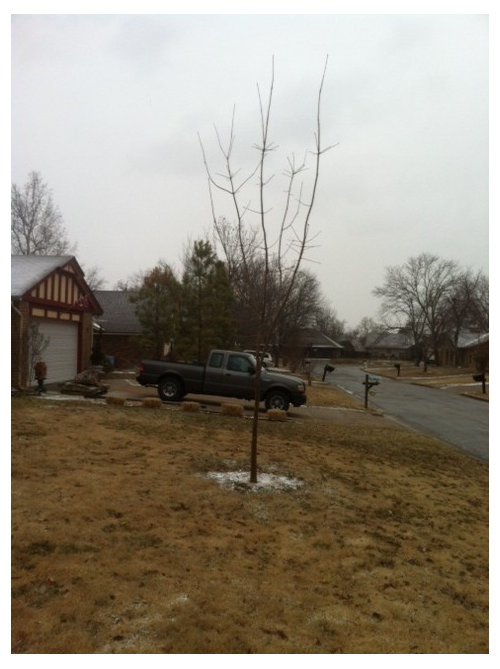
My parent's have two Chinese Pistache that they are concerned about. We know they're ugly ducklings when young and we can't find any definitive information on how to prune. The trees have grown very differently, the one in the backyard looks like a whip and the one in the front yard forks about three feet off the ground and then each fork forks again. I'll be traveling to their house this weekend and would love to prune these trees while I'm there. These are the best pictures they sent me. Any thoughts?

Front yard

Parent's Trees · More Info


Back yard

Parent's Trees · More Info


Parent's Trees · More Info


Comments (14)

  • 11 years ago

    Scott, other than references to it on this forum, I have no experience with that species. But I can tell you that, in all trees, the judicious heading back of side branches-whenever possible to a side branchlet or even a bud-will slow those branches down, giving more juice to the "central leader". Now that term, central leader, can mean different things on different trees. On strongly excurrent species, like pine-family members, to use an obvious example, the central leader is easily identified, not that you'd be doing this type of pruning on a pine-family member, but that contrasts with something like honeylocust-sorry, I'm bound to use northern examples-where most often there is no one lead going up the middle of the tree. Then what you do is simply select the leader that most-nearly occupies this role and subordinate all others to it, via this heading-back pruning.

    The other thing I want to say is, those trees don't have a lot going for them yet. I'd not take a lot off, period. Maybe just some very minor shortening of side branches, the tree in top photo being able to handle a little more work. That one you could really do a subordination pruning and achieve good results.

    Incidentally, this whole thing is just to get the plant growing upward a bit longer into its lifespan. All broadleaved deciduous trees eventually become rounded on top. That's fine-we just prefer not to have it happen 6 or 8 ft. off the ground.

    +oM

  • 11 years ago

    Concur with +toM. Even though this is a tree that in maturity has a broad canopy, best to try to prune to a central leader when young. Now this doesn't have to be more than a couple of inches higher than the lateral(s). And, as noted, if you prune the laterals back very slightly you will slow them down and allow the leader to take hold. What you are trying to do is to get the tree to develop a strong trunk with good structure. I would have liked to have seen more laterals left on lower down to help the trunk develop more girth, but nurseries head up with abandon for ease in handling so rare to see. They are very ungainly when young so don't despair, and the first autumn that they put on a show you will know that it was worth the wait! They are all over here as street trees and there are some Novembers when I almost drive off the road because I am agog at the dazzling shades of orange and coral.

  • 11 years ago

    we can't find any definitive information on how to prune.

    ==>>> 99% of the time.. there are not special rules for different trees ... so if you were looking for a tutorial in regard to this specific tree.. it doesnt surprise me... that you couldnt ...

    FRANKLY ... very!!! .. i dont see that either tree needs anything from you ... what makes you think they do ...

    and in answering that.. what is your pruning GOAL ...???

    i prune trees up.. so i can walk.. and ride the lawn mower at speed.. w/o poking my eyes out ... and then i go as high as i want/can ... depending on my goal ...

    some trees out by the lot line.. only the driving goal ..

    others more in the middle of the 5 acres... high enough.. so i can see what might be behind them.. from my patio chair/deck ... or so that sunlight might get to other plants below ....

    and once my goal is accomplished.. i put away the pruning saw and ladder ...

    the one in front.. looks great .. on these pix.. IMHO ... leave it alone ... you will destroy it.. trying to make it a single leader tree ...

    the one in back ... if it was planted to hide the buildings behind ... then cut it back.. to encourage new side branching ...

    but if that is not the goal.. then dont do it ...

    we dont prune.. just because we have a saw ... and you really didnt elucidate a goal ... other than to note.. you will be there ....

    ken


  • 11 years ago

    yeah, they are still young so you should let them grow into there natural form. Why do you feel you need to prune them. They know how to grow. lol

  • 11 years ago
    last modified: 11 years ago

    Well....the general idea is, trees evolved in plant communities known as forests. Yes, yes, there are exceptions, but this generality holds true. In forests, new growth usually takes root following some kind of disturbance. So let's just say, a windstorm blew down most of the mature canopy. Now the site is flooded with light. Numerous stems begin to grow, all competing with one another for light. This causes them to devote most of their energy into height increment, and that in turn results in a relatively long bole (trunk) and most branches being up near the top. OK so far? So now, we take these plants, put them in our yards and parks where they are flooded with sunlight on all sides, all day long. This encourages them to form a much lower crown than in the forest example above. And that can be OK too, there's no one right way for a tree to grow. But................we like to do things in our yards and parks. things like walk under the trees, maybe cut the grass, so we tend to try to get the crown to form up a little higher than if the tree grew completely unaltered. So again, all we're trying to do is form a higher crown. Not forever, just for a while. Then too, other concerns creep in. All that sunlight hitting the young tree on all sides can also cause an overabundance of branches-far beyond what its forest cousin would be forming. Sometimes, some of these branches rub against one another, sometimes they compete with the leader, possibly forming V-crotches with included bark. These formations are notorious for splitting out later under ice or snow load, etc. So there really are reasons to prune yard and park (and streetside) trees. No, the trees don't care and don't "need" it, we do, especially if we'd like that tree to function in the landscape for as long as possible.

    +oM

  • 11 years ago

    Stop staking the one in the back as soon as you are sure the roots have established...the tree needs to move around to encourage trunk growth. It will remain 'whippy' as long as it remains staked.

    The one in the front could be reduced to a central leader if you prune back the competing leaders. As the tree develops, you can eventually remove those lower branches entirely (2-3 years after you have pruned them to make them less dominant). Young Pistache are so vigorous that pruning back the competing leaders will have little impact on the tree and by August, you'll hardly notice you've done it.

  • 11 years ago

    As I said earlier, I've seen reference to this species in various postings on this forum and elsewhere. Only, now, in researching a bit, did I realize what a fine plant this is, for appropriate areas.

    Good catch, Smivies. Mostly, stakes get left on trees too long, if they were ever needed at all.

    +oM

  • 11 years ago
    last modified: 11 years ago

    Chinese Pistache became very popular in my area about a decade ago, but honestly I've yet to see one that I would consider an attractive tree. I don't think you can get a strong central leader on these because they naturally want to be a bushy tree. I've never seen the fall colors as good as shown in pictures either.

    No offense, but if that were my house I'd dig them up and toss them into the trash pile, and if I had that view in the back yard I'd be looking for something evergreen that could offer some year round screening.

  • 11 years ago
    last modified: 11 years ago

    Most of these trees require VERY attentive pruning while young. Good thing is that as they mature, they develop a nice oval crown that requires little pruning other than the occasional "buggy whips" that grow out of the bottom of the lower limbs - though even those tend to occur less frequently with age. Eliminate the weak branching and forks from the lowest 7 or 8 feet of trunk as they develop and your folks' trees should be fine. That height is if you want to easily walk underneath them; this linked article provides some additional guidance: http://ucanr.edu/sites/UrbanHort/files/80115.pdf


  • 11 years ago

    Thanks for all the comments. After reading over the advice the only pruning done was cutting the tree in the backyard a few inches from the top to promote branching out. We spent quite a bit of time standing in the front yard discussing options for the tree below. The neighbors probably thought we were crazy staring at one small tree so long.

    Many of you asked why we were looking to prune the tree in front, we were concerned about the weak angle of the two leaders and at some point the upper limbs will have a problem with rubbing against each other. If the angle had been wider we probably wouldn't have been concerned. The tree is in the middle of their front yard and will provide shade to the house and patio. They will also want to mow underneath it.

    It comes down to one of the limbs needing to be removed eventually, we just don't know which and whether to do it now or wait a few years. The picture below shows what we were thinking. The orange line is to remove the limb that will eventually grow into other branches. The pink line is the smaller and more crooked leader where the weak angle is. If we remove this leader there is no need to remove the branch at the orange line. Now that you know our thoughts, do you still recommend leaving it alone for now?


    Parent's Trees · More Info


  • 11 years ago
    last modified: 11 years ago

    Crowns on mature CPs tend to droop to where the branching begins. So should probably be trimmed up at least 6 ft for typical mowing clearance - maybe higher depending on how visible they want the house to remain from the street. You can remove the branches later, but the trunk will have less opportunity to recover a vertical form as it grows. If plan is to begin branching above the orange mark, I'd probably cut it now to give that node more time to strengthen/straighten and cut the red one next year - but that is only one amateur's opinion.

    Tree in the photo is the crown of an 8ft b&b tree that has been in the ground a bit over 20 years. Bottom of photo is about 6ft above the ground. Can see the scars where we initially tried to trim it to about 7ft, but had to raise it another foot to keep 9 to 10ft of clearance at the street.

  • 11 years ago

    Scottt, indeed, you are correct to want to avoid having branches rub or even just occupy more or less the same space. Maybe you can shorten one or the other up to a lateral branch/branchlet, thereby changing its direction of growth sufficiently to prevent either of those things from happening later. I get where you're trying to go with this thing, and in looking at bostedo's pics, a tree variety well worth working with. Just remember-heading-back cuts (Always to a lateral) can do much the same as whole branch removal, while still allowing the tree to retain more of its foliage. In extreme cases, even cutting back to a bud can work, although here there really is a general rule of thumb: whatever branch/branchlet one cuts back to should be at least one third the diameter of the part being removed, at that point. Hopefully that makes sense. It's easier to see and show than to write, lol!

    +om

  • 8 years ago

    I’m new at this type of tree I just bought a Chinese pistache tree about 3 Years old and about 6 1/2 feet tall my question is can I over water this tree the reason I ask I water my plants twice a day and the tree in the front yard so do I water the pistache the same way thanks for your time have a blessed evening