Software
Houzz Logo Print
chickencoupe1

Onions: To Mulch or Not?

11 years ago

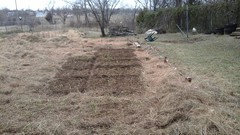
I put them in a hot place because it is the sandiest spot. Then, I raised them 6" to 8" high from the clay grade level. Of course, that means it's very dry. Mulching is the first solution that comes to mind since I'm hand watering and they need consistent moisture. I do have a diverse ecology and don't have any reason to think I'd have an infestation of onion-loving bugs ... or thrips. I've never seen any harm on all the abundant wild onions, here.

When I was digging the potato rows, today, I found a left-over onion beneath the heavy mulch. It was happy. Real happy and it's not the first time I've seen onions thrive under mulch protected from the afternoon sun. I'm thinking they benefit more from the organic material than just the sun block. So, now, I'm considering alternatives since I'm also fertilizing organically (mainly liquid fert: alfalfa, bunny berries and molasses).

How bad is mulch for onions in Oklahoma?

I should have plenty of chipped leaves.
I could use the prairie hay, but it would be a pain.

I'm thinking a good 1/2" of compost soil and, then, leaves?

Comments (8)

  • 11 years ago

    That's an excellent idea!

  • 11 years ago

    Do you just plant sweets with the onions and let the vines run among them, or would you plant in rows and put sweets inbetween. My onions are in a bed. Seems like the 2 roots would compete. I love the idea of living mulch, especially an edible one. Bet leaf lettuce would work, too.

  • 11 years ago

    Not having done this before I can only guess but I would think you would put them near your crop but not where the roots would compete. Maybe then just guide the runners where you want them. Yes, leaf lettuce would work. I've seen beds where they plant everything for a salad all jumbled together. Lettuce, spinach, radishes, all in one raised bed. Just have to make sure everything gets water and nutrients.

  • 11 years ago

    Mulch is fine as long as the weather is not too wet and if you are not watering constantly and keeping the mulch real wet. The way to water anything in the garden is to water deeply and less often as opposed to watering more shallowly more often. This puts the soil moisture down in and below the root zone and not up in the upper soil layers at the ground level and on the mulch if you are mulching. If perpetually wet mulch is right up against the necks of the onions they can stay too wet and can rot. Wet mulch also attracts pests like pill bugs and sow bugs that will nibble on your onions beneath the mulch.

    Onion plants are fairly shallow rooted and do not like competition from weeds. In fact, they hate it. From an onion's point of view, anything that is not an onion is a weed. For this reason, using a living mulch with onions probably is not the best idea if you are trying to get the maximum harvest and maximum sized onions. I use ornamental sweet potatoes as a living mulch beneath pepper and roselle plants, but not in the onion beds.

    I usually mulch onions with grass clippings that have dried a bit before I add them to the garden. In a dry year, I don't necessarily wait for them to dry, but in a wet year I do. For my garden, this is a wet year. Without getting too technical, earlier this week, one of the "Plant Available Water" maps on the OK Mesonet was showing that at the 4" level, 107% of the water there is available for my plants......a huge improvement from last year's winter and spring drought, but now with the opposite kind of worry in place that we might have to deal with soil that is too wet instead of too dry, so when I planted my onions, I didn't mulch them at all. Eventually I'll add some mulch, but not until the soil dries out a lot more. Chopped and shredded leaves can be a great mulch for onions as long as they aren't too wet. When we have a wet year, I don't use them in the beds because of the way they attract about a trillion pill bugs and sow bugs which come to feed on the leaf mulch and then stay and eat everything else., including the onion plants.

    I actually mulch onions less than I used to do early in the season for the above reasons. Later on, as the weather gets hotter and drier, I'll add more mulch. The downside to using less mulch early on is that you have to weed a lot more, but I have found the weeding is less time-consuming than dealing with sow bugs, pill bugs and other soil-dwelling and mulch-dwelling pests after they've all taken up residence in the mulch.

    chickencoupe thanked Okiedawn OK Zone 7
  • 11 years ago

    Thanks, Okiedawn, that's good to know. Right now I'm just putting my onions in so will hold off the mulch. How about fertilizing? I have composted chicken and goat manure but don't want to burn anything so not sure how much to put down on top of the soil or whether to work it into the soil before I plant, or whether to just hold off.

  • 11 years ago

    Thanks, Dawn. I'll water deeply and keep a watchful cornea in that direction.

  • 11 years ago
    last modified: 11 years ago

    Shaer, If you go to the Dixondale Farms website page I've linked at the bottom of the page, you can read about their trench method of fertilizing. I usually work fertilizer into the soil before planting because I want it down deeper in the bed below the root zone of the early plants, but I also use their trench method some years. The trench method can be used with any form of organic fertilizer or synthetic fertilizer. I like Dixondale's own fertilizer for use at planting time, although I don't buy it every year. I usually buy it and use it every other year. In the in-between years, I add lots and lots of organic matter in the fall and winter before planting onions in either February or March. I have clay soil that is mineral-rich, so mostly all I have to worry about is adding organic matter to improve its tilth and texture.

    With any kind of manure, even if it has been composted and even if it is from animals that people swear have never been fed any sort of feed that could be contaminated with herbicide residue, you still need to do a bio-assay test for herbicide residue. There is a specific type of herbicide commonly used on hay fields, pastures, and in city parks and golf courses that can persist even in the manure of animals long after they've eaten food raised with that herbicide sprayed on it. If it contaminates your garden seed, it can kill your crops and make your soil virtually unusable (except for corn and other monocots) for 1 to 4 or 5 years. Google "killer compost" or "herbicide carryover in manure or compost" to read about this long-term, ongoing issue that has been a problem throughout the 2000s if it is new to you. A couple of years ago, purchased, bagged compost killed gardens in a particular area, and the herbicide residue eventually was tracked back to name-brand horse feed that your or I or anyone else could walk in to a feed store and buy today. That's why we need to test all manure before we add it to our gardens----there is no guarantee that our animal feed wasn't contaminated with herbicide residue.

    A neighbor of ours inadvertently ruined her own garden a few years back by using manure from her animals and/or purchased hay as mulch. I don't believe she uses those herbicides on her place, but it was during drought years when ranchers were scrambling to buy hay from somebody....anybody.....in order to have something for their horses and cows to eat. I think that during that time, those herbicide residues were brought onto her place in purchased hay and then came into her garden either via hay mulch or animal manure. Rather than waiting for a unknown number of years for the soil to clear up, she decided to build a new garden in a new area----a workable option for folks on rural acreage who have lots of space, but not for someone on a standard city lot.

    You also can make manure or compost tea and feed it to the plants. That is another way to use clean, herbicide-free manure in a manner that won't burn plant roots. You dilute the manure tea after you make it until its color is the color of weak, watered-down iced tea.

    There are a couple of plants that are such heavy feeders that it can be hard to keep them happy---onions are sort of that way. They will devour any and all nitrogen you give them, and that's a good thing because lots of nitrogen makes lots of onions. With onions, the more nitrogen, the merrier. The number of leaves each onion plant has and the size of the leaves is what determines how big or small (along with rainfall) your onions will be. For big, softball-sized onions, your plants need regular access to plenty of nitrogen and roughly 21" of rainfall/irrigation during the plants' lives. With most plants, we urge folks not to overfeed nitrogen, but with onions, if you want big onions, shoot for producing big leaves and plenty of them. Each leaf gives you a layer or ring of onion flesh. Big leaves give you big thick rings or layers, small leaves give you smaller rings or layers.

    Early in their lives, I like the fertilizers that have more of a 1-2-1 ratio (like Dixondale's) to get the onions off to a good start. Then, a few weeks later, I like to give them some extra nitrogen to help the leaves make great growth. Having said that, sometimes I don't feed them at all and let them make all their growth merely of what is in my soil, but I do enrich the soil with copious amounts of compost every year. I often use Espoma's organic fertilizers, though I find myself not as happy as before with some that have been reformulated in recent years.

    Hope this helps, and feel free to ask more questions.

    Dawn

    Dixondale Farms' Onion Fertilizer Trench Technique