Software
Houzz Logo Print
bob_in_colorado

How much light for seedlings...

11 years ago
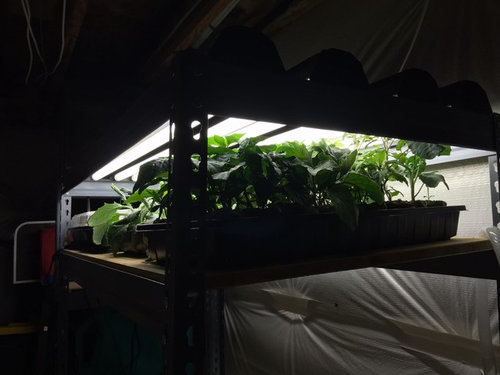
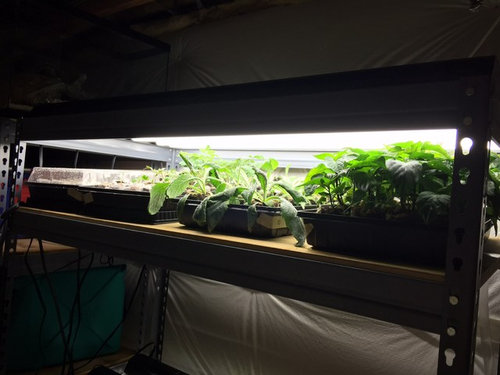
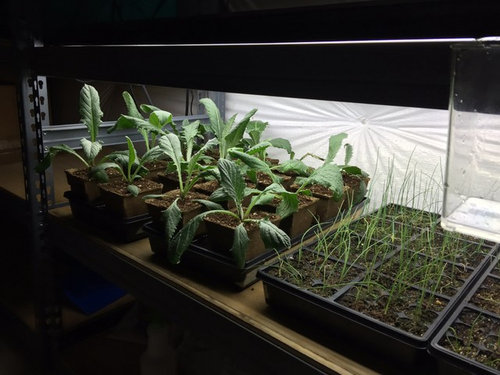
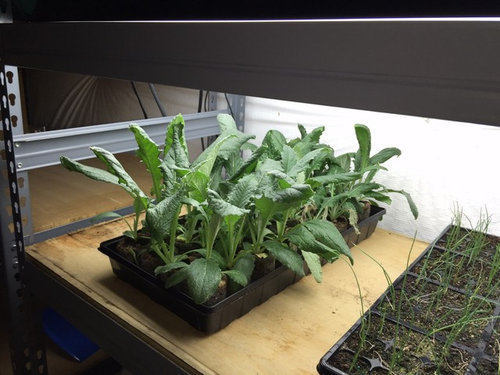
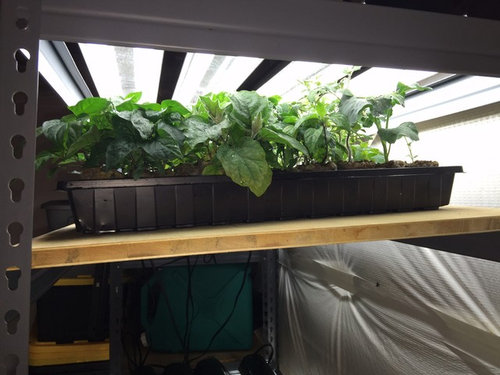
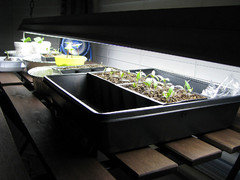
I've started plants indoors as always. I have my seedlings on those grey modular shelves you can buy at the box stores. My question is this.... In the past I've run 4 fixtures, 2 lights each for a total of 8 lights per shelf. Do I need this much light per shelf? See attached pics. As I pot things up and they need more space, I was thinking of cutting it back to 2 fixtures, 2 bulbs each per shelf. The bulbs are T-8, 32 watt, daylight temperature. As they grow out of the seedling stage and get potted up, do they need as much light? Input is appreciated as always.


Also, do my onion starts need that much direct light?


Comments (18)

  • 11 years ago

    In my experience, Bob, each two-bulb fixture is wide enough for ONE 6-cell plug tray (the 2x3 cell packs you start seeds in) if you orient it lengthwise. A four bulb fixture is wide enough for two of them, or one flat (also oriented lengthwise).

    As they grow, I can generally only get a single file row of larger containers under the two-bulb fixtures.

    As far as I can tell from the pictures, I would keep the lights you have.

    As for light requirements, yes seedlings that are indoors at any stage of growth need as much possible light as you can give them. Growing plants under lights is about equal to growing them in the deepest, darkest shade you have in your yard when compared to the full sun (even on a cloudy day) that nearly every vegetable prefers. That also goes for your onions.

    I hope that makes sense... If any of it doesn't just tell me to quit talking gibberish and speak English lol (I just got home from 3 days playing army so my brain is a little fried right now)

  • 11 years ago

    Thanks!

  • 11 years ago

    I'm getting ready to start some seeds indoors, so this thread is very helpful! Thanks Zach for sharing your experience with this. I think on another thread you were saying just normal fluorescent tubes are fine, vs using grow light type bulbs. I have some that say 'daylight' that were left over from my husbands shop. Do you think those are ok to use?

    Thanks,
    Marj


  • 11 years ago
    last modified: 11 years ago

    My name's not Zach, but many years ago I used to grow lots of stuff under florescent lites! I used mostly cool white--'cause that's what I had, but I've used others, and as near as I can figure, any of the different "types" of bulbs are just fine! Hang them on chains with S-hooks so you can adjust them easily, and keep them just a couple inches above the plants. If the plants grow up into the bulbs--no fear! Florescent won't burn anything. That's one of the advantages of using them--in addition to being WAY cheaper than "grow lites!"

    Happy seed starting, Misty!

    Skybird

  • 11 years ago

    No prob, Bob! (Sorry, I couldn't resist!)

    Well, Marj, my name is Zach, but I am HARDLY the only source of information of knowledge lol! Glad It was helpful for you though! Yes, I use normal fluorescent tubes from the cheapest, closest hardware store. There is miles of room for debate on what lights to use, and if you don't believe me, go check out the "growing under lights" forum haha!

    But, I've got concur with Skybird here. Grow lights are, from what I can tell, a waste of money. I have never, and so help me and my "thrifty" self, will never, use them. What I look for when I buy tubes is a color chart (or equivalent) in coolest, or bluest, range I can find. Yes, all of them are really full-spectrum, but, I reckon if one puts outs more blue light than red light, the better off seedlings will be (there is a biological reason that spawned my theory, but, I'll spare you the snooze fest).

    The one and only concern I have with old shop light bulbs is that, overtime, the amount of light output decreases. It may not be noticeable, or only insignificantly so, to our eyes, but, I do suspect the photon loss is noticeable to our plants, at least when they are growing in such a "dark" environment as in our basements, underneath T8 (or whatever size) bulbs. Hope that helps a little more!

  • 11 years ago

    Thanks Zach and Not-Zach - lol! You make a great point about using used bulbs - I will pick up some new ones at HD. Yep, Skybird - I got my S hooks handy and some chain to hang the lights from, which can be easily adjusted for the height as the seedlings grow. I'm going to set one table in the kitchen and one by my front bay window. Along with the light bulbs, they'll get a bit of natural light as well. I'm going to drape some plastic around them to keep some of the moisture in, and add a fan like both of you suggested before for giving them plenty of air circulation! Hoping my starts look better this year because of this - although they've done ok in the past, just trying to improve on things this year :)

    Thanks,
    Another Non-Zach
    ;-D


  • 11 years ago

    Wow, I feel popular around here HAHA!

    I use the S-hooks and chains for raising and lowering BUT, sometimes I find that a bit cumbersome. If I'm feeling particularly lazy (or I run out of chain) I will set whatever containers they are (cell packs, dixie cups, leftover pots from last year) up on blocks to move the plants closer to the lights, rather then moving the light closer to the plants. Just a little trick I use because I really hate extra work ;).

    I have never seen any need to "enclose" the whole growing space in plastic, though, I know there are plenty of people who do. But, I prefer to keep everything on dryer side (after seeds have germinated).

    The fan is a great tool. It improves air circulation, helps dry out the soil to prevent little bugs, fungus, and disease, AND as an added bonus, movement makes seedlings grow stronger and stockier! I don't leave it on all the time, and sometimes I forget to turn it on at all, but, I've always got one as a part of the set up!

    Can't wait to see your seedlings!

    ~A Zach :-p

  • 11 years ago

    So I picked up some new bulbs today. I kept trying to find an indicator on the labels for more blue spectrum, but didn't see that mentioned directly. Did finally find a chart they had showing warm to cool according to the K number of the bulb, and they had the cool end colored blue so went with that! It said the higher the K number, the cooler the light. So I picked up the 6500K, which they also called daylight, bulbs. Hope my soon to be seeds/seedlings like them!

    Marj


  • 11 years ago
    last modified: 11 years ago

    Yeah, I think they are usually labeled as "cool" and 6500K, that's what I buy!

    I can't help myself, I think this stuff is really cool, so my apologies in advance for boring you all to death with the following information.

    Disclaimer:
    NERD ALERT! No reason to continue reading unless you are interested in Zach's theory on using blue light for seedlings.

    First of all, we know that chlorophyll A and B are able to absorb light in the blue spectrum and the red spectrum, but not in the green spectrum. So, blue and red are the "colors" of light we should be focusing on when growing plants indoors.

    Now, that being said, based on absorption spectra (and actually a gentleman named Engelmann back in late 1800's did an experiment using algae and bacteria that proved the same point), plants use blue light a little better than they do red light. That is, they absorb more light in the blue spectrum than they do in the red.

    Hypothetical Example:

    If 100nm of blue light fall on a leaf, it will absorb 80nm of that light and the remaining 20nm will be reflected back out.

    If 100nm of red light fall on the leaf, it will absorb 60nm and reflect 40nm.

    Any light that is reflected cannot be used for photosynthesis and is not helping our seedlings grow.

    Another reason I prefer blue is it's effect on vegetative growth. Phototropism, which is a plants reaction to light, is triggered by blue, rather than red light. We all know that a seedling will grow towards the brightest, closest light it can find. In cases of inadequate light, this produces long, stringy growth we call "legginess." Phototropin, a receptor in the cells that causes phototropism and the bending of seedlings towards a light source, is triggered only by blue light (wavelengths below 500nm). In other words, plants grow towards blue light and by putting more of it close to our seedlings, they should grow straight up instead of stretching out towards light somewhere in the distance.

    Another blue light photoreceptor, cryptochrome (so named by scientists in the 70's who found these receptors to be particularly elusive), is responsible for the slowing of hypocotyl growth. More blue light = slower stem growth = less leggy seedlings!

    Now, I just need the time and space to grow seedlings under under 6500K bulbs and 2700K bulbs to see if in fact my theory is correct, or, if I'm just full of hot air.

    END SCIENCE LESSON! (A resounding applause because Zach finally shut up!)

  • 11 years ago

    Got some seedlings started - Black Krims are looking pretty good at 2
    weeks old. Going to have to thin them out (put more than one seed in
    each pot). Have a few other plants started inside as well - watermelon, pumpkin, amaranth, sunflowers, peppers (three varieties), sweet basil, and San Marzano tomatoes. Thanks for
    all the good advice - think it's paying off :)


    Marj


  • 11 years ago

    That's great! They sure look a lot better than mine this year. I don't know what's going on, but it's been a pretty rough year for seedlings for whatever reason here at my house, and it's frustrating! Especially the peppers, my favorite vegetables to grow, look the worst. I'm hoping it's just malnutrition and (finally) getting them into some potting soil instead of seed starting mix today will help.

    Anyhoo, don't thin them, unless you want to or don't have the space. I always just break them apart and give each it's own pot. They usually wilt for a couple hours, but, they bounce right back. I like to do that before they get true leaves, or before the first pair get's too big, that way the roots don't really have a chance to get all tangled together and there's less ripping and tearing. (If you decide to separate rather than thin, and they are freshly watered, resist the urge to water them again, even though they will be wilting.)

  • 11 years ago

    I don't know what anybody else thinks about this, but I always put several (usually 3 to 5) seeds in a pot, and I don't thin them OR pot them into separate pots (unless I have total failure in another pot and need another plant!) I just plant however many seeds germinate in a pot as "one plant." So most of my tomato "plants" are really 2 or 3 individual plants growing in the same place! I do it with tomatoes, eggplant, and the paprika peppers I grow. (I do that with perennials I start from seed too!) With tomatoes, since they get planted WAY deep, if one of the "plants" is so small that it's gonna get completely buried when I plant them in the ground, I just snip that one off when planting them out. I had a terrible year germinating seeds last year and several of my tomato plants wound up being just an individual plant, and I got noticeably less fruit than when I plant "multiple" plants.

    Wondering if anybody else has an opinion about doing it this way! Whether it's something you've actually done/tried, or if it's just something you think is good or bad to do--and why!

    Skybird


  • 11 years ago

    Skybird i do the same thing. Works great!

  • 11 years ago

    I always separate because, well, that's what I do. I never tried to plant 2-3 "as one" and in fact, back when I used to buy my tomato plants from the garden center I would look for ones that had 2 or more stems growing in the same pot and hack them all apart with a saw and plant them separately, too.

    Course, I have always maintained that "whatever works for you is exactly how you should do it." Just don't go into the tomato growing forum and tell them you do that, your going to either give someone a heart attack, incite a riot, or both haha.

  • 11 years ago

    I used the wrong term in my post by saying 'thin' them - I usually do try to separate them first, and if successful, plant them in separate pots. :) Yea, gotta always try to get more plants going just in case some don't make it!!

    I seem to recall seeing a garden expert on a morning talk show demonstrating planting an urban vegetable garden, and she planted some tomatoes in the same hole. I don't remember her reasoning for doing so, though! So maybe your on to something there, Skybird!


  • 11 years ago

    I saw it put quite well the other day.


    If someone tells me that it's my way or the world will end,


    ... I look for a second opinion.


    ツ Steve

  • 11 years ago

    LOL, sometimes, usually on nights when I have enjoyed my fair share of Banquet's, I poke around the other forums just to see if there's any drama. I find it pretty entertaining how worked up people will get over such trivial things. When I used to frequently post in them, and on occasion answer questions, I always made sure people understood that in this particular endeavor, there is no such thing as "one size fits all" (and in fact, I believe that holds true for most things in life).

    I think we ought start a "share your GW horror stories" thread, that would be a hoot and a half!

    I like that a lot Steve, haha, outstanding!