

Starting a small pecan orchard
Hello all, Wanted to say thanks for all the good info here. My wife and I are starting a small pecan orchard on 10 acres and I'm looking for some advice. We've read all the literature from OSU and The Noble Foundation we can lay our hands on and even spent the afternoon with a county extension office PhD who gave lots of awesome info. So now we are moving forward on getting things planted and really just have a couple of questions and advice.
To describe the land, it's 10 square acres with a small creek that just about perfectly cuts the property corner to corner. Along this area, we have a good number of native pecans, some are huge. at least 3 of them are 3' or better diameter trunks with over 60 foot crowns. We also have a number that are in the 8-12+ foot trunk range. Mixed in is a lot of eastern red cedar, some oak, elm, willow, and a good number of native persimmons. I'm working on clearing the non-pecan trees out of the native grove. Looks like a cedar tornado with through with all those I cut down laying around. The next year will be spent working on choosing the best native pecans to keep.
The creek itself is about 1/2 wet weather only and the other half is feed by a small spring, likely from what seems to be a high water table in the area. Around the creek and through most of the property is sandy and slighly loamy soil. The Extention office PhD liked the texture but said we could benefit by adding some organic material so I have been mowing in the native grasses and will work the soil with clover, rye, or other natural nitrogen fixers to pump up the soil. Will also consider incorporating or top dressing on some manures. Only forty characters so I'll continue in the next post...
Comments (36)

okbryan
Original Author11 years agoSo the soil is basically a sandy somewhat loamy soil with some clay mixed in. Near the creek, the water table seems high. Here in central Ok (west of Shawnee) we just got some snow melt and a few days ago, a solid .75in of slow soaking rain. Digging a hole 3 feet deep in a couple of places, I noticed that in the wettest parts, water slowly seeped back into the whole and lest me with about 12-18in of soil. I'm assuming since the water table is that high, it's because the soil was saturated. During a drier time, a 3 foot hole would have only damp soil. Away from the creek is better. Those large pecans and most of the others are growing in this soil so either the water table remaining this high is rare or it's not hurting them. So the first question is in a setup like this, should I take that because pecans are ground near by as a sign that the soil is ok with pecans?
The cultivars I am planting in addition to the natives are Kanza and Pawnee. These are nursary container grown trees. They are supposed to be good pollenators of one another. I planted this in rows of each alternating between a Kansa row and a Pawnee row to ensure good pollination. I also plan to add Meramac this year or next. This and another cultivar I will probably add via a mixture of grafts on native wood and nursery trees. I'm planting them on a 60/60 spacing to give them plenty of room. If I can find the heart, I might add a good temp producer in the center of the block or 4 trees.
Anyway, I have lots of other questions but wanted to get this out there we these and see what you guys thought!
ThanksBryan
- 11 years ago
My first few thoughts:
You are making good decisions overall.
Do you know what pecan seed nuts were planted to grow those nursery trees?
You can have pecan trees growing, but with poor soil and conditions for nut production. A pecan leaf sample in July or just observations through the orchard around Labor Day for two straight years will tell you if you how good the tree genetic / soil condition combination is on the natives. I am guessing it is good enough for some improved varieties if the natives are good.
You absolutely MUST keep all vegetation within 3 ft (minimum) of the newly planted trees killed out with glyphosate or other method for the trees to grow well. Nothing else is as important as this other than water in the first year.
Kanza and Pawnee are the two most popular and likely best choices. You have a great location geographically that allows you to grow almost any variety and have success. Fire away with any other variety of other questions. I'd love to help.
Scott
okbryan thanked scottokla Related Professionals
Belleville Landscape Architects & Landscape Designers · Kenosha Landscape Architects & Landscape Designers · Colorado Springs Landscape Architects & Landscape Designers · Middletown Landscape Contractors · Emporia Landscape Contractors · Cumberland Landscape Contractors · Lawrenceburg Landscape Contractors · Plainfield Landscape Contractors · Modesto Landscape Contractors · Bend Landscape Contractors · Tulsa Accessory Dwelling Units · Middletown Accessory Dwelling Units · Madison Accessory Dwelling Units · Sacramento Accessory Dwelling Units · Logan Accessory Dwelling Unitsokbryan
Original Author11 years agoThanks Scott. I'll admit I've read a lot of your previous posts here several times for advice. Appreciate the time! I don't know what root stock these trees were grown on but the nursary is in north Texas (wasn't Womack but the name escapes me). Bought them through Marcums in OKC. We didn't really decide on pecans for the land until November but I do know most of the natives seemed to have a good yield and nearly every nut I found by then had weevil damage. I read one of your earlier posts that made sense in if we have a large weevil population, we must have pecans to support them. Now comes the war on weevils. The extension rep pointed out we had some hypoxylon damage. Most of it was on native oaks but he said our largest tree which is a pecan seemed to have it. Hopefully keeping the trees in good health for production will limit that damage.
One question I had was on the value of the natives. I've talked to some folks who say the natives have a good niche market but shellers won't give much for them. Figured it's a good way to get feet wet with producing trees but on 10 acres, we aren't paying off the mortgage with pecans either! Other than that, we were looking at Maramacs and a pollinator in addition to the kanza/pawnee since they and the pawnees are said to have the larger nuts the Chinese seem to want (bring some money back). But this is all just internet reading and I would love to hear your opinion. Also wanted to ask about that high water table in the wettest part of the year. There are large pecans and oaks growing in it but I dug some 3 foot holes which filled in with water to within 12-18in of the surface from the snow melt and rain we had. Just wondering if I should avoid planting there or take the native trees as a sign that it's ok? Sorry so many questions so I'll stop here.
Thanks!- 11 years ago
If you have a couple dozen native trees on your property, or natives to your south and north, pollination will probably not be a big issue no matter whet you plant. Maramec doesn't work for me in the Tulsa area because of scab and late nut maturity. I think you are in a good place to try it. Lakota might be as good or better than any other large nut, but I am not sold on it yet. Two years ago all my Lakota trees had dark kernels.
There has been little wholesale market for natives the last three years, but there are signs of a slight recovery maybe for next year. I would not worry about the water table. Take a leaf sample in July and it will give you great info.
Find a copy of Wes Rice's second book on pecan growing if you can. Fire away with more questions!
okbryan thanked scottokla - 11 years ago
Lakota gets my vote over Pawnee. Wes Rice is a good source for graft wood as well.
okbryan thanked devonhubb okbryan
Original Author11 years agoI'll look into Lakota. I picked up the Kanza and Pawnee since they had them and they seemed to be well matched to one another for pollination. Which kind of brings up another question. I've got some in the ground so far in alternating rows so a row and Kanza next to a row of Pawnee and so on to make sure we had plenty of pollen moving around.
Another question is whether when harvesting, there is any advantage to keeping the nuts from a given cultivar separate (ie kanza separated from Pawnee separated from natives) or does it matter since they will be size sorted anyway? I ask because I've seen a lot of reference to planting in blocks and I found myself obsessing about it when planning where everything was going into the ground.- 11 years ago
Lakota has two big advantage over Pawnee, but also disadvantages. On the plus side it does not scab and it has a later budbreak so the loss of crops to late spring freezes is less frequent. It also seems to me to be a stronger tree and more easy to shape. On the negative side it has not been around as long so we don't know as much about it as a mature tree, and it does not have quite as large a nut or consistency of sized nuts as Pawnee. Because of scab, drought, and late freezes, I will lose the Pawnee crop 40% of the time vs losing Kanza 20% at my place. You will have less risk than I do because of your location.
Pawnee sells wholesale consistently for over $2.00 per lb inshell because of its value to consumers still in the shell. Kanza sells for over $1.50 per lb mostly because of its value to shellers for the nutmeat. Lakota may sell for the Kanza level or maybe the Pawnee level eventually, but too early to tell. By comparison, natives sell as a group in the $.60-$.80 range. These prices are minimums; natives may not sell at all in the future; no guarantees.Nut size is valuable, but shelling properties are just as important, so each variety should be kept separate to get the best price. Each native tree is different so shellers will not get near the yield of halves, quality of kernel, and speed of processing with a group of natives (even if similar sized) compared to Kanza. That is what determines the price.
You will have to fertilize and spray for weevils to get consistent crops and high quality nuts. Kanza is more forgiving.
You will likely never have to remove a tree due to crowding at the spacing you are using. You could easily insert trees like Creek, Oconee, more Pawnee, etc. into the middle of your "squares" and would be able to leave them for 20 years or more.
Lastly, Bill Reid maintains http://northernpecans.blogspot.com/ and that is the best pecan resource online anywhere for people like me.okbryan thanked scottokla okbryan
Original Author11 years agoLocation is interesting because I always see I40 mentioned as the dividing line between north/south cultivars but I'm literally just a few miles south of I40. So does that mean if I plant southern cultivars, they will underperform or am I loosing the possibility of greater yields vs northern cultivars? I'm probably overthinking it but I've been obsessing about that question a lot. I used to live in Tulsa not too far from the Nut House near Claremore and other than getting a little more rain, I don't really remember there being a huge difference in climate. I used to jog on a road that ran through that orchard on the back side and that always peaked my interest in a pecan orchard.
For our natives, I think our game plan is to migrate the grove to improved varieties over time. Just like devonhubb suggested, we have a good number of >4in caliper natives I want to graft. I was kind of thinking of cutting our teeth with the natives we have while we are putting together the rest of the orchard. The extension office agent even said if I wanted to do something novel, graft multiple cultivars onto a single large native rootstock. The other question about native market is if the shellers don't want them, is there an inshell market for them? Feel free to not answer as that's probably a little bit of business intellectual property, I was just curious because I've always read they are known for being a pain to process being small and hard but the nutmeats are tasty. I know those I've eaten from our native trees were good.
It's funny you mentioned the squares because I was just thinking to ask that today. At 60ft, a tree in the middle would be diagonally spaced 42ft from the "corners" which is the recommended starting limit from the OSU fact sheets. But because they are not roughly parallel to the sun's path in the growing season, they would get a few more years of growth perhaps before they start crowding for sun. That sounds logical anyway. I used the 60ft spacing to avoid having to thin later at least in my life time and it was splitting the difference between OSU's recommended 40ft starting and 80ft permanent tree spacing.
Also wanted to ask if there is any value in the USDA organic certification? I read that they say 3 years since the last chemical usage and since this is raw land, that's easy but I'm not sure it's worth it.- 11 years ago
IMO, the most important thing to keep in mind is that most improved varieties will need to be well managed to give consistent good crops. That means they might need water and crop thinning some years, and they will need fertilizer regularly when they get older. Any pecan grove in Oklahoma will eventually need to be sprayed for weevil at some point. This will be the sticking point to organic production. Don't let one unscientific study from one year in one grove fool you. If you do a good job with managing everything else, weevils will thrive. With tremendous effort you might be able to keep their numbers manageable organically, but you will still lose some of your crop.
Southern vs Northern cultivars is all about April and October temps. Maramec, Oconee, Creek, Stuart, etc., will not have a long enough growing season for you about one out of 10 or 20 years (a guess), whereas Pawnee and Kanza will almost never be at risk. In April 2014 I lost my entire crops of everything except Kanza and Lakota which came through at about 40-50% loss. I also lost everything in 2007 for all varieties (including all natives). In 2013 my Maramecs and a couple others did not have time to mature and were worthless.Like Devonhubb mentioned, it is risky to graft onto large rootstocks. Less than 3 inches is pretty safe (stake well), 3 to 4 inches will heal over but is more at risk of blowout the first couple years. Over four inches is very risky but I have some that did well, others not. I have grafted anywhere from 2 ft up to 10 ft to get the right rootstock diameter. I have a few trees I topworked with 4 to 6 grafts, and I have one that is half Kanza and half Caddo. Just have fun! There is no better way to learn differences in cultivars than to graft 2 or 3 onto one tree. The two problems are differences in management and differences in harvest. For example, my Caddo needs spraying for scab, and matures late, whereas Kanza needs no fungicide and matures early. Squirrels and weevil hit the Kanza early, and Kanza is starting to split the shucks when Caddo may still need to be sprayed for late weevils.
There is really little inshell market for natives except for high quality ones that produce regularly. I feel guilty selling average natives to people in the shell so I don't do it. On the other hand I know about 40-50 of our natives trees well enough to know the shell is not thick, the meat comes out easily, and the quality is great. I sell these inshell and also have about 500-1000 pounds shelled out for myself each year to give to friends or sell locally.
One thing I might suggest is that you can get by with the rows being at 60' but trees within rows being closer if the rows go N-S. The trees will eventually touch within rows, but between rows the sun will be able to hit both the E and W sides of the tree, keeping scab and shading to a minimum. This is just an opinion of mine.
I have been spending a lot of time near the Verdigris schools when my kids go there to play their teams and that huge orchard between the turnpike and HW66 backs right up to the school. I always take the scenic back way to the jr high. I don't know if that is the Nuthouse one or not.okbryan thanked scottokla okbryan
Original Author11 years agoYep, that is the Nuthouse. I lived in that neighborhood next to the new football field for a number of years. It's been several years since we've been up there but that big I did notice along the interstate that they have new trees going all the way back. I don't know how many acres they have but it's a big setup and beautiful. Nuthouse used to be their little commercial store along 66 with an old fire truck and some other stuff. Pretty cool place.
So I was thinking about the spacing some more. I do have the rows planned N/S. Do you think I might be better off spacing the rows at 60 and the trees at 40-50 or should I do 60 with a tree in the middle of the square? I am planning to irrigate put the time into managing the orchard rather than "free ranging" it since we only have 10 acres or so. I talked to the dept of water quality and corps of engineers about the creek running thorugh my property to get permits to use the water. It won't be enough when the orchard is 20 years old but it should be plenty to get started.
On that note, sounds like organics might be more costly than it's worth. I'm organic in our gardens but it doesn't make much sense if I'm growing the the bugs. I saw places where certified organic pecans were going for $15+/lb shelled so I figured with our small orchard we could focus on producing organics but you are right after I saw the amount of weevil activity in last year's crop.
Your grafting advice is especially interesting. I saw/read about pecan grafting and was surprised to see what seemed to be a 4in cross section with 3/4in or so piece of scion wood bark grafted in. Then they sealed it up some aluminum foil to keep the heat in the graft down. This isn't the original article but is similar.
http://northernpecans.blogspot.com/2012/04/bark-grafting.html
Here is a video example:
https://www.youtube.com/watch?v=sqsZcubCnrk
I was just striking the size difference between the root stock and the scion. The one I remember made a point to say the scion would catch the diameter of the root stock quicker than one might expect and they were on what seemed like a 4in cross section trunk so that's where I came up with that number. Really what I've got are some understory trees under some large, older pecans that the extension agent said he thought had hypoxylon so I think I would topwork some of these figuring I could practice on them. There are also some native root stock in that size range that are not under anything that I'm keeping so I thought I could work those too. Also not afraid to climb and I need an excuse to get an orchard ladder (do I really need one?). Not above cutting in a graft up high to move a native over. Most of my natives seem to be pretty typical in size though some are pretty vigorous producers. Not sure if they are worth anything other than learning on.
So really it boils down to questions of strategy. Since I am planning to scale into irrigation and management, improved varieties are what I need to focus on? Kanza and Pawnee should produce good qualities and good returns. Lakoha is another to consider and meramac could have problems with a last spring or early fall freeze. Any other cultivars I should really consider? Over the next couple of seasons, plan to graft in on native root stocks some of the above or recommended cultivars. By this point, I'll have removed or cleared the scrub from the orchard and am planing on which pecan trees to keep as natives, which left to graft, and which to remove. All this while getting the orchard itself in order with irrigation, sprayers, etc. Sounds like a lot of work but good work. Does it sound reasonable?
Again, thank you all for your advice and specially Scott, you are basically helping me plan this from across the internet so much appreciation!- 11 years ago
I think all that is very reasonable. If you are doing this as a hobby that is fun and also will give you some money some years, you can get by without intense management and still have success. If you are really smart (more than me), really work hard (more than me), and get a bit lucky, you MIGHT make a nice amount of money or at least SOME profit.
If you will be selling the pecans to end customers yourself instead of wholesale to accumulators, you can try more varieties (accumulators want large lots of identical nuts before they will pay top dollar). Having 1000 lbs of Kanza, 800lbs of Pawnees, 400 Lakota, and 200 each of 3 or 4 others is not a big deal selling to individuals, but is a problem selling wholesale.
One other thing worth mentioning: trees that mature their nuts earlier in the fall will tend to accumulate more weevils than trees that mature the nuts late. This a generalization that may be off a bit, but typically the weevils emerge by the calendar sometime in August (unless soils are totally dry in August), and have a few weeks of life to lay eggs in nuts. Late maturing varieties may not be far enough along in nut development to accept the eggs then so a Maramec will have fewer weevils than a Kanza nearby. I bring this up because of you really want to go organic, it can best be done if you get varieties that mature late, although you risk early freezes. For the last two years the crop has been really late here because of a cold spring one year and a late hard freeze the next. My Kanzas and Pawnees in my yard have all been wiped out by weevils even though there are no other pecan trees for 200 yards and my trees are just now starting to produce well. When the large natives in the area don't produce nuts that year or are so late maturing that eggs cannot be laid in them early on, the weevils will go looking for nuts and will find the Kanza and Pawnees whereas the Maramec and Stuarts will get tested by the weevils but eggs will not live unless they are laid in September.As a result I have harvested only 10% weevil-free Pawnee or Kanza in my yard (10 trees), but my McMillan (3 trees) have been 95% weevil-free because they are so late. Squirrels and weevils will take all your Pawnees and many Kanzas some years unless you work really hard to stop them.
Any time you have a question about anything, put it in this thread. Devonhubb or I may be able to answer, and there are a couple of pecan experts on other forums that might drop in and answer here also. I feel like I am about halfway to being an expert, but I could have been a lot further along if there had been someone to help me more when I first started. Bill Reid's blog is extremely valuable, maybe not as much to you now, but in a year of two you will be able to go through his old posts and relate to a lot of things that now seem not useful.
I suggest always thinking of the pecans as something to enjoy and learn from with the possibility of making some money or at least covering most of your expenses. Worst case (unless you cut off a leg with a chainsaw) if you end up bored with it and sell the land in 15 years, it will be worth a lot more than you paid because of your work.okbryan thanked scottokla okbryan
Original Author11 years agolast modified: 11 years agoYou know, my wife and I were talking about the value of improved land with an established orchard on it vs the raw land we bought. Wonder what kind of a percent it increases the value of the house and 10 acres. To be honest, I work full time but I like the technical aspects of the orchard. So this will be a side gig that I hope to retire into. I hope to buy some more acres from a lady next to me with about 80. If I can get into another 10-20 or more if this setup does well, they will all be planted in container trees since cattle pasture now.
But my wife is a stay at home mom and she manages, orders stuff, and is responsible for selling/shipping/website, etc. Basically she will run the business side of things as our pecan business will be hers. We definitely hope to be profitable and add to the family coffers come harvest time. Just need to find her a mentor kind of like you guys are doing for me on the orchard!
I did spend the day cutting, clearing, and burning the cedars for few acres. I haven't decided whether to keep with the row idea of just put a block of Pawnee over there vs rows of every other kanza/pawnee. Then I've got another place to put in a block of Kanza about 400ft away.
Here is a pic of a couple of my largest natives with a nice lush green native grass coming up from under. Still have some more cedars I pulled earlier to clear out but it really is responding well what I've done under there. I don't know what the grass is but it was there when we bought the property in 08 but was all overgrown in poison ivy and scrub. It's coming back nicely now that I'm clearing it. Still much to do but I've got about 5 acres into this state now (though some is brown johnson grass that I'm going to kill away from the new trees and mow in for some organic material in the sandy loam I've got.
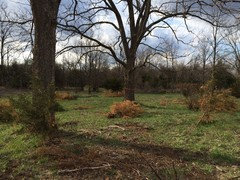
Most of what you see in the background is Pecan but there are some smaller elm/oak with some persimmons mixed in. That is all going and the smaller pecans will get top worked if they are in the clear. Anyway, a lot of work that feels good to accomplish at the end of the day.
So big question today is whether to plant the remaining trees in blocks of Pawnee and Kanza vs alternating rows? There will be at least one pollinator within the block and the natives following the creek split the property down the middle diagonally? And should I tighten the rows leaving a 60' spacing between and say a 40' spacing within the row? Or just do the 60' square and put another tree in the middle of the square? Sounds like Pawnees might be the profitable nut for me since I've decided to use sprays for weevil control.
Just for fun, this was pretty much what it all looked like when I started this last fall. Standing in roughtly the same spot but facing another direction.
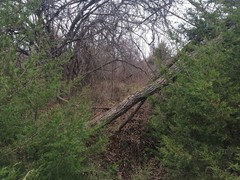
- 11 years ago
Since I have a hard time making decisions, I decided on long-term spacing and then planted in squares at that spacing with the variety I thought was best. Then I put a second choice of varieties that pollenate the first into the middle of each square. So I ended up with rows twice as "thick" as would work long term. My idea was that after 20 years I would know which variety was best and then I would cut out the others, and the surrounding natives would pollenate whatever was left. I will likely keep the Pawnees even though they freeze out more often, get bad scab half of the years, will need crop thinning when they get older, and need irrigation more. Kanza will need almost none of that, but the Pawnees are just so big and sell for so much. My next orchard will not have the temporary trees but will be in rows 50 or 60 apart and 30-40 within rows.
I suggest picking a handful of other varieties like Maramec, McMillan, etc. and grafting these to a couple trees each in places outside of the rows just so you have comparison trees in the future.
okbryan thanked scottokla okbryan
Original Author11 years agoHey guys, thought I would drop an update in. I got in all 20 trees, 10 kanza and 10 pawnee. It is amazing the differences between the varities. The Kanza's are all flush with new leaves and have between 4-6in of new growth. The pawnees seem more closely aligned with my natives as they are just leafing out now and they have catkins growing on them now. I've been pinching off those flowers and thinking the buds and suckers. I've been thinking of the "two foot rule" to prune up the new growth and create a well defined central leader but I'm trying to be cautious not to remove too many leaves this first year so it can get those carbs into the root system. I will say that I am amazed at how much growth these new trees are putting on.
One question I have for the experts is about pruning in the spring time. I've let some of the time get away from me and I have a number of low branches on my natives I want to prune off. I know everyone seems to say dead of winter for live branches but did see a post somewhere talking about wounds healing faster in the active growing season. Also have some trees with two trunks with narrow crotches at or near the ground. For those near the ground (a few inches above) should I remove one of the trunks or leave it. These trunks will each be in the 6-10in range and some are very similar in size (one not obviously dominate).- 11 years ago
A lot of times various pests will eat off new buds or tunnel into new shoots killing many of the initial ones. Because of this I wait until mid May to start pinching off ends of shoots I don't want. Look at the northern pecan blogspot for the best info.
This year Pawnees are just slightly ahead of Kanzas in budding out. Yours may be impacted by conditions prior to getting them to your site and in the ground.
How old and big are your trees and where did you get them? I'm surprised the Pawnees have catkins.
okbryan
Original Author11 years agoThat's probably a good idea. I'm doing my damnedest to leave them alone but I walk the improved I planted this year as well as the natives I've got cleared once a day it seems. I've been reading a lot on the northern pecan blogspot (where I got the 2 foot rule). I'm still wondering if I should be pruning right now our waiting until next winter when things go dormant (can't seem to get a clear answer, some so it's ok, some say they wouldn't do it).
The bud time has been the opposite for me. My Kanzas for the most part have all put on 6+ inches of new growth at the tips while the pawnees and my natives are just breaking out new leaves. These trees came from a nursery in northern Texas (not Womack but another one, I bought these from a Marcum's nursery in OKC).- 11 years ago
There are so many variables the first year trees are planted from nurseries that it is hard to predict what happens early in the growing season. In future years Pawnee will break bud first but Kanza will actually develop shoots with fruit before Pawnee gets that far along, whereas Pawnee will have catkins well before Kanza does. I will try to get a picture of some of mine to post.
I would not prune anything the first growing season except to pinch off high shoots in mid-May to keep one central leader. You will not know which shoot is the best to keep until a few weeks from now.okbryan thanked scottokla okbryan
Original Author11 years agoSorry, on the pruning, I meant on the mature natives. I wanted to remove some of the co-dominate trunks and narrow crotch limbs but I'm afraid of causing problems (infection in the cut limbs from fungus, ants, etc) pruning in the when the trees are active.
- 11 years ago
I think as long as the bark doesn't peel down they will be fine. But it is hard to keep it from peeling from here on out.
- 11 years ago
I've got several pecan sprouts, I want to move to a more desirable location. As late as it is this year, I'm not sure about moving them now. I do want to get it done before the tap root gets too deep.
I have no idea what variety they are. The parent tree grew out of a sack of natives that was placed out back and forgotten about. It's been producing for about 10 years and squirrels have helped plant all over a few acres.
My goal is to get some dug up and transplanted. After a few years, I'd like to do a little grafting.
Any thoughts or suggestions?
- 11 years ago
The tap root will probably be deeper than the tree is tall. You will wind up cutting it....
They will grow new tap roots, but you better figure on watering it for a couple of years until it get re-established. okbryan
Original Author11 years agoHey Devonhubb, just wanted to say I went to the Noble Foundation class on grafting. Picked up some Lakota scions that I'm going to try to either banana graft into the limbs of some natives to top work them and maybe save a few to take up for bud grafts. I've got a stack of natives I haven't cleared that I want to "cut my teeth" on. I've done a little knife making and I'm thinking of putting together a budding knife as a weekend project.
- 11 years ago
I think you will like Lakota. Good choice.
Grafting is addictive. Especially when you see a new graft take off and put on six or eight feet of new growth in one year. Be sure and learn the bark graft. It works great on trees over 3/4 inch diameter.http://northernpecans.blogspot.com/2011/05/bark-grafting.html
- 11 years ago
okoutdrsman, since they grew from seed they are generally called seedlings, and if they grew from seeds of a native tree that does not have "improved" varieties nearby they are generally called natives. Although they tend to have some characteristics similar to the parent tree, they will not be the same and may be really different. Once grafted they are called "improved", "cultivars", "papershell", etc.
I think you should try moving them now. Get as much soil as you can and don't worry so much about the taproot as about getting other roots. Like devonhubb said, just keep the groud damp for a couple of years. Nothing to lose. There will likely be more grow next year!
- 11 years ago
The nice thing about it, I have enough I can pick the ones that are small enough I can rootball without digging to china. My main goal is to locate rootstock and get it to the point where I can graft in a few years. Papershells are the plan right now, but who knows?
- 11 years ago
One more comment, you may actually improve the transplant performance if you are able to cut the taproot at less than a foot deep now and then transplant in offseason. The tree will develop lots of roots to the sides that will help it transplant.
okbryan
Original Author11 years agoJust figured I would give an update for everyone. I guess I'll start with the bad news. So far things have been pretty crazy. We got lots of flooding and a good part of the orchard floor has had standing or slightly flowing water for basically all of May. I've had this property for about 8 years and I've only ever seen water flow across it like that once previously. This year it's been several times that we've had quickly flowing 1+ foot deep water in the native grove and part of the improved section. But other than worrying about waterlogged roots, things have seemed fine. But last weekend, we had a frightening amount of water with 3-4 foot deep water with the creek swelled out several hundred feet wide.
I looked on the FEMA flood map and we basically had a 100 year flood back their this weekend. Had some of the new Pawnees disappear so I thought the worst when I walked out there the next day. I was sure I was going to find stumps with the grafts ripped off the root stock after basically being submerged under fast flowing water with debris enough to make a cedar tree look like it went through a tornado. I was happy to find that all were still there and even with broken bamboo stakes, all the grafts held. Even a couple of the holes had been scoured out but the tree was still there. I restaked and cleaned them all up and all appear no worse for the wear. So other than alot of clean up that will need to be done, we are good! So far the only casualty has been a wind broken Kanza but I cut off the broken part and made scions out of it. Thankfully the there were a few buds left on the bottom of that which are sending up fresh growth so the tree should recover.
Now the good news. I got 10 Lakota scions I've been tinkering with. We grafted 3 of them onto small 1.5in or so natives just to experiment. The scions never really took off but they did slowly start to swell so I hoped the scion was alive. Well three weeks in, two are sending green leaves out and the third looks like it's about to. So I trimmed back the couple native branches I left to throttle things up a bit. I also grafted another larger 3in tree a week or so ago and man you can really see the energy difference. A week later, its buds are starting to break. So Sunday I put on the rubber boots and splashed back out into the native grove and grafted the remaining 6 Lakota scions. Must be the right time of the season for it because both the bark grafts and the couple banana grafts are just starting to show some life so that offers hope that they will bond well.
I also grafted a 6in (chest height) tree that was about 18-20' tall I was going to cut out of a group just to see what would happen. There are no native branches left so I don't know if it will kill it or send the scion up like a rocket but it was a curiosity anyway. So at this point, despite some extra work and some worry about the water standing in the orchard from nearly daily rains, things are going well.- 11 years ago
Glad to hear all is well. Hopefully after all of this rain subsides, we will get some warmer temps and the pecan trees will really take off.
Isn't grafting fun? To me, it sure beats digging holes, planting trees and then watering for two years (or more). - 11 years ago
I had about 100 trees I wanted to graft and collected lots of graftwood, but I broke my leg in late April so they will have to wait till next year. If it would dry up a bit more I might still try some this late.
okbryan
Original Author11 years agoAhh man, sorry I missed this. I'm sure it's too late to graft but if you need some help, I'm happy to. Of the 10 I did, 9 either have swollen buds or even flushing out with new growth. Not sure all will make it but since this is my first time but I was experimenting with some different variations of the bark and banana graft methods and seeing the response. I have noticed on a few that the top buds often well or even start to break but then die and the secondary or lower buds seem to take over. I've got a couple with 6 inches of new growth and others that just have green swollen buds.
Was also going to ask you guys running orchards, do you do any direct to consumer sales like in gift baskets and such? If so, what kind of insurance do you have to protect yourselves?- 11 years ago
Sorry so late in replying. If selling inshell there are no issues. In order to legally sell shelled ones you have to have them shelled at a legal shelling facility like the one in that little town east of Shawnee.
okbryan
Original Author11 years agoThanks Scott. We are probably just going to sell inshell but I just was wondering what kind of insurance you guys carry in case someone gets sick and blames your pecans inshell or otherwise. I know there are food safety insurances for things but have no idea what I'm doing in that field.
- 11 years ago
Many (almost all) people shell them themselves to sell or get them cracked at some local farm store and then sell them. These are both illegal so we don't do it. That takes care of much of the risk. We do shell a lot of ours manually and give them away to friends and family. But we control all parts of harvest and storage so know they are as safe as possible.
This will be a bad year for pecan scab so it is a good year to see how much disease your various trees have on the nuts. Pawnees will have some damage. Kanza and Lakota carry on un-phased. My Caddos will be worthless, and Peruque likely also. - 10 years ago
Hello, my name is Ernesto and I live in southern Spain . exactly in Rota ( only two or three miles from https://en.wikipedia.org/wiki/Naval_Station_Rota,_Spain ) .
In Spain pecan nuts are unknown and can not find in big supermarkets like Carrefour. I have planted 10 trees of Mahan and want to plant seven acres. Here I can only find Mahan , Pawnee , Wichita and Western varieties.
Could you recommend some variety between them?
Thank you so much and sorry if I did not express very well. I used google translator . I read English well but it is difficult to write .
Many thanks and happy 2016 - 10 years ago
This link will tell you which cultivars will pollenate each other: http://www.caes.uga.edu/commodities/fruits/pecanbreeding/cultivars/pollen_pistil.html
These will all need summer irrigation because of cropload and nut size. I really do not know how these will grow and produce in your climate. I suggest planting at twice the recommended density and them removing some over time when you learn what does well there.
A lot of what determines what is best here is our resistance to pecan scab and our length of growing season, and I cannot help you with these since your climate is so different to almost all areas where pecans are grown here. California's Central Valley pecan orchards are probably the most similar to your climate so I suggest searching what is grown there. I know Wichita and Western are grown extensively and do well in our dry, warm climates if managed well.




devonhubb