

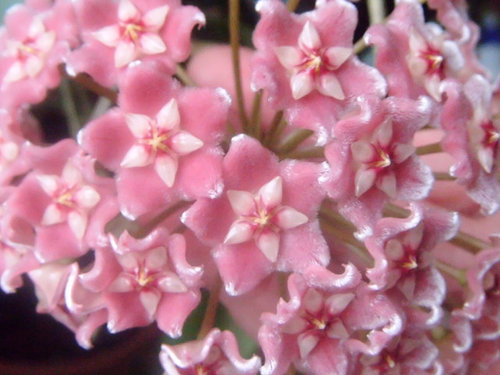
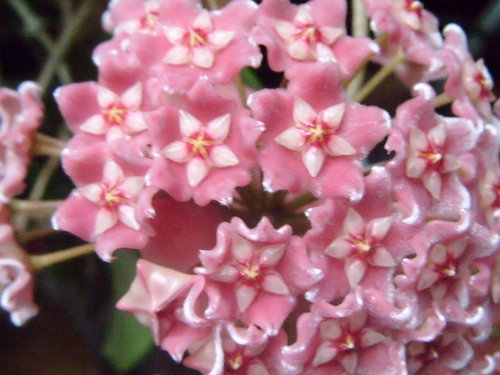
Hoya skinneriana
Comments (34)
Related Professionals
New Haven Landscape Architects & Landscape Designers · Bloomington Landscape Architects & Landscape Designers · Detroit Landscape Architects & Landscape Designers · Lancaster Landscape Architects & Landscape Designers · Temecula Landscape Architects & Landscape Designers · Cheyenne Landscape Architects & Landscape Designers · London Landscape Architects & Landscape Designers · Gaithersburg Landscape Contractors · Clarksdale Landscape Contractors · Frisco Landscape Contractors · Portland Landscape Contractors · Victoria Custom Countertops · Middletown Custom Countertops · Merced Custom Countertops · Magog Custom Countertops 11 years ago
I had not heard that Dee's had a new name! A google search of the name brings up all kinds of different Hoyas. But there is some reference to it on the DG website, referring to it as 'DD's Big One'. I hope someone can clear it up so I can have the right name on mine. And I'm very happy to see the fabulous flowers I have to look forward to!
Denise in Omaha
shelley7950
Original Author11 years agoYeah, it's super confusing...what I heard is that back in the 70's a breeder/distributer named, I think, Loyce Andrews bred a whole bunch of various carnosas with the word "one" in their name...there was "Little One" and "Sweet One" and "Pink One" and half a dozen others...everyone just assumed that "Dee's (or DD's) Big One" was part of that group...but then it turns out it was NOT...however, everyone still considered it a carnosa and it continued on in the hobby for a long time like that...
When I bought my plant as a cutting a couple of years ago from Ric in Florida (who's an AWESOME person to buy from by the way) he sold it as "Dee's Big One"; but last year I saw he was selling it as H. skinneriana...who made the change, and why, I don't know...And I don't think anyone knows for sure how it came into the hobby, so no one knows where it originated or where it's found in the wild...The fact that it's been elevated to a separate species tells me there must be more information out there on it, but I can't find it...hopefully someone here has the missing info.....
- 11 years ago
Hi Shelley, I'm in central Florida, can you give me a line on the 'Ric' who sells hoyas?
Interesting conversation and pics here, I have a small collection of hoyas, I primarily grow aroids and sansevierias. But hoyas sure are interesting. I used to find hoyas for sale at the Univ of South Fla at Tampa Botanic Garden, their supplier of hoyas grew them in pure cypress mulch. I tried that and didn't work well for me, added some perlite and still didn't like it.
I still have an old article about Loyce Andrews that was published in the now-defunct Plants Alive magazine, dated June 1977. She grew hoyas in pure vermiculite -- decades ago I tried that too and rotted every one. Reading the article over again just now, she said "I also feel good about using a mixture of vermiculte and osmunda fiber, or equal parts of vermiculite and sterilized soilless mix".
Shelly, in Loyce's '50 Interesting Hoyas' she mentions Bright One, Little One, and Pretty One.
I doubt there's any new info in this article vs what one can find on Google, but if anyone wants a copy of it I'd be glad to provide it for cost of copying and postage. It's an 'interview-style question-and-answer article with Ms Andrews, 8 pages, 1 in color, includes a small article about B.L. Cobia's Hoya R&D program and their involvement in marketing of hoyas. They're the ones that put names on hoyas that we now know... Silver Princess, Krimson Queen, Krimson Princess, Krinkle 8, etc. 2 pages of the 8 are "50 Interesting Hoyas" written by Loyce.
I still like soilless mixes for most any tropical plants, and hoyas do well in it for me.... 1 or 2 parts peat moss, 1 coarse perlite and 1 part fine or coarse vermiculte. This does dry out fast though, I sometimes drop the vermiculite and add fine, composted pine bark, a product by Fafard. Cornell Univ and Univ of Calif developed soilless mixes way back, maybe the 60s, and Elvin MacDonald wrote books about the mixes and spread the word. I think it was Cornell that promoted a peat moss and vermiculite mix, UC developed peat moss, perlite and vermiculite. Or maybe it was the other way around. Anyway, rambling!!!
I'll price the copying and postage if anyone's interested, can't imagine being more than a couple of bucks.
Russ, central Fla
shelley7950
Original Author11 years agoOMG--Plants Alive...I haven't thought of that magazine in 30 years...I used to be totally addicted to it, couldn't wait for the next issue...I would LOVE to get a copy of the article you mentioned...let me know the cost and I'll get that right out to you...thanks...
Ric sells extensively on e-bay under "ricnfl" and also has an e-bay store that you can access here: ricnfl-HOYAS
I don't know what magic dust he sprinkles on his cuttings, but literally every single one of them has immediately rooted for me, grown fast, and usually flowered within a year or two...He's also quite knowledgeable about Hoyas in general and just an all around nice guy...
I had also forgotten the big push for soil-less mixes from many years ago...I, too, tried them but no longer use them, for a variety of reasons...at least part of it is that the mix is so lightweight, plastic pots are lightweight, and medium to large Hoyas are quite heavy...the result was spilled and falling pots all over the place...I was also never able to work out the correct amount of water and it seemed plants were always either thirsty or rotting...the one good thing about those mixes was that it forced me to fertilize regularly, something I tend to forget to do....
What I'm using now is a sort of "lazy man's" mix, but it works for me---I just take a big scoopful of orchid bark mix and stir in a couple of handfuls of regular potting soil...done...seems to work fine with everything from cuttings to adult plants...I'm sure there are dozens of successful potting mixes out there--I bet everyone on this forum has their own pet mixture...maybe they'll chime in...
- 11 years ago
Thanks for your comments Shelley. I had a subscription to House Plants magazine also, it was excellent and I still have a few of those that had articles I wanted to keep.
I'll look for ricnfl on Ebay, I appreciate that info.
I agree about soilless mixes and the problems with so little weight in plastic pots. I add Fafard's composted pine bark to most of my mixes for tropicals in general, which helps with weight. I do grow all my hoyas, fewer than a dozen these days, in hanging baskets so tip-over isn't an issue.
Two questions of clarification... is your 'regular potting mix' one of the peat-based commercial mixes or are you talking about the heavy, soil-based stuff? Also, what is the 'orchid bark mix' you're using? I'm assuming it's not the fir bark chunks that I have in my shed since that's not a mix. I've seen and used a commercial mix with fir bark, big chunks of perlite or styrofoam, chunks of peat moss, etc, is this what you're using?
Email me with your address at bluesea14808@yahoo.com and I'll get that article out to you. I'm sure you'll enjoy reading it, lots of nostalgia in it for me. I sadly read some years ago that Loyce had passed away.
Russ, central Florida
shelley7950
Original Author11 years agoI just use the "coarse" Miracle-Gro orchid mix from the grocery store mixed with an inexpensive organic house plant mix...I've decided to think of myself as "pragmatic" rather than "lazy" :-)
Many years ago I went through the elaborate light gardens, the plastic sheeting to hold in humidity, regular misting, various fertilizers and soil mixes, etc. etc. Today I take a totally different approach--I have an unobstructed east window and a grow light for winter, and my back deck for the summer; those hoyas that like that setup and thrive and flower, I keep; those that struggle or don't make it, I toss and don't replace. As a result I have a core group of a dozen or so Hoyas that are happy and healthy and bloom regularly...of course I'm still introducing new ones to see what they think of my setup, so my collection is growing, but very slowly....
At least part of the reason for the slow increase of my collection is the FIERCE price of cuttings these days...cuttings now seem to cost what a medium size rooted plant used to run, and rooted plants are just out of the question...I bought two cuttings recently from a well known vendor and between the cost of the plant material and the postage it literally ran me close to $50....what is this world coming to, sigh.....
 11 years agolast modified: 11 years ago
@ shelley
Your skinneriana is very beautiful. Thanks for sharing the story about the mixup regarding its name and the other 'One' cultivars. I, too, thought of those and was very confused about how one had been identified as a separate species.
Actually, Christine Burton states the following in an old issue of The Hoyan that I have earmarked:
"I corresponded with Genevieve McDonald for a short time before her death, when she was a member of HSI. She told me that all of those “Ones” – Bright One, Cream One, Dapple Gray, Pink One, Pretty One, Sweet One, Little One, Little Star, Red Buttons and Gold Star were her seedlings. She said she did not know the parentage of them but all were grown from seeds found on the hoyas growing in her yard on Merritts Island, Florida. For all that she knew they were either selfed seedlings or hybrids."
As far as the history of your plant goes, I was able to Google the following off of DG:
"Incidentally, the plant called 'DD's Big One' has been described as H. skinneriana by Kloppenburg and Wayman in 'Fraterna' Oct. 2011.
It was named for Dorothy Skinner of Modesto CA, and was said to have come into the trade from Randy Bachmann's San Luis Gardens."
@russ
I've always used a 1:1:1 mix of medium bark, large perlite, and peat-based medium. It works very well.
A few years back I experimented with a mix using coir, but that didn't work well for me (although others use coir very successfully).
So, I need to repot those plants this spring and I'm planning on trying out a gritty mix. I might be playing with fire, since I tend to be an underwaterer as it is, but we'll see. The stabilizing ability of those heavy ingredients is very appealing and the drainage is very fine. A lot of people, <i>especially those who grow in Florida</i> do VERY well with it.
But I still always recommend my original mix to newcomers to Hoyas b/c the ingredients are so easy to come by and it is a good blend.
- 11 years ago
I should mention that Kloppenburg was not 100% confident that it originated from San Luis Gardens. It sounds like there's a lack of incontrovertible evidence. It's still a bit of a mystery.
shelley7950
Original Author11 years agoGG thank you so much!! You are the google-meister...That answers a lot of my questions, although (being just a touch OCD) I'm now wondering who Randy Bachman was and what the San Louis Gardens were--literal botanic gardens? A dealer/distributor? A breeder? AND, was Dorothy Skinner the original Dee (DD)? Oh well, what's life without a little mystery?
- 11 years ago
It does seem impossible to Google Randy Bachmann on the internet without getting snowed under by results for the musician. >_>
You might have to ask Dale. But I bet someone old school would know if you posted about it on the Facebook Hoya groups.
It does sound to me like DD was a nickname for Dorothy Skinner.
shelley7950
Original Author9 years agoThank you everyone....it's definitely one of my favorites, and very easy to grow and flower....
- 9 years ago
Easy my patootie! I've been growing it for 7 years and nary a bloom! You must have the touch, Shelley!
Denise in Omaha
shelley7950
Original Author9 years agoReally??? I'm surprised---mine has been as easy as carnosa or motoskei....I wonder if there are different clones? If you remind me I will be happy to send you a cutting from my plant next Spring....it came originally as a cutting from Ric, started blooming within the year, and hasn't really stopped since....Ric's cuttings have always done super well for me....
- 9 years ago
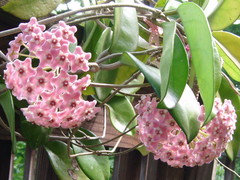
Shelly, that is indeed beautiful. Add another one to the list.
Kloppenburg.... I am surprised he's allowed to write descriptions anymore. Perhaps I'm overly influenced by Chris Burton. I read on this site, that he named H. krohniana from a cutting someone gave to him who had no idea where it came from even or if it was collected from the wild. It's obviously a lacunosa. A description is suppose to be published in a peer reviewed publication which isn't happening.
Denise, perhaps you should repot yours. It seems can become stagnant and stop blooming or growing after a while.
shelley7950
Original Author9 years agoI have to say I was very surprised they gave this plant full specie-hood (is that a word?) since in every respect it looks and behaves like a carnosa variety....I thought it must be based on DNA studies, didn't know Kloppenburg came up with it....and yes, Burton hates Kloppenburg with the white hot heat of a thousand suns :-D....
The advice to Denise to repot is excellent! Sometimes I think hoyas need a little nudge to get going again....
- 9 years ago
Carnosas have never been fast to bloom for me. I think my first one took about 8 years before it bloomed. And I don't think I've ever gotten any of the variegated forms to bloom for me at all. I started a second Dee's to see if it would bloom - different exposure, same thing... Guess it's just my luck!
Denise in Omaha
- 9 years ago
8 years... ooof. This is why I cut down on my carnosa collection. I am patient, but only so much! I might have to try this skinneriana if I get the chance though, just to see.
shelley7950
Original Author9 years agoOr it's just MY luck that I ended up with an easy early blooming clone :-)
I've never had the variegated carnosas bloom for me either, or any of the compacta types--Krinkle 8, Chelsea, etc....
In "The Fragrant Year" the author says that carnosas, "like Boston ladies' hats are not something you should get, but something you should have had" because they take so long to bloom :-)
 9 years ago
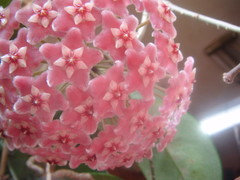
Monica, this is "Dee's big one" Hoya skinneriana. Look how beautiful the flowers are!!
 9 years ago
To be completely honest, I would take the new name (skinneriana) as acceptable with a grain of salt.
Mr. Kloppenburg is well known in the Hoya circle to name and/or re-name plants, as he see fits. This includes cultivars and already named species.
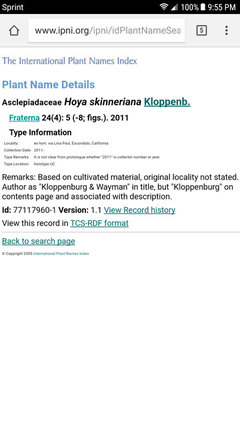
I would keep it as cv. Dee's Big One, as the locality of the orginal plant was not stated, in Mr. Kloppenburg's "publication". It was also mentioned that it was a cultivated plant. Cultivated plants do NOT receive SPECIES names. They receive cultivar names.
IPNI for Hoya skinneriana:
- 9 years ago
Thank you for all that info. I'll keep it tagged as "Dee's big one"....she is a great grower and the flowers, wow!
 9 years ago
This is one of the easiest Hoyas to grow. It grows fast, resists neglect and the flowers form nice big clusters.



shelley7950Original Author