Software
Houzz Logo Print
dbbob

New raised bed garden

11 years ago

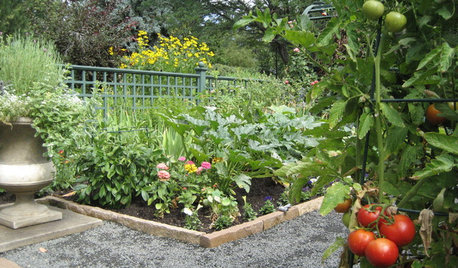
I'm putting a raised bed garden in the front of the house as a neighborhood sharing garden. I'll be planting both veggies and flowers for cut flowers. I have a load of top soil that is sandy loam coming in. What amendments to use? I'd like to stay "organic"

Comments (10)

  • 11 years ago

    Have you had your soil tested? No point adding nutrients that are already present.

    dbbob thanked lisascenic Urban Gardener, Oakland CA
  • 11 years ago

    Good suggestion. And no I have not. Are those home soil testers accurate or should I take it to a garden center. Moon Valley Nurseries is close. What's my best pH level for flowers and veggies and if it's high how do I lower ir?

  • 11 years ago

    Where in the world are you?

    A good reliable soil test for soil pH and nutrient levels is a real good idea, as would be these simple soil tests,

    1) Soil test for organic
    matter. From that soil sample put enough of the rest to make a 4 inch level in
    a clear 1 quart jar, with a tight fitting lid. Fill that jar with water and
    replace the lid, tightly. Shake the jar vigorously and then let it stand for 24
    hours. Your soil will settle out according to soil particle size and weight.
    For example, a good loam will have about 1-3/4 inch (about 45%) of sand on the
    bottom. about 1 inch (about 25%) of silt next, about 1 inch (25%) of clay above
    that, and about 1/4 inch (about 5%) of organic matter on the top.

    2) Drainage. Dig a hole
    1 foot square and 1 foot deep and fill that with water. After that water drains
    away refill the hole with more water and time how long it takes that to drain
    away. Anything less than 2 hours and your soil drains’ too quickly and needs
    more organic matter to slow that drainage down. Anything over 6 hours and the
    soil drains too slowly and needs lots of organic matter to speed it up.

    3) Tilth. Take a handful
    of your slightly damp soil and squeeze it tightly. When the pressure is
    released the soil should hold together in that clump, but when poked with a
    finger that clump should fall apart.

    4) Smell. What does your
    soil smell like? A pleasant, rich earthy odor? Putrid, offensive, repugnant
    odor? The more organic matter in your soil the more active the soil bacteria
    will be and the nicer your soil will smell, to a point. Too much organic matter
    can be bad as well.

    5) Life. How many
    earthworms per shovel full were there? 5 or more indicates a pretty healthy soil. Fewer than 5,
    according to the Natural Resources Conservation Service, indicates a soil that
    is not healthy.

    kimmq is kimmsr

    dbbob thanked kimmq
  • 11 years ago

    Of course if you're importing soil it may test quite different from your native soil, so there's that. You could ask the folks you're buying it from if they have tested it at all.

    Are you getting just topsoil or some kind of mix with compost added? If it's just topsoil, there's no way to know for sure but USUALLY it can use some extra organic matter in the form of compost.

    Usually 6.5-7.5 is a good pH range for general flowers and veggies. And most of us don't trust the home test kits. Your County Extension agent may have a soil testing service. Nurseries usually do not do soil tests but may know where to send a sample. I've tested my soil only twice in 25 years, first because it was a new house and I wanted to know what I was dealing with, and again more recently to see how things were going. If an established garden is growing well there isn't much reason to test.


    dbbob thanked toxcrusadr
  • 11 years ago

    A#1: Add organic matter. Composted manure and/or mushroom compost. It will buffer against texture/nutrient/pH abnormalities, and support a healthy community of microbes/worms, which given a chance to develop in peace, will further heal any abnormalities. With organic matter in soil, a little goes a long way. 5-10% by volume is your target.

    Try to incorporate nitrogen fixing plants into the planting mix, especially as a cover crop in the off season. Legumes, clover, and/or lupine. Make sure to leave the roots to decay, releasing their nutrients into the soil, and creating air/water channels.

    If your soil is from a reputable source (professional landscape materials supplier), and you shouldn't need to go to the trouble of a scientific test. Don't let someone deliver a bunch of construction fill to your doorstep.

    Good luck.


    dbbob thanked Shane Kaser
  • 11 years ago

    Adding organic matter is always good.

    dbbob thanked toffee123
  • 11 years ago

    Kimmq. I'm in southern CA, zone 8b. Very seldom have a frost. Typical summer days 90-95F.

  • 11 years ago
    last modified: 11 years ago

    e have a company here that dredges the bottom of one of the lakes (for the organic matter) which is mixed with sand and has some lime added. Samples are periodically sent to Michigan State University to be tested for pH and then the "soil" is sold as being "state tested", and it is for soil pH. Another landscape supply company buys this soil and markets it as "topsoil", and states it is "state tested".

    Knowing what you are getting is sandy loam is better then something called "topsoil", but knowing just how much organic matter is in that soil is still necessary. Knowing you are in Southern California helps us, too, although the USDA Plant Hardiness Zone does not offer much essential information.

    kimmq is kimmsr

  • 11 years ago

    I put 8 new raised bed gardens in last year. Instead of soil, I used 1/3 perlite, 1/3 peat moss and 1/3 compost. This mix resulted in fantastic vegetable yields of all different types. The only negative is increased watering if rain is lacking.