Software
Houzz Logo Print
hzdeleted_19709676

Question about deterring pests

11 years ago

I am growing chives near my roses because they are supposed to deter aphids. However, I am also growing sweet alyssum around my rose bed because it is supposed to attract lady bugs that feed on aphids. Is this counter-productive? And what is the best way to organically deter pests from my roses. Thanks so much for your advice. Dizzylizzy

Comments (14)

  • 11 years ago
    last modified: 11 years ago

    Lady bugs or any good insect will only come and stay if they have food to eat...

    I'm experimenting with Marigolds but have not come to any conclusions yet as to their effectiveness against repelling rose slugs...

    Marigolds do not repel Aphids that I do know from experimenting...

  • 11 years ago

    Hi dizzylizzy: Lacewings larvae and ladybugs eat aphids, but lacewings do a better job. I prefer lacewings over ladybugs. Lady bugs only come in late fall, and when the weather is right. Lacewings is less fussy. "The life cycle of this green lacewings is about 6 weeks. Their larvae stage lasts from 2 to 4 weeks. An estimated 200 hundred aphids can be eaten in a week by one larva. The average amount of aphids and other pests that a Lacewing will consume throughout its life cycle is 600. " http://www.experts123.com/q/how-many-aphids-can-green-lacewing-eat.html

    Green lacewings larvae are known as Aphid-lions. But the adult flying green lacewings are herbivore. I see lots of them on my Calendula flowers. See link below where to buy lacewings: "Green Lacewing adults are Vegans! They eat only pollen and nectar. They don't have long "mouths" like butterflies so they need shallow throated flowers such as alyssum, bachelor's buttons, crimson clover, daisies, fennel, and other similar flowering plants. "

    Read more: http://www.finegardening.com/vampires-garden-green-lacewing#ixzz3Vhhqzz5t

    From Straw: I planted chives near my roses and it DID NOT help with aphids nor midge. What's known to help with aphids is ORGANIC, slow-released, LESS nitrogen like alfalfa NPK 2-1-2, or horse manure. When nitrogen is high, it promotes fast & soft growth which bring on aphids. I had ungodly aphids-infestation one-time since I used blood meal, high in nitrogen NPK 12-0-0. The drawback of insecticidal soap is it's messy and also kills the good guys: lacewings larvae.

    INSECTICIDAL SOAP http://www.growthis.com/how-to-get-rid-of-aphids-naturally/

  • 11 years ago

    Great info Straw!


  • 11 years ago
    last modified: 11 years ago

    Aphids generally like dry conditions, so drowning is the best method!

    The best most effective and non toxic way to deal with aphids is a good hose spray - strong but not damaging. Knock them off with hose spray every time you see them - best to do this in the morning before the sun gets so hot to burn the leaves. You don't want to do it at night because you will encourage black spot. Do this every time you see aphids. On less spiny plants, squish what you can with fingers or cut off aphid-infested stems and tips and put in garbage. DO NOT USE any pesticides, even "safers" - they all kill bees. systemics kill bees as well.

  • 11 years ago
    last modified: 11 years ago

    Yes like sadie says a hose spray can be effective against aphids...

    BUT water normally doesn't burn leaves here. I have sprayed our rose leaves in 100 degree weather with water and no leaf damage. Our local plant nurseries have sprinklers blasting water on different plant leaves in very hot sunny weather all day long.. We get rains on very hot days then it gets sunny... So I always considered that a old wives tale...At least up North here anyhow...lol

  • 11 years ago

    Thanks everyone, for the valuable tips! Beware aphids!


  • 11 years ago

    Jim, I am curious about marigolds and rose slugs. Last year I had marigolds surrounding my hybrid teas, and no rose slugs, but a knockout bush in another area of the yard was totally infested by them. Now I am wondering if it was my marigolds that saved the others. I think I will plant them again this year!!


  • 11 years ago
    last modified: 11 years ago

    What is a rose slug - dare I ask? we have every manner of slug and snail here in the Pac NW - is there a slug we don't have here? the slugs here decimate marigolds for a pre-appetizer snack. Do I really want to know what a rose slug is - lol


  • 11 years ago
    last modified: 11 years ago

    Rose Slug is different then the slugs you are referring to sadie.

    About Rose Slugs

    Despite their name, rose slugs aren't actually slugs. Instead, they are the larvae of rose sawflies, non-stinging, flying insects that belong to the wasp family (Tenthredinidae). Three species commonly appear on rose plants: the rose slug (Endelomyia aethiops), the curled rose slug sawfly (Allantus cinctus) and the bristly rose slug (Cladius difformis). Adult sawflies have yellowish-green bodies that reach 1/4 to 3/4 inch in length, while the larvae have 1/2- to 3/4-inch long, yellow-green bodies, yellow to yellowish-orange heads and several caterpillar-like legs. Although the three species look similar when it comes to size and coloring, bristly rose slugs have wiry hairs covering their bodies, while curled rose slug sawflies curl up when resting. All three rose slug species inflict similar damage and require the same treatment methods.

    Young rose slugs feed on soft leaf tissue, leaving just veins and a papery, see-through surface material behind. Mature rose slugs frequently chew big holes in the foliage. Although mild infestations might make plants look unattractive, the roses suffer no lasting damage. Severe infestations not only make leaves curl and turn brown, but can also cause severe defoliation, which leaves plants weak and vulnerable to diseases and other insect pests.


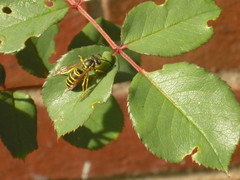
    TOOK THIS PIC A COUPLE YEARS AGO OF A ROSE SLUG:

  • 11 years ago


    Could of been the Marigolds repelling the Rose Slugs... I had the same result last year as you speak about so I'm experimenting more with Marigolds this year...


    dizzylizzy415

    Jim, I am curious about marigolds and rose slugs. Last year I had marigolds surrounding my hybrid teas, and no rose slugs, but a knockout bush in another area of the yard was totally infested by them. Now I am wondering if it was my marigolds that saved the others. I think I will plant them again this year!!


  • 11 years ago

    Thank you, Jim, for a GREAT shot of rose slug, and very good info. The year I planted over a dozen marigolds: there's a drastic INCREASE in wasp. Wasp is a predator of rose slugs. We get so much wasps (in our outdoor light), inside our grill, inside the patio box ... that I quit planting marigolds by our patio ... no more wasp. Marigolds is best planted by roses .. that attract wasps & other beneficial insects, and wasps are very good in devouring rose-slugs.

  • 11 years ago

    Very True Straw! I'm not sure what all factors are involved that's why I'll keep experimenting with Marigolds to hopefully find out...

    Took these pics in the past....


  • 11 years ago
    last modified: 11 years ago

    Thanks so much, Jim, for all the great info and pics on rose slugs. And thanks to everyone else. No wonder i don't have them; we have TONS of mud wasps.