Software
Houzz Logo Print
jordan_macphee

Kale is getting leggy even under grow lights - what am I doing wrong?

11 years ago
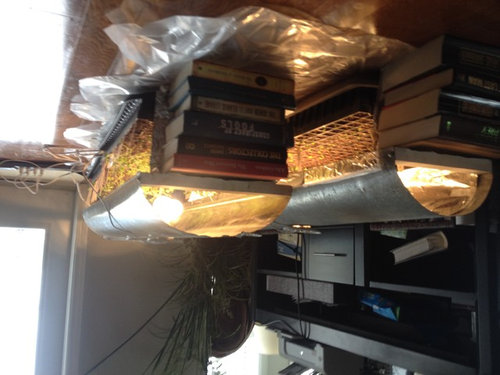
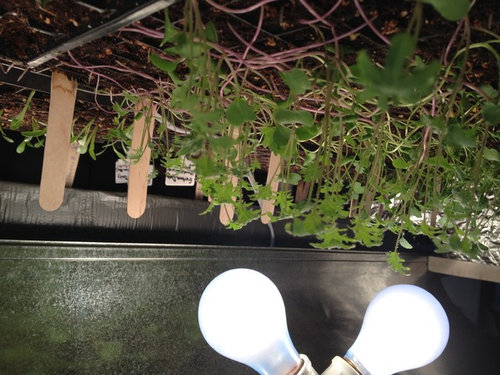
My homemade grow light fixture setup. I don't know why my photos are uploading
upside down. They're right side up in my computer's folder. I tried flipping them upside down in the folder and re-uploading but they still did this. Oh well.


I
made the rookie mistake of letting kale grow indoors for four days after
germination without any grow lights (I was waiting for the weekend to make the fixtures), which made them get really leggy
(tall and spindly), and eventually fall over for the most part. I didn't throw them out, I just placed them under my grow lights in case they're salvageable. Likely not though. Here's what they look like:


So I replanted a new tray of kale and I finally got around to making my own grow
light fixtures out of dryer vent pipes and used grow bulbs (rather than
tubes). I read online that about 50w per square foot would be
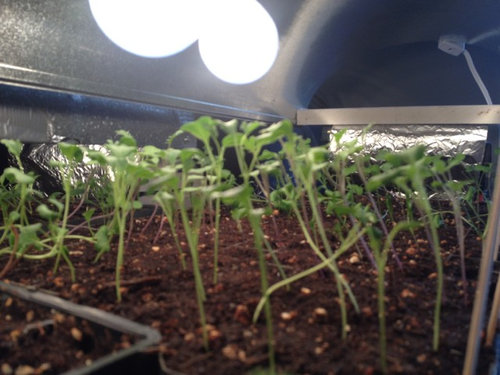
sufficient, and I have 4 100w bulbs in about a 4.5' x 1' fixture, which seemed to be more than adequate, but my kale seems to be getting leggy again, even those that are directly underneath the grow lights. They're not falling over to the same extent, but they look almost identical to the first batch! Notice how tall and thin the seedlings even an inch away from the lights are:

Remarkable! Right side up!

So what am I doing wrong here? One thing I'm going to do is space out the lights so that they're distributed evenly instead of two bunches of two like they are now, but that won't do anything to solve the problem of those seedlings directly under light not growing properly. Just feeling pretty discouraged after two full trays and weeks and nothing much to show for it. Help much appreciated.

Comments (11)

  • 11 years ago

    Whatever the light is, its not strong enough. Did you read 100w incandescent?

  • 11 years ago

    If those are incandescent bulbs such a Philips Agro Light, you are the victim of a scam. Incandescent bulbs are too inefficient for practical use as grow lights. Also, incandescent bulbs emit a relatively large amount of far red light which causes plants to become leggy.

    What people typically do for a 4' x 1' grow space is place two fluorescent shop lights next to each other. With four T8 bulbs, that amounts to 140 watts. Menards is currently having a sale on shop lights, $9.98 after a $5 mail in rebate, limit 4, at least in the Chicago area. As for bulbs, you may as well use Sylvania Sky White which unfortunately are not currently on sale at Menards, but, when they are, go for $40 per case of 12.

    Also, all else equal, the length of stems increases with the difference in temperature between day and night, i.e. light temp. - dark temp.. You can even grow extra short plants by making the temperature when it is dark higher than the temperature when it is light. Yes, that is the exact opposite of what happens naturally. But, in any case, for maximum photosynthesis, the air temperature during the light period should be around 80 deg. F. and you should put a thermometer among your plants to check this.

    Jordan MacPhee thanked aruzinsky
  • 11 years ago

    Thanks for your response. I can't find the little package that they came in, but that may be the type I bought, rings a bell anyway. I assumed they were fluorescent, but admittedly didn't look very hard.

    I've replanted everything (again) and changed to fluorescent bulbs, two 6500K and two 2700K per light fixture to provide a good spectrum for early and late stages of growth. I'll rotate the fixtures or seed trays once a day to make sure all the seedlings get a good mix of each type of light.

    I'd like to avoid the expense of shop lights, and the method for building homemade light fixtures is much easier and less expensive for bulbs than for tube lights. Do you think that the four 100w fluorescent bulbs spaced every foot will be sufficient?

  • 11 years ago
    last modified: 11 years ago

    Are you talking about 100w equivalent or real 100w equivalent to 400w? It's worth trying and see how it goes but if you're using 23w cfl equivalent to 100w then I have my doubts. Just move the plants a little bit everyday. Also for seedlings and greeny things 6500k is thought to be superior to lower Kelvin light which is added for fruiting and flowering.


    I know you said you weren't into the idea of shop lights but that would be my suggestion if you hadn't mentioned wanting to avoid them.

  • 11 years ago

    Thanks for responding. To be accurate, they are actually 23w fluorescent bulbs, 100w equivalents, in case you thought I meant 100w fluorescents as ~400w equivalents. In that case, do you think that is sufficient?

    The dryer vent pipe I used to make them seemed pretty reflective, but I could look into that white spray enamel. Is it commonly used to make homemade setups more reflective? Also, I was thinking of making "walls" to prop up against the length of the fixtures to maximize reflectivity, by taping aluminum foil to long pieces of cardboard. I suppose an easier method might be to spray the cardboard itself with the white spray enamel?

    Yes that was my plan. I'm using all 6500K lights now. I only had four at the time, so I bought more today.

  • 11 years ago

    @gardev: Is there an advantage of the shop lights over the CFLs other than even light distribution? Is there higher output?

    It's just that the homemade setup is actually more expensive than the premade plug in and go kit at the hardware store: $70+tax for parts + hours of labour as opposed to $60+tax for the ready made kit with two T8 34w lights. In comparison, I can make this CFL setup for $40+tax and 45 minutes of labour. If it were just a few, I'd spring for the extra cost, but I'm going to have 10 or 15 of these when all is said and done, so we're talking about a difference of $200-300 or more. And I don't mind spending the time making them to save that money.

  • 11 years ago

    "they are actually 23w fluorescent bulbs, 100w equivalents"

    Then I have my doubts.

    "spray enamel. Is it commonly used to make homemade setups more reflective?"

    You can't beat the white coating on shop lights for reflectivity because it is made by a special process, but, white paint or enamel is the second best thing that you can do and it is better than aluminum foil.

    "I can make this CFL setup for $40+tax and 45 minutes of labour."

    But, I just told you that you can get buy two shop lights at Menards for $19.96 and four Sylvania Sky White bulbs for $13.33 for a total of $33.29. As I said before, you can't beat the reflectivity of those reflectors. Also, the heat from the shop light ballasts will be further away from the plants than with CFL ballasts.

    Incidentally, if you buy a more expensive kind of shop light that gives you easy access to the inside, you can change ballasts and rewire to overdrive the bulbs. The light is brighter but the bulbs don't last as long. There are instructions on the internet. I recommend instant start ballasts. I only mention this because some people consider this fun and I suspect that you might be one of them.

  • 11 years ago

    Insufficient light leads to legginess, but excessive heat can be a culprit even with adequate light. For instance, growing kale seedlings at 80F sounds like a recipe for failure - this is a cool-weather crop which would not appreciate anything over temps in the upper 60s. The same advice applies for growing most vegetable seedlings, including tomatoes.

  • 11 years ago

    "For instance, growing kale seedlings at 80F sounds like a recipe for failure - this is a cool-weather crop which would not appreciate anything over temps in the upper 60s. The same advice applies for growing most vegetable seedlings, including tomatoes."

    Did you read my previous comment about the effect of light and dark temperature differences on stem length? Did you ever try growing a plant with a higher dark period temperature than light period temperature? I did by growing tomato seedlings with lights on during the night and lights off during the day in a greenhouse.

    See http://forums.gardenweb.com/discussions/2005610/how-to-easily-supplement-fluorescent-with-incandescent-light. I was struwwelpeter then. I call your attention to the following:

    "In hopes of keeping plants stocky, I will try to keep the average dark temperature higher than the average light temperature. To do this, the lights are on only from 6 PM to 10 AM. The greenhouse heater is set to go on below 55 deg. F. and the greenhouse ventilator fans and shutter are set to go on at more than 95 deg. F.. I am aiming for 80 deg. F. light temperature and 95 deg. F dark temperature."

    "To my amazement, these tomato plants are shorter but heavier looking than their greenhouse grown counterparts. The weather was mostly sunny, and, my Gro-Lux bulbs are decades old and used. Who would have guessed?"

    "Left to right, daylight, Gro-Lux, Gro-Lux Plus Incandescent. You can read the variety on some of the tags. The pots are 4.06 inches diameter at the top outside.

    http://www.general-cathexis.com/images/BigZac3.6.jpg
    http://www.general-cathexis.com/images/BestBoy3.6.jpg
    http://www.general-cathexis.com/images/VelvetRed3.6.jpg


    The biggest difference is with Velvet Red (which some people claim is the best tasting cherry tomato that isn't sweeter than a normal tomato). This is the first time I have grown it. It is supposed to have bluish foliage and fuzzy fruit."

  • 11 years ago

    I have tried growing kale with supplemental grow lights with very little success. For me Kale seems to need a lot of heat/light in order to take off at first, as my only ones that are successful are those that get planted in July and are allowed to bake in the sun without water for a few weeks (which is the opposite of everyone elses experience). Whenever I attempt growing them indoors, the sprouts stay short and get to the point of about 4 leaves and then freeze that way forever until the seed leaves dry up and they slowly turn yellow.


Sponsored