Software
Houzz Logo Print
reglilly

Meyer lemon failing

11 years ago
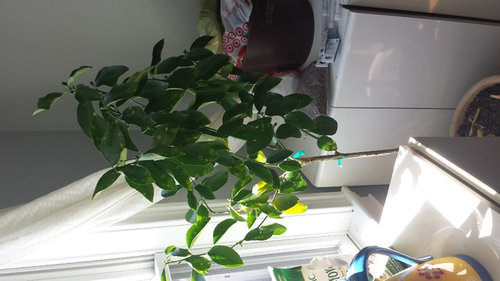
Hi -- I've read a lot of posts here and elsewhere, but I'm puzzled by my tree.

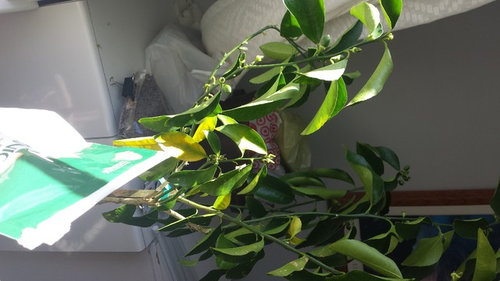
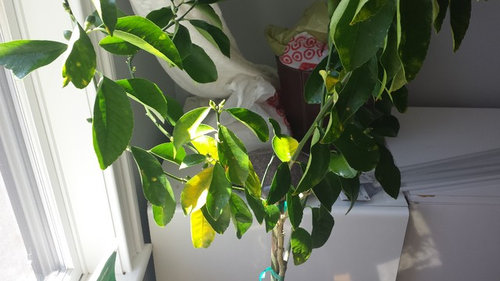
Several months ago the tree bloomed a lot, but very only a few lemons set, and they fell off. Then it bloomed A LOT and a lot of fruits has set. Since that time, the leaves have been dying. Some mottle and turn, others turn yellow from the end/central vein and fall off. I discovered it had spider mites and I washed every leaf and sprayed with neem oil. That was six weeks or more ago, and it's continuing to die. It's possible that we over fertilized it and I thought maybe boron toxicity? My wife and I have very different ideas of when it needs water. It gets well watered once a week.


Any thoughts?


Thanks

Reg

Comments (22)

  • 11 years ago

    Most of the dirt is from Pam's Fast Growing Trees, plus some addition potting soil to fill in the pot I transferred it into. In terms of watering, if I stick my finger a couple of inches in the dirt and its dry, should't I water it? Is it worse to let it go dry for a week or two or to slightly over water it?


  • 11 years ago

    Ok. Yes and no. Depends on how deep the pot it. If it is dry 2 or 3 inches down its probably ok at that point. That soil is probably going to hold way too much moisture. While you are here check out the container forum for some great soil mixes. A good one to use is what we call the 5.1.1 mix. 5 parts pine bark, 1 part perlite and 1 part peat. Thats the basic mix.

    It is for sure worse to overwater. an over dry tree can typically be saved if stressed really bad but root rot from overwatering can be a death sentence.

  • 11 years ago

    Would it be worth repotting it now with the 5.1.1 mix? I just got it last fall -- it's trunk is only a 1/2" or so and it's set a lot of fruit. Also, should be just let it get very dry and the cater spoaringly?

    Thanks for your help. You don't know how much we fretted about this and the sources I've queried!

    Reg


  • 11 years ago

    Reg

    how soon can you get it outside? what kind of temps are you having? I would probably go ahead and repot this one now.

  • 11 years ago

    Our average last frost is May 7. The 10-day forecast is for lows in the high 30s and highs in mid 50s to mid 60s. Is that warm enough? I can bring it in if a freeze threatens.

    I guess I'll go ahead and repot. Do I try to get as much dirt off the roots as possible (I assume it not a bare root transfer), or just shake what comes loose off and put it in the 5.1.1 mixture?


  • 11 years ago

    Well that is quite a long ways off. Ideally a bare root repot would be done when its much warmer. The 60's are ok but nothing below 40's is what I try and do.

    I would lift the rootball and see how wet the bottom is and how the roots look. Dark yellow to brown and you have some rot going on. Anything lighter and they should OK.

    I would still repot but not a total bareroot. Tease off some of the bottom and sides. It may start to look real bad but thats normal.

    good luck.

  • 11 years ago

    Thanks! I think I have a plan, now!


  • 11 years ago

    One last question: when I repot and look at the roots, if I see either dark yellow or brown roots, should I try to trim them back to white roots, or just plant and pray?

    Thanks so much,

    Reg

  • 11 years ago

    When you have the plant out of the pot checking the roots, put a string of yarn, old shoe lace, clean mop cord, in the drainage hole. This will help wick the perched water away from the roots until you can repot. I wouldn't do any root pruning until the repot. When you do repot remove as much of the old soil as you can from the root ball. Jack


  • 11 years ago

    Thanks, Jack. Do you mean that I put this wick in the pot when I repot or in the meantime? And are you suggesting I 'depot' the plant now and let it sit till repotting later when it's warmer (76 degrees today, wonderful!).
    Reg


  • 11 years ago

    If you don't want to re pot just stick the wick up into the drain hole it will wick the perched water away. I would never 'depot' and let it sit until repotting but you might want to depot, look at the roots, and see how they are doing and then put the tree back into the same pot. Jack


  • 11 years ago
    last modified: 11 years ago
    Yes, wicking should be done if you don't plan repotting for a while to avoid root rot by wicking the water away so it will dy out faster...

    Your watering concerns me, although you already know that any potting SOIL is not a good mix to use if you want porper areation in the root zone and or prevent salt build up that kills fine roots..The fine roots are the ones that take up moisture and if they are roted or burned, your tree will do what it is doing in a sea of plenty..

    If you plan on the wicking method, make sure you let the wick dangle...Also, once it's time for your next watering, flush that mix out with a good amount of frsh water for at least a minute or two..It should take the salt deposits with it..

    Do you water in sips? Do you water until it flows out freely from the bottom all winter? Does it get lots' of sunlight? Do you fertilize during the winter too? Can upi take a close up shot of the roots and mix too? What kind of water do you use? What kind of fertilizers? What temps is your tree exposed to on a regular basis?

    Just a bit more info will help us alot)
  • 11 years ago

    I've waited till I stuck my whole finger (I've got big hands) in and it was dry. I watered it with about two quarts of water, and it flows through fairly quickly. I have the pot up on bricks inside a large tray. I'm anxious to repot -- the root rot scares me -- so I think I'll do that in the next few days even though it's not warm enough to take outside. want to see what the roots look like. The dirt seems quite loose -- I was able to easily poke my finger in all the way.

    It is in a sought facing window that gets several hours of sunlight every day. I did rotate the tree so that it got sun on all sides. The temps never go below 58 degrees in the house, which is well insulated, and it doesn't go much above 64. There is a forced air vent under the windows a few feet from the trees, so I don't think it's roots are getting cold. I use tap water -- here in Saratoga Springs it contains lots of minerals. I use Espoma organic fertilizer, which I put on more than a month ago and was going use every four months.

    It's dropping a few small lemons although the ones that are on it are growing fairly rapidly. In the last week or so it has started blooming again. Leaves are still yellowing, not at an alarming rate, but steadily.

    I'll take some more pics when I get a look at the roots.

    Thanks!


  • 11 years ago

    Two quarts of water is not nearly enough. If this was my tree I would re pot now and just bring it inside at night if the temps go below

    40 f. I have had my Meyer lemon outdoors for a few weeks now and low 40's has been fine for it. After re pot in a fast draining mix make sure you give it lots of water then let it get almost dry before watering again. I like to soak my citrus for several hours to get the whole pot wet. Jack

  • 11 years ago

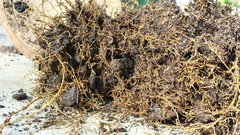
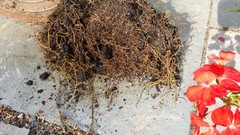
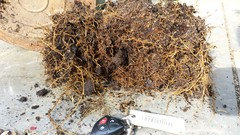
    I was taken away from all gardening for several weeks. Now I'm repotting the tree. Here are pictures of the roots. They aren't brown brown, but are sort of tanish beige. They're not white. Does this mean the tree has root rot? Almost 2 dozen baby lemons fell off, and some more leaves in the interim. Two lemons have hung on, and it has just finished flowering again, and many lemons are setting.

    A farmer at the farmer's market (who raises lemon trees) said he thought it was due to lack of cross fertilization. He doesn't raise Meyer lemons, though. These pictures were taken in the late afternoon sun without a flash.

    Any thoughts?


  • 11 years ago

    The roots actually look decent.

    Josh

  • 11 years ago

    Well, the roots look pretty good, too I wonder about the brownish section in the middle, though. How do they smell? If they smell rotten, then the roots were too wet in that section, and you've got root rot going on. If so, you can rinse the roots with a 1:20 bleach to water solution very gently, prior to re-potting. I would try to re-pot and mix up something that is well draining. You can search the forum for "gritty mix" or "511 mix" for some good indoor potting medium recipes. I would water very well so the water runs out, and I would be fertilizing with every watering. I would use a water-soluble fertilizer that has as close to a 5-1-3 NPK ratio as you can find, along with all the micronutrients. I have no idea what "cross fertilization" means. And, I would try to find a fertilizer that uses a non-urea nitrogen source. If you look at DynaGro's Foliage Pro (can be purchased online at many different sources):

    http://www.dyna-gro.com/Website%20pdf%20Files/Foliage-Pro%20Sht%202014.pdf

    And, not a bad idea to supplement your water soluble fertilizing with a time release granular product. I prefer to use Osmocote Plus (must be the "Plus" formulation to get the right NPK ratio and all the micros).

    Since you're in Florida, I think it's not a bad idea to keep your citrus inside. Just to reduce the chances of contracting Citrus Greening disease. If you can keep your tree inside, and all psyllids outside, you're safe :-) Rotating the tree is a great idea, it sounds like it's getting lots of sun, so that's great. Lastly, watch for pests such as scale and spider mite, the two big bugaboos for indoor citrus, and treat accordingly (and repeatedly), if they pop up.

    Patty S.


  • 11 years ago
    last modified: 11 years ago

    Very good advice from everyone!

    I just want to add, the fellow at the farmer's market is not quite right, most citrus don't need cross pollination to set fruit. All cross pollination does is make seeds, the seeds benefit from the pollen, but most citrus trees will set fruit without any pollen so you can grow it inside and it should develop nice fruit, as long as it gets everything else it needs. There is a word for this trait, parthenocarpic which means it can set fruit without pollen. ( See Patty I remembered this time, lol!)

    Some growers plant citrus groves way out in the country far away from any other citrus trees just so they will NOT get any cross pollination, and therefore will get seedless fruit.

    There are a few citrus that do need cross pollination, such as Clementine mandarin, but lemons do not fall in that category including Meyer lemons.

  • 11 years ago

    I've been using only Plant one every 3 months. I was told by a garden center guy that the long lasting organic was the way to go. What is the best fertilizing regime? I'm in upstate NY (Saratoga Springs ) and not in Sarasota Florida, where I guess growing lemons is more challenging.

  • 11 years ago

    Autocorrect: Plantone.

  • 11 years ago

    I'm missed reading all of Patty S's comment on my phone; now I see the fertilizing regimen and I'll find the products you mention, Patty. I'm assuming all that holds even though I'm not in Florida, but upstate NY. The soild didn't smell bad, and I repotted with the 511 mix. I also am guessing that taking the tree outside here is a good idea given my location. I've sprayed it with neem oil. I have a small plumb tree in the yard that I'm going to spray with Bt because it has a leaf eating caterpillar. Maybe I should spray the lemon tree just in case? Is Citrus Greening disease just a Florida thing, or something I need to watch up here?

    Thanks!
    Reg