Software
Houzz Logo Print
3ilovepie

Remote blower range hood?

11 years ago

We were all set to go with a VAH 3 blower - just torn between 24" or 27" deep.


Then I spoke with someone who said a hood with a remote blower would be quieter.


True?

Comments (45)

  • 11 years ago

    I have a remote (roof mounted) 1000 cfm blower, while not "quiet", I would be willing to bet it is way quieter than having that same blower motor mounted six inches above my head...

  • 11 years ago

    Comic relief appreciated.


    Was it much more complicated to install? What brand do you have? Would you rec?

  • PRO
    11 years ago

    Can you use a remote blower with a Vent a Hood ?????

  • 11 years ago
    last modified: 11 years ago

    VAH has the remote blower option, but it is not VAH any more. The baffle structure is same as others. There are maybe other popular brands for this application, likely less expensive.

  • 11 years ago

    If my kitchen and family room are one room - is this a better choice?

  • 11 years ago
    last modified: 11 years ago

    I think there are some other factors to consider. For example, if it is often like minus twenty thirty degree in the winter and snow/ice a lot, a remote blower may not be a good idea. If the duct is a short run, like venting to side wall immediately, then I would think the noise reduction is not so significant. In fact, since it would be a single motor vs three small motors , remote blower may be noisier. My dining and kitchen are completely open as well, it is quiet already just couples of feet away from the hood, although it is not noise free for sure. And no need to raise voice talking just beside the range top. I only worry about makeup air will draw too much electricity in the winter running high in the winter, but not noise. :-) I would suggest you listen to the noise at store if you have chance. VAH's sound characteristics is different from baffle/filter's, especially at high. But if you at least have no such issues mentioned above and the thing is VAH itself is not cheap, remote blower probably is better in both noise and bucks.

  • 11 years ago
    last modified: 11 years ago

    Not complicated to install, other than cutting the hole in the roof and re roofing that area.


    I had it narrowed down to Modern-Aire and Prizer, (formerly Independent), which I chose. I felt the fit and finish was just a bit better. I don't think either makes their own remotes, M-A uses Abbaka, and my Prizer blower looks strikingly identical to a Thermador VR1000. Either would be a good choice. I'm not a fan of the VAH magic lung concept, but that's just my opinion....

  • 11 years ago
    last modified: 11 years ago

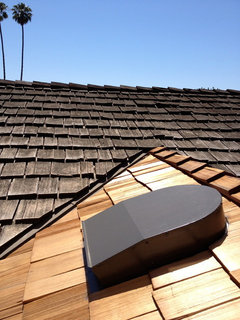
    VAH use a blower to perform two functions, so their blowers have to be integrated with the hood. Other hoods with baffles or mesh filters can work quite well with a rooftop blower. This type of blower is intended to fit on the roof nestled in the shingle array. Any competent carpenter or roofer or likely handyman could deal with this. Then it is a matter of running ducting that you would need anyway. If you want reduced fan noise, add a silencer into the path. (See Fantech.)

    Dominant blower noise is fan tip turbulence, and three VAH blowers can generate a lot compared to a larger slower fan that will easily fit on a roof but not so easily in a hood.

    kas

  • 11 years ago

    What I find most troublesome about all of this is that I have no idea what either really sounds like. Im less concerned about the visuals - more about function and noise.

    Ive done some preliminary pricing - and neither the remote blower option or VAH are a deal. Both start at 2-3K.

    Our builder has worked with remote blowers - so install is not a deciding factor either.

    So we are back to function. The options are VAH 3 blower (900 cfm - but they swear its equal to 1200 cfm) or a 1200 cf. remote blower that will go up a few feet and then outside (our ceilings are 10 feet - so it is not a huge run - but something). Other useful information - placement is in the room that we will be in most (tv, eat, read, play). We live in Toronto, so its cold - does that really impact function that much?


  • 11 years ago

    I would go with a remote blower - much more quiet. All you have to do is clean the baffles. IMO, the VAH is crap.

    Someone spoke about ice and snow. I live in Minnesota, I've had remote exhausters since 1980. Several times they had a slight ice problem. All you need to do is start cooking, or boil some water - and the rising heat will melt any ice.

  • 11 years ago

    Geoffrey, what brand do you have?

    I just saw Broan - it has 1500cfm and Wolf - it has 1200 cfm (and a lot more$$).

    I like the variable settings dial - so that we can adjust as required.

    Thoughts? Other options?

  • 11 years ago

    I have a hood that came packaged with my Wolf gas range. So I don't know the make.

    When you select the hood you want, just make sure the exhauster will work with the speed control that comes with the hood (most will).

    A good HVAC dealer should be able to install the exhauster on the roof and run duct work to the hood.

    Grease baffles are the way to go. I clean them twice a year - just put them in the dishwasher. Those squirrel cage fans and filters are a mess.

  • 11 years ago

    There has been a lot to take in - always great to read about what others have done - picture are a bonus.

    We are looking at getting an Abbaka remote blower. We need to speak to the HVAC guy - but wondering if 1500 cf. is too much. Also wondering who sells hoods with baffles and variable speeds.

  • 11 years ago

    Assume that with all the pressure losses (baffles, transitions, silencer if used, duct walls and turns, MUA path back into house) the 1500 cfm fan will actually pull 900 cfm. This is sufficient for 10 square feet of hood aperture (baffle area), or the aperture area of the largest of Wolf's Pro Island hoods.

    kas

  • 11 years ago

    kaseki, its always a lesson for me when you join a discussion.

    Interesting.... the individual who I will be purchasing the unit from (in Canada - and referred to by Trevor Lawson) said that if we use a 45 degree elbow a bit of a run and a 45 degree elbow that there would not be a lot of loss and the power of a 1500cfm would be a lot for our needs. I reiterated that the CC has a lot of BTU's and he kept ensuring me it was too much - particularly if we are not going to have a long run or 90 degree turn. He assures me 1000 cf. will not lose power....He builds gorgeous hoods - but I will discuss with HVAC guy and our contractor.

    We are not sure about the silencer (more a budget issue at this point). The MUA is still tbd. We have a HRV unit in the plans and need to figure out from the HVAC person what else we will need - and the best way to ensure pressure and airflow are optimal.


  • 11 years ago

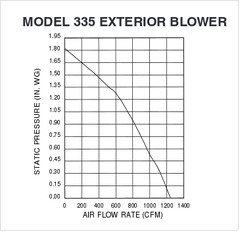
    All real relevant blowers lose flow rate with pressure drop. (Rootes superchargers and piston air compressors maybe less so.) Large ducts with a few bends are not the greatest cause of pressure drop in the loop from cooktop to outside and back inside, although they count. With many windows wide open, the greatest cause is likely to be the baffles at their design flow rate (whatever that is; don't expect real performance data from residential equipment makers). I think a couple or so tenths of an inch, w.c., is a plausible pressure loss.

    Next is the loss from the irregular transitions in the hood. With only one screened window partly open, you will have a tenth or two at the window. Windows closed up and depending on house leakage will likely cause several tenths, more if a tight house. A large MUA duct will have a slight loss, but with a filter the loss will be significant.

    In the image below taken from Broan's data, one may see that an inch of pressure drop cuts flow to 2/3. This is an example of why I use a 2/3 factor in blower cfm derating; one has to guess at the pressure losses. So aperture area times 90 cfm should be enough for actual flow rate, then multiply by 1.5 to pick the blower. Erring on the high side is not a problem; if you go overly large, you can run at a lower power level even for wokking or grilling and have lower blade-tip turbulence noise. Possibly a silencer will not be needed for normal conversation at full capture of hot effluent.

    Blowers and hoods will be sized for particular duct diameters, so some compatibility in selection is recommended.

    Caution: A mere filter in an MUA duct may be enough to drop the house interior pressure to below -0.03 inches, thereby risking back-drafting combustion appliances (if any). This can be avoided by giving the appliances their own MUA path, or adding the complexity of blower powered MUA. It is hard, though, to provide separate MUA to a fireplace.

    kas


  • 11 years ago

    I've had a Vent-A-Hood, a Best By Broan, and A Zephyr. Two of them were remote blowers. They were all loud. They all did the job. They were all good.

    What I didn't like about the one of the remote systems was a constant flapping of the vent cover in a moderate to high wind.

    Which one would I buy again? The Vent-A-Hood.

  • 11 years ago
    last modified: 11 years ago

    3lovepie,

    Informative post.

    Given I am close to Toronto too, can you let me know where you are planning to buy your hood from (referred to you by Trevor Lawson)? We had planned on getting a middle of the road hood with baffles from the site linked below. We priced out Modernaire and it was too steep for us. Still undecided where to get the hood from. We too are debating the need for a remote blower system.

    I have not heard much about silencers. Can anyone elaborate about silencers?

    Canadian vent hood supplier

    hood we were considering

    Carol

  • 11 years ago

    Carol, the supplier we were referred to is steep too... can only manage getting a remote blower (Abbaka) from them ( Allan @ http://www.customrangehoods.ca). If you want a VAH - we got a great quote from our appliance guy. Let me know if you want that.


    Homechef59, great to have input from an individual who has experience with multiple units. Do you mind if I ask about your set up (range type, room size/function, cfms).


  • 11 years ago

    Oh, we talked to Allan too. We got our quote for a Modernaire hood from him. He is knowledgeable, but his price was too steep for us. Is Allen the only one that will sell the remote blower from Abbaka to you in our area? Can you call Abbaka directly and ship one to one of the cross border mailboxes you can set up? We do that a few times of year. There is one in Niagara Falls NY that we ship to.

    I have read mixed reviews on the VAH (mostly bad) on this forum so we don't have the VAH on our short list. Not sure what one is to do about make-up air (DH is doing lots of the house build DIY so this is on our list to explore). We too will have a HRV (whole house with zones in key rooms). I plan to email the HVAC designer we used (he was separate from the installer) to check on make-up air in our climate and with our level of air tight home.

    I will follow along on your thread -- thanks for starting it.

    Carol

  • 11 years ago
    last modified: 11 years ago

    The only silencers I know about are made by Fantech. They are sized for different duct sizes. I have the 10-inch model; it is about 14 inches in diameter by 3 feet long. Internally it has a porous sleeve. Functionally it removes the higher frequency range of sound, which is where the turbulence noise of fan blades is dominant. It has no effect on baffle noise, of course. You will also need duct clamps for the ends. I don't recall the pressure loss value from a conversation with Fantech, but I believe it was a pretty small. A link to their 10-inch silencer is below:

    Note Fantech is at Fantech.net

    kas

  • 11 years ago

    Thank you kas for the info on silencers. What are the downsides to using a silencer? You mentioned above the issue of pressure loss. How will pressure loss impact the effectiveness of the fan (do you get a strong cfm fan to compensate?) A silencer seems like such a good way to go to keep the fan noise at bay in open concept houses. What is the catch and why would one install a remote blower instead of a silencer?

    Carol

  • 11 years ago

    Am I mistaken in thinking the remote blower can go on the side of the house? Our contractor said that's where he has usually installed the outside unit (as opposed to roof).

  • 11 years ago

    Thanks Kas for your clear explanation.

    Carol

  • 11 years ago

    Yes, a remote blower can be mounted on an exterior side wall. I have mounted a few that way over the years. Keep in mind they are fairly large, and not too attractive, so an inconspicuous location would be advisable. Also take into consideration any prevailing breeze you might have so that the smoke goes away from the house, and not back in an open window or courtyard.

  • 11 years ago
    last modified: 11 years ago

    How long is the duct run? If the duct is vented almost like just behind the hood like in my place, I doubt you will get much noise reduction by using an remote blower and there is no space for a silencer. I would not risk the roof by putting the remote blower there as it is potentially a heat source.

  • 11 years ago

    Can it be a horizontal run?

  • 11 years ago
    last modified: 11 years ago

    I think it can run in and along the bulkhead. You need ask the contactor how he will run the duct. The drop of the bulkhead is around 12 inch, and the duct for this amount of CFM would be 10 inch. So if the bulkhead is already there, the duct may or may not be able to share the space with other pipes in the bulkhead.

  • 11 years ago

    eshmh wrote: "I would not risk the roof by putting the remote blower there as it is potentially a heat source."

    I'm unclear what the perceived issue is here. Exterior blowers such as Broan (and Wolf) and Abbaka are designed to operate safely installed in the roof of a wooden framed house roof. And all of the upblast and downblast blowers used in more professional isntallations will be even more isolated. In general, the blower motor is in the airstream and self cooled. Unless there is a duct grease fire (difficult to start past the baffles), the air temperature being moved past the roof is only modestly warmer than household air. Is the roof thatched?

    kas


  • 11 years ago

    Kas, here, the attic's temperature can be -20 to -30C in the winter. Even the room temperature is hot for attic. The idea is that during the winter, the ice and snow on the roof should never accidently melt in a local area so that ice dam would not be created. When I put my hand to the intake of the hood, the air moved is actually feels pretty hot, especially when I wok or evaporating sauce. As 3iloveipie said, we usually vent to a side wall instead of roof here. I am no expert, but I think what I said above could be a reason.

  • 11 years ago

    CooknCarpenter - Did that roof duct cover come with the hood or is it from the same company (Prizer)? I didn't see it on the website but I like the aesthetics much better than the one I currently have going in my new build. Please let me know when you get a chance. Thanks

    Andrew

  • 11 years ago

    Ah. so. An ice dam countermeasure. Another dimension added to the many affecting hood ventilation design. Good catch.

    Although much of the path from the blower exhaust down the roof will be cleared of snow (at least mine was), an ice dam is possible. Where risk of an ice dam causing a problem is high, I would go for a similar flow rate blower in an upblast housing. (These will be mini versions of those one might see on the roof of a restaurant.) They are manufactured by companies such as Greenheck. Motor selection should be an induction motor capable of being controlled by the typical simple variable controllers (diac/triac) found on hoods. Upblast blowers are typically mounted on "pedestals" fabricated for the roof slopes they will be mounted on. Pedestal height is also a selection variable, and at the cost of obtrusiveness, can rise above any likely snow pack.

    I think you will hear motor droning when mounted to a wall. If the fan blade assembly were balanced by an engine balancer, this might be reduced. Still, vibration isolation in such cases would be difficult.

    kas


  • 11 years ago
    last modified: 11 years ago

    @ Andrew K... yes, that is a Prizer remote blower, but as I said, not sure if they make their own or farm them out, as it does look exactly like the many Thermadors' I've installed.

    Google "Thermador VR1000", and see if you don't agree...

  • 11 years ago

    Any ideas (other than wolf and modernaire) on who makes a wall mount hood with baffles and variable settings? I've spoken with Abbaka, but they weren't sure who else made compatible hoods.

  • 11 years ago

    The site I linked above has some with baffles. Not sure on the quality as we have not ordered ours yet - but the prices are not as high as Modernaire. They are a Canadian supplier. We are getting ours coated a grey/blue colour locally (and keeping the stainless bands for contrast).

    Carol

  • 11 years ago

    Carol, are you planning on using a remote blower with a hood from that site? You need to be sure of variable setting - it must be a hood you can "tune" to the speed you want. Let me know if you know anyone who has purchased from the site - would be nice to know what the quality is on these.

    I've found that Brigade and Broan have options that have variable setting knobs, baffles and are shells (ready for remote blower). Broan is about 1300 CDN and Brigade about 2100 CDN.


    Kas

  • 11 years ago

    Our current plan is to not do a remote blower and deal witht the extra noise. Even Allen (who sells Modernaire) did not think we needed a remote blower in our situation. I wish I could remember who on this forum suggested that site for hoods. I can't remember if they had purchased one from the site or were just considering purchasing one. I might need to be the guinea pig on that hood and report back. I hope it will be good enough quality.

    I will search and see if I can find some ratings on the hood supplier I posted.

    Carol

  • 11 years ago

    3ilovepie, you said your dinning and kitchen are in the same room. What does it mean? Do you refer to literally both in a room or just open concept? I had my VAH at full 900 CFM this evening, pan frying fish sounds louder than the hood. Have you actually listened to VAH's sound? In case of not, you can go to Caplan's to try it. They should have a live 2-blower model at the time I bought mine. 3-blower one sounds same or even slightly quieter than the 2-blower. IMO, cleaning is not really an issue. I don't even need a dishwasher to clean the dripping trays once a while.

  • 11 years ago

    I found some HomeStar ratings on the Canadian vent supplier I linked above. I have no personal knowledge of the product and company, and certainly no affiliation. If the ratings are legit, many past customers seem happy.

    Carol

    Homestars ratings


  • 11 years ago
    last modified: 11 years ago

    Eshmh, our home wll be open concept - kitchen is combined with eating area and family room.

  • 11 years ago

    Carol check out the article about homestars....reviews-on-homestars

  • 11 years ago

    That's the same as what we have. Ours is an L shape. The kitchen and the family are at the two ends and the dining at the corner. There is nothing separating the function areas. The noise can be heard, but it does not bother us at all in any room. I wish I had a chance to experience the remote blower option. :-)

  • 11 years ago

    I've never had "open" concept before. My DH is very sensitive to high pitch humming - we are hoping putting the blower outside will help some of this (and a silencer).


    We've not heard a remote or VAH. I will go to Caplans.

  • 11 years ago

    Yes. You then at least know one of the options for sure. Caplans obviously also have live "normal" hood fans. When I compared them there, the difference is very noticeable, especially at full speed.