Software
Houzz Logo Print
hokie98

Suggestions for increasing P, decreasing K

11 years ago
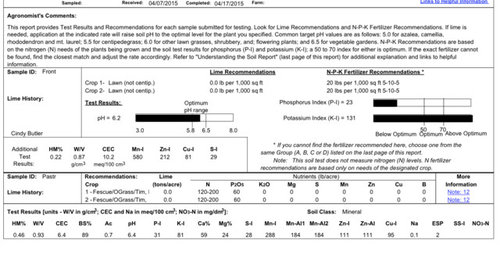
We bought our property about 18 months ago, and the previously owner didn't seem to high on yard work. We're not obsessive about our lawn, but would like it healthy. Candidly, I don't mind a weed here or there, but the crabgrass, etc., I can live without. Last fall we aerated and threw down some seed and some basic fertilizer recommended by a local gardening center. We probably put the cart before the horse, but I sent off a soil sample a few weeks ago and just to the results back (we're in the piedmont of NC, so the results went to NCSU). Here are our results. I've asked our local extension agent if I understand this correctly. Looks like we're deficient in phosphorus and have excessive amounts of potassium, but our pH is good. (BTW, I'm most concerned with the 'Front' sample, the 'Pastr' sample is an unused field to our rear). They recommend a 5-10-5 fertilizer but do I really want to add more potassium, or is that not really a big deal? Another other recommendations?


Comments (10)

  • 11 years ago
    last modified: 11 years ago

    That's a bit of a switch! Typically most soils have adequate levels of P, unless they were previously heavily farmed and it is often K that is in short supply. Additional N is pretty much a given for any soil. Nonetheless, that fertilizer recommendation seems reasonable. I wouldn't be overly concerned about the excess K - potassium is mobile in plants and can be taken up in quantities greater
    than needed for optimal growth. It's referred to as "luxury consumption". Plant available potassium is constantly changing in the soil and is
    dependent on many factors which are interconnected so the levels reflected in the lab analysis may not be the same if tested next week or next month.

    Just a caution about the additions of P. Phosphorus high ferts have been determined to be a major pollutant of groundwater, streams and rivers and their application has been restricted in a number of states (Illinois, Maine, Maryland, Michigan, Minnesota, New Jersey, New York, Vermont, Virginia, Washington, and Wisconsin.) Scotts has peremptorily removed P from all its lawn fertilizer products as a result. But even those states where it is restricted or in some cases, banned, its application is still permitted with soils that test deficient.

  • 11 years ago

    Thanks! I sent my extension agent the report, and since I posted this question, she's replied. She's a little confused at the results because even though it was 2 different samples for 2 different sample areas (our front lawn) and a rear pasture/field, which borders a river, it seems to be a condensed report. I have asked her if maybe I should send them 2 different samples (NOT mailed in the same mailing box) because I'm expecting the results would differ (the front lawn soil being much more clay than the pasture). I agree with your comments regarding P. I am cautious about it, especially since we live next to a river. I want to be a good steward of the land. So to that point, I don't want to needlessly add P to specifically our front lawn if I really don't need it. With our clay soil, I'm a little surprised our pH is as high as it is, but perhaps that's because they did indeed combine my samples.


  • 11 years ago

    Just use superphosphate and urea, and amend with fall leaves, which have relatively low nutrient content.

  • 11 years ago

    What glib said. Also, bone meal is another way to get P into the soil. It's a low solubility form so it takes awhile for it to work, but it will not run off like soluble P. We used bone meal on our clay when our dwarf fruit trees didn't bloom and it worked. If you have clay soil, P sticks pretty well and you won't have to add it forever like you might with N. In fact, you can overshoot, so you'll want to test again after several years of moderate additions to see where you're at.


  • 11 years ago
    last modified: 11 years ago

    Thanks all. Per my ext agent's recommendations, I called the Agro lab and the results are not combined as the ext agent thought (they just look different b/c the lawn results are in a homeowner-friendly format and the pasture/field results are in a farmer-friendly format). But yes, we do have clay soil, so we'll give it a try. I'm guessing no one has done much with this yard in at least 10 years.

  • 11 years ago

    Why would you put leaves on a lawn? Amending bare soil, yes. Or using as a mulch on planting beds. Even using ground leaves on a lawn is not very productive unless you have aerated first. All they do is smother the grass unless you can get them down into the root zone.

    I'd also have reservations about using a superphosphate. When you apply soluble phosphorus fertilizers, such as super phosphate, to
    the soil, chemical reactions cause this readily available phosphorus to
    revert to forms that are not available to growing plants. This is called fixation. This means
    the benefit of phosphorus fertilizer decreases steadily after
    application. Consequently, you need to apply phosphorus fertilizers at the proper
    time and during certain seasons to minimize losses caused by fixation. This is also the type of phosphorus product that directly relates to leaching and water pollution. I'd opt for a lower concentrate or preferably, an organic source like the bone meal.


  • 11 years ago

    Consider 16-20-0 which also has about 10 - 15% sulfur if I remember correctly. It's my preferred rose fertilizer.


  • 11 years ago

    Regarding leaves on the lawn; I have both, mowed leaves into the grass in the fall, and shredded leaves in a chipper/shredder and spread them on the grass under an oak tree. In both situations, the leaves were completely gone by spring and the grass was visibly healthier and greener than the surrounding area. I have heard that earthworks are the culprits. :)

  • 11 years ago

    Wow, thanks kimmq, I'll try what you recommended!! The second half of the sample report (labeled "pastr") is what borders the river. It has been previously used as a horse pasture, and we hoped to do the same, but with the flood plain being there, we can't find a good place to build a barn outside of the floodplain. So I don't think we'll be able to use it as we intended, therefore, all that field may do is grow grass. In light of that, I'm not really too interest in amending the soil there since it seems to be doing pretty well - the grass is very green and knee high right now on that piece of our property. It's the "front" area that I'd like some help with, and I don't disagree at all that it probably needs some heavy compost/organic matter. The grass is very sparse, which of course means there are plenty of weeds. It's about a 2+ acre area. I may have to hit up some of my horse friends for compost...

    But thanks again, you were WAY more helpful than my extension agent, who basically just said "go buy the 5-10-5 or similar" that was recommended!!