Software
Houzz Logo Print
aruzinsky

Failed LED Strip Lighting Experiment

11 years ago
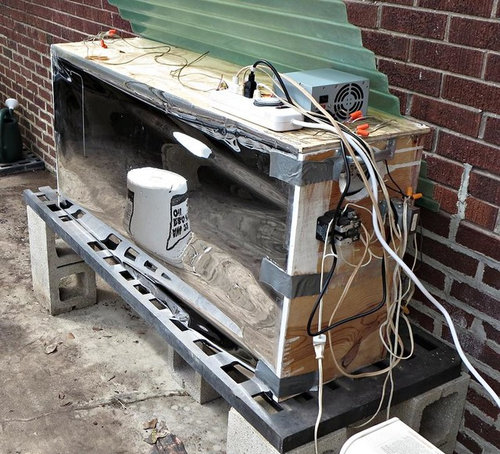
The goal of this experiment was to determine whether 140 watts of red and blue LED strip lighting could be used to grow tomato seedlings to a practical advantage. I previously proved that 200 watts of T12 fluorescent grew shorter and stockier plants than the natural sunlight in my greenhouse, see http://forums.gardenweb.com/discussions/2005610/how-to-easily-supplement-fluorescent-with-incandescent-light, therefore greenhouse grown plants were used as controls.
I purchased the following:

http://www.vozop.com/index.php/5m-300leds-plant-growing-led-strip-red-blue-5-1-grow-plants-light.html

and

http://www.vozop.com/index.php/led-strip/smd-5050-led-strip/5-meters-300-leds-light-strip/smd-5050-led-ribbon-12v-waterproof-16-4-feet-300-leds-red-light.html

Note the "2400 lumens" rating for the red strip. In retrospect, I should have bought the cool white version which is rated "780-890 LM/W" for a total of 11,232 to 12,816 lumens.

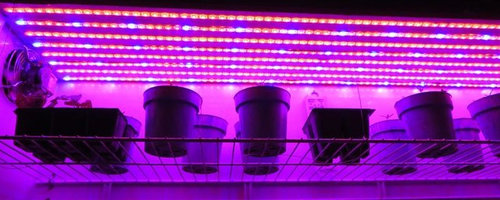
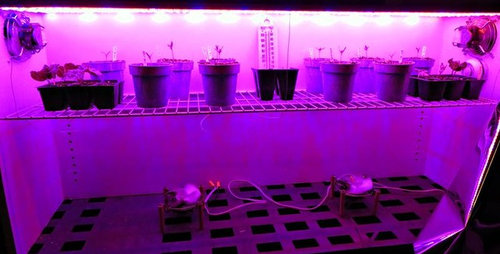
As soon as I applied electricity to the strips, I strongly suspected that the strips were too dim. Furthermore, the red LEDs in the "plant grow" strip were exactly the same as the red LEDs in the all red strip even though I paid much more for the red and blue strip. Furthermore, the oringe tinge of the red LEDs suggested a peak wavelenth of 620 nm. Also, as can be seen in the images below, the blue LEDs appear brighter than the red LEDs. Nevertheless, I proceeded with this farce. I cut the strips into 48 inch pieces and mounted them on a board that rests on top of my growth chamber. I used an old, obsolete computer power supply that is rated 12 amperes at 12 volts. Tomato seedlings that were planted on 3/30/15 and grown in the greenhouse were transfered to the growth chamber on 4/13/15.

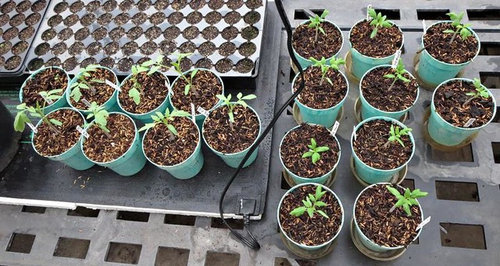
On 4/20/15, it was evident that the LED grown seedlings were much worse than the ones grown in the greenhouse. In the photo below, the LED grown tomato seedlings are the group to the right.

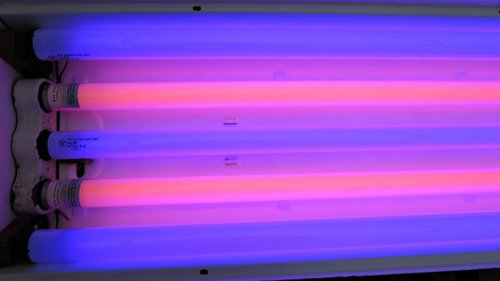
Believe me, the LED grown plants look much worse in person. To save these plants for planting into the garden, I replaced the LED board on top of my growth chamber with these fluorescents:


Normally, I use 3 red and 2 blue, but, I'll see whether anything can be learned with 3 blue and 2 red. Incidentally, in case you are curious, the red bulbs were custom made with a single phosphor peaking at 620 nm and the blue bulbs were made and sold to treat jaundiced babies.

Also, to continue my LED strip lighting experiments, I ordered Warm White (2800K to 3500K), White (5500K to 6500K), Cold White (7000K to 8000K), Red and Blue versions of the following LED strips:

http://www.vozop.com/index.php/led-strip/5630-led-strip/smd-5630-led-strip-light-12v-60leds-m-ribbon-lighting-tape.html

Note that the "21000 lumens" per "92 Watts" gives 228 lumens/watt. For comparison, Sylvania Skywhite T8 fluorescent bulbs are 2700/32 = 84 lumens/watt. Thus, the manufacturer's specifications for the LED strips seem too good to be true. Thus, the next experiment will also determine the morality of the Chinese manufacturer.

Comments (12)

  • 11 years ago

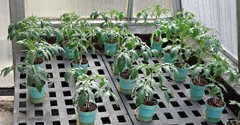
    These are photos taken on 5/5/2015 after I removed the plants from my fluorescent light growth chamber on the previous day:

    The right row were the daylight controls; the rest are from the growth chamber. Incidentally, the polycarbonate panels on the right are new whereas the ones reported at http://forums.gardenweb.com/discussions/2005610/how-to-easily-supplement-fluorescent-with-incandescent-light were about 25 years old, i.e., I now have more daylight. The only variety with the curled up leaves is New Girl from the growth chamber. The daylight grown New Girl are without curled leaves and are the tallest in the right row. Otherwise, the varieties are Big Zac, Better Boy and Best Boy.

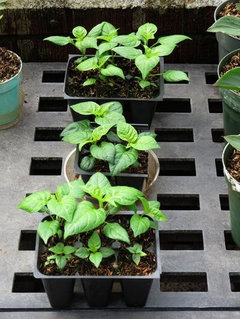
    The above are Carolina Reaper Pepper seedlings. Only the middle tray is from the growth chamber.

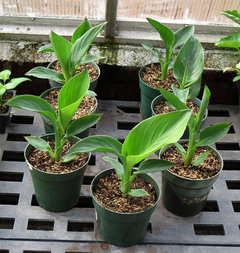
    The above are Canna South Pacific Scarlet seedlings. Only the closest three are from the growth chamber.

    My only conclusion is that I was able to salvage the plants from the failed LED strip lighting experiment.

  • 10 years ago

    Using PC power supply(especialy old one) for any LEDs is fattal error. Efficiency of LEDs drops resolutely- can be only few % of the values of luminious flux. Test voltage by potentiometr. Redo by serius stabil LED power supply 180W min.


  • 10 years ago
    last modified: 10 years ago

    kotbogomot, you are wrong in so many ways.

    "potentiometr" is not for testing voltages; a potentiometer is a mechanically variable resistor. Before starting this thread, I tested the voltages using a digital multimeter.

    Just now, I checked the ratings of my old computer power supply and it is 16A at 12V or 192 watts whereas the current requirements for all of the strips are less than 12A. Also, before starting this thread, I connected just one 48" strip to the PC power supply and another power supply and the resulting brightnesses of the individual strip was the same as when operated in parallel to all the other strips.

    The fundamental problem of today's LED strip lighting is that the strips incorporate current limiting resistors that severely waste electric power. That may change in the future, if manufacturers can inexpensively incorporate current limiting transistor circuitry onto the strips. But, right now, these strips are only good for decoration.

  • 10 years ago

    Ok. Iam not good in english, srry. But i had same problem and now with new power supply iam doing pretty well. Its voltmetr :) one archaic : http://www.wikiskripta.eu/index.php/M%C4%9B%C5%99en%C3%AD_nap%C4%9Bt%C3%AD

    U have to check voltage under load. Iam using 5630 chips and voltage drop under load was neraly 3V(9,2V) at the end of 1m strip(60pcs) with PC power supply.

    Also checking brightness on blue and red color by eyes is inadequate. Only way is to check volatge on various places under load- everywhere should be 12V or by luxmetr.

    PC power supply is not good for 12V stabil current consumption. 12V is not main branch of PC power supply and is restricted often.

    Further more -not waterproof strips are better(luminious flux,durability) and also quality of LED chips may be diffrent.

    Mayby you are unlucky with quality of yours chips. But it realy works in my case.


  • 10 years ago

    Exactly what brand and model of LED strip lights did you buy and what did you compare it with? Why don't you post your own thread and give all of the details like I did?

    In my case, the brightness to my eyes and the plant growth results from 140 watts of LED strip lighting were much, much less, maybe, 90% less, than from 200 watts of red and blue fluorescent lighting.

  • 10 years ago

    "voltage drop under load was neraly 3V(9,2V) at the end of 1m strip(60pcs)"

    I forgot to mention that you are supposed to connect the power supply to both ends of the strip sections (like I did). That way, there are no voltage drops at the ends but, instead, half of what you measured at the middle of the strip. I mention this because it is not too late for you to correct this mistake.

  • 10 years ago

    This post gets very interesting,enjoy reading this kind of product development.

  • 10 years ago

    I was at Best-buy and they have powersupplies for pc's 400 watt for $29.00

  • 10 years ago
    last modified: 10 years ago

    I think you can get 12v, 24V and even 48V power supplies at Ebay for a good price too see link

    http://www.ebay.com/sch/i.html?_from=R40&_sacat=0&LH_BIN=1&_nkw=Switch%20Power%20Supply%20Driver%20adapter%20AC110%7E220V%20TO%20DC%205V%2012V%2024V%2048V&rt=nc&LH_FS=1&_trksid=p2045573.m1684

    Working together with adjustable up or down convertors you can build a nice setup.

  • 9 years ago

    This really helped me out! I was totally about to start running my led strips near my house plants at night to give them some extra light in the apartment since I like to keep my sun shades down.... Good to know that it probably wouldn't be worth the extra electricity.

  • 9 years ago

    I'll throw in my own two cents here.

    For starting seeds, I use T8 strips. I have 4 tube fixtures above each of my seed starting shelves, and I use 2 cool white (~4100K), 1 warm white (2700K-3000K and 1 daylight (6500K) in each fixture. I don't have pictures, but my seed starts under these lights look about the same as seedlings started in full sunlight. Seedlings need a much more balanced spectrum of light, and conventional white lamps seem to very work well for sprouting seedlings and in the early stages of growth.

    The red/blue lights are often misunderstood, and most of the ones on the market have a "mix" that is tailored for growing "medical flowers" from established plants. In that environment, blooms = $$$$, so those lights are made to stimulate blooming with a lot of red light. You don't want to stimulate seedlings to bloom immediately, so red light is not what you really want to put on seedling starts.

    Looking at aruzinsky's setup, I see 11:1 red:blue. That's really pushing it even for established plants, and not what seedlings really need at all.

    For established tomato and pepper plants, the red/blue (3:1 or maybe 4:1 red:blue) LED "grow lights" work great. You'll get prolific production from those lights as they really stimulate blooming and fruiting. Just be sure you're fertilizing regimen is adequate for the production you're demanding from the plants. Using the LED "grow lights," I got more cherry and Roma tomatoes per plant from my "basement tomatoes" last winter than from the plants in my garden over the summer.

    There are some kinds of plants (leafy herbs like basil and cilantro, and woody herbs like sage and rosemary) that you don't want to stimulate to bloom. Those plants benefit from a lot more blue light after they are established. Blue light stimulates leafy growth. The "blurple" LED strips or lights with 3:1 or more red:blue LED's will make cilantro and basil bolt and bloom quickly, without producing much tasty foliage. I'll be experimenting this coming winter with all blue or blue/white(/deep red) LED lighting for my leafy and woody herbs. This comes after a year of failure using the red/blue lights with a high red:blue ratio last year. I had some of my woody herbs die from lack of (proper) light, and my leafy herbs bolted/bloomed early and failed to produce much foliage with the very red "LED grow lights."

Sponsored