

Soil Test Results
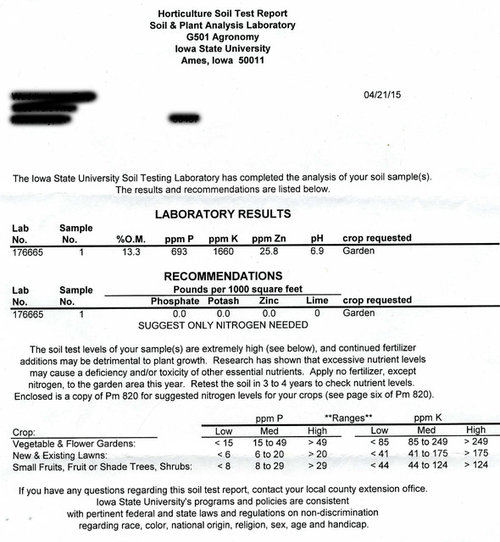
I've been gardening for many years and have never bothered to have a soil analysis done until this year (on a whim, basically). I make a lot of compost and spread it around pretty liberally on my garden that's roughly 3000 square feet. The compost is a mix of whatever I can come up with: weeds, old hay, pig manure/bedding, wood chips, corn stalks, dead livestock, etc. As you can see in the soil test results below, my numbers appear to be off the charts. Phosphorous is 14x higher that what they consider "high," and potassium is almost 7x higher. Are these tests skewed in some way because their tests are designed with chemical fertilizers in mind? If they were testing soil with more natural amendments in mind would the baselines be higher?
I guess I'm more curious than anything, as I've been gardening this way for over 10 years and it's always worked for me. Just a little surprised by how high the numbers came back. Thanks.
Comments (32)
 11 years ago
I think it is pretty typical, gardeners tend to put on a lot of fertilizer one way or another. I sampled my garden a couple of years ago with similar results. Plants are happy and will grow at their full potential as long as nothing is limited, and all your test is saying is that nothing they measured was limiting. Note that there is a lot they didn't measure. The upper limits are mostly economic; they are based on response curves, and economically there is no reason to go above them because farmers will not get enough return on the added expense to justify it. And possibly there might be environmental considerations. However from a gardeners perspective neither of these are much of a consideration; we work on a different economic scale and generally do not cause a lot of erosion. So I would say carry on with what you are doing.
 11 years ago
I agree pretty much with fertilizersalesman. Most of the testers seem to have farm economics as a baseline. The best of soils may be over the top some.
Related Professionals
Indianapolis Landscape Architects & Landscape Designers · California Landscape Architects & Landscape Designers · Providence Landscape Architects & Landscape Designers · Santa Barbara Landscape Architects & Landscape Designers · Amherstburg Landscape Architects & Landscape Designers · Tuscaloosa Landscape Contractors · Kansas City Landscape Contractors · Syracuse Landscape Contractors · San Diego Landscape Contractors · Amherstburg Landscape Contractors · Madison Stone, Pavers & Concrete · Hilton Head Island Stone, Pavers & Concrete · Lawrence Stone, Pavers & Concrete · Niles Stone, Pavers & Concrete · Eugene Stone, Pavers & Concrete 11 years agolast modified: 11 years ago
There is an optimum range for specific plant nutrients, usually based on what you are growing (some plants pull more nutrients from the soil than others, like harvestable crops). Depending on the specific nutrient, more than optimum levels is not necessarily a bad thing. It just means there is no need to add more.
The high P levels is most likely due the volume of compost used and its source - animal manures tend to be pretty high in P. And since P is not very mobile, this builds up over time. Your OM levels are pretty high as well, confirming than you are applying more compost than is necessary or useful. You should shoot for around 5%.
K levels are variable based on the time of year. If this test was done recently, that would explain it. K is highest in early spring, usually peaking around March.
edited to add: soil testing has nothing to do with whether or not you are using a lot of fertilizers, whether you are using a lot of organic amendments or whether you are a farmer or a home gardener with just an ornamental landscape. They are all testing the same things and the low/optimum/excessive levels are all the same with slight variations for the type of crop/plant intended.
- 11 years ago
ditto above info.
To echo what the test results say, you only need to add nitrogen. - 11 years ago
In my case, I added only compost (but lots of it) to a site that had 7ppm P at the beginning. Two years later, P was above optimum. Now I add only leaves and urea, and trees here (I think) will not leave P in the leaves because it is so scarce in the soil, but surely I have increased P and K.
Really, any site except extremely sandy locations, it is two applications of compost or manure, then urea forever.
- 11 years ago
What are the other nutrient levels? Is part of the test missing? The ratios of nutrients are more important than anything. What methods did they use to come up with these numbers? The various methods will always change the numbers and you seem to be missing quite a few of the numbers of importance. There is also no mention of base saturation percentages but there is a category for recommended lime. This is a very antiquated test.
- 11 years ago
The amount of organic matter (13.3 percent) is quite high which helps explain why the P and K are high, but they appear to be in balance and balance is what you want. An optimal level of OM in soils is 6 to 8 percent so I'd not add more for a while except as mulch.
Keep in mind that a soil test is a guide, one of many tools to use to help us grow better crops.
Have you talked with your county horticulturist about these results?
kimmq is kimmsr
- 11 years ago
Well, at least you can slack off on the gathering and composting of organic matter, and spend a little more time on something else. :-] It happens to a lot of us. I've cut back on my composting and compost additions for the exact same reason - P and K. Fortunately I just bought 16A of woods with terrible clay and my DW wants to start gardens there, so I have an outlet for my composting addiction. Maybe you can adopt a flower bed in a park or boulevard.
- 11 years ago
3000 square feet is a good sized garden, for me it is anyway.
A couple Q's -
Did you sample in more than one spot?
How far down into the soil did you sample? Or scrape off the top layer?
Did you mix samples from different spots or just the one spot?
Maybe you should bag 'n sell your compost? boojix2
Original Author11 years agolast modified: 11 years agoThanks everyone for the info.
Yes, I took samples from 10 or so beds that I mixed together when I was done. I have an actual soil probe that I found in a cornfield, and I used it to get a sample of soil from the surface all the way down to maybe 4 or 5 inches.
It did seem like there should have been a lot of other levels measured in the test, but this was all the info I got. It was pretty cheap, and I really only did it out of curiosity (and to make sure I wasn't severely lacking in something), so whatever.
For several years my garden has been getting the brunt of the compost. I guess with this info I can feel better about spreading it around onto some otherwise lower-priority places.
- 11 years ago
This is an explanation of what the soil testing lab at Iowa State University tests for, it always helps to understand what it is you are paying for. That lab will do other, more comprehensive, test if you wish and want to pay for.
One test, once, is a measure of the soil at one point in time. To be useful there needs to be several tests to show trends.
kimmq is kimmsr
- 11 years ago
Soilhugger,
Mehlich3 with Bray1P is antiquated now?
(Here's a hint. Every number that is determined is not necessarily reported. Can you think of any reasons why that might be?) - 11 years ago
"The ratios of nutrients are more important than anything. ... There is also no mention of base saturation percentages ... This is a very antiquated test."
Actually, it is the saturation percentage concept that is antiquated. After extensive testing, it has been discarded by reputable labs. See the following if you're interested.
Soil cation ratios
for crop production, http://www.extension.umn.edu/agriculture/nutrient-management/soil-and-plant-sampling/soil-cation-ratios/Base Saturation
and Basic Cation Saturation Ratios— How Do They Fit in Northern Great Plains
Soil Analysis?, http://www.ipni.net/ppiweb/ppinews.nsf/0/7e7ab207f19b210a8525702a0067dc63/$FILE/Soil%20Analysis.pdfNutrient Ratios,
Sufficiency Levels, or Both?, http://www.ext.colostate.edu/pubs/ag/nutrientdigest/2013-spring.pdfTHE ADVISABILITY
OF USING CATION BALANCE AS A BASIS FOR FERTILIZER RECOMMENDATIONS, http://www.soils.wisc.edu/extension/wcmc/2004proceedings/Kelling1.pdfEffect of varying
Ca: Mg ratios on yield and composition of corn (zea mays) and alfalfa (medicago
sativa), http://www.tandfonline.com/doi/abs/10.1080/00103627909366885#.VPyPqPnF9XsSoil Calcium:
Magnesium Ratios and Lime Recommendations for Cotton, https://www.cotton.org/journal/2005-09/2/upload/jcs09-065.pdf - 11 years ago
azdoctor,
That was going to be my next hill to climb. ;)But, it seems you've already done the leg work.
- 11 years ago
I did not see where on the test it listed "Mehlich3 with Bray1P".
The nutrient levels found by the IAS students were most likely found to be sufficient according to a range they show as sufficient based on pH (also known as antiquated).
In the ag world, the only farms able to correct their year after year decline in production are basing their nutrient load correction on base saturation.
It is easy to criticize something you don't fully understand. Furthermore, the agronomists that utilize the cation ratios are looking at all of the nutrients. Where most of the arguments against it default is the idea that the agronomists are only looking at the ratios and relying on that one test. This is not the basis of the BCSR but instead seems to be the philosophy of the majority of the companies that sell soil testing ("Apply N as urea at 1 lb/M now", "Add lime to correct pH to 6.8 at 400 lbs/A", "Retest in 3-4 years", etc).
The other agrument is that the BCSR method suggests that the Ca, Mg or K are limiting by nature of the plant's needs. The truth is that the correct balance of nutrients, corrected over time, will increase the health of the texture and microbiology go the soil. Unbiased labs, that do not receive grant money, corporate gifts (including scholarships) or sell fertilizer, amendments or testing, recommend testing spring and fall until levels fall closer to correct and sufficient. They also utilize paste extracts, water, and tissue tests, and common sense to determine where the nutrient imbalances are actually coming from instead of just blindly throwing more materials at the ground and into the water shed.
Research to argue research exists for any subject matter. Studies also found that smoking is good for you at one point in time and that Round Up is "highly unlikely" and "a low risk active ingredient for developing resistance".
Oh, and make sure to add that N if you are, as all of the studies above were, looking for a response. Farmers across the US have been looking for a response since the 60's and sure got one with added nitrogen.
- 11 years ago
What a pile of manure! Where is your data, soilhugger?
"sufficient according to a range they show as sufficient based on pH (also known as antiquated)." SUFFICIENT LEVELS HAVE NEVER BEEN BASED ON pH. SHOW US YOUR DATA.
"the only farms able to correct their year after year decline in production are basing their nutrient load correction on base saturation" SHOW US THE DATA
"the correct balance of nutrients, corrected over time, will increase the health of the texture and microbiology go the soil" HOW CAN BALANCING NUTRIENTS CHANGE SOIL TEXTURE?? NONSENSE!! SHOW US THE EVIDENCE THAT MICROBIOLOGY (OR PLANTS) RESPOND TO NUTRIENT BALANCE.
"They also utilize paste extracts" PASTE EXTRACTS ARE USED ONLY FOR SALTS, pH, AND BORON.
"Research to argue research exists for any subject matter." YOU'RE REALLY TELLING PEOPLE TO IGNORE THE FACTS THAT DON'T CORRESPOND TO THEIR VIEWPOINTS.
"Farmers across the US have been looking for a response since the 60's and sure got one with added nitrogen." WHY ADD ANYTHING IF YOU'RE NOT LOOKING FOR A RESPONSE?
It's painfully obvious that you did not look up or read the papers I suggested. If you do read them, and find bias in their approach or conclusions, then tell us about it. But if you are just uncomfortable with research that upsets your preconceived notions, then just admit it. Just tell us, "I don't care what the facts say, I have my beliefs and I'm stinking to them.
And quite often the Base Cation Saturation Ratio recommends MORE fertilizer than the sufficiency approach. Maybe the people pushing this approach are corporate shills.
- 11 years ago
BTW
Mehlich 3 and Bray 1 are two completely different tests.
Bray 1 is dilute hydrochloric acid and ammonium
fluoride solution, and designed only for P, and generally applied to neutral to acidic soils.Mehlich 3 is a multipurpose extractant used for multiple nutrients. It contains acetic acid, ammonium nitrate, ammonium fluoride, nitric acid, and a EDTA, a chelating agent. It was developed to allow labs to run test with less expense by permitting multiple nutrients to be analyzed in a single extract. It was designed for neutral to acidic soils, but has been used inalkaline soils also.
- 11 years ago
Soilhugger:
I did not see where on the test it listed "Mehlich3 with Bray1P"It's on the university soil testing website. It just took a couple of clicks to find out.The nutrient levels found by the IAS students were most likely found to
be sufficient according to a range they show as sufficient based on pH
(also known as antiquated).
I can see you're unteachable. I'll stop now.
azdoctor:
Bray 1 is dilute hydrochloric acid and ammonium
fluoride solution, and designed only for P, and generally applied to neutral to acidic soils....
I am very aware. I listed both methods because those are the methods used by the lab that conducted the analysis that we are discussing. - 11 years ago
I've read them all before. Teaching soil chemistry, physics, biology and hydrology to this forum is not what I have planned for my afternoon. Based on the excited responses, some folks on here are clearly unteachable. Believe in whatever it is you believe in for soil correction. Most of the universities that dismiss BCSR do so because they are on record saying they endorse pH and sufficiency driven agriculture.
boojix2: Sorry the forum came to this. If you are truly interested in knowing what is going on in your soil, you can contact me through a PM on my page. - 11 years ago
The history of the base saturation ratio theory:
80 or so years ago the there were competing theories on nutrients and growing plants at their maximum potential. One theory was the nutrients had to be in the perfect ratio and the other was that the ratios did not matter as long as sufficient nutrients were available.
A respected scientist named Albrecht was a proponent of the ratio theory and stated that the amount of nutrients in the soil were irrelevant as along as they were in the proper ratios. Albrecht also insisted that pH was irrelevant and had a lot of wild ideas about soil health transferring to human health. In the 1930's research by Albrchet and researchers in New Jersey who copied his methods had some promising results and released a preliminary 'perfect ratio' for soils.
Subsequent research showed that the ratio theory did not hold up and that the sufficentcy theory did. Over the years the ratio theory has been completely and totally disproven, and in fact researchers looking back at the Albrecht and New Jersey data believe the promising results they got were a result of changes in pH and had nothing to do with nutrients at all.
The ratio theory would have been long forgotten except that Albrecht championed this and his other ideas until his death in the late 1970's. At this time the counter culture, environmental, back to the land etc movements were questioning chemical based agriculture amoung other things and Albrechts ideas found a receptive audience. Upon his death he gave all his papers to a good friend who used them for the basis of a magazine called 'Acres.' This popular publican has been championing the ratio theory and dismissing pH ever since. Additionally disciples of Albrecht such as Niel Kinsey have made a career out of preaching the Albrecht sermon.
As a result the ratio theory is well is alive and well, even though it has was conclusively proven to be completely wrong generations ago. People who dismiss it are not part of or victims of a vast corporate conspiracy, they simply know what they are talking about. If you use the ratio theory it won't hurt anything as long as sufficient nutrients are available. Generally the ratio theory results in adding unneeded nutrients, but again it will not hurt anything. You cannot ignore pH however.
- 11 years ago
Good synopsis, fert. Unfortunately, soilhugger does not embrace the scientific process. Religion is based on beliefs, not facts, and beliefs cannot be dislodged by facts.
- 11 years ago
I really don't care if people want to use the ratio theory in their garden, or plan their day around their horoscope, or do other non-scientific things with their lives because it does not effect anyone else. But when they actively try and disseminate misinformation as facts I feel obligated to point them out for what they are -nonsense.
- 11 years ago
What a train wreck. All because an innocent gardener got a soil test and posted the results! LOL
- 11 years ago
https://www.youtube.com/watch?v=x2H60ritjag&spfreload=1
Sorry to use her link again houzz forum folks but Elaine is a busy lady for good reason. Her opening basically covers it. From the start into the first 1 min, then 2:15, 4:55, 6:20, and then 8:00, for those of you with short attention spans. Enjoy!
Listen to the rest of it too if you want to actually learn something worth applying to the real world.
BCSR has bailed out SLAN farmers many times. The ax that university/pH/sufficiency ONLY folks continue to grind must be based on the corporate drive to apply more inorganic materials, pesticides included. DIRT!
- 11 years ago
We seem to have some people with deep seated needs to attempt to insult and disparage those that disagree with them. If you cannot make your point without insults, don't. Keep in mind the moderators can delete insulting posts and maybe ban those that continue to do so.
kimmq is kimmsr
- 11 years ago
It is not disagreeing with me that I object to, it is the disagreeing with 100+ years of science. And I am not insulting the poster to the forum, I am insulting the charlatan who is peddling pseudo science, denying well established facts, and doing so to make a buck. This is not a case of 'everyones opinion is valid, can't we all get along?' There have been hundreds if not thousands of studies that have conclusively proven that the ratio theory is not valid. pH is relevant to soil chemistry just like it is to bench chemistry. To deny this is utterly absurd, as there have been ten of thousands of scientific studies on soil pH around the world and none of them have concluded that pH is irrelevant. I apologise if you do not find cheats and liars as offensive as I do.
- 11 years agolast modified: 11 years ago
Soil pH takes care of itself if you balance the nutrients, this is also reproducible on the lab bench. Assuming that "Lime or not" will correct a soil's lack of productivity is "absurd". Knowing what is driving pH in the lab is just as important before you add a chemical that will react poorly with the material causing that high or low pH you have in your Erlenmeyer flask.
The BCSR folks have more than satisfied customers around the world. Customers, that in most cases tried the SLAN recommendations and hurt their soils productivity long term. I personally have helped hundreds of individuals reclaim their crop vigor, flavor, yields, and profit. The classroom science that I studied, quoted, and taught doesn't account for that, not in the traditional sense. While selling for the largest agrochemical company in the world, that company also could not account for that success. They have however had to recognize that a big part of one of their fungicides' efficacy, is the "fertilizer" component and activity. I also worked for one of the largest fertilizer producers/distributors in the world and their objective was absolutely "more pounds on the ground" and if growers saw improvement, then good for them.
If all of these BCSR method growers (large, small, fruit, trees, turf, etc) are having incredible results, in their fields (not on the university bench, or research farm) does that make their results opinion or fantasy? Maybe those millions of customers have been fooled? Fooled or not, this notion of applying more materials and higher costs over SLAN is the lie. All of our growers apply less materials total than they ever did using university sufficiency recommendations and has always been the basis of the BCSR method.
I'm not going to name customers, although I'd love to showcase some specific successes, but I will say the improvements are seriously impressive. The large majority of the testing and consulting I do is pro bono. Anyone that is confused, unsure, I feel might have been shorthanded or has more to discover, is absolutely a pro bono customer. I don't know a single pro bono salesmen.
- 11 years ago
Soilhugger:
There's a grain of truth in what you say, but serious errors also. In general base saturation percentage (percent of cation exchange filled with calcium, magnesium, sodium, and potassium) IS related to soil pH, but not necessarily. It is easy to increase base saturation with material that do NOT change pH. If one adds calcium sulfate (gypsum) to soil, the calcium saturation will increase, but pH will not. On the other hand, if calcium content is increased by adding calcium carbonate (lime) the pH will increase. There is no direct relationship between BCSR or base saturation percentage an soil pH. Because there OFTEN is a relationship it APPEARS that using the BSCR method works, and often it does - but not always.
There is also no evidence that using a sufficiency approach demands more fertilizer than the BCSR approach. In fact, I see crazy recommendations based on BCSR that recommend large amounts of unneeded fertilizer. The sufficiency approach is more conservative and less expensive.
It is too bad you did not read the studies I posted.
- 11 years ago
soilhugger541,
To add to what azdoctor said, nutrients do not change pH unless they are in an acidic or basic form (which fertilisers generally are). This being the case you can have very different pH levels at the same nutrient ratios depending on what you started with and how you got there. Therefore pH does NOT "take care of itself if you balance the nutrients." pH is one component of fertility, not the only or necessarily the most important component; the 'ether or' 'us against them' mentality is a result of misinformation and agitation by con artists like Elaine Ingram and Neil Kinsey.
Lime is added to raise the pH, not to add nutrients. It is true that in most agricultural/garden soils there is a much greater response to nutrients than lime, but this does not mean that pH is irrelevant. Generally speaking if the pH drops below 5 you are going to start running into toxicity issues (aluminium) regardless of nutrient ratios. If you go above pH 7 you will run into deficiency issues (manganese etc) regardless of nutrient ratios. In your situation you might be able to ignore pH and get away with it, Where I live and the native pH is in the upper 4's you cannot, and it is a mistake to make universal claims based on your limited experience.
I do not disagree that there are many satisfied people using the ratio theory. However, you are badly mistaken about the amount of fertiliser used as compared to conventional science based methods. Nutrient recommendations made based on the ratio theory are on average 50% more expensive. The reason being that the nutrients having to be balanced are based on the one that is the highest and the others are brought up to that level. Ratio based recommendations almost always result in adding nutrients above what is sufficient for maximum plant growth. Over applying nutrients may indeed give good results, but it is a waste of money and is as a best case scenario equal to science based sufficiency recommendations. Your success with over-applying nutrients is not an indictment of the sufficiently method; it simply means you didn't know what you were doing.
 11 years agolast modified: 11 years ago
Take care of the soil and it will take care of the plants.
Exxx-actly, it's that simple. And Amen.











gardengal48 (PNW Z8/9)