Software
Houzz Logo Print
suesheldon

When to apply Crabgrass prevention

11 years ago

I bought Scott's "new" version of Step 1 that allows for seeding while preventing crabgrass. I had used their previous version that allowed for seeding with successful results and as per my father's rule, applied when the forsythia bloomed. My forsythia is in bloom now but this new version says not to apply until temps are consistently in the 60's. That could be awhile here in Rochester, NY and I'm concerned about waiting too long and missing the opportunity to thwart the crabgrass that will be in full bloom in my neighbor's yard all summer. The bag says the active ingredient is Mesotrione and is labeled 21-22-4. I'm not seeding now, but want to be able to fix some areas that may not come back which is why I bought the Scott's. My lawn is KBG and Perennial Rye and I use alfalfa meal and corn meal to supplement my soil. The only chemical application I do is Crabgrass Control in the spring. So, should I follow the bag or go with my gut and do it now with temps in the 50's? Thanks very much!

Comments (21)

  • 11 years ago

    If the forsythia is blooming, the crabgrass is about to germinate so go ahead and apply. If you want to take the soil temperature (it's the soil temperature, not air temperature, that matters), crabgrass can start germinating when soil temperatures get to 50-55 degrees. How long will this pre-emergent be effective? If it only lasts about a month, you might want to use a longer lasting pre-emergent. How large are the questionable areas that you fear may not come back? Could you sod them or move pieces from other parts of the yard? KBG spreads and can fill in bare spots. The product you're about to use is going to put nitrogen down at a time it's not needed. It's better to use pre-emergent that has no nitrogen. The best time time to apply nitrogen to KBG is the fall (September, October, and a winterizer in November) with another application around late May. KBG needs 3-5 lb./K of nitrogen a year. How much is it getting through the alfalfa and cornmeal? You should consider doing fertilizer in the fall.

    suesheldon thanked beckyinrichmond
  • 11 years ago

    On the up side, crabgrass tends to be later in the season (cg that sprouts in July still has ample time to seed out, and a clearer field to grow in). Right now, you're stopping most broadleaf weeds and some of the more cold-loving grassy ones.

    On the down side, that means your pre-emergent has to last through crabgrass season...

    suesheldon thanked User
  • 11 years ago

    I was concerned about the 21% Nitrogen on the bag and the fact that my KBG grows like crazy in the spring without applying anything but alfalfa in May. My repair areas are pretty small so I could probably use a longer lasting pre-emergent without an issue...I've opted for Scotts for seeding in the past because I have such a fear of dry ferts- burning, striping etc. I have a corner lot and am surrounded by untreated yards so I have to do something....didn't have any crabgrass last year that couldn't be pulled out as soon as I spotted it while cutting so I'll go ahead with it tomorrow and hope for the best. When I called the garden center, they said they had had a number of calls regarding the timing of application but highly recommended following the guidelines on the bag because the formula is "new". I didn't winterize with a dry fertilizer but did apply alfalfa before Thanksgiving and will do it this May along with corn meal to help with any lingering effects of snow mold. Dumb question...how do I take the soil temp- just a regular thermometer? Thanks for the advice.

  • 11 years ago

    I've never used a pre-emergent later in the season- just this forsythia guided one- maybe it's a Rochester thing passed on from local Dads to just treat the lawn when the yellow bushes bloom and you're covered for the crabgrass that pops in July! This new stuff is supposed to treat broad leaf weeds...and be unkind to bentgrass...that's a good thing since I've tried 3 times to eliminate the creeping bentgrass I loathe and it has super powers that just keep it coming back- won't cry if this stuff I drop stifles its growth and spread!

  • 11 years ago

    With a "standard" three month pre-emergent, application around April 15th means you're covered through July 15th anyway--and even a bit beyond as I always think they underestimate the effectiveness a bit. I use a six month formula (sprayed Prodiamine) and still re-apply in late September to give me coverage through early winter.

    >> Dumb question...how do I take the soil temp- just a regular thermometer?

    A digital meat thermometer is great, actually, although the temperatures near the bottom of the range aren't terribly accurate. They don't have to be, knowing it's in the neighborhood of fifty is good enough.

    suesheldon thanked User
  • 11 years ago

    Read the Scotts bag on how long it will prevent crabgrass from germinating. I expect it will be something like 4-6 weeks. So after that, crabgrass can germinate unless you put down another pre-emergent (or more of the Scotts for another month's coverage). A normal pre-emergent will give you coverage through the summer. What you have is a starter fertilizer designed to act as a short term pre-emergent for weeds when sowing grass seed. This fertilizer will probably cause your grass to grow even faster now (at the expense of the roots) and you will have to mow more often, maybe twice a week, to avoid cutting more than 1/3 of the leaf at a cutting.

    suesheldon thanked beckyinrichmond
  • 11 years ago

    That's absolutely correct if the pre-emergent is Tupersan. It's only a short-term pre-M designed for seeding, and doesn't get in the way of grass sprouts.

    It also has a very limited effectiveness overall.

    I'd suggest Dimension 0-0-7, Barricade, or something like that for wider-spectrum, longer-term results.

    suesheldon thanked User
  • 11 years ago

    The pre-emergent is mesotrione (Tenacity) which is a very good product but it has a limited time of effectiveness. Crabgrass will be germinating later this spring and this summer unless there is additional pre-emergent. And since you need to do something else, you might as well get it now and just do the one application which will take you through the summer. Either return the Scotts or save it for when it would be really useful: when you're seeding. As for why the bag directions on when to apply the Scotts differ from advice on applying pre-emergent for crabgrass, it could be that they are giving advice on the best time to seed, because it's meant to be used at seeding.

    suesheldon thanked beckyinrichmond
  • 11 years ago

    Missed that, thanks Becky!

  • 11 years ago

    Morph, maybe you could advise her a bit more on fertilization. She's doing alfalfa at Thanksgiving and in May, along with cornmeal in May. On an organic fertilization program, I guess lbs. of nitrogen per application isn't so important, since it works differently. But you need warm soil and active microbes and so Thanksgiving seems the wrong time for alfalfa. And she's missing the prime time to feed in the fall: early September when the grass needs to recuperate after the summer. I use Milorganite but also use synthetics in the fall and urea for the winterizer after growth stops and before the ground freezes. I'm using cornmeal this spring to hopefully prevent brown patch. I consider the Milorganite and cornmeal as extras, not as substitutes. I can't advise on what feedings she should be doing when but you are on an organic program. Sue, are you interested in what Morph could advise on organic feedings?

    suesheldon thanked beckyinrichmond
  • 11 years ago

    You'll excuse me, at the moment I'm visually impaired in my right eye (durned allergy season). But I got the gist of that.

    And yes, those feedings are timed wrong (as well as too trim on the protein). Sue, let me know if you want me to advise.

    suesheldon thanked User
  • 11 years ago

    Would love more of your advice! Last year I put alfalfa down once a month right through to before Thanksgiving. We've had problems in the summer with fungus issues and the alfalfa seemed to diminish those last year...also changed the way we watered so that may have been the primary improvement- longer and deeper as opposed to the frequent watering we had been doing trying to stay green in hot, humid temps. Also abandoned my favored "golf course" shorter cut (that was really hard for me) in favor of raising the blade. That also netted better results since I wasn't stressing the lawn as much and my eye adjusted to it...when I started to crave the mower, I made myself stop staring at it! Using the corn meal this spring but am waiting til it warms up a bit. For a city yard that is visited by nearly every dog in the neighborhood, it looks pretty good- except for the damn bentgrass patches that I can see every morning from my bedroom window...the dew highlights those islands of lighter green but after rotator cuff surgery this winter I just don't have the oomph to try killing it off a FOURTH time. I do know from reading the forum that I should have winterized last Fall but between the bad wing and synthetic fert fear, I chickened out and polished off the last of my alfalfa meal instead. Thanks to you and Becky for the guidance. Don't know if the photo posted- haven't tried that before!

  • 11 years ago

    I'm like Charlie Brown with the football on the subject of bentgrass...3 times with Round Up- 3 seasons of re-seeding, 3 failures and countless explanations to passersby who wondered aloud "what happened to your lawn?!". Thanks for that info on alfalfa and northern lawns since I thought that could be done frequently without harm. I'll see if my grain guy can get me soybean meal- anxious to try that if it's even better than the green up I've gotten from alfalfa!

  • 11 years ago

    Morph and Andy talk about overusing alfalfa causing a hormone issue. I've never asked them where that came from, but I suspect it is university stuff. I'd like to read up on that topic.

    What kind of grass do you have? Is it fescue or Kentucky bluegrass?

    And how high are you mowing? Is it the highest setting? Because bentgrass is a full sun type of grass. If you can get a tall grass to overrun it, it might thin out and die. We can do that with St Augustine and bermuda in the south, but St Aug has much coarser blades which cast a bigger shadow. Fescue would be a problem, because the bentgrass is a sod forming type grass able to fill in the thin areas between fescue plants. Kentucky bluegrass would compete for those thin areas, so if the KBG were grown taller, that shade might gradually shrink the area of the bentgrass down to nothing.

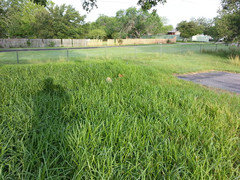
    I just posted this picture of my dog walking through my tall grass in George West, Texas. Tall grass is definitely an acquired taste. The dog's tail is about 32 inches high.


    suesheldon thanked dchall_san_antonio
  • 11 years ago

    It's KBG and PR...but it's an old house so there may be traces from prior sunny mixes. All of the seed I've used has been that mix. A lawn at your posted picture's height would summon the city mowers and a ticket here!

  • 11 years ago

    Since Lucy keeps pulling the football away, try Tenacity. It'll kill the bent, won't touch the KBG or PR at proper rates, and help keep the bentgrass from coming back.

    Your KBG and PR might bleach out a little bit, but the process reverses pretty fast. I just sprayed about 400 sprouts of P. trivailis and barnyard grass in my lawn...this was not a good winter. I might notice the bleaching if I look closely.

    >>I'll see if my grain guy can get me soybean meal- anxious to try that if it's even better than the green up I've gotten from alfalfa!

    It's superior. Nothing compares to the green that soy gives you, except Milorganite (because of the iron in it).

    suesheldon thanked User
  • 11 years ago

    Morph, you're talking about liquid Tenacity that is mixed precisely and sprayed on the grass in a sprayer (but not a hose end sprayer since it needs to be applied precisely). Since she has a granular form of Tenacity in that Scott's product (unless she took my advice and returned it), would that work on the bentgrass? How about if she uses that on the bentgrass spots in addition to normal pre-emergent for the whole yard? Would that work? Any pros or cons? It would seem to be easier to use if it would solve the bentgrass problem.

    suesheldon thanked beckyinrichmond
  • 11 years ago

    I was wondering the same thing...even if the Tenacity in the Scotts (still have it) isn't potent enough to kill the existing bent, I'd be glad if it just kept it fom spreading. Just not up for a big lawn renovation this year.

  • 11 years ago

    I have no idea if the granular will kill the bentgrass, but it would give about a month of protection against sprout of additional. If you don't kill the bent? There's no sense in bothering with the protection. Bentgrass tillers very, very well, and a pre-emergent won't stop that.

    suesheldon thanked User
  • 11 years ago

    Sue, you could call Scott's (they must have a customer service dept) and ask. Or call a customer service number for Tenacity if you can find one. I expect a granular may not have much effect on a mature plant, that it may only affect germinating plants. The liquid form of Tenacity is absorbed by the leaves and a granular product won't go into the leaves. Does that bag say to not use on bentgrass? If not, then it won't kill it. If you do decide to try it, it might be good to go with normal pre-emergent now to get the crabgrass protection going and use the Scott's around Memorial Day (or when the spring flush slows down) when it's a better time to fertilize. Use it over the whole yard so the nitrogen is distributed evenly.

    suesheldon thanked beckyinrichmond
Sponsored
Wannemacher Interiors
Average rating: 5 out of 5 stars26 Reviews
Customized Award-Winning Interior Design Solutions in Franklin Cnty OH