Software
Houzz Logo Print
lisa7310

Do pothos prefer to be pot bound??

11 years ago
last modified: 11 years ago
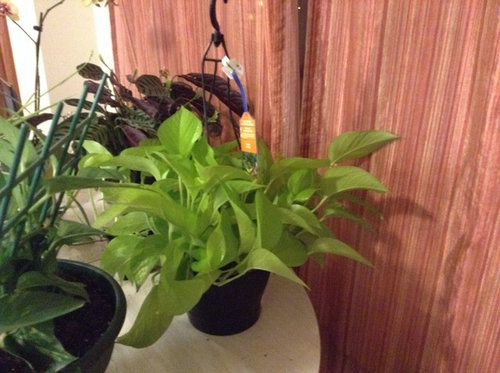
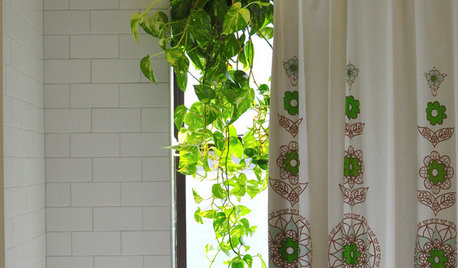
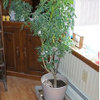
I have a gorgeous neon lime pothos with light green leaves. It is in a hanging pot but it is getting crowded in the pot. Should I transplant it?? The pot is a 10 inch pot. Should I go up to a 12 inch or 14 inch pot?? The one in the background is my prayer plant

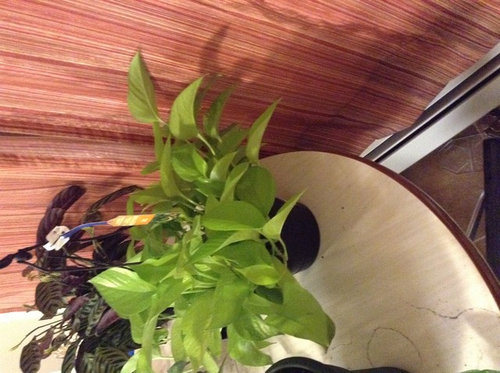
  • Sorry not sure how to rotate the picture

Comments (13)

  • 11 years ago

    As Al indicated, the whole "plants preferring to be pot bound" is a myth/urban legend that, unfortunately, refuses to die.

  • 11 years ago

    They grow naturally as a semi-epiphyte, so their roots spread out over tree trunks and through the leaf litter on the ground. That's far more root space than any pot could provide, especially a crowded one.


  • 11 years ago

    I also would have to agree with Al. I don't know if this is kosher in the houseplant world, but something I did successfully: I too have a pothos plant in a hanging planter, and it was getting very rootbound and congested. In fact, there was nearly no soil left in the pot, it was almost all roots! Unfortunately, I didn't have the space for a larger planter. So I carefully unpotted the plant and shook off what soil was there. Then I gave it a trimming top and bottom--I cut off about half the stems and about a third of the roots. I figured since the roots feed the stems, when trimming roots one must trim at least that much of the stems as well. I packed it back into the same pot with fresh potting soil and kept it moist. The shock made the pothos wilt a little and lose a few leaves, but it bounced back quickly and is much happier now!

  • 11 years ago

    Being pot bound stresses the plant and often a plant will flower because of it, leading people to think the plant is happy, when in fact it's a survival trait! Next size pot up should do

  • 11 years ago

    Potting up, as opposed to repotting (like Whammytap did), unless it's undertaken BEFORE about the point where the root/soil mass can be lifted from the pot intact - always leaves root congestion in the original root mass. Unfortunately, this congestion is a limitation that permanently limits the plant unless corrected; so, the best you can hope for when potting up is that the plant can temporarily regain SOME of it's ability to grow normally. The 'growth spurt' growers see after potting up is nothing more than an illustration of how much better the plant could have been growing all along were it not for the root congestion. It shows you a small part of the limitations root congestion is imposing on the plant's ability to function.

    From another post - using numbers to illustrate the delineation between repotting and potting up:

    I often explain the effects of repotting vs potting up like
    this:

    Let's rate growth/vitality potential on a scale of 1-10,
    with 10 being the best. We're going to say that plants in containers can only
    achieve a 9. Let's also imagine that for every year a plant goes w/o repotting
    or potting up, its measure of growth/vitality slips by 1 number, That is to say,
    you pot a plant and the first year it grows at a level of 9, the next year, an
    8, the next year a 7. Let's also imagine we're going to go 3 years between
    repotting or potting up.

    Here's what happens to the plant you repot/root prune:

    year 1: 9

    year 2: 8

    year 3: 7

    repot

    year 1: 9

    year 2: 8

    year 3: 7

    repot

    year 1: 9

    year 2: 8

    year 3: 7

    You can see that a full repotting and root pruning returns
    the plant to its full potential within the limits of other cultural influences
    for as long as you care to repot/root prune.

    Looking now at how plants respond to only potting up:

    year 1: 9

    year 2: 8

    year 3: 7

    pot up

    year 1: 8

    year 2: 7

    year 3: 6

    pot up

    year 1: 7

    year 2: 6

    year 3: 5

    pot up

    year 1: 6

    year 2: 5

    year 3: 4

    pot up

    year 1: 5

    year 2: 4

    year 3: 3

    pot up

    year 1: 4

    year 2: 3

    year 3: 2

    pot up

    year 1: 3

    year 2: 2

    year 3: 1

    This
    is a fairly accurate illustration of the influence tight roots have on a
    plant's growth/vitality. You might think of it for a moment in the context of
    the longevity of bonsai trees vs the life expectancy of most trees grown as
    houseplants, the difference between 4 years and 400 years lying primarily in
    how the roots are treated. We may not expect our plants to live for hundreds of years, but the expectation of good health as a result of good care is a blessing from any angle ...... unless you're growing kudzu. ;-)

    Al

  • 11 years ago
    last modified: 11 years ago
    What I sometimes do if a plant begins to get a bit big is at repotting time gently wash the roots and prune a good mass of them away, then repot into the same pot, a bit similar to the technique in bonsai. Some plants might not like this though-notably palms. Not sure about pothos as you guys call Philodendron, never grown one. Yet...

  • 11 years ago

    That sounds good, Larry, that's a real repot. Sorry your palm didn't take it well, haven't had any problems doing that with parlor palm. Am I remembering correctly that you had a 'Metallica' palm? Was it that one?

    The lime colored plant above is Pothos (Epipremnum,) not a Philodendron.

  • 11 years ago

    Yes I still have the metallica palm, growing nicely and flowers each year, often twice (it has another flower spike now!)

    Ive also had a Dypsis which grew huge! They dont mind repotting but theyre not keen on having the rootball messed with

  • 4 years ago

    Pothos are semi epyphites ( air plants ), they naturally grow in crevices in tree branches. They do not like to have their roots disturbed. As the soil depletes, you can add new soil to the pot, but you should not repot into a larger pot. In the case of Pothos, smaller is better. The idea that all plants need regular repotting is not true. It depends upon what type of plant, it is. They will develop root rot, if given too much soil. FYI I am a ALCA certified Interior Plantscaper.

  • 4 years ago
    last modified: 4 years ago

    Ken - No plant likes or prefers to have their roots disturbed in the immediate, so it should not be a surprise that pothos isn't the sole outlier. That a plant endures some minor and temporary stress is not all that unlike people dieting, exercising, or going to the ER to get sutures to close a wound, or have a broken bone set and fixed in place temporarily. While these things might be uncomfortable or stressful in the moment, it is in our own best interest to endure the temporal discomfort to avoid future issues more serious.

    "In the case of Pothos, smaller is better." No, this cannot stand as an accurate statement w/o some qualification. First, to make the statement you absolutely must assume that the medium being used is so water-retentive that up-potting to a pot anything other than slightly larger than the former jeopardizes root health. Using the media I and many others here use would allow a grower to plant the tiniest of seeds or a minuscule cutting in a 55 gallon drum filled with grow medium. You might not yet understand plants cannot be over-potted when using grow media incapable of holding water between soil particles; or that the closer a grow medium comes to having no water in the voids between soil particles, the less consideration need be given to the potential of over-potting.

    "The idea that all plants need regular repotting is not true." Well, if what you said is true, it's true only in the same sense that you needn't change the oil in your vehicle, change your infant's diaper, or avoid trying to leap from tall buildings using a bed sheet as a parachute.

    Let's use pothos as an example. As the roots reach the point of root congestion that allows the grower to lift the root/soil mass from the pot intact, the congestion will have begun to limit A) growth rate B) the plant's level of vitality C) its ability to defend itself against pathogens biotic and abiotic D) and perhaps eye appeal, though the greater diminishment of how it looks will come as root congestion is allowed to increase.

    If Mother Nature thought it was best for plants to grow on a tangled and congested mass of roots, plants would sit immediately atop tightly compacted cubes and spheres of roots. Nowhere in nature do roots grow in a compact mass unless there are influences preventing them from occupying whatever volume of soil is required to satisfy their need for water/ nutrients/ anchorage.

    "It depends upon what type of plant, it is" No, it does not. All terrestrial plants that I know of suffer stress when roots are congested and the stress level increases in relation to the level of congestion. Potting up relieves only a fraction of the stress caused by root congestion, this, because it does not address congestion in the center of the root mass. Potting up is a half-measure that ensures the plant remains stressed until such time that a pair of hands gets into the center of the root mass and relieves the congestion and hopefully fixes the problem roots.

    In order to relieve all stress affecting rootbound plants, they must be fully repotted, which includes completely or partially bare-rooting the plant; removing large unnecessary roots that serve no purpose other than plumbing; and other problematic roots (crossing, j-hooked, encircling, girdling, roots growing straight up/down, and roots growing back toward the center of the root mass); and a change of all or almost all of the grow medium.

    I happily acknowledge that it makes more sense to work toward relieving root congestion by dividing some plants or by vegetative propagation, which in a sense makes your statement in bold immediately above true, but no plant grown under conventional container culture remains unaffected or unlimited by root congestion beyond the point where the root/ soil mass can be lifted from the pot intact. It is absolutely essential to fully address root congestion in order to fully eliminate the stressful effect it has on plants.

    I recognize that the stress associated with root congestion is often used as a tool to force the plant to produce a greater profusion of blooms, limit the plants growth rate, or produce any of several physiological reactions deemed desirable by the grower, but stress is a signal the plant is operating at or beyond the limits it was genetically programmed to tolerate; so, from the plant's perspective, stress is always a limiting factor, even if the effects of stress pleases the grower.

    "They will develop root rot, if given too much soil." Again the comment deserves qualification, and is based on the assumption that all available media are inherently limiting due to a tendency to hold an excessive amount of water. We can only cause root rot by over-potting if A) the medium is inappropriately water-retentive for the task at hand, or B) watering habits are inappropriate. Not all media is inappropriate and not all growers over-water.

    I'm not sure how you'll square the idea that allowing a plant to continue to suffer the stress of root congestion in order to avoid root issues related to over-potting is a good thing, when both can very easily be avoided by simply using a healthier and more appropriate grow medium.

    Al, who is not an ALCA certified interior plantscaper. ;-)

  • 4 years ago

    "ALCA certified interior plantscaper."


    That explains a lot, lol.

  • 4 years ago

    I hope that's a free course of study if it teaches the benefits of pot bound plants. But that does make it harder to get your $$ back.


    The concept of "smaller is better" without any kind of parameters is not the kind of applicable info that anyone can use, and can not be the product of logical thought because if smaller is better, Pothos should grow better in a 4" pot than a 10" one, and would then be massive and uncontrollable in a 1" pot.


    The art of bonsai has been established for centuries, or longer, so we can look there for clues. In very crude simplification, a small pot constricts a plant and the result is a shrunken specimen.


    But it is not inherently better for any specific plant to be constricted or to roam fast and free. There can be wildly different goals.