Software
Houzz Logo Print
matt_conner88

Problems With Banana Plant

11 years ago
last modified: 11 years ago
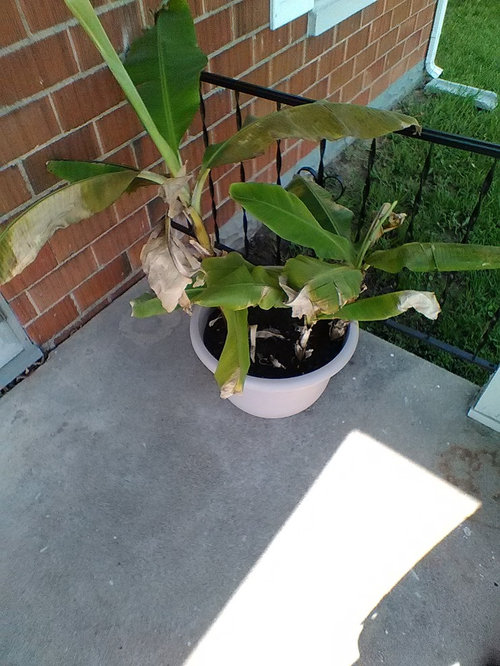
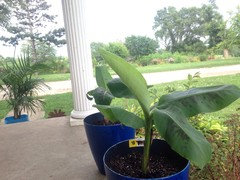
Hey everyone! Would you guys happen to have any recommendations on what may be wrong with my Banana Plant? It's been in the house all winter long and was doing really well. Then a few weeks back I took it outside and it just started going down hill. Not sure why. I had it getting full sun for a few days and then when I noticed the leaves beginning to change I put it on our northside porch out of the sun. The soil is still quite wet from the last time I gave it water. Maybe I shouldn't have put it out in the sun?

Comments (20)

  • 11 years ago

    Matt,

    Worry not, the plants are adjusting to the change in sunlight. Usually you'll want to slowly acclimate the banana plants to outdoor sunlight, working from heavy shade to dappled to full sun over the course of 2 weeks or so.

    While the plants are still going through the acclimation process, you might want to consider up-potting to a larger size, or splitting the bananas across 3 different containers. Though I can't be certain what variety you have, it's a large enough type that a single well-fed Banana plant could occupy a 25 gallon container by summer's end.


    Mike

  • 11 years ago

    Thanks Mike! I tried last year to seperate it but the root ball is so big and thick I think I will have to literally use a hand saw to cut into it. Do you think that would be safe for the plant?

  • 11 years ago

    Absolutely, Matt. I was just separating some banana pups myself, I would have taken photos of the process for you, had I known.

    5 simple steps:

    1. remove the plant from the pot and hose out the root ball as best you can, washing away as much soil, perlite, etc as you can.

    2. Cut off any roots near the bottom that are growing in a circle (those that followed the perimeter of the pot) and any roots growing over the top of the corm (aka bulb or rhizome).

    3. Use an old kitchen knife, or saw, etc to cut the corm between plants.

    4. Repot, water deeply, and move the plants to a shady location (like the spring transition we just talked about).

    5. If you managed to preserve the majority of the roots, wait 2 weeks before fertilizing. If you had to cut most of the roots away (see note below). Wait at least a month before fertilizing.


    Note: If you find it difficult to determine where the corm is in relation to the root ball, start cutting away as many roots as necessary. The plant has more than enough energy in the corm to rebuild the entire root system from scratch within a few weeks.


    I've got between 20 and 50 Bananas in my yard of varying sizes. If you need anymore help, don't hesitate to ask.

    Mike

  • 11 years ago

    Thanks again Mike! Is there a certain type of potting soil you would recommend?

  • 11 years ago
    last modified: 11 years ago

    You and I live in very different environments, so don't take my suggestion as absolute gospel here, but most any general purpose soil should be fine. Just avoid using any of those moisture-retention varieties.

    For potted plants, I mix my own soil these days. I purchase perlite and peat moss in bulk, mix in a little compost/leafcover and native soil, and adjust quantities depending on pot size and banana variety.

    In a perfect world you're watering your plants every day. It's inefficient and hardly economical, but ideally, that's what your doing. Since you can't maintain that, your goal is to provide a soil that can stay moist without forming a muddy sludge. Moisture-retention specialty potting mixes often fail that.

    Bananas love heat and moisture, but too much of either one (growing under a desert sun/or potted in a fishpond) can kill them.

    Mike

  • 11 years ago

    The concrete in full sun maybe hot on the roots.

  • 11 years ago

    Thanks Mike and Shannon for the help. Mike, out of curiosity. What in the world could I use to keep these in? Around here, I think I have it in the biggest flower pot I can find lol. I've been trying to figure that out for the last couple of years....

  • 11 years ago

    Thanks for the information Mike! I would love to be able to put the plant into the ground but I just hate having to do that and then having it to take it back up before winter sets in. To me, it just seems almost cruel to the plant doing that, knowing, that in a few months I will have to dig it back up and bind it back into a container. It seems like that could be stressful to it. But that's just my train of thought lol. Do you think by putting the whole thing into a bigger container would be my best option or would you just seperate the plants? I would much rather try to keep it altogether but at the same time I want to do what's best for the plant. Thanks again for the all the help Mike :)

  • 11 years ago

    It's my pleasure, Matt. I don't get to discuss this stuff in my personal life, so people like you provide an outlet for me =P

    Judging from your photo, there are 4 (or maybe only 3) plants in that container.

    I would, for the time being, leave the largest plant in that container, and split the others, putting each one in a 3 or 5 gallon pot. In a month or two, depending on how the plants are progressing, I would consider upgrading their pots.

    I personally suggest splitting them up for a few reasons, but basically, the sooner you break them up, the sooner they can become torally self-sufficient and provide you with more pups. Bananas start off growing from a single corm. Each pup produces its own system of roots and in time, that root ball will produce a healthy corm. The longer a pup remains attached to the parent, the further retarded its corm growth will be (it's a Republican's nightmare: a free-loader living off the wealth of another =P)

    They've all got well-established root systems and will do fine on their own. Separating them just speeds up the process.

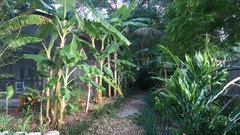
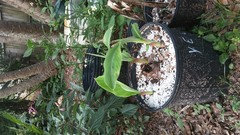
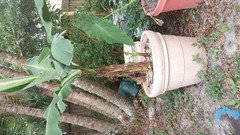
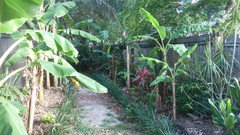
    Just so you don't think I'm some random dude throwing wildly inaccurate information to you, I thought I should provide a few photos for you. I'd offer more photos of my banana collection, but Houzz/Gardenweb have a serious issue with image orientation.


    Most of the bananas on the left were tissue-culture purchases that were supposed to be Ice Cream Bananas. They ended up being (I believe) Namwah. There are a total of 16 plants on the left, ranging in height from 4 inches to 9.5 ft.


    This was a recent acquisition. It was a damaged banana plant with 3 eyes ready to produce pups. I potted it up in a 3 gallon container so I could nurse the corm and pups until they're ready to go directly into the soil. Potting mix is 50/50 peat/perlite (heavy rains forced the perlite up to the top)


    Dwarf Cavendish + 1 pup in a...I don't know, 10-15 gallon container, maybe? I'm currently renovating some garden beds, so thought it best to pot this guy up in the meantime. He's only 4 feet tall, and can only reach a maximum height of 8, maybe 9 feet, so he's not suffering for the pot size currently.


    I recently acquired (aka dug up from an abandoned lot) some bananas and planted them. It's almost impossible to tell, but there are 8 distinct mats growing on the right side of the bed with 14+ banana plants total. Some of the pseudostems haven't grown since transplanting, but have instead, started producing pups. In the last month I've had pups grow from nubs to 4 ft in height.

    I've got a few more varieties and planting locations, but you should get the gist of things.

    Any more questions, don't hesitate to ask.

    Mike

    Matt Conner thanked foreverlad
  • 11 years ago

    Thanks Mike! That sounds like the thing to do. Sounds like a good project for me to do this coming Memorial Day Weekend :). I hate to see any plant just wither away and die especially if I can prevent it. I will let you know how everything goes. Thanks again for all the help Mike!

  • 11 years ago

    I live in NJ, so obviously bananas won't live outdoors in winter here. But I did put them in the ground, where they grew large and developed pups, then dug up and brought in the smaller pups in the fall. That way I could keep them in relatively small pots indoors and transplant outdoors again in spring. Could be worth considering, instead of getting huge pots and tons of potting soil.

    Matt Conner thanked shelma1
  • 11 years ago

    Thanks for this detailed discussion.

    Foreverlad--I was resigned to not getting double mahoi due to its size, but with all the discussion of cool over wintering/dormancy indoors, I'm inclined to try this. I'm in zone 7a, so any nanner here gets no more than 12 weeks outdoors. Is this a fool's errand?

    I'm hoping that with digging/dormancy, and perhaps judicious shortening of the ps, it might be possible to coax ripened/edible fruit from what might otherwise be an unmanageable ceiling-scraper here.

    Comments?

    Thanks!

    Rick in CT zone 7a

    Rredbbeard@yahoo.com

  • 11 years ago

    Never give up hope Rick. I would totally do it if I were you. I haven't grown the Double Mahoi myself, but being in the Cavendish family, it's a great choice with a reasonable size.

    Once temperatures remain above 50, it's safe to bring them out and replant. Once temps are consistently over 60, expect slow growth. 75 and above will be prime time for growing, so start throwing all your fertilizer at it then.

    The trick is to give the plant as much time as possible to adapt to its new environment before it's time to perform. You could probably coax an extra 6 weeks of growth out of it, so long as you bring it out as early as possible, cut all fertilizer 1.5 months prior to a freeze, and dig it up/move it before temps hit 32.

    I'm ashamed to admit I don't know how long Cavendish types take to ripen. Once you see a flag leaf, you'll have to find a way to protect and maintain the plant and pre-existing leaves, even if winter is coming. otherwise you'll have to wait for the next stem to mature.


    Mike

  • 11 years ago

    Btw Mike, forgot to mention earlier, awesome plants! I seperated mine. I ended up getting 4 pups out of it along with the mother. I put the least one in the gorund and it looks pitiful. Not giving up on it though! I think kit will come around. The others all seem to be doing just fine. Btw, is it safe to peel the old brown looking skin from them plants? I would probably just cut them off instead of actually peeling them. Or, should I just leave them be? Seems like I read somewhere, maybe this thread, that banana plants like acidic soil as well. I have some Miracle-Gro Azalea, Camellia, Rhododendron Plant Food that I have been giving to my Gardenia Tree. So I wonder if that would help the banana plants? Thanks again Mike for the help :)

  • 11 years ago

    Matt,

    4 pups sounds like a great collection to work with.

    Fight the temptation to peel your plants. Despite how ratty they look, that pseudo-stem skin is still serving a purpose. I've screwed up plants by trying to peel away the dead layers. See, while the top portion of the husks are dried and flaky, the further down you pull at that layer, the richer, thicker and more full of moisture you'll find it to be. What you peel away leaves tender, naked and uncolored stem that isn't half as supportive to the overall plant as you may believe.

    Basically, if you peel from top to bottom, you'll find the bottoms are thicker and "healthy" and the plant may start leaning or tilting due to a loss of support. I've had 10ft plants get reduced down to 3ft because I wanted a clean stem.

    Allow the plant to divest itself of the old skin. Since banana plants produce new leaves through the center of the plant, each new leaf helps strengthen the stem by continuously growing outward. When the skin falls away on its own, you'll know you're making some serious headway in the growing department.

    You're free to trim free-hanging bits of the stem, but otherwise, just let it be.

    __

    Bananas do do well with slightly acidic soil, but don't worry about that. It's more important you find out how they do now in your native soil before you start amending. If we start seeing stark yellow leaves or a weak stem, we can start deducing what sort of problems you might be facing, but in the meantime, we just want to know they can grow at home.

    If you want to feed them, focus on a fertilizer with a 3-1-2 N-P-K ratio. Phosphorus isn't all that important to the plants, but Nitrogen is essential for top growth, and the Potassium feeds the eventual fruit.

    Anyway, sounds like you're off to a great start. Don't mind pitiful looking pups. They're likely better off being started in pots, but don't worry. Each pup is like a teen forced to grow up on its own: it was living off the strength of the parent corm and now it has to make its own way, so it'll be a bit slow as it adjusts to its new responsibility. It'll be fine, given time. =)


    Mike

  • 11 years ago
    last modified: 11 years ago


    what fertilizer should I buy and how often should I use the fertilizer for these bananas (they are planted in slow-release miracle grow soil right now the bag said it is good for 6 months). So should I use additional fertilizer or just leave it. Btw I'm in zone 5a

  • 8 years ago

    foreverlad(9b - Tampa Bay) / Mike, I stumbled on this page in hopes of finding the answer to my banana tree troubles. I know the last post was from ‘15.... May I still ask you a couple desperate banana related questions? Amy

  • 8 years ago

    colerorebeck, easiest to use all purpose miracle grow, once every two weeks.

  • 7 years ago
    last modified: 7 years ago


    Hi,

    Recently I changed my banana's tree pot and then I found out it hase spider mites then I spayed dish washing powder and oil on the leaves. After afew days I washed the leaves. Then the leaves started to yellowing and withered also the stem started to withered. I washed the soil and then watered with bordeaux mixure. Now how I can revive this plant? may be die this stem and grow a new stem?

Sponsored
Whisler Home Improvement
Average rating: 5 out of 5 stars9 Reviews
Franklin County's Committed Home Improvement Professionals