Software
Houzz Logo Print
philipp_beisheim

Plumeria - dehydration or stem rot?

11 years ago
Hello,


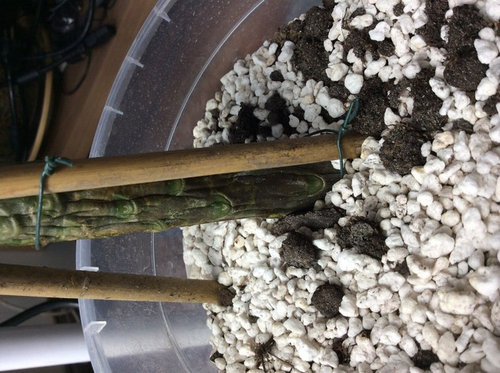
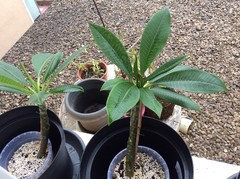
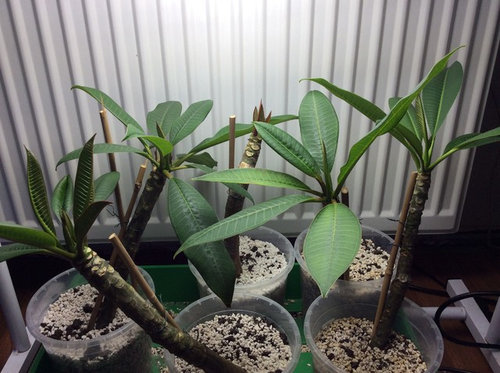
I have successfully rooted some plumeria cuttings from Hawaii. The biggest plant with more than 6 developed leaves is showing some black parts at the bottom of the stem. However it's not softer than the other plumerias, though not rocket-hard.

Given the well developed root system I started to water them once a week (giving them just a bit of water) or when the inside of the pot has no condensed water. I thought this frequency is conservative enough to prevent stem rot.


So the key question is: do I see signs of dehydration or is it the contrary stem rot? What is your advise: water more often or stop watering?


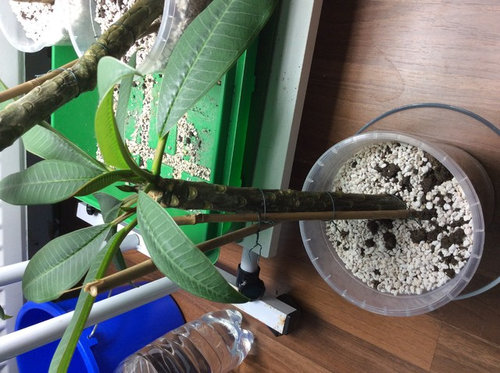
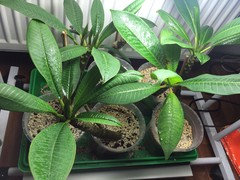
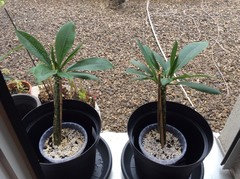
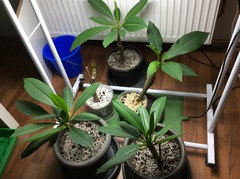
Here are some pics

(Overview)

(Stem rot or dehydration?)

(The problematic plumeria)

Comments (31)

  • PRO
    11 years ago

    I can't tell from the picture. Maybe use a pin to see if you draw white sap in the area of question?


  • 11 years ago

    I pinned it in the darker area and directly under the surface there came white liquid out of it... It's a good sign, isn't it? How much water do plumerias need with so much leaves?

  • 11 years ago

    I would think that it needs more water, but if you have something under the pot your plant will not drain as well and will be sitting in water, which you don't want to do. Try watering it and put it in the sink or bathtub to drain. It also needs as much sunlight as you can give it. Mine are getting full sun and in the backyard in pots and I only water about every 8 days this time of year. In the summer I water more and in the winter I do not water at all. I hope that this will help. Barb

  • 11 years ago

    Thanks for your answers! Until now I was very very restrictive with watering. I only have the plants a small drink of water such that the soil wasn't moistened but still dry for ca 80%. There was almost no drained water. So I think I will increase the amount of water noticably and see if the wrinkled stem gets healthier. I will keep you posted...

    (Additional thoughts are still welcome!)

  • 11 years ago

    If you have a well developed root system and good drainage then you can water them well - I would water it thoroughly and then let it get on the dry side before watering again but not too dry. You don't have a whole lot of soil in those containers so I can't see it holding a lot of excess water, especially with a good root system.

    Is it warm where you live or where you're keeping them?

  • 11 years ago

    The plants grow on a heating mat indoor in a room heated up to 25 degrees Celsius during day and around 18-20 degrees Celsius at night. The plants sit under artificial light around 12-16 hrs per day.

    Given your recommendations I have just watered them with a more reasonable amount of water. I removed excess water from the pan and keep my fingers crossed :)

  • 11 years ago

    The tension in the leaves can be used as an indicator of hydratation aswell. Usually whem they are pretty loose without tension either the sun and heat is to intense or water is needed, or both at the same time. As long as the soil drain really fast , you can water tham even daily.

    Aloha

  • 11 years ago

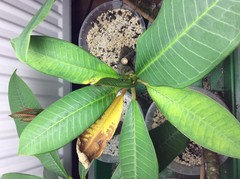
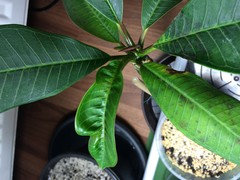
    The Plumerias show first signs of relaxation... However another one started to turn its leaves yellow. One leaf is already almost 'dead' (see attached photo). Any ideas what that is and what I can do to safe the other leaves?


  • 11 years ago

    I am in the minority here , but I plant mine in mostly potting soil and water constantly. Of course, I live in Galveston, Texas along the coast and it's often warm. During winter, I keep them under lights inside - and you guessed it - water them like crazy. I haven't had any problems with rot.

    When I started growing plumeria and adenium, I was warned about dormancy. Dormancy allows minor problems to become major ones. Research has suggested that when a plant encounters a problem such as a pest or illness, if it is actively growing, it can usually easily "grow through" the problem. If it is dormant, the problem is magnified because the plant is not active. I have one adenium that goes dormant no matter what I do, and that's the only one that I stop watering - well mostly, lol.

    So, assuming that the lights your plants are under are strong, I would water more often, rather than not. However, if at all possible, this plant needs to be in the sun!

  • 11 years ago
    last modified: 11 years ago

    Since that is an older leaf it is normal for the oldest leaves to mature and then cycle out. The newer leaves are the most important ones to watch. If you have good drainage and good root systems, your plants can tolerate the watering though and I really think you might want to water more. Also, once the roots are visible on the edges of the containers you may want to put them in bigger pots (not a whole lot bigger, but bigger), which will then hold more moisture for the roots.

    Good luck, you're doing a great job!

  • 11 years ago

    I also water them a lot, as much as daily during the summer, as long as the medium drains fast( couple of days) you dont have to worry.

  • PRO
    11 years ago

    it looks like the lower leaves are shutting down to conserve water. since you have increased your watering it should grow new leaves. At least two other leaves will yellow and fall off.

  • 11 years ago

    After applying some more regular watering that also includes some fertilizer the plumerias seem to feel pretty well again! The leaves are getting 'giant'! I will repot them into a bigger pot soon and from June onwards I would like to put them outdoors. Is there anything to consider when changing the location from inside (16hrs per day under growth lamp) to outside?

  • 11 years ago

    Thanks for the update. They really look very healthy at this point.

  • 11 years ago

    they do look very healthy. I used t have a couple of these trees back home in tropical asia. They do love their watrer. I suggest when putting them outside, place them under a sunshade like black netting for the first few days to condition them before putting them out under full sun. Also put them in a larger container so they don't run out of water too fast and also so they can grow larger.


  • 11 years ago

    As Ianna has mentioned, just make a progressive exposure to direct sun light , firsts days just a couple of early morning sun and the rest of the day shade, day by day giving them incremental exposure, after a week or so they will be use to the new luminic condition.

    Alohaaa

  • 11 years ago
    last modified: 11 years ago

    Listen to the others, but I thought I'd chime in. I just toss mine right out from 24 hour light inside, to full sun outside. The worst I usually see is 1-2 leaves dropping, usually not even that. The only ones I keep in shade for any time are those without roots.

  • 11 years ago

    depends on humjdity I think. In equatorial Asia, the humidity is so dense it actually protects plants from burning up. In dryer zones, one has to be more careful as I learned so very quickly when I put out my tropical plants and burnt them (in my first year in Canada). I puzzled over that for quite some time til I finally understood why these plants needed to be kept in a greenhouse even in summer.


  • 11 years ago

    The outdoor experiment has started... I will repot tomorrow into the black and bigger pots you see on the pictures. Let's see what happens!!


  • 11 years ago

    The weather forecast is getting worse so I am unsure what to do with my repotted plumeria. The forecast says that the night temps go down to 42-46 Fahrenheit, daily max temps are 60-68 Fahrenheit. Mainly cloudy so no direct sunlight. Chance of rain.


    Option 1:

    Continue position it indoor under growth light. It would look like this:


    Option 2:

    Put them indoor behind a window so that it can get as much natural light as available without being exposed to low outside temps. Current sky looks like this:


    Option 3:

    Despite the non-optimal weather condition, put them outside to get them used as soon as possible to its future environment. I will still have the option to put them indoor overnight.

    Which option would you prefer?

  • 11 years ago

    Phil, what is your zone? Be careful about keeping tropicals outdoors when you can expect a dip in cold weather. Some people have tried zonal denial gardening, but note that it takes only one particularly cold night to kill off years of effort. These are trees but you can grown them as potted trees which you can bring indoors in a heated greenhouse when the weather gets too cold.


  • PRO
    11 years ago

    I would leave as is for now. Then re-evaluate when the forecast looks better.

    IMO there really will not be that much of a transition from inside conditions to your area's spring conditions. It's a bigger issue when something goes from 70 degrees with low humidity to 90 degrees full sun and high humidity. That's when there may be a bit of shock.

  • 11 years ago

    I live in Germany (the Internet tells me something about climate zone 8a). Temperatures in summer range from 60 Fahrenheit (night) to 70s/80s at daytime. Depending on the summer :)

    So currently we are just at the beginning of summer. Conditions will usually get better in June/July.

    Is it a good idea to grow them

    in a mobile greenhouse (those used for tomatoes)? This protects them from rain and may create a better micro climate?


    Btw: thank you all for your valuable recommendations! I highly appreciate it!!

  • 11 years ago

    unless that's a heated greenhouse its best to keep it out of the cold...

    Here's something straight out of webpage of one supplier:

    Care Plumerias
    require at least 1 inch of rain (or equivalent watering) each week. More
    water may be required for plumerias growing in containers, but don't
    overwater or the trunks will rot. Feed plants twice a month during the
    growing season with a high phosphorous fertilizer. Plumerias normally
    require little pruning, but any shaping should be done in spring.
    Plumerias are sensitive to cold and should be protected when
    temperatures dip into the 40Fs. Check periodically for pests such as
    spider mites, white flies, and mealybugs. Use a horticultural oil or
    insecticidal soap to control these pests.


  • 11 years ago

    Leave them under lights till rain passes, that's my oppinion. Personally I bring mine outside when temps are consistently in the low to mix 40's, but I don't have them under lights durring winter, wish I had the room to do so.

  • 11 years ago

    Providing sufficient room becomes also an issue for me after reporting ;)

    Would it be sufficient to position the plants behind a window? This would provide indoor temps with normal daylight spectrum. Would you prefer this option over the artificial growth light?

  • 11 years ago

    @ phillipp - how much longer would they actually have to be under lights? If summer is on the way than it wouldn't be long.

    If you have inflos & want intense color I wouldn't recomend leaving them behind a window. Glass blocks UVB I believe. One year I left a tree inside behind glass because I was afraid of cool night temps & I had an early inflo. The tree was a noid rainbow & actually bloomed white & yellow instead of it's typical rainbow color. This is why I believe it's the suns intensity that leads to more colorful blooms as apposed to heat. If you don't have inflos than it's not a big deal.

  • 11 years ago

    I have no inflows yet. I just planted the cutting in late January. Would it be to optimistic to hope for inflows in the first summer just after a couple of months?

  • 11 years ago

    The one I have posted a photo of on May 13 is still suffering from something unknown. One leaf has a deformation whilst the others are getting black dots...

    Any ideas what the plant wants to tell me?


  • 11 years ago

    Hi Phillipp - the leaf deformation is often related to thrips or spider mites / sucking insects so easily treated with some insecticidal soap or pesticide if they are persistent. The black dots could be a few things-I'm sure others will have more info for you but I would ask about fertilizer, moisture levels, that kind of thing.

Sponsored
Wannemacher Interiors
Average rating: 5 out of 5 stars26 Reviews
Customized Award-Winning Interior Design Solutions in Franklin Cnty OH