Software
Houzz Logo Print
chase_caprock

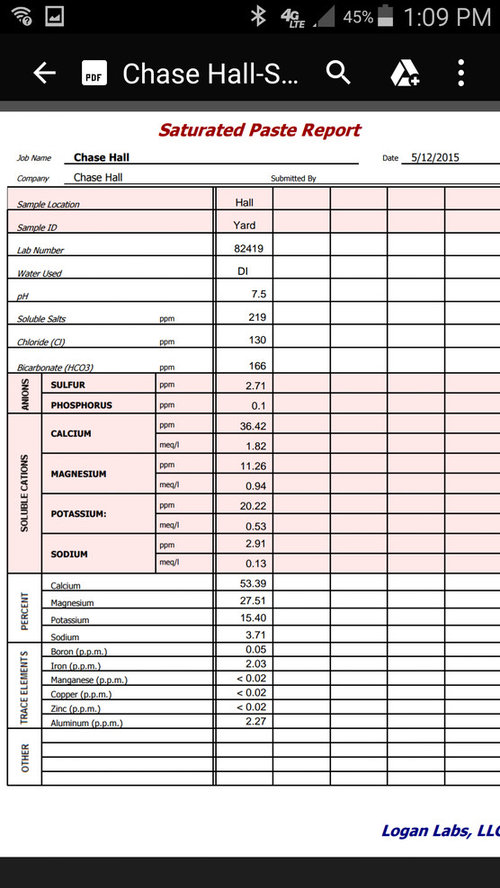
Logan Labs Soil Test Help

11 years ago
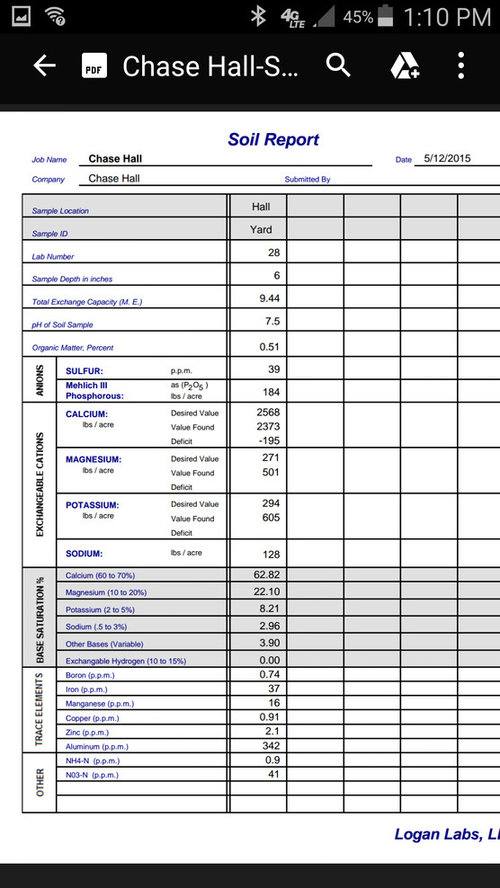
Please let me know if anyone can help me interpret my results. I live in Midland, TX if that helps.


Thanks in advance


Chase


Comments (8)

  • 11 years ago
    last modified: 11 years ago

    Thank you so much for all the help.

    Just a few notes- It is a Bermuda Lawn, and from what I can tell it is common Bermuda although the neighbors look to have hybrids.

    When I moved in August 2012, the yard was 90% weeds, mostly sandbur, and a wreck. 2013 was mostly spent doing everything wrong, although I was successful in killing most of the weeds.

    In 2014 I found this site and the Bermuda Bible, and followed that almost flawlessly. I used a reel mower twice a week, quit watering so frequently, and eventually by late summer last year the lawn finally started filling out and looking decent.

    This spring the lawn didnt come back as strong as I thought it would, which prompted me to finally do a soil test. It seems to be barely green with a few yellow patches mixed in. If I go a full week without mowing, the whole yard throws up seedheads (which I think means its under stress?)

    I do mulch with every mow, but being in Midland Tx we don't have many trees here. Is there anything else other than the Milorganite I can put down to help the OM?

    Is there a specific brand of Starter Fertilizer recommended?

    And lastly, should I do another soil test just before Winter, or wait until next spring?

    Thanks so much

    Chase

  • 11 years ago

    Wait a year for your next soil test, so figure April or so of 2016. That'll give everything time to work in.

    You can choose any starter brand, bag rate on them will target 1 pound of P per thousand, so I tend to recommend that you choose the cheapest per thousand square feet of application.

    Seedheads just happen sometimes, not necessarily under stress. Mine's stressed this year, but not throwing seedheads. Two years ago, nearly a perfect spring, it was seedheads galore.

    Barely green with yellow patches is a symptom of a shortage--the only real shortage you have is iron, so definitely lay on the Milorganite!

  • 11 years ago

    Texas Weed is one of my favorite lawn gurus. When he came out with the Bermuda Bible it surprised me that he did not include any organic feedings. My only modification to the BB would be to add at least one organic feeding per year either as a substitute for one of the monthly feedings or in addition to.


    Since you were doing things basically right and getting less than stellar results, that's when even I would suggest a soil test. As you can see, you have an oddball soil. The quantities of amendments needed just to fix the chemistry are almost unprecedented. I suspect that once you get the chemistry corrected, the biology will improve quickly.

    Morph, Chase's screen name is telling. If you have never seen caprock, it's awesome and everywhere in central Texas. It was created by rain pounding the bare soil for thousands of years. The rain compacted the soil into rock ranging from an inch thick to many feet. Niagara Falls flows over caprock, and that's caprock rubble lying at the base of the falls. It's pretty sturdy stuff to be growing plants in. With all the odd chemistry in Chase's sample, I'm wondering if that is a factor in the creation of the caprock in the first place???

  • 11 years ago

    In this instance, I'm pouring on gypsum for two separate reasons--a modest amount to correct the calcium issue, and a larger amount to try to abolish some of that sodium. Which is about to become a serious issue if it isn't taken care of. That's going to knock extra calcium into the soil, but better that than excess sodium--and replacing sodium (a strongly alkaline ion) with calcium (a weakly alkaline ion) will tend to knock the pH down a bit.

    I'm actually running the risk of creating a bit of calcitic caprock here. As I abolish the sodium as sodium sulfate and leave some free calcium and gypsum (anhydrite, selenite) behind, it can react with organic matter to form calcite. The resultant amount will be minor as 25 pounds per thousand isn't a great deal of gypsum.

    In this soil, I expect the calcite to weather back over time as there's no notable calcium excess. So the risk is quite minor. And the burnoff rate of OM in a soil that sandy is very fast, so it'll turn to humic acid pretty quickly compared to, say, my silt soil.

    Hence, also, the overapplication of starter fertilizer. I'm hoping the phosphoric acid knocks out some of the calcium excess I'm setting off.

    The biology of this soil, what there is of it, is quite weak due to the very low levels of organic matter. Synthetic applications' effectiveness will be very limited, with a severe slingshot effect.

    Probably most important is to increase that OM by any means necessary. Hence my recommendation to cast even minor things like the morning coffee grounds onto the soil. This is, perhaps, the one time I might be tempted to recommend compost if it weren't so durned expensive and difficult to apply.

  • 11 years ago

    Yeah, I was about to suggest compost but then I caught myself. I would suggest corn meal after corn meal or whatever is cheap at your local feed store. In your area it might be cottonseed meal. Those are a lot cheaper than compost, easier to use, and much more effective at feeding the soil biology.

  • 11 years ago

    Should I aerate before I put down these next applications?

  • 11 years ago

    Nope, aeration will do more harm than good. We want the stuff at the soil surface to work down on its own. That'll make sure the top inch gets the same treatment the deeper soil gets.

    chase_caprock thanked User