

HVAC quotes: Need help deciding between options
Thank you in advance for your time and efforts!
My 21 year old upstairs condenser unit has been leaking for past two
years. I paid $333 last year to get it recharged. This year it is
showing signs of low pressure again - constantly running and then no airflow. I
think it is time to replace it, and to replace the 21 year old furnace
at the same time as well even though it is working just fine.
Location: Atlanta
House Details: 2700 sq ft two story house built in 1994, 1200-1300 sq ft upstairs. Stucoo exterior. Very sunny and bright.
Current system (installed by builder in late 1993):
2.5 ton Trane XE1000 condenser Model# TTR030C100A1
80K BTU 80% AFUE single stage furnace Model# TUDO80C936BC
Heatcraft coil
The main floor system is working fine and is similar except that it has 2.0 ton condenser.
Current comfort level: Satisfactory.
We like to keep temperature around 78F in summer and 68F in winter.
There are two rooms - a guest room and an office - that are always
hotter(colder) in summer(winter). The flow through the register in these
two problem rooms seems fine. The office has an obvious problem in that
it doesn't have a return register and one CANNOT be added. The only
thing that can be done is to push more flow through the same supply
register (no new supply line can be added as well). For the guest room,
which is served by a long run of 6" duct, it seems the only solution is
to use a high speed register or add a new supply line.
Usage:
Electricity cost $0.091/kWh
Maximum (August) usage 150 kWh
Gas cost $0.42/therm
Maximum gas usage (Jan-Feb) ~180 therms
I
got five quotes - the two from vendors affiliated with Home Depot and
Costco were the highest and their sales rep did not inspire much
confidence. It was easy to rule them out. The remaining three are from
Carrier, Lennox and Trane.
Continued in next post:
Comments (49)

sk_dolcevita
Original Author11 years agoLennox sales rep inspired most
confidence, seemed very detail oriented and is knowledgeable. He was
the only one who counted the number of registers and matched them with
ducts and their sizing. He came very highly recommended by a neighbor
who got his system last year.
Carrier sales rep was bit
slimy - very salesman like (in a negative way). He told me Carrier
rebates cash rebates expire on May 15 to pressure me into signing on the
dotted line. However, Carrier website shows the rebate is valid for
systems bought by May 31 and installed by June 15.
Trane
sales rep was nice to work with but I have doubts about his knowledge
and attention to detail. His quote was riddled with typos due to copy
and paste but I understand these guys are working very long hours right
now. However, I do wonder if this sloppiness would show up in final
work.
Here are the items common to three quotes:(1)
None of the vendors (all five) performed Manual J. When questioned
they say given my satisfaction with comfort level and no
remodel/redesign since last install, it was not necessary.(2)
Biggest bang for the buck would be upgrading to a communicating 2-stage
heat variable speed furnace. However, they said I should go down to 70K
BTU furnace 80% AFUE.(3) 2.5 ton single stage condenser unit - non-communicating.
(4) Upgrade to MERV-11 5" filter.
(5) No new lineset. Existing lineset to leak tested with N2, flushed and vacuumed.
(6) New condenser pad and condensate drain pipe and drain pan with safety switch.
(7) Permits will be pulled and code inspection satisfied.
(8) 10 year labor warranty with annual maintenance contract ($280 for 2 systems with 1 filter per year).
Here are the quotes:Carrier:
INF 16 system
58CVA070-12-1 furnace
24ANB630 condenser (don't know if this is communicating or if that is even necessary for a single stage condenser)
CNPVP3014 coil
SYSTXCC1TC01 Infinity thermostat
To
alleviate problem in the two problem rooms, the quote proposes
"increase bedroom supply to 7" at plenum, relocate/modify office supply
on the plenum."Price $6,880
An alternative to above is to use a Performance 16 2.5 ton single stage
condenser and COR Smart thermostat - price for this option $6,400.
Lennox:SL280UH070V36A furnace (Signature series)
XC14-030-230 condenser (Elite series)
CX34-38A-6F coil w/ TXV
ICOMFORT WiFi thermostat
Install
new metal supply and return plenums, insulate with R6 Insulation, use
tab-collars with dampers on the supply for air balancing.Install (1) additional supply serving the guest bedroom.
Increase the supply line serving the office from 6" to an 8" then reduce back to an 6".
Install New Outdoor Electrical Disconnect Box and 3/4" x 6' electrical whipPrice: $6,467 if paid with check for a 5% cash discount
Trane:TRANE
XR16i comfort systemTUD2C080A9V3VB furnace
4TWR60301000A condenser
4PXB0036 coil
Nexia 824 thermostat
Increase air flow to guest room, office (replace and
reposition on plenum). I think new supply and return plenums will be
added but not sure.Price: $5,877
Questions:
Do the configurations make sense?
Is the price right?
In terms of what is know about these systems and their brands, where do I get best bang for the buck?
Which is generally known to be most reliable?
Which brand is cost-effective to repair?
Any missing parts/recommendations/best practices?
Does it make sense to sign up for annual contract?
Your final recommendation?
Related Professionals
Westminster General Contractors · Chattanooga General Contractors · Jackson General Contractors · Cornwall General Contractors · Mountain Home Home Remodeling · Quincy Home Remodeling · Westminster Home Remodeling · Lafayette Home Remodeling · Portland Home Remodeling · San Luis Obispo Home Remodeling · Logan Home Remodeling · California Bathroom Remodelers · Elkton Bathroom Remodelers · Frederick Bathroom Remodelers · Palm Desert Bathroom Remodelerssk_dolcevita
Original Author11 years agoTigerdunes, thank you for your response! I am sure Lennox quote includes media filter cabinet. I have to check on other two - they both mention upgrade to 5" filter and I just assumed that media filter cabinet would be included.
I realize you have to keep your answers brief as you reply to lot of these queries everyday. However, could you add few more lines? Why Trane? Is it just the price? Or is it they are best for performance and reliability? Also, downsizing to 60K furnace from current 80K - what is the thumb rule related to BTU versus sq footage?- 11 years ago
A 60K BTU is plenty for a 1300 sq. foot second floor. My second floor is 1600 sq. ft. and I have never had a problem keeping it warm with my 60K BTU furnace.
The Trane equipment is very good. I am partial to Carrier. I like the Carrier quote, but the Trane price is hard to pass up. Let's see the price difference when you get the quote for the XV80. The price difference will likely be smaller.
sk_dolcevita
Original Author11 years agoMike, what is your location? Trying to judge what kind winters you have.
- 11 years agolast modified: 11 years ago
To be clear, Trane dealer quoted the XV80 80 K size. Too large, drop down to the XV80 60 K size. Plenty large enough for your location and upstairs living area. I would want a pleated filter media cabinet like Trane's Perfect Fit if you don't already have one. And I would add a return close to the bedroom or office that you say does not have a return. I consider Trane and Carrier HVAC similar in quality and reliability. Don't care for the Lennox brand at all. Get the AHRI matching number from the Trane dealer and post back. There is no rule of thumb for sizing except for lazy dealers.
IMO
- 11 years ago
I am in central New Jersey. The winter design temperature in area is 15 degrees F. The load calculation for my second floor was about 50,000 BTU at 10 degrees. This winter we hit zero degrees and had no problems keeping the temperature at 71 degrees.
The winter design temperature for Atlanta is 23 degrees. The heating load for your second floor is probably under 40,000 BTU. I would not be concerned about getting the 60K BTU furnace.
sk_dolcevita thanked mike_home sk_dolcevita
Original Author11 years agoThanks Tigerdune and Mike.
I had reservation about my Crane sales/design person and after reading your and Mike's comments, I have finally lost faith in him. I am having another vendor coming in on Monday and they do both Carrier and Trane, but are partial to Trane. I will keep you updated.
Two questions in the meantime:
Carrier and Lennox folks keep referring to poor quality of Trane compressors. Is their any truth to this, or is this anecdotal/myth?
One of the suggestion to alleviate hot/cold spot office area with no return vent (and no possibility of adding one) is to increase the duct size from 6" to 8" and then narrow it down to 6" at the vent. Someone tells me that is a bad idea as may cause the vent to sweat and drip water. What do you think? I think the room has flow (one can feel it, not measured) and am wondering if increasing it even more can really make for the lack of return vent, or is like throwing good money after bad.- 11 years ago
You need a return close by to the room that has none both for better comfort and airflow. The question about Trane compressors is unadulterated nonsense and poor ethical behavior by whoever told you this scare tactic. Yes Trane has compressor failures like all brands do but I suspect if numbers were available, Trane compressors would have high reliability and longevity. They make their own compressors and other brands primarily use Copeland which are reliable as well. Install by good dealers make a difference as well.
You have lost confidence in Trane dealer because of spelling/grammatical errors? If not that, then why? Size of furnace? That's nonsense too.
IMO
sk_dolcevita
Original Author11 years agoThanks.
I have lost faith in Trane dealer because I feel he wasn't diligent enough. He was the only one who didn't downsize the furnace. Then he insists that I will get a $400 rebate from GA Power and when I called GA Power, they said the rebate is only for converting to heat pump. So it is many small things. I really don't care about typos, they were just an irritation.
I have another Trane dealer coming in on Monday and I am optimistic. Based on yours and Mike's comments, and pricing, Trane is looking very good!- 11 years ago
No need for a HP unless rebates cover the increased cost and then I would need to know your nat gas cost/therm and electric cost all inclusive/KWH.
BTW, details may have been missing from Trane dealer but you rec'd excellent pricing.
IMO
sk_dolcevita
Original Author11 years agoBack again - it has taken multiple efforts to correct typos and "you said I heard" issues to nail down the Trane system I am being offered. The salesperson means well but seems to have ADD while typing. But I do understand he is not the one doing the install and I just need to make sure that quote is written correctly. I think it is a great system for a very good price, and I am surprised. Here we go:
AHRI# 7562134
4TWR6030H1 Condenser/heat pump (see more on this below)
TUD2B060A9V3VB 80% AFUE 64K furnace (Manual J indicates anything over 51K is good)
4PXCBU36AC3 coil
Nexia 824 thermostat
SPACEGARD 2410 Media filter (I guess this is AprilAire product)
Price $5977 minus $400 GA Power rebate for dual duel systems + $100 rebate for programmable thermostat = net cost of $5,477 if rebates come thru.
Other included items:
Flush refrigerant lines
New equipment pad
New supply sheet metal plenum
New return sheet metal plenum
New flue piping
New condensate drain line
Install aux.condensate drain pan with safety switch
New low voltage wiring
10 year parts/Lifetime heat exchanger/1 year labor warranty
Now the final questions -
(1) I am trying to figure if I can bring the cost down by going to non-heat pump outdoor unit. The heat pump rebate is $400 and I don't know if that covers the increased cost. I did tell the salesperson I was not interested in HP, but I can't get through to him ;-)
(2) Would it be better to request one of the Honeywell products (Prestige IAQ YTHX9421R5085WW/U or Wifi Smart, both arounf $200 on Amazon). I would like to have DOD feature and whatever it takes to operate the HP on outside temps.
(3) Spacegard filter versus Trane's Perfect Fit?sk_dolcevita
Original Author11 years agoBTW, additional information to consider HP or not (if $400 rebate doesn't make up for it) -
Usage:
Electricity cost $0.091/kWh
Maximum (August) usage 150 kWh
Gas cost $0.42/therm
Maximum gas usage (Jan-Feb) ~180 therms
Overall, my annual power and gas bill is about $2000, split about evenly. But that may be temporary as gas is insanely cheap for the moment. I have seen my heating bills more than twice as large as now.
- 11 years agolast modified: 11 years ago
This is heck of a system. The major question you have is whether to go to straight AC or HP condenser. The 824 stat gets rave reviews. If not more than $100, I would get the Perfect Fit media filter cabinet. It is made to fit the Trane furnace. Same that I have.
7562134 ActiveSystems XR16 TRANE 4TWR6030H1 4PX*BU36AC3 885 *UD2B060A9V3 29000 13.00 16.00 27600 9.00 18400 HRCU-A-CB 219 646 Yes
Pricing is great!
IMO
- 11 years agolast modified: 11 years ago
Keep in mind rates need to be all inclusive to get an accurate picture of leverage between electric HP versus nat gas.
Here are my findings. I think your nat gas rate is highly suspect.
Cost per 100,000 btu of useable heat
Electric baseboard:$2.37
Heat pump:$0.88
Natural gas:$0.61
Take a look.
TD
sk_dolcevita
Original Author11 years agoDear Tiger,
Thank you for your time and effort.
I am
attaching a snapshot of the gas bill. The specified rate is $0.539 per
therm but I get 25% discount on that (they give it every year at the
time of renewal if I show inclination to switch). I realize these are unusually low rates that may continue for at least few more years.
BTW, I estimated my heating cost by subtracting four lowest months of summer from the rest. This suggests I spend $425 per year on heating my house.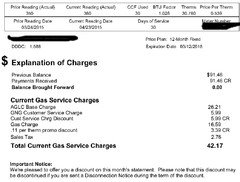
sk_dolcevita
Original Author11 years agolast modified: 11 years agoRe: electricity charges - here are the published rates (http://www.psc.state.ga.us/calc/electric/GPcalc.asp):
WINTER - October through May
First 650 kWh: 10.87¢ per kWh
650-1000 kWh: 9.89¢ per kWh
Over 1000 kWh: 9.78¢ per kWh
SUMMER - June through September
First 650 kWh: 11.71¢ per kWh
650-1000 kWh: 16.25¢ per kWh
Over 1000 kWh: 16.63¢ per kWh
Only during summer (June - October) we go above 650 kWh break-point and as high as 1100 kWh.
Again, by taking the period out when we have no heating or cooling, I can estimate the annual cooling cost to be around $350.
So total annual heating + cooling cost = $425 + $350 = $775. If I assume this number is evenly distributed between the two floors, and that my new system gives me 30% savings over my outgoing 1994 SEER 10 system, my estimated efficiency-related savings are = 0.5X $775 X 50% = $116 per year. That is much ado about nothing :-(
sk_dolcevita
Original Author11 years agolast modified: 11 years agoIt seems equipment and its install is now nailed down. I am happy with what I am getting and what I am paying for it. However, just got blindsided with a monkey wrench. My neighbor is building a swimming pool and just informed me she will be putting 6' high privacy fence between our properties due to code requirement. Well, this means the ingoing unit will be 12" from the house wall and 12" from the fence on the other side. I am told this is bad; it will make the compressor work harder and hotter due to poor circulation, negating some efficiency gains as well compromising its longevity.
If the above is true, the solution is to move the outdoor unit to another location. I have been quoted $950 for this task which includes:
"Relocate
AC to back of home includes (new refrigerant lines, new low voltage control
wire, high voltage and disconnect, refrigerant lines to be concealed in
paintable downspout)"Does this seem reasonable? The materials cost is not much here, probably $100. Is $850 a good number for labor?
- 11 years ago
I would ask neighbor to pull fence back 1-2 foot to allow you proper clearance and servicing room. His problem should not make a problem for you. Mark off the measurements you require and see what his reaction is.
If my decision, I would not get the HP and I would upgrade to the Perfect Fit Trane cabinet.
Make certain dealer knows how to set up dehumidify on demand.
TD
sk_dolcevita
Original Author11 years agoDealer has agreed to change to a Perfect Fit media filter and change the thermostat to Honeywell Prestige YTHX9421R5085at no extra charge.
HP to not HP --> OD unit + coil goes from 4TWR6030H1 + 4PXCBU36AC3 coil to4TTR60301000A + 4NXCB032ACA,
but there is no change in price due to $400 utility rebate for an HP.
So the only reason to not to go with an HP would be something related to
longevity, reliability, and repair costs. What do the wise men say?- 11 years ago
I would not change thermostat...why do you want to?...if the cost of the HP is a wash taking into acct the rebate, then go with HP...keep in mind the life of the HP is less than straight AC but you do get that flexibility between fuels..any more action about the clearance issue?...I hope you have discussed with your neighbor and an accommodation can be reached...
sk_dolcevita
Original Author11 years agoAlso, talked to the neighbor - she is not budging. She has about 15' of space available and I requested her to consider moving the in fence by 1'. Unfortunately, she just keeps reading me her property rights and that she has the right to put the fence right on the property line. Ten years of good neighborly relationship gone down the drain. Oh well, her loss...
So here is the situation with the OD unit. In current location, the unit is going to have 15" - 18" on either side (the other two sides have lot of open space). Is this good enough?
The cost to move to a new location is going to be $950 for ("Relocate
AC to back of home includes (new refrigerant lines, new low voltage control
wire, high voltage and disconnect, refrigerant lines to be concealed in
paintable downspout"). Is this a reasonable price?- 11 years ago
How do you and neighbor know where the property line is? It is customary when building fences to pull fence 6-12" off a known property line. If there is a doubt about property line, I would insist that neighbor provide a site survey. Why is neighbor being so stubborn? Does the loss of 6-12" really make a difference? I won't comment on the relocation price since I can't see what's involved.
What does dealer have to say? Does staying in same spot with new condenser(you have the physical measurements?) affect warranty? If dealer says no, I probably would lean staying put. But get this in writing.
IMO
sk_dolcevita
Original Author11 years agolast modified: 11 years agoThere is about 14' between out property, 4.5" on mine, and rest on hers. She pulled county records that show the property line and it is consistent with our understanding. She is adamant about what her property rights, literally not yielding an inch :-) So I give up. I will, however, try once more to see if she would be amenable to cutting 6" off from the bottom of 4 planks in front of the unit (or let me drill several holes in them). That should help the unit in being able to pull more air from that direction.
Of the four dealers I talked to, only one was emphatic about relocating the unit. The other three, including the one who will get the job, say they are not crazy about the fence being so close but they think it will be OK. I have to check if he will warrant the install in the current location in writing.
The physical dimensions of 4TWR6030H1 are 50"H X 37"W X 34"D. That leaves me 20" to play with. Trane's installation manual has "Suggested Locations for Best Reliability" and it calls for 12" minimum around all sides. So I am short 4". Since this just a suggestion, I don't know if I can go with 10" on each side and how much of an issue is that. I am hoping Trane has enough tolerance for this built into the system. For example, Carrier's instructions for 24ANA Infinity call for only 6" on one side closest to the wall and at least 12" on other three sides.
Everything was going so smooth until till this fence came up and I saw a new side of my neighbor.
sk_dolcevita
Original Author11 years agolast modified: 11 years agoI came across this website/worksheet to do HP versus furnace analysis:
www.eia.gov/neic/experts/heatcalc.xlsAccording to this website, at my current natural gas rate ($0.429/therm) and electricity rate ($0.132/kWh), the cost of million BTUs is $5.36 and $14.78, respectively. For an HP to make sense, the gas prices have to go above $1.19/therm. So it seems I will need to turn the HP functionality off for several years for now and turn it on if and when gas prices go above that threshold. The only reason to get HP right now is that it is a free option (after rebate) that would serve as an insurance for future spikes in gas prices.
Does my understanding make sense?
- 11 years ago
I don't think your neighbor is being as unreasonable as you seem to think. I live in a city and our yards are small. Every foot does matter sometimes (just as you're finding out in trying to locate your compressor, of course). Your neighbor paid to buy her lot and pays property tax every year on it, so she should be able to enjoy all of it, consistent with the zoning/setback laws. If your neighbor asked to locate the fence 1 foot on your property line for that 4 foot run, so that she could site her pool more advantageously, what would you have said? That's exactly the situation you're asking her to do, just you're asking to invisibly reserve and use airspace on her property for your benefit.
If you're only short 4 inches on the recommendation, I wouldn't worry about it. I'd let the contractor install the unit in that location, and it might be better to take all the shortage on one side (rather than splitting it) based on how the unit may need to be serviced down the line. Any inefficiencies are unlikely to add up to the present value of $950 to relocate it. Plus, the longer lineset is going to cost you a small amount of efficiency as well, no matter how you insulate it.
sk_dolcevita
Original Author11 years agolast modified: 11 years agoJim,
Yes, I have decided to not to relocate the unit. Even with hypothetically shortened life, I should come out ahead or even with the $950 option of relocating. I think it is a reasonable bet. The new unit will have 12" between itself (control side) and the house wall, 8" between itself and the new fence and the other two sides would be wide open.
I never said she was being unreasonable. Of course, she has legal rights. However, legal rights are not the only dimension to judge what may be optimum. She and I have been neighbors for over 15 years and have had a cordial and friendly relationship. It is likely that we would be neighbor for another 15 years. Or even perhaps for the rest of our lives. So yes, she is legally right but her brusque behavior and unwillingness to even talk about mitigating alternatives has torpedoed all the goodwill that we had built and hoped to enjoy for years to come. In any case, I have made peace with it. It is her loss. She is not going to have a friendly and warm neighbor, and if she is OK with it that's fine with me.
BTW, I had offered her two solutions - offset her new fence 4-6 inches into her property (she has 11' space on that side and that space is used very infrequently (her condenser units are located there and sound like a helicopter). This would have not affected her enjoyment of her new swimming pool or property in any humanly perceptible way. She wouldn't listen to that, so I suggested another solution. I asked her if she would be amenable to replacing 6 planks in the section of the fence in front of the condenser with a lattice. This would help bringing up the air circulation on that side to whatever is desirable. She just walked away.
Couple of months ago, she had motion-activated high brightness halogen lights installed on her house. To our horror, these lights were aiming squarely at our main bedroom windows. Our bedroom would light up randomly during night (curtains and blinds helped but not enough). I asked her if she could have her lights re-aimed. She refused saying she could do whatever she wants on her property. Again legally right but a disturbed mind.
It is also worthwhile remembering that one would probably enjoy one's property more if one has good neighbors (among other things such as the neighborhood, etc.). There is social aspect to enjoying one's property. That is, unless you wanted to live on social media.
In closing, I can do lot of legally allowed things on my property that would be absolute nuisance to her. For example, I could install a security cam on my roof with a wide angle lens capturing her backyard and stream it live on internet for crowd monitoring. I could do it in such a way that it would be all legal. But I wouldn't because I have better things to do in life. It's a sad life where you have to be a lawyer all the time.
- 11 years ago
That does certainly paint a different picture in totality. I'm confident you made the right call on the AC location and wish you the best of luck with your neighbor...
sk_dolcevita
Original Author11 years agolast modified: 11 years agoThe install is scheduled for next week. However, I am going over the deep end regarding HP or no HP.
Based on commodity prices ($0.429/therm gas and $0.132/kWh electricity) and HSPF of 9.0 (AHRI 7562134), I am getting $0.52/100,000 BTU for gas furnace and $1.467/100,000 BTU for HP using this website. I don't know why my numbers are different from Tiger's, but in either case gas heating is cheaper than HP at the moment in Atlanta.
If the above is correct, I am basically getting an HP (at no additional cost) only as an insurance against future spikes in gas price. However, in return I am getting a much more complex system (compared to a straight AC) with adverse implications for operating ease, longevity, maintenance, reliability and repair costs.
And then there is a practical issue. The ideal configuration would be to lock the HP out till gas/electricity pricing dynamics becomes favorable, which could be many years down the road, if at all. I am told this lock-out outdoor temperature is set on the thermostat. I have looked around to see how high can this HP lock-out temperature be set. Ideally for Atlanta it would make sense to lock the HP out in 65 - 70 F range so it never comes on. However, from the little I have found googling, it seems the highest one can go is to 55 F.
Is there a way to hardware disconnect the HP (versus software disconnect through the thermostat)?
Running furnace with manual override of HP on thermostat is not an option - I would like the HP to remain invisible until I need it.
Any advise/suggestions/tips? My installer and every other vendor - six of them - that gave me a quote still believe HP is cheaper than gas furnace. They cannot explain why even when I show them the cost numbers. I have to figure this out more or less on my own with your help.
- 11 years ago
My advice would be to forget about the heat pump and get the AC only, even if you can get the heat pump at no cost after the rebate.
If you do get the heat pump, you should be able to wire the thermostat so that it is configured for a furnace and AC only,
- 11 years ago
Realize that your COP/HSPF numbers are blended numbers across the entire heating season.
The air-source heatpump will be much more efficient when the outside temps are in the 50s/60s than it will be in the 30s/40s. The HSPF blends all of that together, but you will find during the shoulder seasons, that the air source heat pump will be a cheaper source of heat than your furnace, even with the stated energy costs. As it gets colder, the furnace will win. That's why you might be having a hard time finding a lock out T-stat that can be set into the 60s, as there's no reason for it.
sk_dolcevita
Original Author11 years agolast modified: 11 years agoJust wanted to update on my project and also clarify few things -
My HVAC system was finally installed on June 25. Just to recap, it is a dual fuel system for upstairs (~1400 sq ft) with duct work in attic:
Trane XR16 Comfort system
AHRI #: 75621904TWR6030H1000AA single stage heat pump/condenser, 2.5 ton
TUD2B080A9V3VB 80+% afue variable speed two-stage gas furnace
4TXC high efficiency evaporator coil
R-410a refrigerant
Nexia Model 824 thermostat
AprilAire Media Air Cleaner (filter) 2410
used existing line setsTotal cost $5,477 (includes $500 in utility rebates).
Few pointers in case they can help someone:
(1) The install was eventful, unfortunately. It started with wrong equipment being brought in for install. Fortunately, I had the sense to compare the stickers on the box to what I was expecting. So this delayed install by several hours as the correct equipment was brought in. So do check what your installers bring before they proceed with unpacking.
(2) I let the installers do their stuff but made two demands. First, let me know when they braise and flush the line set with nitrogen so I can observe. And, second, have me present when they are ready to stop pulling the vacuum - I wanted to see 350 microns or less (recommended by Trane's installation manual) with my own eyes.
I managed to see the braising/flushing process - it took only few minutes. I am not sure what I should have expected here and all I can is to hope this duration was sufficient.
As to pulling the vacuum down to 350 microns or better, I didn't get to see it. They started pulling vacuum and after two hours or so the gauge was reading about 900 microns. Another hour or so, we were down to about 750 microns. At that point, I decided to run a quick errand and was out no more than 30 minutes. When I came back, lo behold, the vacuum pump had been disconnected and system already charged. I was dumbfounded and questioned the installer how the pressure dropped from 750 microns to 340 microns in 30 minutes I was gone. His answer was that pump oil needed to be changed and once he changed it, the pressure dropped like a rock. He showed me the picture of the gauge reading 340 microns. I didn't have the presence of mind to check when that picture was taken, so now I will live with my doubts about this. If they are honest, then the vacuum was pulled to 340 microns. If not, it was some number around 700 microns. I am kicking myself for running that errand.
(3) In general, I felt my installers rushed through final hours (they were on their second day due to the equipment mix-up and delay) and didn't spend enough time explaining the workings of the new system and especially the thermostat. In fact, their lack of understanding of thermostat was less than desirable. They basically connected the wires and let the thermostat ride with the settings it was shipped with. That brings me to following three points.
(4) Compressor heat lockout - as discussed previously, given my very low gas prices, I wanted to lock out heat pump heating at as high a temperature as possible. The sales guy said "no problem, we can set it at 50 F." The installer said "no special setting needed, the thermostat comes with default set at 60 F." Well, this ain't true. I found this after the crew left and I figured out how to get into the technician access menu for the thermostat. In absence of a wired outdoor temperature (ODT) sensor, the compressor heating cannot be locked out with Nexia 824 - that menu is blocked. I have called Trane (it is almost impossible for residential owners to get in touch with Trane tech support) and they couldn't tell me at what temperature heat pump would be locked out in absence of ODT sensor. My dealer has no clue and is wondering why I am asking. My best guess is that this number is 30 F but this is just a guess.
With my own research, I found that if I was to install an ODT sensor, I can unlock the lockout menu and set the compressor heating lockout at any number up to 70 F. So I have asked the dealer to supply an ODT sensor. Not sure if they will.
Moral of the story - Nexia smart thermostats allow great flexibility for setting heat pump lockout provided you have a wired ODT sensor. Get it.
(5) After few days of use, I noticed that the system cooling cycles in 4 minutes on/4 minutes off cycle. I didn't like this as everything I had read tolls me that you need about 10-12 minutes of cooling on to efficiently remove the humidity. Also, such frequent cycling is bad for compressor life and efficiency, and the frequent on/off sound is very distracting. So I called the dealer. They sent a tech, and the guy stood there staring at the thermostat and wondering why was I complaining since the system was cooling just fine. Then he told me to disable dehumidification. I didn't like that (not the least because the sales guy mentioned dehumidification at least twice per minute when he was trying to make the sale) but I obliged. Two days later and the system is still cycling 4/4.
This is when I noticed my thermostat has been set at 6 cycles per hour for compressor cooling. This is different from 3 CPH recommended as default in the thermostat manual. So I called the tech again. I was told they don't mess with thermostat settings; thermostats are installed as shipped. I asked about the disagreement with manual and I got blank stares. I am persisting on dealer finding out from Trane (1) what the correct CPH setting should be, (2) if that (setting of 6) is the cause of observed short cycling, and (3) if not, then what. I am not hopeful.
(6) System fan - this one I am confused by the observed behavior. I have a variable speed blower. In cooling mode with fan set in auto, I can hear the fan and feel the air flow. The thermostat system status shows fan in auto mode at 100% speed. It is always at 100%, never lower. So I guess variable speed does not work here and one gets 0 or 100%. More confounding is what happens when I turn the cooling mode off and set the fan to manual on mode with 100% speed. I hear nothing. No sound and a weak air stream. This doesn't make sense to me and I asked my dealer about it. They think I am an idiot.
I haven't paid the dealer yet.
- 11 years agolast modified: 11 years ago
7562190 ActiveSystems TRANE XR16 TRANE 4TWR6030H1 4TXCB004CC3865 *UD2B080A9V3 28800 13.00 16.00 27400 9.00 18300 1HRCU-A-CB 218538 Yes
The furnace is oversized. Sorry to say it but that's stupid especially when I pointed it out in earlier post. You bought a 2 stage furnace and the fact is you should never ever have a need to use high stage.
2-3 CPH on condenser.
DF systems should have outdoor sensor so homeowner can control lockout on HP to nat gas.
Good pricing but I don't like the level of install.
IMO
- 11 years ago
How can there be a heat pump lock out temperature if there is no outdoor temperature sensor? The default may be 30 degrees, but the heat pump has to be told the outdoor temperature. Does this make sense?
It is sad when an HVAC contractor doesn't know how to properly set up a thermostat. Good for you for being persistent and figuring these issues out yourself.
sk_dolcevita
Original Author11 years agoMike, the thermostat gets outside temperature from internet. But when used in this mode, heat pump lock out cannot be set. If the lock out is set to some default temperature in this case, I cannot get any one to tell me. But there were some hints online that this may be 30 F.
- 11 years ago
If there is a default, then it will be in the installer's documentation. The fact that you can't change the default leads me to believe the lock out will only work with an outside temperature sensor. Don't go by online "hints".
I don't know anything but this thermostat, but I assume the outside temperature display is there as a convenience only.
You don't need the heat pump. It is not going to save you any money. Let your condenser rest during the winter.
- 11 years ago
Obviously that furnace is oversized...if not trading it in for the 60 K model, I would have the high stage of the 80 K decommissioned. Hate to see this and shame on the dealer who should know better.
IMO
sk_dolcevita
Original Author11 years agoMike, yes. They have to give me the wired ODT sensor so I can lock out the heat pump. This was discussed between them and I several times before I signed on the dotted line and they had assured me this was possible. So as far as I am concerned they have to deliver on it even if it required ODT sensor.
I just found another issue as I dig into this mess. I was trying to understand the fan behavior. In particular, from the sound it seemed the fan always ran at one speed. I was puzzled and digging into the thermostat menus, I confirmed this. The fan was either 100% or 0% speed. And it runs for additional 1 minute or so after the compressor shuts off (cooling fan delay). I found this odd - why did I buy a variable speed blower and why was I sold one. I mentioned this to the dealer and could get a satisfactory explanation. And then I checked the install guide - and it was there (see attached, in particular the graph and the table). There are four settings one can choose from. To really benefit from the variable speed the jumpers on the inside unit need to be configured in so called enhanced mode (option 4 in the table) where the fan starts at 50% speed and then to 80% for about 1 minute (fast cooling); the fan then stays on at 80% for 7.5 minutes (dehumidification); if necessary, ramps to 100% to get to the set point temperature and stays there as long as required, and ; ramps down to 50% and then 0% over three minutes to extract extra cooling efficiency. Well, this is not how my system has been configured. Mine is configured as option 2 in the table - 100% fan speed, followed by 1.5 minute delay - there is no variability of fan speed that can kick in.
I have call in to my dealer...sk_dolcevita
Original Author11 years agolast modified: 11 years agoTiger,
I did ask the sales guy to downgrade to 60K. Not only I listened to you but I had a manual J done and the answer was about 54K. So 60K made sense and that's what I asked for (and the sales guy agreed). After much digging I see what happened. This seems like a big disaster. The TUD2B080A9V3VB furnace is specified as follows:
1st Stage Input BTUH 52,000
1st Stage Capacity BTUH (ICS) 41,600
2nd Stage Input BTUH 80,000
2nd Stage Capacity BTUH (ICS) 64,000They gave me a furnace with 64,000 BTUH 2nd Stage Capacity. Are the furnaces specified by input or capacity? If input, how was I supposed to know? I told the sales guy several times to double check and he was sure... :-(
Given all the problems, what should I do? Any suggestions?
- 11 years ago
When they come back, I would have dip switches checked at the furnace. The default settings from the factory are never correct. Dbl check Comfort R as well.
IMO
sk_dolcevita
Original Author11 years agoTiger, re: furnace capacity (see above) - is furnace specified by input capacity or output capacity? And when manual J says 54K, is that referring to input or output?
I just want to confirm it is input in both cases before I go nuclear on the dealer.sk_dolcevita
Original Author11 years agoAlso, when you say "dip switches" are you referring to what I posted regarding fan operation above, or there are some others. Also, what is Comfort R?
I am sorry I am asking this basic stuff. I did the best I could and was hoping the dealer/install crew knew what they were doing.- 11 years ago
Furnaces are advertised by input capacity, but it is output capacity that matters. Your house needs 54K BTUs, so you need a furnace that outputs that much. An 80K BTU furnace at 80% AFUE will output about 64K BTUs in the high stage.
If you had purchased a 95% AFUE furnace, then the 60K size would have been sufficient. If your house is 2700 sq. feet then I don't think the furnace is over sized. I would have rather seen you purchase a high efficiency furnace. I assume the installation would have been very difficult.
sk_dolcevita
Original Author11 years agolast modified: 11 years agoMike,
This furnace is for upstairs only (1400 sq ft, 11.5 windows, 1994 build, good airflow, average insulation, Atlanta). There is a separate furnace for downstairs (1350 sq ft) in the crawl space. There is a high-ceiling entrance foyer with a tall palladium window common to both and this area was not included in the manual J (i.e. this load was given to the downstairs 80K furnace).
Note that the previous furnace provided by the builder was a 80K input furnace but I didn't know of cycling issues then and never paid attention to it (ignorance is bliss). So I don't have a data point from there as to whether that was correct sizing or not, but hopefully builder did his sizing correct ;-)
So when someone tells me that manual J says 54K, do they mean output capacity? I think this is the central question - if it is indeed output capacity, then most of the time the furnace will run in 1st stage at 41.6K output and move to 2nd stage only on coldest days. Hopefully this is not too of a bad design?
I was told 95% efficiency furnace was not allowed for an attic install here. I vaguely remember another vendor telling me this was due to increased risk of CO leak, but it could have been something else (or sales guy just making up something, who knows). So I went with 80% efficiency. Also, I thought that most of the heating load would be handled by downstairs furnace and that would be the place to spend money on higher efficiency. In the meantime, variable stage two-stage furnace for upstairs would give a sweet spot for bang for the buck.
- 11 years ago
Now I understand why Tigerdunes thinks the furnace is over sized. It is only heating half the house. Sorry for the misunderstanding.
The winter design temperature for Atlanta is 23 degrees. I am skeptical the upstairs requires 54K BTU.
Most installers won't put a condensing furnace in the attic for fear the condensate will freeze. Properly applied heat tape will solve that problem.
I hope you will get the installation issues resolved. I don't have a lot of confidence in this installer. Keep after him until everything is resolved to your satisfaction.
- 11 years ago
Get that furnace changed out to the 60K model. Plenty of BTUs for your upstairs zone. You won't regret it.
IMO
- 11 years ago
Installing the temperature sensor may be a bit tedious but it is straight-forward. It should have been done beforehand. The installer will have to 'tell' the thermstat that the sensor is there. Have them place the sensor in a shady spot so as not to be influenced by sun or the HP unit itself.
Now that I see this is a communicating furnace, the thermostat should show the fan info. So ditto the advice to have the installer recheck the dip switches in the blower. These guys don't seem to know anything about it so maybe you'll need to get the installation manual and show them what to do. Same for the thermostat.
With regards to the lockout settings, the normal approach is to have an overlap of the temperature ranges for the HP and the auxiliary (gas) heat. In your case, you desire these temps to be rather 'high'. Like stated above, I would not be upset or otherwise freak out if the HP runs above 60*. It's going to be very efficient at that high a temperature. But you are the one who will be observing the bills so you can watch them.
With that in mind, I might recommend a low HP cutoff at 55*-60* and a gas turn-on at 60*-65*. You will always want the gas number to be higher than the HP number by a few degrees. This keeps the thermostat from getting confused if the outdoor temperature oscillates (which it can).
Dip switches: besides the fan profile you picked up on, the fan speed (volume in CFM) needs to be set to match the tonnage of the HP. Furnace blowers allow for a range of values and I bet the default is not 2.5 tons.






tigerdunes