Software
Houzz Logo Print
s8us89ds

Crazy, Hippie, Untamed, Wooded Back Yard?

11 years ago
last modified: 11 years ago
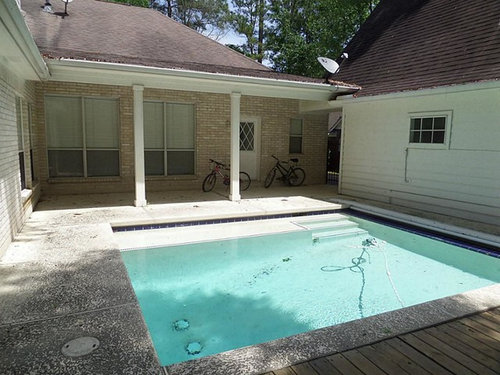
Here's a picture of my neighbor's back yard:

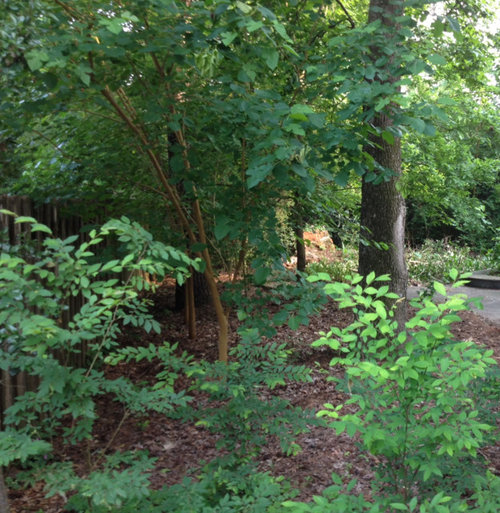
And here's a picture of my back yard:

As I ponder it, I suspect that I have too much hardscape. My goal is to have my entire back yard covered in leaf litter, underbrush, etc. The wildlife loves it. Luckily the neighbors can't see it. There have been no confirmed cases of West Nile Virus yet, so I'm cautiously optimistic about mosquito-borne parasites.

Comments (33)

  • 11 years ago

    Plants are good! Here's wishing you much success. Just be aware of non-native invasive types-they can wreak havoc on such areas-and you should be fine. and no, not at all saying don't use any non-native species, just to watch for known troublemakers.

    +om

  • 11 years ago

    Hi, thanks. My back yard is 95% native. I have 1 invasive Chinese Tallow Tree that I need to girdle one of these days. And I have 1 small Loquat tree that I keep for the fruit. Everything else is native. I get regular visits from my neighbor's Bamboo, but I cut those visits short.

  • 11 years ago

    Very nice...and I applaud you...I'm doing a mini-meadow in the backyard myself.

    s8us89ds thanked dbarron
  • 11 years ago

    Thanks! I don't feel so quite freaky and strange any more!

    I haven't done birdbaths or bird feeders yet. I have mixed feelings about those, but that's a discussion for another day.

  • 11 years ago

    For my part, I dislike the common practice of "feeding" birds. I believe it does more harm than good. But supplying food-bearing plants-that I do endorse and do much of myself. And water is good. I see incredibly dumb admonitions to "not leave water in your bird bath", etc. when in fact, all one need to is keep the water fresh, thereby eliminating mosquito breeding. It's really simple to do. And the birds def. enjoy it.

    +oM

  • 11 years ago

    I may be one of the few folks that agrees with you on avoiding artificial bird feeders.

    I think artificial bird feeders teach birds to become dependent on humans instead of honing their natural survival skills. And then all it takes is one homeowner to move, die, run low on money, forget, or get bored...and then the local birds lose a significant food source. A food-bearing plant is my idea of a more permanent bird feeder, safe from the whims of humans.

    I also think an artificial bird feeder could also become a conduit of diseases among animals, as I've read some folks allege. I suppose it could also become a conduit of human poisons through disintegrating plastics, peeling paints, fading finishes, and contaminating soap residues.

    And artificial bird feeders are probably also perfect hunting traps for cats and other predators.

    And I'm not sure that artificial bird feeders make sense from a dietary perspective. Birds eat mostly wild berries and insects. If we fatten them on too many sunflower seeds, they're not really getting the kind of diet that they have evolved to eat.

    We humans mess up ecosystems badly. I think we should try to keep things as natural as possible. An artificial bird feeder just seems to screw things up on many levels. It may be fun for bird watchers. It may make people feel good for a little while. But I don't think it's the right approach for maintaining wild bird populations. Call me a cynic. :)

  • 11 years ago

    Thank you for summing up the idea behind my previous post! And I would add to the list of dangers when purchased "bird seed" is fed to birds-the possibility that it may have been produced by Scotts/MiracleGrow/conglomerate corporation and actually contain pesticide residue. Yes, this really happened!

    +oM

  • 11 years ago

    Ouch. And since you mentioned artificial bird baths, I'm more open to them...but I don't want to set myself up for the commitment of having to change the water every several days...for the rest of my life. I wish there were some sort of bird bath that would change itself...and not require any electricity.

  • 11 years ago

    I manage to keep mine clean and fresh with minimal work. A hose nearby (or my dehumidifier water) which I use to both blast out some old water/stuff floating in that water and then refill. Honestly, we're talking seconds of work per day in my setup.

    +oM

  • 11 years ago

    Both the Audubon Society and the National Wildlife Foundation among others recommend feeding birds with several caveats. Don't bother reading on if you aren't even willing to rinse and change the water in a birdbath every three days!

    Basically, because we have indeed messed with nature, birds need supplementary food. Yes, it is lovely to think we should keep things as natural as possible, but the reality is that most don't. Honing their natural survival skills is not up to us, I think, especially since we have and continue to destroy their natural habitat. Not many people garden with native plants, although awareness of the need to do so is growing. With all the pesticides many use, especially in suburbs and rural areas, insects are harder for birds to find. There are many seed-eating birds and many who will eat seeds when other food is scarce or just to supplement their diet. Winters like we had here on the East Coast this past year make it very difficult for non-migratory birds. Also, many migratory birds need extra nutrition when they are about to begin their spring or fall migrations. Leave your perennials standing since birds will eat the seeds from the seedheads that are left standing when other sources have disappeared.

    I feed year-round. I put out suet in all months other than the really hot summer months when it would be a melting mess. The birds decide when they need the seed. There are times of year when feeding is heavy and times when it is less so. Remember that most berries do not appear until mid to late summer. Putting out a variety of foods (including nuts, cracked corn, fruit) is a good idea and spreading feeders out is a good idea.

    Do buy seed from a specialized store rather than big box store or grocery. It is expensive, but you can buy specific types and there is less waste. They are also more likely to be careful about their seed sources.

    I just cleaned my tube feeders this afternoon when I got home from school with a bleach solution, rinsed well, and will refill in the morning. I also have two tray feeders that I clean regularly.

    If you don't want to do that or don't have time, then don't feed because not keeping feeders clean can lead to disease.

    A water source is especially important for birds which is partly why I mentioned a birdbath. Watching them flap around in the water is great fun, too, and enables them to keep clean. Young blue jays are a riot to watch. I have six water sources in my yard. I change the water in all of them every other day or every three days if feeling lazy or busy. It does only take minutes, so not a big deal for me. Like Tom, I drag the hose over and use that to rinse and refill. I also have used the water from our dehumidifier. :-)

    Only you can decide how much you are willing to do. I love waking to the sound of bird song every morning and watching the birds. They keep my insect population down and the robins hang out with me whenever I garden or water, waiting to move in to get the insects I disrupt or uncover. I cannot imagine not doing what I can for the birds. Disclaimer: grew up in the 50s-60s and Rachel Carson's Silent Spring was on a required 8th grade summer reading list. Turned me into a steward of our planet.

    Stepping down from my soapbox. Ha.


  • 11 years ago

    Gee, I thought I was the one who had mentioned bird baths! Oh well fellow traveler, we're in agreement on many points. I just don't like all the cheap bird seed mixes, the weeds coming up under the feeders, the increased chance of disease transmission, couple with the fact that overwhelmingly, reproducing birds need insects, not grain.

    +oM

  • 11 years ago
    last modified: 11 years ago
    We do agree on a lot, Tom. I mentioned the birdbath, but you gave more info!

  • 11 years ago
    last modified: 11 years ago

    I think you guys may be successfully starting to convince me into trying a birdbath. Maybe I'll even let it breed a few more mosquitoes. I already seem to have more mosquitoes on my property than the Amazon Rainforest because of my leaf litter "ground cover" everywhere.

  • 11 years ago

    You won't get mosquitoes from the birdbath if you change the water at least every three days-I use the hose to rinse out and refill our large one. Easy peasy.

    If leaf litter has anything to do with them, I am doomed! :-(

  • 11 years ago

    I might do it once a week or even once every 2 weeks. Mosquitoes aren't so bad. The bats and lizards need to eat, too.

  • 11 years ago

    It might not stay clean enough for the birds if you let it go a whole week.

  • 11 years ago

    Then again, while it may be a contagion source if you have sick birds....birds drink from dirty mudpuddles all the time.

  • 11 years ago
    last modified: 11 years ago

    My goal would be to make the bird bath as self-sustaining as possible: to set up something that could last decades or even centuries with minimal human input.

    I could let rainwater recharge the basin. We probably get at least 2 significant rain events most every month in Houston, aside from drought years. I could let mosquitoes breed - I could probably live with that. Maybe I could set up a "slow leak" in it so that the basin drains completely (or loses all its contents to evaporation) in 3-7 days. That would cut down on the bugs. That would also make it a periodic water source, generally available only after rainfall.

    I would also have to periodically clean out fallen leaves, otherwise it would eventually turn into a very shallow planter, filled with soil and weeds (kind of like neglected roof gutters).

    I could instead opt for a continuously-streaming water fountain, which wouldn't collect as many leaves. But then it would need energy to pump it. Electricity would be wasteful. Solar would be good, but then it wouldn't run at night or on overcast days.

    Or I could just dig a hole and be done with it. I've experimented with various small ponds in my back yard and they have mostly resulted in dismal-looking, black-colored, mucky, mushy, leaf-gathering, frequently-flooding, mosquito-infested, ill-smelling messes. And that's probably a pretty fair description of our local natural creeks, ponds, and bayous. It seems only toads, dragonflies, and gators are happy in them. When I see homeowners in swampy Houston putting in artificial ponds with bright-colored boulders and bubbling, crystal-clear water, I think it looks as natural as a washing machine in their yard.

    So getting back to bird baths, I'm envisioning some old stone, mildew-streaked, half-leaf-filled, brown-watered, buggy relic. Something straight out of an old churchyard. It can solemnly stand watch over the fallen leaves. It can be nestled in the shade of a thicket of Oaks and Holly. Will any birds ever visit it? Probably only when they're very desperate.

  • 11 years ago

    Update: After thinking about the bird bath idea, I decided to Google and found advice from the Cornell Ornithology Lab. They say mud puddles are what birds like best. They of course roast traditional feeders for a variety of reasons. I should have known.

    I actually have plenty of puddles right now in my back yard, thanks to Houston rains/flooding. And there are multiple retention ponds within a couple hundred yards of me, one of them in a park to the west and another along a golf course to the east. We have standing water in the irrigation ditches on at least half the properties in our neighborhood right now. I've seen these puddles for weeks during this rainy spring.

    Maybe the birds in my neighborhood have more than enough water sources in my area. I wonder if a bird bath in my front yard would even be used.

  • 11 years ago

    s8us, i don't know what you are reading from Cornell, but they do NOT roast traditional feeders and they talk about the need for clean fresh water. Maybe you should go with your first inclination and skip the whole thing. Here is a link to the Cornell Lab of Ornithology's web page: Cornell Lab


  • 11 years ago

    No sweat. I decided I'm too crazy, hippie, and untamed to go with a traditional bird feeder. It would look too normal in my untraditional yard. :) I decided to go with the mud puddle/pond/hole approach. I already have one that has been serving my local amphibian and mosquito populations for several years. I can't bear to fill it in for the sake of that sweet, noisy croaking all day and night long. I've seen birds and squirrels drink from it many times, too.

  • 11 years ago

    All things considered, a self-sustaining water source of some sort would be the ultimate. Not easy to come up with though. Me, I just have a postage-stamp yard with two birdbaths that I refresh frequently unless rainfall has done so. I really like watching robins and other birds splash around in it. They obviously like it. I also own 20 acres 60 miles to my north and there we've dug a "wildlife scrape", that is, a relatively shallow pond. to say it gets used would be an understatement. That's a wild and woolly place up there, with near-every type of habitat which can be found in the region in good supply. But here at home is just a typical city yard, albeit one holding many natural treasures.

    +oM

  • 11 years ago

    Tom, can you upload pictures of your postage-stamp-sized back yard?

  • 11 years ago

    I'm one of the leading dorks on GW...er Houz I still hate that word) and as such, have never posted a single pic, since joining in the early oughts. So I suppose I can "promise" to, but I never get around to it, lol.

    +oM

  • 11 years ago

    You don't have a smartphone or a tablet with a built-in camera?

  • 11 years ago

    Sure don't.

  • 11 years ago
    last modified: 11 years ago

    Same here, +om. Dumb phone here that I hardly use or carry. My wife answers the phone in the house as I'm usually outside.
    I just have an old Canon point and shoot camera that is far out of date and manage a picture or two. ;-)
    No bird baths or feeders here also, because of the ponds I dug with a bulldozer years ago. Feeders also concentrate the birds for other bird predators. Some 'Birders' have platform feeders just for that purpose so they can watch and photograph the predators in action. I see enough of that naturally.
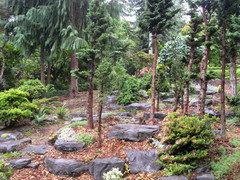
    I'm building a giant bonsai, miniature old growth sub-alpine forest, on
    a windy, rocky ridge. Whew! It still needs some work....always does.
    (It's not work, it's play!)

    Sedums and other small scale groundcovers are going to be added. The azalea will be pruned to look like a small deciduous tree.
    Going small scale enables a lot more interest in a limited area......and me with 10 acres. What am I thinking? Sure wasn't along the lines of a perennial cottage garden.
    Mike

  • 11 years ago

    Do I have to dig up old smartphones out of a box and mail them to you guys? :) The photos on this forum are half the fun. You know what they say about a picture being worth a thousand whatever.

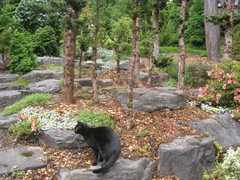
    Mike, that photo is great! But are those miniature rocks? To my eye, some of those rocks in that picture are 4 feet wide.

  • 11 years ago

    Some are almost 4 ft wide.
    I ordered a truckload (16 tons) of rock from a quarry and had them drop it off above where they are now. I then slid them down into position on a length of channel steel. A friend helped me. We used a couple of iron bars and each had a shovel. It wasn't too difficult as long as we didn't try to go too fast. Plus, as landscapers, we had a lot of 'practice' rolling square rocks around and getting the right side up and the face looking the right way so the best side is in view. Some rocks are better looking than others and after awhile you get to know them pretty well, but when they wink back at you, it's time to take a break. I call this rock placement style, 'Lumpy Strings'
    Here's a picture that gives it more of a sense of scale. The cat's name is Ali.
    She follows me almost everywhere......and 'helps' too!
    Mike


  • 11 years ago

    That's great stuff

  • 11 years ago
    last modified: 11 years ago

    Mike, I've said it before, but you've got one of the best gardens....period! And that's even with a cat in the picture!

    +oM

  • 11 years ago

    Thanks, +om. I value your opinion.
    I'm not governed by a lot of normal convention when it comes to design, but not to the point of being weird. I don't care if a tree is straight or not and I don't count blossoms as if they were cash. Form and the setting is more important.
    Anyway, thanks again.
    Mike


Sponsored