Software
Houzz Logo Print
gouda2

Kill Weeds before starting organic lawn care

11 years ago

Ready to start with the organic lawn care program.

My question is do I do a round of chemical fertilizer + weed b' gone to kill a my broadleaf weeds before starting. I have lots.

In the PNW.


Comments (22)

  • 11 years ago

    No fertilizer. The most efficient weed control will be with a chemical lawn weed herbicide, like Weed B Gone or one of the many others. I like the handheld spray formulation of Bayer All in One Lawn Weed and Crabgrass Control because you can direct the herbicide directly on the weeds. But it also comes in a concentrate or a hose end sprayer if you have a big lawn to treat.

    What's your next step? You are getting a bit late in the season to do much at the moment.


  • 11 years ago

    Probably start with the weed control.

    I would assume I can add compost and an initial protein fertilizer up until it starts to get really warm?


  • 11 years ago

    Using any product, such as Weed B Gone, is not something any real organic grower would ever consider, much less recommend on an organic forum, so no do not spray any "weed" killer now or ever.

    Start your organic lawn care program with a good reliable soil test so you have an idea what the soils pH and nutrient level is which can guide you in making necessary corrections to the soil so you can grow a good healthy turf which can then help control those unwanted plants called "weeds".

    Questions to ask about that soil start with How much organic matter is in that soil?

    How well does that soil drain?

    How well does that soil retain moisture?

    What does the soil smell like?

    What kind of soil life exists now? How many earthworms are there?

    How does the soil handle? What is the tilth like?

    Perhaps these simple soil tests might be of some help,

    1) Soil test for organic
    material. From that soil sample put enough of the rest to make a 4 inch level in
    a clear 1 quart jar, with a tight fitting lid. Fill that jar with water and
    replace the lid, tightly. Shake the jar vigorously and then let it stand for 24
    hours. Your soil will settle out according to soil particle size and weight.
    For example, a good loam will have about 1-3/4 inch (about 45%) of sand on the
    bottom. about 1 inch (about 25%) of silt next, about 1 inch (25%) of clay above
    that, and about 1/4 inch (about 5%) of organic matter on the top.

    2) Drainage. Dig a hole
    1 foot square and 1 foot deep and fill that with water. After that water drains
    away refill the hole with more water and time how long it takes that to drain
    away. Anything less than 2 hours and your soil drains’ too quickly and needs
    more organic matter to slow that drainage down. Anything over 6 hours and the
    soil drains too slowly and needs lots of organic matter to speed it up.

    3) Tilth. Take a handful
    of your slightly damp soil and squeeze it tightly. When the pressure is
    released the soil should hold together in that clump, but when poked with a
    finger that clump should fall apart.

    4) Smell. What does your
    soil smell like? A pleasant, rich earthy odor? Putrid, offensive, repugnant
    odor? The more organic matter in your soil the more active the soil bacteria
    will be and the nicer your soil will smell, to a point. Too much organic matter
    can be bad as well.

    5) Life. How many
    earthworms per shovel full were there? 5 or more indicates a pretty healthy soil. Fewer than 5,
    according to the Natural Resources Conservation Service, indicates a soil that
    is not healthy.

    kimmq is kimmsr

  • 11 years ago

    Where to begin with the above comment.........First, the OP is just beginning his organic lawn care program. Exactly how do you suggest he deal with the weeds that currently exist, of which he states he has "lots"?? Hand removal?? Are you volunteering?

    Going forward, a healthy, well-maintained organically grown lawn will outcompete weeds and any that appear can be removed by hand. But one needs to get to that point first. The reality of the world is that chemical weed herbicides are by far the most efficient and least disruptive way of dealing with what is currently present. Once that is accomplished, then he can proceed with an organic regime.

    The world is not black and white. There are many shades of gray and this is one of those areas where bending the dogmas regarding organic gardening makes the most sense. The rest of the post is the same, oft-repeated and typically unnecessary advice that poster responds with to virtually every single post. Too bad there is little to no connection to real world gardening and more useful advice.


  • 11 years ago

    Thanks for your advice. I have been mulch mowing. I think the compost, mulch mow, weed herbicide and deep once per week watering will be a good start.


  • 11 years ago

    Anyone that tells someone that wishes to be an organic grower to use materials that are not acceptable to an organic grower is not an organic grower, gardengal. Using Weed B Gone, glyphosates, and other similar products means that person will not be organic for a minimum of 5 years, maybe longer, no matter what else is done to the soil.

    Organic growers are concerned about the soil and getting the soil into a good healthy condition is what all real organic growers strive for and that means not using any plant poisons, ever. Often getting the soil into a good healthy condition means tilling in organic material to get the level of organic matter in the soil to where it should be, something that can be accomplished over the summer, but getting the soil into that good healthy condition before trying to get a lawn growing is essential otherwise one simply tries to play catch up forever after.

    kimmq is kimmsr

  • 11 years ago

    kimmsr, you really need to get over yourself. You are not the moderator of this forum nor are you the keeper of the "Organic Code". YOU don't get to make the decisions for anyone to decide if they are organic or not. One can choose to adopt organic gardening practices at any point in their gardening career. In the simplest terms that just means eschewing the use of synthetic fertilizers and pesticides and the moment that happens, they become an organic gardener. There is no "5 year rule" involved - there is a 3 year 'flushing out period' if one wants to become organically certified but that doesn't apply to home lawn care. Nor does it apply to the vast majority of other gardeners that wish to follow organic practices. Very few go to the effort of organic certification and those that do are farmers intending to sell their produce as 'organic'. Certification and its requirements has little to do with home gardeners or with organic lawn care.

    You seem to have little grasp of the real world. Sometimes compromises are made that get us to the point where we need to be quickly and efficiently. The OP using a weed killer is making that compromise. As soon as the weeds are taken care of, he can then embark on his organic practices and voila!! He is an organic lawn care practitioner! As for tilling up the entire existing lawn to improve the soil, that is just a ridiculous suggestion. No one does that. Soils can be improved over time via routine lawn care practices like aerating, spreading OM and mulch mowing.

    You do the concept of organic gardening no favors with your rigidly dogmatic viewpoint. Your continued harping on the way YOU think it should be done discourages and intimidates those who are new to this methodology. You scare people off by making it seem that unless they follow your strict adherence to the 'rules', they are failing in their efforts. Yes, using lawn weed killers are not considered organic practices but they are a fast and efficient means of getting to the point where one can embark on organic practices and continue them successfully going forward. And that I believe is the whole point.

  • 11 years ago

    Gardengal, someone needs to be the gatekeeper to keep people that have little knowledge of proper organic practices from making bad suggestions to people that want top be organic growers but need guidance.
    I am sorry you do not understand the basics of organic practices, and refuse to learn them.

    kimmq is kimmsr

  • 11 years ago

    Oh I understand them perfectly well :-)) Probably far better than you do. However, I also realize that people live in the real world rather than in some theoretical organic gardening textbook and need to make choices that work best for them. Moving towards an organic gardening methodology can take some time before the gardener can leave the world of chemicals behind. That doesn't make them any less dedicated to following these practices going forward.

    And you assume far too much. No one needs a gatekeeper.......least of all a self-elected one like you. Your knowledge of the practicalities of gardening - and lawn care in particular - is seriously lacking.

    I suggest you stop confronting me at every turn because you are not going to win this battle. You have been called on it many times in the past and not just by me.


  • 11 years ago

    I once saw an environmental ad of some sort.. and it talked about "shades of green". It spoke about everyone taking small steps to be more environmentally friendly in their lives.... and some people people will or will be able to take more steps then others... but how any step is a good step... as long as everyone is moving towards being more green.

    As a similar set up.... I recycle all the standard plastics that our local curbside recycling company will take... but I also keep the #5 plastics that they don't take and periodically will drop them off at whole foods... who take this type for some recycling into tooth brushes of some sort. Chastising a neighbor that only does the curbside recycling... but throws away #5 seems counter cause to me.

    Can't we all just be a "shade of green" vs "green or not green"


  • 11 years ago

    I did not know we were at war, gardengal. I did not know a discussion was a win or loose.

    Yes there have been many people that have disagreed with me in the past and there will be more in the future, but when someone suggests using synthetics, as you have, that tells me they do not have a basic understanding of organic growing.

    kimmq is kimmsr

  • 11 years ago
    last modified: 11 years ago

    @OP - You were getting a late start this year. Likely your lawn will still be covered with weeds this summer. I would encourage you to consider "Lawn Solarization". This process takes 4-6 weeks during the heat of the summer, and will kill all weeds, weed seed, and pathogens in your soil. The nice thing is, there is no chemical residue left over, so next fall when you do your overseed you will be in real good shape.

    One of the things I like about Organic lawn care, is that it forces you to think outside the box. It's easy to pickup a chemical weed spray, or manage a 4-step program... It takes soil knowledge and a buildup of healthy soil to successfully manage your lawn organically. I always tell people, if your really not into it, managing your lawn organically isn't going to work... Even when you are interested, it can be frustrating! That's why the vast majority of people go to the big box store and just throw around whatever they are selling... it takes effort to submit soil tests, analyze results, and apply compost/grains accordingly.

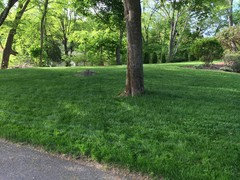
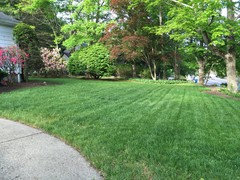
    This is my lawn, 6 years, no chemicals. Still not perfect, I have some problem areas, and keep learning more all the time.. but my neighbors finally "Get It".. They thought I was nuts when I told them I don't use per-emergence, weed n' feed, 4-step, ect...


    Lawn Solarization Instructions

  • 11 years ago

    I actually don't think it's too late to put down some fertilizer IF you are using something like alfalfa meal or soybean meal. It's what I did when I began renovating my lawn. You can't "burn" your lawn this way, even in the heat of summer.

  • 11 years ago

    I agree with DandyLioness. I too add Milo and cornmeal to my lawn during the summer along with Texas tea. I also mulch mow and cut at the highest setting on my mower. I make sure there is at least an inch of water every week (sprinkler and/or rain) and my lawn is dark green and thick with minimal amounts of Poa which I've learned to live with. I think the key thing here while fertilizing in the summer is making sure that your lawn has that inch of water per week during those hot summer months. If it's 3-4 consecutive 90 degree weather days I would water an inch again. I "listen" to my lawn and can tell if it is in need of watering after fertilizing during the summer, This is my second year going organic and my lawn is in its best shape it has ever been while living in my home since 2011. Compared to my neighbors whom use chem lawn care services, the difference is night and day. Their low cut grass full of chems browns during the summer. I've actually seen the lawn care service workers staring at my lawn wondering what I am doing. Feels good. :)

  • 11 years ago

    capt08, please identify what you mean by "Texas tea" since that may refer to oil, iced tea with various liquors added, or something else.

    kimmq is kimmsr

  • 11 years ago
    last modified: 11 years ago

    Hi Kimmq, sure. I got the recipe from a user at this website named dchall during the Texas Tea-off hence me calling it "Texas" tea instead of compost tea. Here's the link in case anyone wants to give it a go. It's inexpensive and easy to do. Works very well for me and hopefully it'll help others as well.

    http://dchall.home.texas.net/organic/teamaker/

  • 11 years ago

    So "Texas Tea" is just another name for aerated compost tea.

    kimmq is kimmsr

  • 11 years ago

    Embrace your broadleaf plants is my advice. If you subscribe to the monoculture philosophy of Scott's lawn "care" industry, then I agree with Kimmq, you are not an organic gardener. My lawn contains a wide variety of grasses, clovers, dandelions, and other wildflowers. Before it was lawn, it was dinner for many generations of grazing animals, and still is a nutritious dinner plate for the rabbits and deer who also help fertilize it. I use many of the lawn components on my own dinner table, ie dandelion greens in stir fries and salads, and mint in my iced tea, and chamomile to make herbal tea.

    There are plenty of non-organic lawn forums that advocate poisoning the landscape, but this isn't supposed to be, by its very nature.

  • 11 years ago

    Since I went all organic several years ago and finally became certified, I've been able to sell the composted grass clippings for a nice premium price.

  • 11 years ago

    I agree with spedigrees. Embrace the braodleaf "weeds". A mono-culture lawn is not really organic in my humble opinion. Keep it mowed (mulch mow), keep it watered, feed the soil from time to time and you're all set. I'm often told i have the greenest/nicest lawn on the street.

  • 10 years ago

    A lot of good advice given already. I suppose you could solarize the ground if you wanted to start with a clean slate.

    That said, you shouldn't have to live with weeds of any kind if you don't want to. Pull them up or dig them up. If they are so bad that you have to take out a large area, go ahead and do it. Just overseed with the desired grass seed and water it in. Keeping an organic lawn is a process, It's not like flipping a light switch.

Sponsored