Software
Houzz Logo Print
detour_gw

Question about crack in granite

11 years ago
last modified: 11 years ago

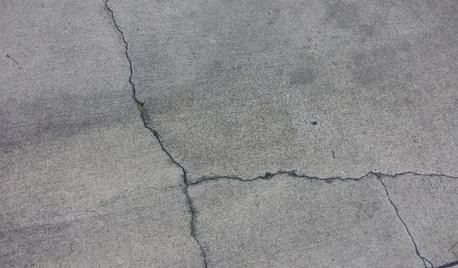
We redid our kitchen 2 years ago to include using Cold Stone granite for the countertops. When buffing the sealant during my last cleaning/sealing - I noticed (by texture) a crack in the narrower section of the granite. It is jagged in pattern, following the character of the granite and runs from the back to the front. When I contacted the fabricator regarding how to protect/prevent from getting worse, they casually wrote it off as being part of the risk of this type of granite and that it is probably just a fissure.

Out of curiosity as to how "bad" the crack is, I took out the drawers beneath it and examined the underside of the granite. The granite is covered with the mesh (as you would expect), but what I found odd is that there a skim coat of something over part of the mesh that appears to follow the line of the crack.

Given it's been 2 years, the fabricator is quick to refer me to their installer who will charge me for a service call to evaluate/fill - and they are adamant that the skim coat I'm seeing isn't any type of repair, nor an indication that the fissure was a known risk of cracking.

I'm not finding anything on use of this a skim coat type application to the back side of granite - so I was hoping I might learn something from someone here -

Is this a common practice used by the quarry? By the fabricator when fissures are identified? Should the fabricator have known not to have used this section?

Comments (7)

  • 11 years ago

    Fissures are a normal part of granite. Quarry repaired fissures are a normal part of some of the more decorative weaker stones with mesh that are making it to market these days. If fabricators rejected slabs with fissures, some stones couldn't be fabricated at all.

    Fissures and cracks can be repaired, usually almost invisibly. It's not a big deal. Call the stone professional in for a repair.

    And look to your floors and cabinets for settling issues. That's the only time that a repaired fissure will be under stress. But it generally opens up adjacent to the old repair as the glues used in repairs are stronger than the bond that the stone has with itself.

  • PRO
    11 years ago

    Set a straightedge over it. If it doesn't rock or show a dip, I wouldn't fool with it. Natural stone has cracks; get used to it.

  • 11 years ago

    Straight edge does rock a little.

    I fully appreciate the fragility of the more intricate and busy granites - of which Cold Stone is. And I understand it is a natural material, complete with imperfections and fissures. Note I didn't call the fabricator to complain or question what "they" did - I called to ask how to best stabilize and repair. Cold Stone, with all of the variety of material in it is beautiful, and we understood that that also adds to it being fragile (although the biggest risk is during fabrication and transport/installation - not generally once installed). I was just uncomfortable with how defensive the fabricator got when I asked about the skim coat-like material on the underside that it caused me to question whether or not I was getting the whole story - and hoping to learn more from the folks here when I couldn't readily find much of anything about when or why that was done.

  • PRO
    11 years ago

    detour:

    If your top was installed with wood shims, they could be drying out and/or compressing unevenly and putting pressure on the fissure. Keep an eye on it and see if it gets worse.

  • 11 years ago

    From what I can see of the underside, I do not have wood shims. Part of this particular piece was installed between top and bottom cabinets (top cabinets were pre hung to appear to sit on the granite) - so the installation was done by sliding the piece into place (versus setting on top of base cabinets). But having said that - there were clearance issues for it to slide in during the installation and I they had to undercut the top cabinet to get enough clearance - after a few attempts of brute force finessing didn't address the installation issue. I wouldn't think it would take 2 years for anything caused by that to appear though.

  • 11 years ago
    last modified: 11 years ago

    Being unlevel to either side of the crack means that something is settling and that spot is no longer fully supported. I'd put a level across the floor in front of that as well as the cabinet floor inside the cabinet. You need to know the source of the stressor in order to judge the severity of the issue. For instance, is this new construction or a new addition to an existing home? You'd expect settling to occur as everything continued to dry out if that were the case. Less so if this is a 70 year old home. That might indicate a different issue. Either way, the crack in the granite is only the symptom of the underlying problem. Cracks can be fixed. Easily. But the problem itself, may be or may be not be an issue in the future. It depends.

  • 11 years ago

    The kitchen remodel was to an existing structure without changes to the floor or flooring in this area (it's a dining room wall that used to have a free standing buffet, and now has built in cabinets - cabinets were installed over existing hard wood flooring). The cabinet configuration in this area is an under counter beer cooler, 27" wide base cabinet, 27" wide base cabinet and an under counter wine cooler. The right side of the wine cooler has a lower end panel, and base cabinetry continues to the left of the beer cooler. The uppers above both coolers go down to the counter surface. Because the wall of cabinetry extends to the left of the beer cooler, there is a seam in the granite above the left 27" base cabinet (towards the left edge). The crack is above the right 27" base cabinet. There are braces supporting the underside of the granite to the front and back of both coolers (ledger board, etc.).

    This is not a high-use counter area - not a prep area, not an area where hot or cold items would accidently get placed directly on the granite, and definitely not an area where one would support themselves to reach something else (the uppers are glass front display cabinets).

    Looking at trim and other finishes that might indicate settling - I can't readily identify where either of the 27" base cabinets or the end panel/braces appear to have shifted.

    It makes sense that something has changes to apply stress to the granite - just not sure what.