Software
Houzz Logo Print
sevimo

Too much Ca / not enough Mg?

11 years ago
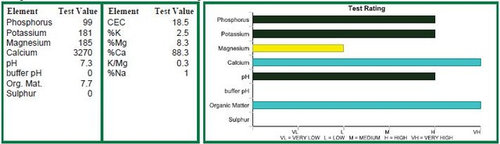
Hi, I've got my first soil test results, and I find them somewhat perplexing:


Perplexing because according to my previous pH-meter measurements I thought I have fairly acidic soil (5-6 range, depending on location, which is not unusual for Toronto), and this result came pH-neutral (even weakly alkaline). This is for a small patch of my lawn, so might be just a sampling error (will send out mix from a larger area later on), but assuming results are representative, what are the recommendations? Looks mostly good to me (pH actually works better for lawn, vs 5.5), except for a LOT of Ca, and not a whole lot of Mg. Is this a serious issue for a lawn (turf type tall fescue, if that's important). Can this be alleviated? I generally don't use synthetic fertilizers, but would epsom salts help? I've read different opinions on that ;)

Thanks!

Comments (12)

  • 11 years ago

    Have you been liming your lawn? That could account for the high Ca, depending on the type of lime used. Would also account for the higher pH reading as well.

    How is the lawn looking? What do you normally fertilize with?


  • 11 years ago

    The organic matter content is very good at 7.7% and that makes up for a host of apparent 'deficiencies'. I would say unless your lawn is showing symptoms that could be traced to Mg deficiency, there is no need to worry.

    How did you measure pH when you did it yourself? Did you collect a sample and make a 50/50 slurry with distilled water? If it was one of those meters that you just stick in the ground, that's almost certainly the problem. I would trust the lab value over a home test.

  • 11 years ago
    I didn't use any lime, but I own this place for less than 3 years, so it's hard to say what previous owners did. While I was here, I top dressed with compost twice a year, added soybean meal twice a year, and alfalfa pellets in spring only. This is a very small lawn, so I could put down a lot of this stuff ;) Also, I core aerated twice.

    The lawn looks much better than originally (I also overseeded a lot), but is still a bit too thin in some areas. Most likely, due to insufficient light - some parts are under high tree canopies, so I figured Kentucky bluegrass is not a good fit here. That's why I am replacing the lawn with turf type tall fescue, which should do much better in partial shade. Considering light is not ideal, I wanted to make sure that everything else (nutrients, soil prep) is as good as I can make it. Hence the soil test.
  • 11 years ago

    Albrecht, in his studies, wrote that the Ca:Mg ratio should be about 7:1

    I'd be happy with that soil.

    kimmq is kimmsr

  • 11 years ago

    Depending how good of a representative sample you sent in, if you really have 0 sulfur and low magnesium, them some epsom salt might be good.

  • 11 years ago

    I did my own measurements with a pH meter, but unlike $10 HomeDepot specials, this one is supposed to be fairly accurate.This is the meter I used. The results were pretty consistent (yet variable) across different spots in my backyard. Having said that, plugging this meter into soil would measure very top layer of the soil, vs a bit deeper that I've sent for analysis.


    I don't doubt lab measurements, but am wondering if my sampling was not good. What I did is this: first, I cut existing sod on a small patch of the lawn (~25 sq.ft that I was re-sodding), so top 0.5-1" of soil were removed. Then I core aerated this patch, so there were plenty of ~2" plugs (aerator goes ~3-4" down). Then I randomly collected ~1 lb of plugs in a plastic can, mixed it, and this was my soil sample. I should try chemical home method, to see if I can get similar reading to the lab. Any pointers on improving sampling (should I go deeper, take top soil/thatch into consideration, etc?)


    Now when I am thinking about this, there is a lot of hardscape (interlock, flagstone, retaining wall), all of which have limestone screenings as compacted base. Could it be leaching Ca / raising pH? There are no screenings under lawn itself (but it's small, about 20x15').


    And what would be specific Mg deficiency signs for a lawn (considering it is not in full sun conditions, so some lack of vigor can be attributed to that)?

  • 11 years ago

    Well, my Ca/Mg ratio is quite a bit higher than 7:1, more like 10+:1 based on saturation. Also, I thought that excessive Ca may suppress uptake of pretty much all other nutrients. Is this a concern, or does it happen with much higher Ca levels than mine?

  • 11 years ago

    Your sampling technique sounds fine, the plugs seem like an excellent way to get a composite sample of the top 3-4". You could try your meter again using a distilled water/soil slurry and see if you get a different result. And try it in vinegar and a baking soda solution to see how well it's calibrated.

    As far as the Mg, ask the lab that did the analysis what recommendations they have based on your local soil and climate.

  • 11 years ago

    Lab didn't recommend anything on Mg in the original test, but when I asked explicitly suggested SulPoMag at 5lbs/1000sq.ft. Sounds reasonable, I think.


    I am planning to re-sod the rest of the lawn ASAP, so will try to collect more samples from the whole lawn, and re-run the test (and do it with a home kit as well). We'll see how it compares.


    Still can't get over pH levels. I mean, our whole neighborhood is under humongous oaks, pines and spruces (native, not planted). These would generally favor acidic soils, correct? I even have several large native conifers right around the lawn. That's why it was easy to believe my own soil test. That to say, the soil under the lawn might be imported, or limed for a long time for all I know.

  • 11 years ago

    no, they do not favor acidic soils. I am under oaks, and the pH is 7.6. Add a bit of Mg fertilizer if you wish, but you have enough to support growth.


  • 11 years ago

    Depending on how big your lawn is, it might be a good idea to break it up into pieces and test a composite sample from each. If you have areas of high or low pH you won't know where they are if you composite the whole thing.

  • 11 years ago

    The Calcium and Magnesium should be in balance, just like any other nutrient, because plants need enough, but not too much, Mg to properly utilize the Ca and enough Ca to properly utilize the Mg, but not too much. An excess of one can interfere with the use of the other which could result in growth that is more attractive to insect pests and plant diseases, or Blossom End Rot, as one example.

    An old and long debunked tale is that evergreens, Oaks, and some other trees only grow in acidic soils, or that they will make the soil they grow in acidic. Not true. Same as Maples
    (Acer spp) growing in alkaline soils or making soils they grow in alkaline, again not true.

    kimmq is kimmsr