Software
Houzz Logo Print
cptk1

Cutting Propagation is Actually Very Difficult

11 years ago
last modified: 11 years ago

I'm sure that with intermittent mist and the drainage afforded by an outdoor bed, the success rate with some species can be very high. However, propagating plants from cuttings in a tote, or plastic bag, or other similar methods suggested by a plethora of articles on the web, is infinitely more difficult than some people will lead you to believe. Without intermittent mist, you are trying to balance environmental conditions on a knife edge. A little less humidity, your cuttings are desiccated and dead. A little more, they are rotted and dead. Same with the moisture level of your medium -- this in particular is incredibly difficult to get right. You need to sterilize everything, but you could just as easily kill your cuttings with the sterilization solution. Then there are light levels, temperature levels, time of day you take cuttings, time of year you take them, etc, etc. So many things can go wrong and if even one does, you will not be successful.

All the articles that state that "taking cuttings is a very easy way to propagate plants" are wrong.

Comments (36)

  • 11 years ago
    last modified: 11 years ago

    I agree with you.

    I think that when people talk about the ease of it, they are referring to easily-rooted species.

    Some species are at least a little difficult, and then there are those that are downright difficult. And what about the really, really difficult?

    With the latter, even with access to good conditions, unless everything is spot on then there will be problems. It is hard to get things spot on. Pipes leak. Contact with the heat bed is uneven. All sorts of things.

    I would like to have built a propagation house to my specifications. Not easy though, and it would be hugely expensive I suppose, and would it be worth it when my output probably wouldn't be huge. Thoughts?

  • 11 years ago

    I think the easiest things to get right are the following:

    (a) The time of day to take cuttings - early morning;

    (b) Care of the cutting material - pop it into a plastic bag, moisten the contents and keep out of sunlight. Make the cuttings asap but if you can't, put the plant material (in its bag of course) in the fridge.

    (c) Time of year to select material - this will depend on the plant species and is learned by listening to others, trial and error, reading etc.

    The things that are difficult are:

    (a) Getting a really good contact with the heat bed.

    (b) Preventing other people from opening screens/changing settings of misters/over-watering/under-watering/under misting/deciding that misting isn't any good and let's have fogging and other control freaks.

    I would love to start my own propagation business where I get to decide everything. I've only ever worked for other people.

    Trouble is, if I were to do everything myself, that's when I would really learn the difficulties I suppose.

  • 11 years ago


    There are certainly conditions at professional places, but let's just talk about the garden, where you have some better control about what is done.

    The complication may come when you're starting out, but after you get the hang of it, you'll realize there isn't as much difficulty as you may have first observed. For example, when you see those videos of experienced people doing it, they really literally are just "cutting it" and "sticking it in" the growing medium. That's it.

    Then of course, there are different methods that includes the transparent or opaque bag over the cuttings, maybe even some equipment which does the same thing but for more cost, and even

    But the most important thing that is not quite clear in every tutorial (though some mention it, once you realize and learn what you're doing --- they just mention it so fast that it seems less important), is how to take the cutting. I used to stick in stems that would seem to be OK as long as there was moisture, but it wouldn't root. I learned later that what you stick in the ground should have 1-2 leaf nodes, where you have removed the leaves. After gaining this understanding, I have a much better success rate.

    Now as far as the growing medium, the most important thing for my needs is moisture in the growing medium. I don't really worry about keeping humidity in some enclosed container, though I have used that myself. If I can just keep the soil moist, that works for me. To keep it moist, it can be an enclosed container, the bag method, or even a pot in standing water in a dish.

    As far as sun goes, yes I'm careful about full sun for the cutting. So it is either in morning sun only or shade. There are a few cuttings from plants that handled the sun just fine (such as succulents) but in general, I do take care of them in the shade or morning sun.

  • 11 years ago

    Cptk1, you certainly are the pessimist! With that kind of outlook, I'm surprised you feel qualified to grow any plants at all! I've grown many different plants from cuttings, some in bags and totes like you mentioned, and haven't found it nearly as difficult as you seem to have. Yes, there are things that can go wrong and ways you can improve on things once you gain experience, but it's not rocket science. I hope new gardeners aren't scared away by extremely pessimistic and unrealistic viewpoints like yours.


  • 11 years ago

    I have been propagating plants for several years. Each year I some what change my method always trying to increase my percentage of success. At present I am using a Nearing Frame, a fog system, and intermittent mist. This year I even built a waterbed for bottom heat for my mist system. Some years I have better success than other years. One of these days all of my methods will be highly successful and I will be producing more plants than I can sell. I am looking forward for that day. Until than I will just keep trying to improve my methods of plant propagation.

  • 11 years ago

    Make sure you don't forget all the points I made before you think you disagree. The first thing I said was that my assessment excluded intermittent mist systems.


    Other than that, of course my post wasn't comprehensive. We all know you can tear off a piece of sedum or coleus and stick them in the ground. Ability to root varies greatly by species. But across the spectrum, you will meet with very little success without mist.

  • 11 years ago

    cptk, let's get specific. What plants are you wanting to take cuttings of and maybe we can help.

    Even backyard growers can be successful, and without misting apparatus.


  • 11 years ago

    I'm not trying to propagate anything at the moment. I'm just sharing my experience with people who may be thinking of trying this. I'm not saying you will have 0% success, but it is difficult and you will experience a lot more failure than the articles would lead you to believe.

  • 11 years ago

    I forgot to mention in my earlier post that I am also air layering. This winter I got some clear plastic individual cup cake containers. I will be trying these out on some of my Muscadines shortly. I will gladly elaborate if I am so requested to do so.

  • 11 years ago

    Some people just have brown thumbs, I guess. Some say you have to kill a few plants to earn your green thumb. Cptk1, maybe you just haven't killed enough plants?

    When I look at propagation methods, I see growing plants from seed as the one that's harder than some texts seem to suggest, not cutting propagation. When I've carefully monitored my soil moisture, I have always had pretty good (and fairly predictable) "luck" with cuttings. Seeds are different. Sometimes I'll plant two containers using the same soil and the same lot of seeds. Both containers can be as identical as I can make them. One will have nearly 100% germination, the other 0. I understand some of the possible explanations, but still find it "mysterious" and annoying.


  • 11 years ago

    I think, in general, everything that we undertake is more difficult than we are lead to believe.

    For example, childbirth, marriage, being a parent, watering the garden adequately with sprinklers in times of drought without runnoff or the mulch taking up all the moisture... the list is endless. There is always more to it than we think. Things crop up. Just when things seem to be working, the blasted wheelbarrow gets a puncture.

    So, I agree with the original poster. Things are harder than we are lead to believe.

    I could speak here about how to ride a horse: go with the horse's movement. Keep your balance so that you don't upset his. Easy. Any mug can do it. Not. It takes years to learn body control, mind control, patience control...

  • 11 years ago

    That's interesting. I find it virtually impossible to fail with seeds. If every plant grew true to form from seeds I would have never had a reason to mess with cuttings at all. I've even had a pretty much 100% success rate with seeds that require a month of cold stratification.


    Cuttings are an entirely different story. Honestly, I'm a little bit surprised by some of the reactions because I don't think what I'm saying is at all controversial. I think most people that have experience with cuttings would agree that your success rate is much higher with intermittent mist than without. Otherwise, why would nurseries spend thousands of dollars on elaborate propagation systems? The purpose of my post was to let newcomers know that this is not simply a matter of "stick a stem in a shoebox of sand and get new plants! It's so easy!" It's not easy with these home methods. Your success rate won't be 0%, but it won't be 100% either, and it may be extremely low depending on the species.

  • 11 years ago

    LOL! You sure are a pessimist. I've grown plants from cutting for 20 years now with very few problems. I squirt my cuttings daily with a hose. No need for a mist system for most plants.

  • 11 years ago

    I found out that even with the proper equipment the success rate can be erratic. I use my mist system, fog system, Nearing Frame, and air layering and some years I have better success than others. The first year I got into plant propagation I had great success, and I knew next to nothing. Now that I know more about the process my success rate seams to be declining, but never a 100% failure. I keep telling myself that one of these days every thing will work right and I will have more plants than I can sell.


    Hans

  • 11 years ago

    I've never gotten around to trying air layering. How does it stack up to cuttings in terms of difficultly? Seems like it could be easier since the stem is still getting water/nutrients from the plant, but I'm not sure.

  • 11 years ago

    It is actually easier than misting. In my experience I usually had about a 95% success rate. But it is much more labor intensified. You prepare one at a time, not like with a mist system 40-50 at a time. So I do it all to improve my success rate.

  • 11 years ago
    last modified: 11 years ago

    i do a few plants-penstemons, delphiniums,echinacea, etc.-because i actually want more of them, mostly i propagate just to see if i can-it's very satisfying.

    there is a learning curve involved but mostly it's learning and PRACTICING techniques.

    as for all the hoo-haw you mentioned.

    i live in nevada-it doesn't get much dryer than that. the cuttings are covered with clear plastic bags and sprayed every few days -if i remember. if you use a mist system, you have to use fungicides, pesticides, which aren't for me.

    if you use healthy material, why worry about all that sterilization stuff? i use a surgeons scalpel which i occasionally wipe off on my jeans. the lighter the potting soil you use the better.

    the people who do videos have done it thousands of times, so yes, it is easier for them. but i've never had any real problems as long as i pay attention and do it right.

    i do agree with some of the other posters. if you think you can't do it, you probably won't be able to.

  • 11 years ago

    I think that in many ways the OP has been misinterpreted.


  • 11 years ago

    There is a lot to be gained from taking cuttings, and very little to lose as long as the health of the mother plant is maintained. So my advice is have a go!

  • 11 years ago


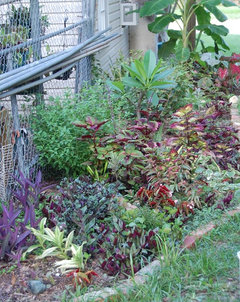
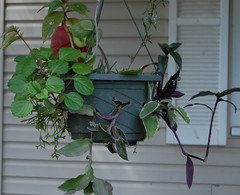
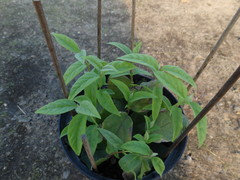
    Everything in this pic was propagated, except the bananas & Caladiums.

  • 11 years ago

    late to this thread but for a light mist I use an old mister that I used to put in the kids room when they had a cold. Works great and I turn it on and off as needed, a very fine mist that keeps the humidity up just fine.

    Of course some cuttings are hard, but someone on the forum once said, "the fun is in the process" and I would add that for some of the more difficult cuttings the fun is in the 1% that did survive.

  • 11 years ago

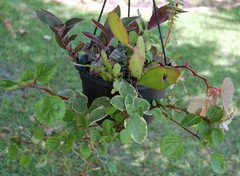
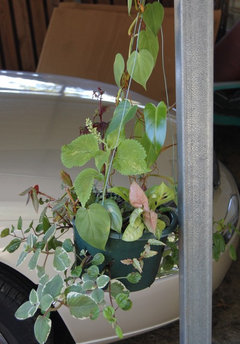
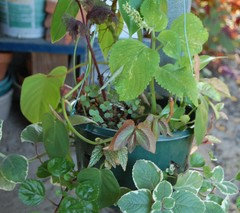
    Pots of propagated plants. Most of the stuff on the sides was added last weekend. Will have plenty to start the landscape over again in the spring.


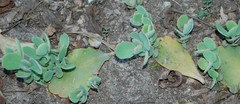
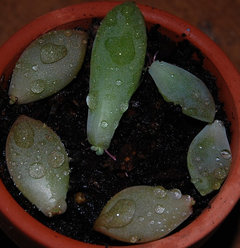
    Kalanchoe leaf-edge babies.

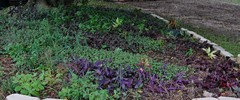
    This was just sparse grass a few months ago. Pulled all of the grass out (except the spiderwort/Tradescantia and jewels of Opar/Talinum.) Populated by cuttings of various members of Commelinaceae family, and a couple Coleus cuttings to wilt & show me when things get dry.

  • 11 years ago

    Tiffany, how do you get the Kalenchoe to propagate, I have nothing but rotting leaves.


  • 11 years ago

    Uh-oh, sorry to hear. :( I just laid them on the ground. I kept doing them over winter inside too, such a boring season. For inside, I lay the leaves near a bright window until the baby plants/tiny roots start to appear, then lay on soil surface in a pot. Stem cuttings do well too, let them dry overnight before sticking in a pot.

    Do you know what species you have? There's a TON of Kalanchoes, but not all make leaf-babies in that same way. Leaves that fall on their own rarely propagate that I've seen, but when pristine-looking leaves are removed, I have almost total success with them.

  • 11 years ago

    I have ones that look like yours, I will try again with new leaves, I think the problem is maybe the moisture level. It is hard to let them dry, for some reason I always think they look thirsty.

  • 11 years ago

    Good attitude, trying again! Until some roots form, moisture can't be used. That thought helped me stop trying to water cuttings & leaves of succulents.

    My pic of leaf-babies (above on 9/20) is K. fedtschenkoi, BTW. If yours is the same kind, also look for stems to make aerial roots. The aerial roots take off instantly, but stem cuttings w/o them also have done very well for me.

    A variety of pics of K. fedtschenkoi here to compare:

    http://allthingsplants.com/plants/view/112178/Lavender-Scallops-Kalanchoe-fedtschenkoi/

  • 11 years ago

    In early July I was cutting back my Deutzia 'Strawberry Fields' and I remembered this topic. So I thought lets take some cuttings and see if they will root. I made 8 semi-ripe wood cuttings and put them in a pot filled with normal potting compost. The cuttings were not treated with rooting hormone. I covered the pot with a clear plastic bag. I put some wooden sticks in the pot to prevent the plastic from falling on top of the cuttings. The pot was placed in a bright spot inside the house but away from direct sunlight. Temperature was around 23 to 26 degrees Celsius. The cuttings were misted 2 times a day with a plant sprayer.

    In early August some cuttings showed new growth. I refrained from pulling out a cutting to see if roots were forming. In mid September I noticed a root coming through a drainage hole on the underside of the pot. More cuttings showed new growth. I kept on misting the cuttings by hand 2 times a day.

    Yesterday I gently tried to pull out a few cuttings but those seem to have formed roots. I will leave the cuttings in their pot and will pot them on in individual pots in the spring of 2016.


  • 11 years ago

    Are you saying you use no water at all on succulents? What medium do you use?

  • 11 years ago
    last modified: 11 years ago

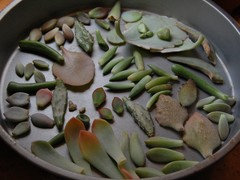
    Until there's some kind of root forming, moisture can't be used. To fight boredom during winter, I like to collect various leaves (from plants that are known to be able to propagate from individual leaves,) and put them in a single location, so I can keep an eye on them easily.

    When roots start to form, leaves are ready for a pot, and a spritz of water.

    For stem cuttings of succulents, I let them dry overnight, then put in a pot. Not making any of this up, just following the helpful advice of folks from GW forums.

  • 11 years ago

    Some are, some aren't. Penstemons, salvia, dianthus - piece of cake. Daphne, abelia - less so. Soft cuttings - worrying - hardwoods, no probs. root cuttings - easiest of all. Sometimes seed, sometimes cuttings, depending on what I want, how long I am prepared to wait and moastly, how likely I am to succeed or fail. I love growing seeds as tbh, they are sown, watered and left to get on with it - none of that lurking in the fridge or mucking about with gibberelins or lights - they sit outside all winter and come up when ready - I don't have to faff or monitor them.

    In other words, there are no hard and fast rules here - sometimes I have a go at all methods - starting with seeds then propagating what grows by dividing or cuttings of all types. Might do a soft-wood cutting which fails so will have another go-round with a hardwood one later (with roses, say). Sometimes, a basal cutting...it all depends.

  • 11 years ago

    My success rate with cuttings increased when I started using high-top plastic domes (the best ones have adjustable vents) instead of encasing pots in plastic bags. Visibility is a lot better, it's easier to keep soil moist instead of soggy, and foliage doesn't have to lie up against damp plastic where it can rot.

    Beyond that, you need to learn requirements for individual plants - which need to have cuttings dried out before planting, which require extra head and humidity etc. Then there are varieties that just don't root well (I have considerable difficulty rooting the wax begonia "Big", whereas other wax begonias "take" readily for me).

    I enjoy the process and being able to plan and execute mass plantings without having to depend on my local nurseries having what I want (at any price).

    By the way, I think those commercial outfits with mist systems are striving for ultra-fast* propagation of large numbers of plants with an extremely high success rate. Needs are different for home gardeners.

    *it probably decreases costs considerably for greenhouse operators if they have to provide heat and supportive care for a mass of cutting-grown plants for a significantly shorter period of time.

  • 11 years ago

    Yes, I think you are right. A commercial grower must have a correct set up whereas the home gardener can make do.

    But when you have come from a commercial enterprise and now have the time to propagate what you want to propagate, but don't have the heat bed, the mist and the protection from the elements, it can become somewhat frustrating.

    Come November, I plan to make some cuttings of tea tree, just to test my new heat bed. Heat bed consists of a whopping pile of Autumn leaves, to which I added a load or two of horse manure. Later came the grass clippings and weeds, as they became available, and the bed started cooking. It's hot near the top and should, I hope, provide the right amount of heat (huge leap of faith here) for the Leptospermum to root.

    The whole thing will probably be a dismal failure but who cares. It's all at The Very Experimental Stage. Whatever I learn can be used when I try rooting Daphne in December.

  • 11 years ago

    Sounds great, but I would be a little careful. I have had compost piles going up to 150* which is way to high to propagate cuttings.

  • 11 years ago
    last modified: 11 years ago

    Yes, definitely.

    I've just had my hands in the top of the *heat bed* and it feels quite nice. I notice, when I investigate, that not all the ingredients are moist. Sometimes there is a dry patch of leaves. Sometimes a bunch of weeds. I would win no prizes for making compost but since I have re-christened the heap, I'm not worried.

    Not yet, anyway :O

  • 11 years ago

    The only path to success is trying!

Sponsored
J.Holderby - Renovations
Average rating: 5 out of 5 stars4 Reviews
Franklin County's Leading General Contractors - 2X Best of Houzz!
More Discussions