Software
Houzz Logo Print
davidryanredler

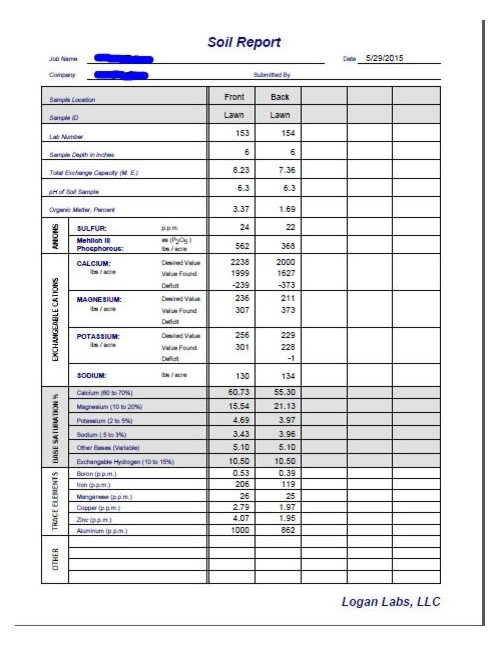
Help Deciphering My Soil Test

11 years ago
I just moved in Dec to a newly built home in a suburb of Tacoma, WA. Both the front lawn and back lawn were cheap builder grade sod. Some kind of fescue/rye mix.

The front sod was placed over construction fill dirt, complete with debris and trash (Skoal cans and small 2X4s).

The back lawn sod was laid over a few inches of sandy top soil.

We had a very mild winter and the grass began to grow early this year. I spread a pre-emergent and I've fed the lawn continuously with grain, Milorganite, and some local equivalent to Milorganite (Sound Gro 5-5-0).

Comments (22)

  • 11 years ago

    Oh, I forgot to mention some of my reasoning.

    Sodium 3.4%, 4%: Hella high, and high enough to start causing problems with many plants (lawns are actually pretty salt-tolerant on average, although some species and cultivars do far better than others).

    The gypsum will not only help raise the calcium in the soil, it'll abolish some of the sodium and wash it out as sodium sulfate (a readily mobile salt) as opposed to sodium ions (clingy little things).

    Over time, I'd like to see that sodium level drop. A lot.

  • 11 years ago

    Thanks for taking the time to explain this to me!

    Other than the recommendations you gave me, there are other issues i need to address. I am beginning to have a poa issue and I have Bayer Celsius to spray for these post emergent weeds. However, this August I am over seeding with TTTF and want a pre-emergent that wont mess with the fescue germination. Do you have any recommendations?

  • 11 years ago

    Any pre-emergent where the layer lasts 2 months or less won't interfere, and most pre-emergents have an application amount that would target 2 months.

    If you want my honest opinion? In a year when you're planning massive overseeding, don't use a pre-emergent unless you got it down very early (like early April) at the lowest application amount. P. annua isn't a strong summer sprouter, what you have now sprouted last fall. Most other weeds are stronger sprouters in spring than they will be in summer.

    At seeding time, you can use Tenacity or Tupersan as pre-emergents to help defeat some weeds. Neither have a wide spectrum of coverage, but they won't interfere with the grass seed, either.

    Tenacity is also a modestly effective post-emergent for P. annua, particularly if you strike it in spring and send it into summer stressed. What the Tenacity can't kill, the weather takes out.

  • 11 years ago

    Because things got green so fast this year, I put my pre-emergent down in April. I used some granular type from Scott's at the bag rate. It obviously doesn't stop poa, and I dont think it stops crab grass.

    My yard is surrounded by weed gardens that my neighbors like to think of as 'lawns', so its an uphill battle. I mow just over 3" so around the edges and along the sidewalk I have poa.

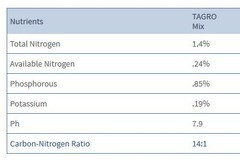
    In your initial recommendations you suggested that I mulch in leaves. I don't have any trees large enough to produce enough leaves to mulch my lawn (and neither do my neighbors LOL). I do have access to this local material Tagro mix. Its 25% sand, 25% sawdust, and 50% bio-solids by volume. A cubic yard sells for $10. What are your thoughts?


  • 11 years ago


  • 11 years ago

    March or April pre-emergents don't do much against P. annua since it actually sprouted and rooted the fall before--usually September or October. It, like grass, survives the winter with absolutely no issues.

    Fall's the most important time to have a shield down for P. annua. I tend to apply mine in April with the shield calculated to last into October (I use Prodiamine, so that's not a challenge). Then in mid September I apply the remainder of my allowable yearly amount of Prodiamine to cover well past soil freeze.

    Skip the Tagro; the sawdust is incredibly slow to decompose and nitrogen hungry while it does so. The compost is a poor feeding (to pretty much none at all), and the sand is going to slowly change your grading and drainage (not to mention being rather unattractive at the soil surface).

    I'd rather see Milorganite (20 pounds per thousand square feet), soy (15 pounds per thousand), or something like that going down now and then.

  • 11 years ago

    Applied the lime, gypsum, and a 35lbs per 1k of SoundGro.

    Got some cracked corn that I'll use as soon as everything settles.

    How much/how often should I be applying grain or Milorganite to help with my OM deficit?

  • 11 years ago

    Monthly if you can, although I'd skip July. Grasses have very little interest in feeding during July.

    However, even if you can only manage three times or so per year, that's great.

    12dred-wa thanked User
  • 11 years ago

    I only mulch mow. Just in the last 4 months I've dropped 100lbs of grain and over 300lbs of Milorganite or SoundGro* (SoundGro 5-5-0 in 50lbs bag covers 2k Sq ft) . I also spread a little compost top dressing in the front lawn. Yet I still have abysmal OM numbers.


  • 11 years ago

    Oh, and my lawn is approx 2300 Sq ft

  • 11 years ago

    What about this approach?...

    I will feed the lawn Milorganite since I could use the iron and it has a lower phosphorus count that SoundGro, and my phosphorus is already too high.

    Milorganite 2× per month (except July)

    Grain 1× per month

    I'll do this until November

    Your thoughts?

  • 11 years ago

    I'm kind of surprised that nobody picked up on the OP's comment that Bayer's Celsius is going to be used on the lawn. Celsius is for warm-season grasses and has a front-page warning about using it on cool-season grasses.

    "Do not use on bahiagrass, seashore paspalum or cool-season turf types, including tall fescue, fine fescue, Kentucky bluegrass,perennial ryegrass, or creeping bentgrass"

    12dred-wa thanked andy10917
  • 11 years ago

    Thanks Andy. I haven't applied this yet. That would've sucked.

    Do you recommend a post emergent for poa that is safe with TTTF?

  • 11 years ago

    You mentioned "Poa" several times, but none of the mentions says which "Poa" is your concern...


  • 11 years ago

    Poa annua.

  • 11 years ago

    For Poa Annua, Tenacity works pretty well, if you stay the course. That said, don't spend the whole season chasing the problems that are in the rear-view mirror. The worst phase of Poa Annua is past - get the lawn healthy and get a good Pre-M down in early Fall to prevent Poa Annua recurrence next year.


  • 11 years ago

    The poa annua is just unsightly. The seed heads protrude above my lawn and are very noticeable.

    I only mulch mow and so all those seeds are just thrown back into the lawn. So I know I have to do something about them or it will be 10x the problem next year.

  • 11 years ago

    You can bag when it's seeding in spring and use the pre emergent in the fall


  • 11 years ago

    Would Tenacity be effective by itself? Or should I use it at seeding and another pre-m later once my seeds have established?


  • 11 years ago

    Tenacity is a post-emergent with some pre-emergent properties. We use it as a pre-emergent because it can be applied at seeding and at 30 days after germination. It has pre-emergent capabilities for about 30 days. That bridges the period of the 60-day wait to apply Dimension or Prodiamine. It's not a great pre-emergent, but "pretty-good" is great when other options are very limited.


  • 11 years ago

    Thanks Andy. I'll give this combination a try.

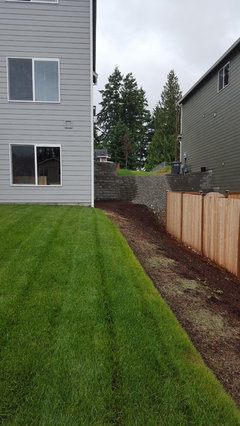
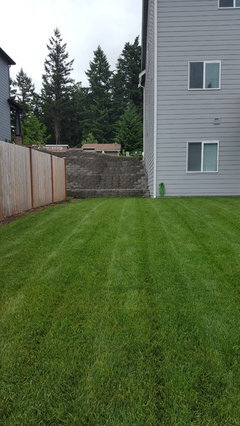
    Hoganjr, I don't have a hopper for my mower. I gave up using my power mower after carrying it up and down the stairs to my back lawn a few times. I would get burned and would sometime leak some fuel on myself getting to and from my back. So I got a push reel, its only 45lbs and doesn't get hot or leak. See the attached photos...