Software
Houzz Logo Print
lauren_wozniacki

I need help with using fertilizer

11 years ago
last modified: 11 years ago

Well I have never fertilized a lawn before.

Things I have.

6-24-24 Anderson fertilizer

Rotary spreader

and about 2400 square ft lawn in front.

The bag says nothing about how much to apply. From what I have read it seems like I need 16 lbs? That seems like a lot?

I have some dumb questions. How do you know how many lbs of fertilizer you added to the spreader?

Do you have to water for a few days after or just one time?

I have a already beautiful lawn. I just want to boost it going into the warmer months. Just kinda clueless.

Comments (34)

  • 11 years ago

    That's actually the wrong fertilizer--it's more for people who need to add phosphorus and potassium. Which you may or may not, only a soil test could tell you for sure.

    The limit on that stuff is 4 pounds per thousand square feet at a time, or about 10 pounds (a little less) over your 2,400 square feet. That's going to be extremely low on the nitrogen (0.24 pounds when 1 pound is required), and high on potassium (1 pound when very little is required) and phosphorus (ditto with potassium).

    If you can, I'd return that and get a high-nitrogen (high first number) fertilizer.

    Let us know what kind of lawn you have and your general locale and we'll design a fert program for you that's at the correct times and uses the correct amounts.

  • 11 years ago

    My late father used it for years. We had the most beautiful lawn like a golf course. We have mostly bluegrass. In metro Detroit area.

    I've noticed it's not as lush as the back yard and needs a boost. Last year we skipped the winter feeding. It's only had a spring feeding so far.

  • 11 years ago

    You can use your bathroom scale to weigh the fertilizer. Weigh yourself holding an empty bucket. Add product and weigh yourself holding the bucket. Add or take away until you get to the weight needed. Then put the fertilizer in the spreader. If I were you, I'd take Morpheus's advice on the kind of fertilizer. KBG needs a good amount of nitrogen each year (most of which should be applied in the fall). A soil test will tell you whether phosphorus and potassium are needed. And whether you need lime (and if so, which kind).

  • 11 years ago

    Who does soil testing? My understanding was that this kind of fertilizer is good for root growth? I know he never bought anything else. And had a super green thumb... :)

  • 11 years ago


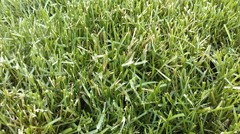
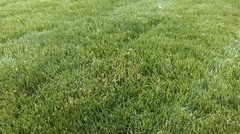
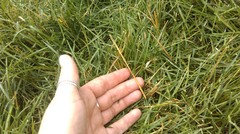
    Ok what's going on with my lawn now. The tips are turning Brown it's giving the lawn an overall bad appearance. Is it the fescue I accidentally put down last year? The seed pods are also Brown

  • 11 years ago


  • 11 years ago

    Seed pods naturally turn brownish as they age. That'll go away as they either fall off or you mow them off.

    Other than that, the lawn looks desperately nitrogen-short and also like a little iron wouldn't be taken amiss. I'd generally recommend feeding heavily (20 pounds per thousand square feet) with Milorganite.

  • 11 years ago
    last modified: 11 years ago

    Does milorganite smell horrid? I have seen the stuff. It was very neglected last spring and fall . So I'm not sure what to do with it now since it was my dad's baby.

    I have read not go fertilize too close to summer because of root growth?

    Is it nitrogen deficient because of color. In the beginning of the season it was beautiful

  • 11 years ago

    There is no potassium in the milorganite. Is that because of the lack of flowering?

  • 11 years ago

    Potassium is only recommended if a soil test shows you need it. Imbalancing potassium levels in soils is not a good idea, although at least it isn't a water pollutant.

    Milo's smell is kind of like mud flats, actually, and fades fast. A few hours after application, I can't smell it--but I don't have the most accurate nose. Handling concentrated scents regularly tends to dull it. My better half doesn't complain, though, and if it were offensive...I would hear about it.

    Late May to very early June is actually the absolutely correct moment to fertilize.

    The color there is an indicator, plus the way the grass is growing. It just doesn't look like it's very happy at the moment.

  • 11 years ago

    We just cut it today and it rained hard for 24 hours. Is it because it is patchy looking or? I'm trying to better my lawn care practices and I'm new to this so thank you! I do plan on picking up miloganite and hopefully spreading it by Wednesday . Should I cut again before spreading?

    I used corn gluten in the back and it worked really well, but we need to reapply back there too. In the back we overseed and use the corn meal and so far so good. I made the mistake of getting the corn gluten in the rocks. Dogs licked those rocks for days .

    We have dogs and milorganite would be tasty to them and we try to keep it el natural for them but the front yard is for looks. Lol

    otherwise the mower if set on the highest setting.

    I know I keep reading about soil testing. I know we also have a bag of lime in garage too. making me assume we needed it once upon time.

    Do normal stores carry or do soil testing?

    If I could ask my dad anything this year it would be about the lawn that he babied so much! I keep asking him to come to me in a dream lol. :)

  • 11 years ago

    It's more subtle than that. The color is dull and kind of flat, with a chartreuse overtone that's shading more toward a grayish-yellow. That implies that the grass can't synthesize enough chlorophyll to fully color it up. And in this case, I'm accounting for the fact that it's fescue (a well-fed KBG actually has a blue overtone, from blue topaz to true blue, sometimes shading slightly toward cyan).

    The way it's growing also kind of says, "Meh." It can't be bothered to grow straight up. Other than that, there's something very, very subtle in there that simply says "low nitrogen" to me that I can't put my finger on.

    You can cut or not before Milo; it's not a stress on the lawn either way. The stuff is very gentle.

    Most stores don't do soil testing, or if they do, it's not worth it even if the test is cheap. Ditto with kits you can buy; they give too little information. Logan Labs or UMass really do give the best information, although I prefer Logan.

    Just because you have a bag of lime does not mean you need it. If I could get people to stop doing one thing, it would be to cease mindlessly throwing lime down on the lawn. On heavily acidic soils, it will help...until the acidity is canceled. And they usually use the wrong lime, creating a massive magnesium overage in the soil and setting off other problems.

    In small amounts, Milo is harmless to your dogs, although it may turn their poo dark from the iron in it. Ask me how I know this...

  • 11 years ago

    It was my mistake to seed with fescue mix in the fall. I personally prefer kbg.

    It is strange to me cause just last week I feel the lawn was much healthier looking then since this weekend blah. I'll include a random picture I took during flower planting.

    It's weird to me how fast it changed. I had enough fun keeping them from literally licking to corn gluten meal from the grass!! Lol.

    According to my neighbors my dad had many secrets to the lawn!! Lol we have a three house competition I believe I'm currently losing

    I guess that had a poo color too

  • 11 years ago

    For a soil test, take a number of samples from around the yard. Use a bulb planter or trowel and dig out a plug of soil four inches down. Take out the inch between 3 and 4 inches and put that in a bucket (first three inches, 0-3, can go back in the hole). Mix the samples in the bucket together and fill up a baggy. That's what you mail in. There is a worksheet to fill in. Results are emailed back to you.

  • 11 years ago
    last modified: 11 years ago

    To me it appears that the grass is torn ragged and shredded in those close ups (could be the seed head browning?)

    You are going to want to get that blade sharpened... ! will help health and appearance as well. :-)

    Dump a heavy dose of Milorganite down before a good rainy stretch... .you'll be winning that lawn compitition in a week or two!!! Reapply every few weeks, get a soil test from Loan... you'll keep that Lawn Trophy :-)

  • 11 years ago

    I'll get on that soil test for sure. I'm going to get some milorganite tomorrow. I am gonna measure but I'm thinking the front is about 2500 square ft. So is one bag going to be enough .. I do enjoy using something that won't burn the lawn because I'm not the greatest straight line walker lol.

    Literally just sharpened the blade . I'll have to take a peak at it again.

    I have never had fescue and didn't realize it had such long tips. I don't like it!! Lol. I was actually wondering if rye grass was mixed in there.


  • 11 years ago

    With Milo, a little long or short doesn't matter. Although I'd measure the area just to be sure, overlapping because you meander (something I do as well) is not a problem unless your path resembles a mathematical drunkard's walk.

    Then it's only a problem because you're likely to miss.

  • 11 years ago

    Will do!! Thank you guys I love this site !

  • 11 years ago

    A little update what is this about ..

  • 11 years ago

    beckyinrichmond: I've seen you recommend that people sample 3 to 4 inches down and not to use the soil from 0 to 3 inches in the sample (ie, return the soil higher than 3 inches to the ground). My understanding from Logan's instructions was to take a core sample down to either 4 or 6 inches and put the WHOLE sample in the bag, removing roots, rocks, etc. and then indicate whether it is a 4 or 6 inch deep core.

    http://www.loganlabs.com/doc/Soil%20Sampling%20Instructions.pdf


  • 11 years ago

    I can't say it really matters. In the case of phosphorus additions, taking the whole sample core is best as P perks down very slowly. Although not a major problem, we still don't want to miss the additions and over-apply.

    In my soil, I tend to sample from the deeper layer only (1-4"). I have enough of an O horizon (organic) atop the A soil layer (top soil) that sampling the entire core would give me a seriously inflated organic matter percentage. Plus the stuff in the top inch has been worked in by the insects and isn't really completely decayed yet. I know it's there, I know it'll work down over time, but the roots don't sit in the O horizon and I don't need to worry about it much until it integrates. If the numbers for the top inch are a touch off, so be it--it won't be severe.

    (Yes, this means that my 14% OM percentage is actually intentionally measured on the low side).

  • 11 years ago

    I was just repeating instructions from aroundtheyard website. There are no instructions on here which people can easily access. The soil team at aroundtheyard.com are great with their analyses and know what they're doing. If Morpheus says it doesn't matter for his analysis, go with that. I did a little searching on aroundtheyard.com to get the rationale. Four inches down means you're sampling topsoil instead of subsoil. The inch between 3 and 4 gets a sample in the middle of the root zone and they then interpolate from that to account for the entire root zone. The first few inches would over report things like organic matter and nutrients recently added.

  • 11 years ago

    Hi Becky. Sorry for the delayed reply. I don't think people need instructions here for the Logan test. When you go to their website, the instructions are there (see link above). If Logan specifically says to sample from soil surface down to 4 or 6 inches, and instead you discard the top 3 inches, then I believe you will be skewing the results. Logan is expecting one thing, and is accounting for that in their reporting, but they are being given something different. If I had a little more time right now I'd call them and ask. I will be sending them a sample in about a month, so I'll call them then to clarify.

  • 11 years ago

    Interesting. When I took my soil sample last year I only took about an inch from each plug...I'd say approx the 4-5" depth. If I was supposed to go from the surface down, I wonder how that skewed my results? I'm interested to hear what the proper method is and how that will affect my results.

  • 11 years ago

    Tim--you're fine. Post adding stuff (phosphorus, most notably), proper sampling through the entire profile is better, but it won't impact most other nutrients that much. Calcium, magnesium, potassium, and most of the minor elements perk through rather well and distribute themselves through the profile.

    There can certainly be exceptions when using calcium oxide or magnesium oxide, but I never recommend use of those anyway (well, not as a general rule, but there's always an oddball and I can think of one case).

    Phosphorus levels, post using starter or triple super phosphate, will read rather low the second year if you only sample the deep part of the soil. Phosphorus perks at a snail's pace.

    That might lead to overapplication of phosphorus, which could be a potential problem...except that we target 200 anyway. Even doubling that will only bring you to 400 if you started at effectively zero. 400 is not a problem and well within normal range, if at the high end.

    Organic matter levels will tend to read low when sampling deeply (something I do intentionally), but there's no down-side to increasing OM levels through the mid-teens at the absolute floor. OM also perks down incredibly slowly.

    Re-testing rapidly post an application of anything isn't recommended, so that's not usually a problem.

  • 11 years ago

    Morpheus is doing the analyses, so go by his advice. I was assuming he was using the same methodology as the aroundtheyard soil guys. They recommend going to a four inch depth for lawns, six inches for garden, and specify for the lawn samples to come from the 3-4 inch part. We should be grateful for all the time Morpheus gives in studying people's results and sharing his expertise.

  • 11 years ago

    Overall, I'd follow Logan Labs' advice. In this case, I'm just saying that for an initial soil sample, the errors caused by not following their advice aren't much of a problem. In successive years, they might or might not be.

    In the case of a P addition, sampling from 3 to 4 inches will give a low value the first year afterward. That's not much of a problem if you point me to the old thread so I can review what I recommended last year. If not, and I don't remember (and I probably won't remember!), I'm likely to overapply the P.

    It's true that the data from the first inch isn't very important. There aren't many roots in the first inch (although there are still a fair number, just not the mass compared to below that). But the first inch is still in your soil profile, still hold resources, and may be holding added resources that simply haven't perked down yet.

  • 11 years ago

    About to do my first sample and sent it to Logan. My lawn is about a year and a half old KBG. As per Morphs advice I'll take my first samples at 5-6 inches deep.

    Just to make sure I'm doing it right......I remove the top section that contains the grass and thatch area.......and remove any debris such as rocks/roots

    Is this correct for my first sample?


  • 11 years ago

    I'd take it from 1 to 4 inches instead (if I said 5 to 6, I was wrong). Not, again, that it'll make a huge difference on your first sample, but....

    And yes, take out debris.

    By the time we're hitting the 5 to 6 inch point, Kentucky bluegrass doesn't have much root (except in sandy soils). Fescues and rye do.

  • 11 years ago

    I applied milo and a scotts fertilizer 32-0-4 about a month ago. I applied corn meal about a week ago........and BLSC BLKH last night. Will this effect my results in anyway?


  • 11 years ago

    OK, I just called Logan Labs and explained the question. They said that you should take a core sample from the surface down to either 4 or 6 inches, and specify which depth you did. Take approximately 15 representative samples and remove the roots, small rocks etc. At that point they blend everything together very well and then do their test. This gives a representative idea of what the soil looks like. If you want to sample the 3 to 4 inch depth ONLY, they said you can do that but you should make a note as such on the forms.

    The idea I got from them was that you only get a representative sample if they have the whole core, surface down to 4 or 6 inches. They do the calculations necessary based on the depth you tell them and assume they are getting the whole core, not just the bottom of it.

    Hope that clears some things up.


  • 11 years ago

    Thanks for calling!

  • 11 years ago

    Darin: No, you're good. The organics won't have worked into the soil yet, so we won't see them on the soil test. But you won't see them for about a year anyway, so no big deal.

    Kelp Help and Soil Conditioner don't have any impact on resource measurements.

Sponsored
Haus Studio
Average rating: 4.8 out of 5 stars28 Reviews
Franklin County's Preferred Custom Cabinetry & Design Studio