Software
Houzz Logo Print
danielle_waters

Please help - Having trouble finding the right range hood

11 years ago
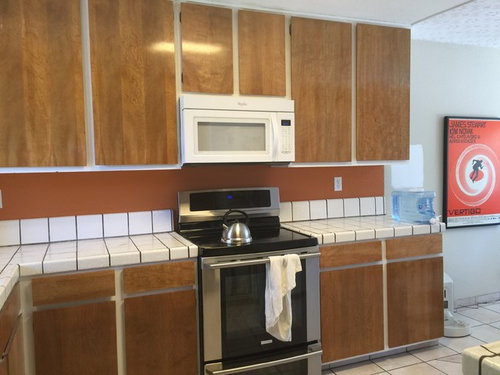
I currently have a 30" Electrolux freestanding induction range with an OTR microwave. I would like to replace it with a range hood. I use mainly the front burners and do a lot of pan seared meats and cooking of bacon.

My easiest option would be to replace with something like this:

http://www.ajmadison.com/cgi-bin/ajmadison/AK70BS.htm

however its only 22" deep, will this be an actual problem, or sufficient for my needs

If I have the cabinet modified I could do one of these:

http://www.ajmadison.com/cgi-bin/ajmadison/AK70BS.html

http://www.ajmadison.com/cgi-bin/ajmadison/BSLPL240.html

http://www.ajmadison.com/cgi-bin/ajmadison/PRH18M30SS.html

These are all 24" deep

The only 27" deep hood I could find was a wolf and I really dislike its apperance as well as its controls, if there are other options please let me know

My main concern is venting capability, followed by looks (going mid-century), and then cost

any thoughts on what I should do, or any suggestions to alternative range hoods?


Comments (11)

  • 11 years ago

    Thank you kaseki that does help, but can you clarify what the aperture area is, is it the square footage of the entire hood or just were the baffles are. As you mention the capture aperture configuration seems to vary considerably between brands and models. Most have the lights towards the front leaving the first 4-6 inches without baffles, this seems like it would miss a lot of the rising affluent at the front of the hood, or is this not the case? One of the blue star models Im looking at seems to have angled baffles in the front and back with lights directly in the center, would that design be preferable?

  • 11 years ago

    Ah! This is a potentially complex topic. Normally what I mean by 'aperture' is the open area at the bottom of the hood that leads to the baffles, but not any flat or rounded edges between that area and the hood outside surface. Please note that in many hoods, the baffle areas themselves may be less than the 'aperture' I am referring to. What makes this complicated are two things:

    (a) There is some flow at the edges that will tend to pull air past the edges, and hence the effective aperture is slightly larger than my definition above. This depends on hood design and air flow rate, and this effective size increase is larger for lower velocity (lower temperature) effluent plumes than higher velocity plumes (for a given blower speed).

    (b) The interior shape of the hood may have angled surfaces to baffle areas that are smaller than the bottom aperture, and depending on the angles and flow rates some curling out (downward momentum transfer) of the effluent plume is possible. This is more often seen in some commercial hoods (see link) in extreme cases than in, say, Wolf / Independent Pro hoods in residential settings, but there are so many hood designs departing very far from the optimal commercial designs that there can be many other opportunities for containment failure due to surfaces not having baffles. This is also affected by how much volume is between the baffles and the hood entrance.

    For an illustration of what it is all about, see page 4 of this link
    http://www.fishnick.com/ventilation/designguides/CKV_Design_Guide_2_031504.pdf

    Additional links:

    https://www.captiveaire.com/Sitedocs/videos/Hoods/Schlieren/SVideo.asp?EXH=1&PSP=0

    http://www.energy.ca.gov/reports/2003-04-10_500-03-007F.PDF

    "One of the blue star models I'm looking at seems to have angled baffles
    in the front and back with lights directly in the center, would that
    design be preferable?" That design is closer to commercial than many others, and would in general be [functionally] preferable, given adequate air flow rate, lights not being in one's eye sight-line, and cook's staff tolerance for cleaning the lamps.

    kas

  • 11 years ago

    Another question is what type of ducting do you have in place? Are you able to install or replace ducting to meet the requirements of the hood you choose?

    Danielle Waters thanked greasetrap
  • 11 years ago

    Currently I have a standard 10 x 3 1/4" coupled with a 6" round duct. It goes up maybe a few inches and then 90's to the back and vents to the outside wall behind the cabinets. I already have a general quote from a contractor on "upgrading" the venting, not knowing exactly what I would be doing. I assume this setup can be changed to 8" or 10" without too much trouble but I'm not positive.

  • 11 years ago

    My other question would be what are your long-term plans for your kitchen? Are you happy with it the way it is, would you like to change it completely, or something in between? The simplest option would be to buy a reasonably-good hood that fits your current cabinet space and ducting. That wouldn't be perfect, but it would be a big improvement over what you have now. If you want to get into a larger hood with more airflow and capture area, then things get more complicated and expensive. You have to ask yourself whether it's worth the extra cost and aggravation to get the best possible solution.


  • 11 years ago

    The hood choice is part of a larger kitchen refresh. We will be doing new floors, countertops, backsplash, refrigerator and built in microwave, adding a new wall of cabinets and replacing hinges and drawer boxes in existing cabinets. I'm willing to spend the money now to get it right.

  • 11 years ago

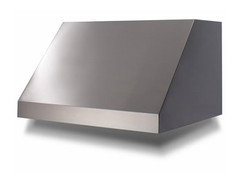
    I decided to go with the bigger Bluestar model with front and back angled baffle filters and continuous fan and light control with 1200 cfm internal motor. Also got the extra 12" x 30" duct cover to take it all the way to the ceiling between the wall cabinets. Heres hoping that it works really well as they are not inexpensive.


  • 11 years ago

    Danielle, care to comment on how your hood is working? How about the noisiness of it?

  • 11 years ago

    The hood is now installed and I have been using it for a few weeks now. Turns out the internal 1200cfm motor does not fit inside the 30in hood despite Bluestar marketing and technical specs, so I had to get the 1000cfm remote blower.

    First thing I did was put oil in a fry pan and turn on my induction stove to power boost with the hood on maximum. Burned the oil to the pan but almost no smoke or odor escaped the hood, just a bit over the front because the hood is only 24" deep, but could not smell anything from a few feet away from the stove. I knew it would not catch absolutely everything, but I felt the 27" would have just been too big for my small kitchen.

    It does sound like a jet engine even on low, but I wanted the most power I could get out of retrofitting the space. I like to sear and fry almost every night and this works perfectly for me, but it's not for everyone.

    My contractor and the metal worker I hired to install and cut the duct cover to size said it was the heaviest hood they had ever seen and it didn't even have the blower in it. It is a very nice piece of metal and I like that there is no branding on the outside, just a Bluestar logo in the middle on the inside when you look straight up.

    I also like that the lights are in the middle of the hood, good coverage all over the surface. I replaced the halogens with LEDs and I like them but they do not dim as well as the halogens, but no heat.

    Overall I am very happy with my purchase and my very skeptical husband is too. He thinks it looks clean and performs well. I don't fill my entire house with smoke constantly now.


  • 11 years ago

    I'm so glad your hood is working for you Danielle! Thank you so much for the review. It sounds like a very "bluestar"-ish appliance - all about the function (I have a range). Best wishes.