Software
Houzz Logo Print
zacharys

Call me crazy...

11 years ago
last modified: 11 years ago
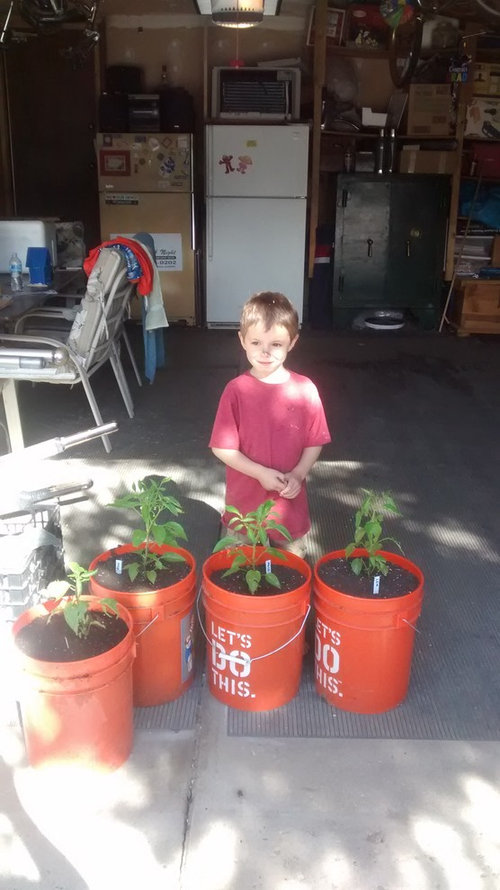
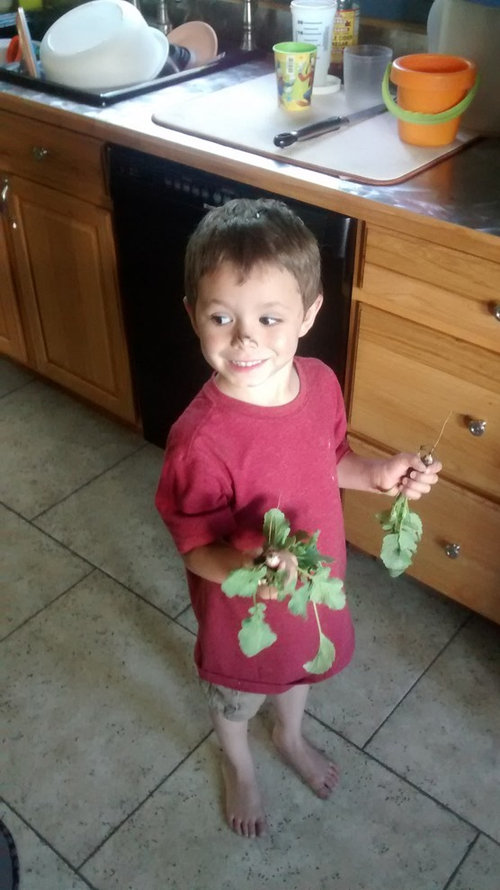
But hope springs eternal. I gave up on hoping the weather is going to show significant improvement and planted my eggplant bed today. Tomatoes went in last Friday, and hot peppers, besides the habs are planted. However, peppers go in containers so in theory I could have planted them anytime, but they are much easier to move around in 3" pots than 5 gallon buckets. I also put bean seeds in the ground and harvested most of the radishes with the help of the kiddo.

So all I have left is 3 tomatoes and 4 habs and we will be all set for vegetables this year! FINALLY!

surprisingly, when I was digging the holes for the eggplant, the soil was fairly friable, not mucky soup like I was expecting.

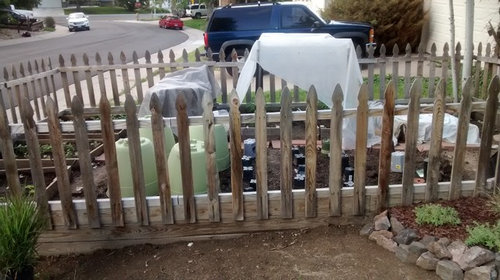
And there it is with my own IHMS (integrated hail management system) made of landscape fabric, plastic sheeting and pots lol. Irritatingly, the SECOND I brought the eggplant to the front yard there was flea beetles on them, and they were so pretty out back :(.

Comments (7)

  • 11 years ago

    Northeast Colorado weather made network news - tornadoes & hail.


    See Zach, what you need is glacial till. Maybe you have some of that nearby. My soil has so many rocks that it's difficult to make a puddle! If one forms and you are out in it, you'd best tie yourself to a nearby tree so as not to be swept underground as it drains ...


    It's not quite that bad. The soil can be too wet to sensibly mess with. I believe that what little soil there is must have blown in so it's light stuff, there in the gravel. Waiting 24 hours after saturation is enuf. I'm not sure if Colorado is getting the 24 hours but I've got the rocks available for shipment ...


    Okay, yer crazy, and now with rocks in your head, but don't mind me. I'm just talking to hear my head rattle. You should know how much of a contrast there is just 800 miles up the RM cordillera. Not only may we be taking on the drought this year but today or tomorrow, the thermometer may hit record highs.


    Last year, the summer was a record hot one in some nearby locations. However, we didn't hit 90° in June! This afternoon, that milestone will be passed. And, it's only the 7th!


    I may be crazy with heat soon ... Without the presence of a cute little kid to properly ground me in what is really important in life. Don't be surprised if news reaches you that I've been carted out of my garden and off to the funny farm.


    Steve

  • 11 years ago

    I planted my tomatoes from the swap and put up my own version of the IHMS today!


  • 11 years ago

    Looking good, Liz! I found out today that an IHMS actually only works if it's set up. Luckily my tomatoes and eggplant are covered under see-through material so it stays up all the time, but, the potatoes and lettuce I cant leave under bed sheets and plastic pots all day everyday, especially when the temp gauges are reading 80+. Leafy greens might be a bust this year, but the potatoes ought weather the storm just fine, I think the flea beetles have made them so the hail just goes passes right through the leaves.

    Steve, We might have some glacial till up in the mountains, but, since the Laurentide Ice Sheet never made it as far south as Colorado, all the glaciers we've ever had are/were isolated ones up in the high country.

    What we DO have is eroded mountains that were either washed down or blew across the prairie and at times even built sand dunes along the front range during REALLY dry years, and sometimes as far away as Nebraska (the Sand Hills region of the Cornhusker State is made out of sediment that was once our foothills and peaks). Consistent flash flooding deposited alluvium at the base of the mountains, so our native topsoil is surprisingly a very sandy loam!

    However, since modern times, agriculture and development have stripped us of that and we are left with clay. Around Denver, one way to tell if your property was either farmed or ranched is how bad your clay is. If your subdivision was historically farmland, your clay will be much worse than if it was ranch land. As far as I know, the area I live in was owned by a rancher, George W. Harriman, and later it was a dairy farm run by the Beers Sisters. I have clay, but it's a friable, crumbly clay that drains fairly quick as opposed to heavy dense "potters clay" that a lot of other folks have, especially closer to the river where irrigation was much more accessible.

    So, that's much more than you ever wanted to know about that.

    I think was 2011 or 2012 we broke the record for highs, and broke the record for days in a row of record highs! In July I think it was we had 1-2 weeks straight of days in the 95-110* range. I was working at the power plant then, and it was almost a safety hazard to go inside, where the thermometer was registering above 140*. That was the year I got really good at running the dozer because it was the only place besides the office that had AC. What a contrast to last summer. I think we had a total of about 4 days above 89 and we were getting lows in the 40's even in late June, maybe even 1-2 nights in July!

    You know Steve, if you want to borrow the kid for a little while to keep your sanity, I think it could be arranged LOL!


  • 11 years ago
    last modified: 11 years ago
    I think that in order to be a gardener, you have to be "blessed" with a crazy gene or three - and farmers must have many more than that - so, yes, Zach, you are as crazy as the rest of us are! We live in a feast or famine world I guess, too much water or too little water is something we have to deal with; being an eternal optimist is of great help in this hobby of ours!

    I have almost all of my vegetables planted now and have no IHMS set up so I am living even more recklessly than some of you. I am hoping the bean seeds don't rot in the ground and my squash and cucumber seeds may end up remaining in their packages until next year if the soil never dries out, but thus far my peppers, tomatoes, potatoes, carrots, etc., etc. are surviving, and my one little artichoke seedling might even manage to get above 6 inches tall at some point. Someday maybe the rain will stop so some fertilizer can be applied - I am sure most everything good has been washed out of the soil, leaving the clay behind!

    Westminster used to be an area covered by orchards - the very first orchard was established in 1870 not very many blocks from where I live. Not sure what this did to the soil around here, but it wasn't good! My soil is definitely closer to adobe clay than the friable stuff you have, Zach.

    Speaking of what happens to soil after the land has been farmed or ranched for years, if I had been a gardener when I lived in Vermont, I would never have left. The soil there is black and rich and workable even under water, lol. The entire state, I think, was once almost deforested and made into dairy farms; the addition of a hundred years or more worth of cow poop has done wonders for the soil. I pretend that the bags of composted dairy cow manure I add to my vegetable garden soil will result in such lovely soil in my raised beds, but thus far I have been disappointed, lol.

    Holly

  • 11 years ago

    Well, I have the "crazy gene," but I'm definitely lacking in the "optimist" department. Well, 1 for 2 aint so bad I reckon.

    I had my tomatoes covered in heavy plastic sheeting, I think I may be the the only person in the metro area that is having the break out the hose every so often and actually water! How neat is that?!

    So, I don't recall all the details, but it has something to do with dryland farming in an arid environment being especially bad, contributed significantly to the Dust Bowl of the 1930's. After another series of droughts in 50's and 70's, almost all farming east of the divide is irrigated farming, though, we know from the past 10-15 years that that style of agriculture may not be much of an alternative.

    Ranching, on the other hand, is not nearly as hard on the soil because undulate grazing is an integral part of the ecology here. Cattle simply replaced the bison in that respect, and many native shortgrass prairie species respond favorably to being chomped down by large herbivores. Plus the dung they leave behind adds valuable OM.

    One of the main differences in the soil of Vermont and that of Colorado is the fact that we are a much more arid environment and our soils generally lack the deep humus rich layer that is found further east. Our dirt is full of minerals rather than the rotting leaves and sticks and all the other stuff that falls to forest floor and basically turns into compost. Since we have virtually removed fire and flooding from both Western forests and grasslands, we have removed two very important factors that were the main sources of nutrient replenishment, further degrading our soils. I'm probably in the minority who believes that we ought NOT contain, suppress and halt every destructive force of nature that was put into place for reason, but I digress....

    Keep adding the compost Holly, it may take a while yet, but it will be worth it and each yer you find it a little better than the last.

  • 11 years ago

    I live in an area where flood irrigation was the norm until very recently, when the big Colorado River salinity project came into effect and with Federal grants and put a lot of the irrigation system into pipes and pressurized sprinklers. When they did the Dolores River irrigation project 20 years ago, its all pumped and sprayed, no more flooding.

    So before, all the farmers up the hill from me would flood their fields, the water would leach down through the assorted soils then hit the 'bedrock' layers of sand stone and move horizontally until it came to the surface and seeped out, leaving a rim of white alkaline salts, the seepage water would accumulate in the draws and ravines, moving on down eventually to the Colorado River. I still get this to some extent, the guy up hill and NE of me irrigates so much that every year in August, I get springs popping up in a few places on my property.

    The big irrigators are pretty happy - they went from not having enough water to effectively flood their land every time it needed water to now being able to deliver it evenly, all in all using less water to better effect. I dunno how much its reduced the salinity flowing into the Colorado River, but it sure dried up a lot of perennial ponds, rivulets and cat tail swamps. For me, I got a nice surprise one year on my taxes, having to declare some $1400 from the gvt grant as income, my share of some over-engineered irrigation water distribution box they built to put four or five of us in pipe. On the upside, I now get enough natural pressure that I can set out low-pressure sprays that work pretty well.

  • 11 years ago
    last modified: 11 years ago
    Humankind's attempts to "tame" Mother Nature have almost always ended up badly. She either really does have a "rhyme and reason" for doing things or over hundreds of thousands of years things have just WORKED. And now we have thrown a spanner into the works with all of our "improvements" both before and (mostly) after the industrial revolution. The price of progress, they tell me, but I begin to wonder if Mama isn't ready to wash us off of her world like the destructive pests we have become!

    I try to maintain my optimism, Zach, but my supply of it seems to be dwindling quickly. I woke up this morning to more pouring rain and water about 4-5 inches deep in my back yard and with water pouring into my house's crawlspace and into one of my sheds. Lacking sandbags, I have piled up blankets and sheets to try to divert the water away from my house and shed, with mixed results - obviously, not the best materials to use for this purpose, but it's all I have to use right now and it was better than nothing.

    Here are some pictures of my backyard garden under siege:

    The patio:

    The patio and my pitiful attempts to divert the water away from my house:

    Other parts of the "lake" on display:

    My pump set up under cover during this morning's rain storm and some of my drowning peonies and oak trees (water droplets on the lens - oops):

    And I am now starting to see some small puddles of standing water in the upper part of my backyard, too, where my main vegetable garden is located. (That ramp behind the pump set up in the last photo leads up to my upper garden.) My raised beds are still draining, but, if this $#@@%&&*$ rainy season keeps on keeping on, and I see nothing that indicates it has any intention of ending any time soon, my raised beds will no doubt be like Dan's are before too long.

    Holly