Software
Houzz Logo Print
ky_vegetable_gardener

Diagnosing and treating pest problems

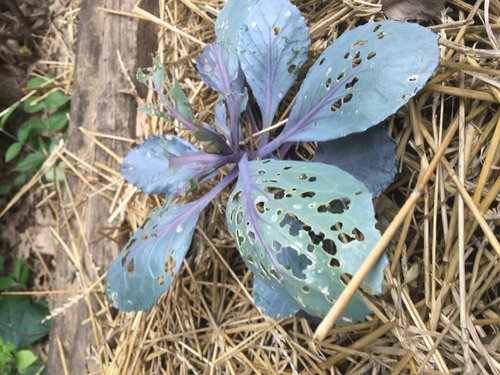
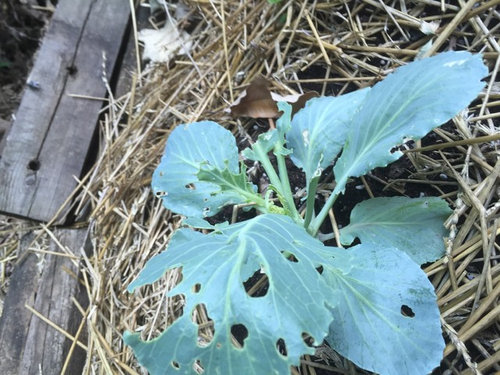
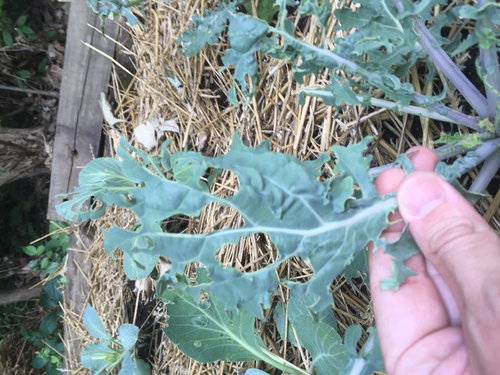
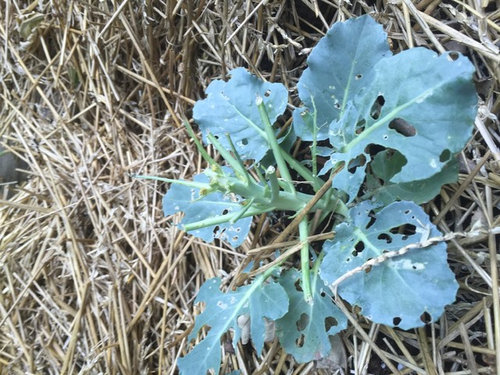
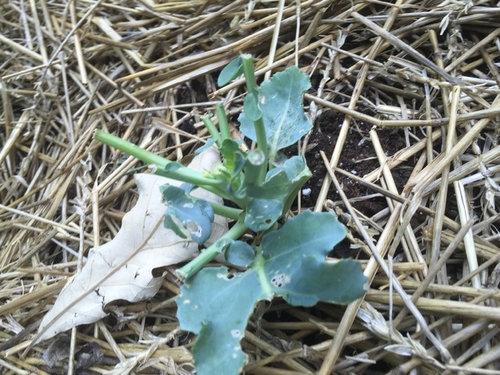
My garden was looking good until this week, when it was mostly destroyed
by pests. I am having trouble figuring out what might be causing the
problem. I have not seen direct visual evidence of anything (i.e. I
haven't picked slugs off my plants, seen many little critters on my
leaves, etc). In other cases the plants are pretty
much decapitated.

I'm pretty new to this and I'm not really sure what to do. I would like to avoid spraying anything. It's possible that I have multiple problems (i.e. that whatever is chewing holes through my leaves is different from whatever is completely eating the tops off some of the plants).


I've included some representative photos.


Comments (14)

  • 11 years ago

    Thanks, I'll try that. And caterpillars actually make sense. They must hide well during the day!


  • 11 years ago

    The top four photos could indicate the presence of either slugs or Cabbage Loopers or the Imported Cabbageworm. The larva that are the last two are almost the color of the plants they are eating, but will be present all the time. A bit difficult to see but they do not move very far. Slugs, on the other hand, do their work mostly at night and move to shelter during the day except on rainy days.

    The Cabbage Loopers and Cabbageworms are those small white butterfly or light brown moths. Slugs can be found lurking where it is cool and moist, under mulches, rocks, boards, etc.

    This link is to a good source of information about cabbage pest control.

    http://www.clemson.edu/extension/hgic/pests/plant_pests/veg_fruit/hgic2203.html

    The fifth picture looks like rabbit, woodchuck, or maybe even deer at work.

    kimmq is kimmsr

    ky_vegetable_gardener thanked kimmq
  • 11 years ago

    Be certain to look on the undersides of the leaves. Some caterpillars can hide very well because they are the same green color as the leaves.


    ky_vegetable_gardener thanked jean001a
  • 11 years ago
    last modified: 11 years ago

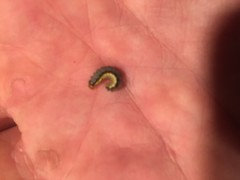
    Thanks everyone. Look who I found on my cabbage! You were right: he was very hard to find.

  • 11 years ago

    This was my first interval of what was going to be a succession of brassica. Next time I'll use a row cover, but maybe it's a bit late for these preventative measures this time around? For now I'll just go worm hunting every night and see if I can get ahead of this thing.


  • 11 years ago

    Unfortunately after the butterfly lays the eggs there is nothing you can do but stay on top of it. I feel for you!


    ky_vegetable_gardener thanked bibbus 7b
  • 11 years ago

    For a short time after the larva hatch from the eggs "Bacillius thuringiensis - Kurstaki" would be an effective control for many leaf chewers, but for plants like the cabbage family that does not rely on pollinators to produce what we eat, the Floating Row Covers offer the best protection from insect pests.

    kimmq is kimmsr

    ky_vegetable_gardener thanked kimmq
  • 11 years ago

    You might also benefit from using an azadirachtin product such as Azamax or Azatrol. I prefer a combined mix relying upon azadirachtin in combination with spinosad A & B [Monterrey Garden Insect spray.] Very, very safe to use and highly efficacious against the many pests found in our gardens and landscape.

    ky_vegetable_gardener thanked Gary Figueroa [Zone 8B]
  • 11 years ago
    last modified: 11 years ago

    Azadirachtin, Neem Oil, and Spinosad are both broad spectrum poisons, meaning they will kill a very large number of insects including beneficial insects unless used with great care. If one thinks that 1 percent of al the insects in the world (8,000 of the 8,000,000) are a lot, and you do not have strong and healthy plants growing in your garden that will be less susceptible to insect attack you probably will need these poisons to control them.

    Keep in mind that Integrated Pest Management is not about using the most toxic poison available from the start. Start with the least toxic material and, if necessary, work your way up to the most toxic. But make the soil the plants grow in into a good healthy soil that will grow strong and healthy plants that will be less susceptible to insect pests so you will not need those very toxic poisons.

    kimmq is kimmsr

  • 11 years ago

    A thoughtful response of which I wholeheartedly agree, kimmq. What's apparent to me in this forum is that there exists those of us with deeper knowledge and experience alongside lesser informed members. Since I'm new to this, I see the significance of tailoring my know-how so as to continue sharing, avoid alienation and learn from everyone. As someone who understands the nuances of IPM, it should be understood that what I begin with is the enlivenment of the soil. A living soil provides the necessary foundation in support of whatever it is that we intend to grow. Point well taken.

  • 11 years ago

    Hello, sorry about your fine garden. As a pest professional I can advise you for next time to use an insect netting. Be sure that there's virtually nothing you can do to stop the butterfly from laying its eggs in your garden.

    You can either spend lots and lots of time hand-picking the creamy eggs themselves, or just use insect netting. Also you could plant Nasturtium for abit of natural pest control, it looks nice too.

    Another thing I've heard of is the nematode Steinernema carpocapsae, which you can mix with water and spray onto the plants. The caterpillars will consume it and die. Problem is - the eggs have already been laid!

    Overall, insecticides are the only thing that's effective enough. @kimmq is right, though, the least toxicity possible is the best place to start. If you were to go that way, my professional advice is to start with a pyrethrum-based spray, as it's the least harmful and the toxicity is minimal even after just one day.

    Good luck :)

  • 11 years ago

    Pyrethrum, albeit is a botanical insecticide is also in indiscriminate broad-spectrum short-lived contact insecticide. While it presents little hazard to mammalian life, it wreaks havoc on predacious beneficials as they have no way of defending either against contact or the resulting catastrophic response from their contact. The argument that permeates much of this sharing is to avoid the use of pesticides all together. And, while I understand that mindset, I much prefer to maintain a lush, vibrant garden relatively free of destructive insect pests. Therefore, I rely upon spinosad, azadirachtin, potassium salts of fatty acids and a variety of Bacillus products and forms to achieve my desired outcome. Scouting and timing are two essential activities one would undertake in their effort to control destructive garden pests. I make time for this kind of thing. Whereas, letting my considerable effort be lost to easily controlled insect pests...belongs to the club of "I got better things to do with my time than hand pick bugs from my plants!"

  • 11 years ago

    Integrated Pest Management is a 5 step process of control of any problem in the garden.

    1. Identify the problem. What is really causing the problem?

    1. Identify the least toxic method of control?

    3. Apply that control.

    4. review the effectiveness of the control applied.

    5. Return to step 1.

    Never start with the most toxic means of control, which includes the pyrethrins, since that limits your choices right away. Often a simple sharp water spray is all that is needed, knock the wee buggers off the plant and they will die.

    kimmq is kimmsr

Sponsored
Peabody Landscape Group
Average rating: 3.5 out of 5 stars8 Reviews
Columbus' Reliable Landscape Design & Contracting
More Discussions