Software
Houzz Logo Print
sawyerbrownlive

Super sick of problem

11 years ago
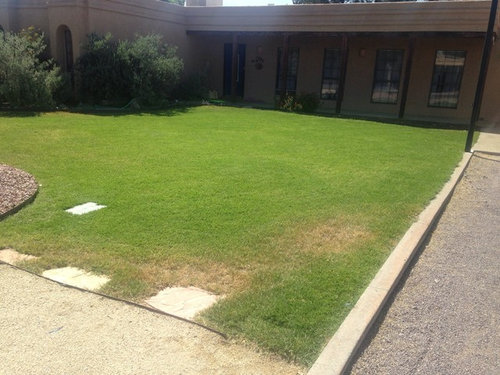
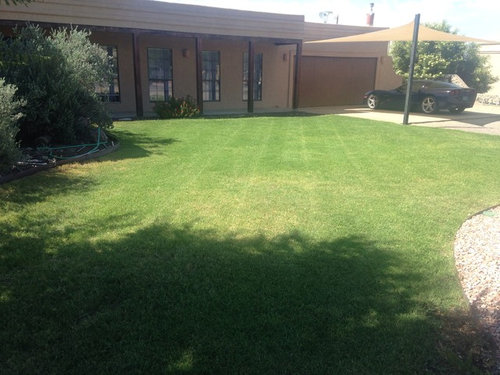
I'm excited to finally sign up for this form! I'm 37 years old and have been a homeowner with a nice lawn for the last six years. My previous houses had zero scape and therefore needed very little care. My current home has a very nice landscaped backyard but the grass was struggling when I moved in. My front yard was ugly zero scape, so I pulled it out and put in grass. I had it Hydroseeded with African Bermuda and put down a very good topsoil beforehand. I have plenty of sprinklers that cover every square inch. I live in the desert of New Mexico and it gets blazing hot with no humidity. So my sprinklers come on three times a day four times a week. Yet I have patches every year that are so dried up that it looks as if I don't water it at all. My research shows that African Bermuda is drought tolerant and doesn't need much water. I call BS because I think it needs water every single day. If I go a few days without water to give the roots a chance to go deep, my lawn dries up. If this works, I have uploaded a couple of pictures so you can see. I have fertilized, reseeded, and used Scotts turf builder. Any input is much appreciated, thank you.

Comments (10)

  • 11 years ago
    last modified: 11 years ago

    Your best friend will be the Bermuda Bible. Google it and memorize it. What are your temps there currently. DEEP infrequent watering looks like what you may be missing here. 1" per week all at once when the temps are in the 90's. You can put down tuna cans in the yard to measure how much water you get in a given period of time. Doesn't look like you have slops, so you shouldn't have run-off. If you do, water to the period of run-off wait an hour or 2 and continue watering until you get 1" of water down. Other highlights of the Bermuda bible is fertilizing with a high nitrogen fertilizer once a month. See the Bermuda bible for recommendations. Hope that helps for a start.

    Possibly a soil test will be helpful as well to see what your soil lacks. If not, I recommend putting down at least one application of organic material a year. I use Alfalfa pellets at 20lbs per 1k sq ft.

  • 11 years ago

    If you do plan on getting a soil test done. Look-up Logan Labs and posts your results here and someone will help you out with the results.

  • 11 years ago

    I will sure look into your recommendations. Thank you very much!

  • 11 years ago

    African bermuda is a new one on me, but nevertheless, it can go a full week in 90 degree temps ONCE THE ROOTS ARE ESTABLISHED. As long as you're babying it with 3x per day watering, it's going to have problems. I've discussed an issue on a golf course where they water frequently like you are doing. What happens in bermuda is a fungus gets growing on the grass which prevents the moisture from penetrating the upper surface of the turf. It beads up and sits there until it evaporates. If that is happening on your lawn, you should be able to fix it by spraying the lawn with shampoo. The normal rate is 3 ounces per 1,000 square feet. It can be any clear shampoo. The shampoo will break the surface tension of the water and allow it to penetrate past the surface of the grass. Once the soil starts getting the water, the roots will go deeper and you can back off on the watering frequency. And once you get backed off to once every 5-7 days, that fungus should die off and you won't have to shampoo it again. If 3 ounces per 1,000 doesn't work, it is perfectly safe to spray it on up to a foamy lather. Eventually it will break through the surface.

    Here's a summary of the Bermuda Bible
    Monthly: 1 pound of nitrogen fertilizer with little to no P or K
    Weekly: Water once a full inch, all at one time.
    3x weekly: mulch mow at a low setting

    The grass growing in the shade can be expected to thin out considerably. The only grass that will do well in that much shade is St Augustine. There are other ground covers you might use in there. Start planning now. You should see it thinning by the end of this summer.


    As an aside, xeriscaping (the word you were looking for which sounds like zero scaping) does not have to be ugly. Here's a picture of a yard in San Antonio that needs no supplemental water.

    The ground cover is Asiatic jasmine. One layer of hedge is boxwood. Another is pittosporum in various degrees of free-form or trimmed. The upper canopy is live oak. Once established these plants can go from rain storm to rain storm. Now it might be a little different in NM, but there are drought resistant plants that will look nice and not like a desert scape.

  • 11 years ago

    I definitely appreciate any suggestions and ideas. To answer the question about our temps here, we are in mid June and have been at 90+ for the last two weeks and broke 100 about four days ago. We will continue to be between 101 and 105 until sometime in early to mid August. Let me take a minute to defend myself on my watering habits. When I first had the grass put in, four years ago, my research revealed exactly what you said. That the roots need to get established and the best way to do that is to water once a week deep. I have tried this about 5 times and each time I come home from work in the late afternoon on about day number 3 with no water and half my lawn looks crippled. In fact, in the corner opposite of the picture in front of the front door that corner often times will only get water once or twice a week because a slight breeze prevents the water from reaching the corner. It will look dried up and dead just like the picture shows until I make sure to water it every day or every other day. So I wish I could water once a week as suggested. My lawn is pretty even, so maybe I should manually turn the water on with the tin can as you recommended. Determine how long it takes to get it 1 inch of water and then set the timers accordingly?

  • 11 years ago

    Yes please do the can test.


    Are you using in-ground sprinklers? I had an in-ground system at my old house but went immediately to oscillator sprinklers to get better coverage. The radial spray pattern from the ground system delivered water to the perimeter of the throw and only mist from the sprinkler out to the perimeter. So I had 4 hoses and 4 oscillators. I only watered where the grass looked weak. I watered each spot for 4-6 hours depending on the temperature. I would turn it on in the morning with a 4-hour hose timer and come home at lunch to see how it went. If it needed more I reset the timer to 2 hours and went back to work.

  • 11 years ago
    last modified: 11 years ago

    Your lawn looks pretty good except for those few spots. I think everyone is right on with the infrequent watering. I would atleast try it. I am no expert but when I am passionate about a subject, I research and read a lot. It just so happens lawns is one of my passions. With that being said, I believe 1 inch once a week should be a guideline and not a hard rule. Depending on your soil, climate, etc. It may be 1 inch every 5 days or 1 inch every 10 days. I live in North Carolina and have clay soil so naturally, my soil holds water longer than somebody who might have more sand.

    Also if your grass is showing signs of stress after a few days of not being watered, it makes me wonder if you are fertilizing enough or at all.

    Like I said to begin with, your lawn looks good except for those few spots. They're either not getting watered enough or I wonder if something is going on with your soil in those spots like maybe it is hard or compacted. Have you tried putting a screw driver in those spots to see how easy or hard it is to push it in the ground? I could tell you the exact spots in my lawn that are going to show signs of stress first and I don't know why that is. I am going to continue trying baby shampoo on those spots and if that doesn't work, I might need to try (don't kill me everyone) aerating those sections. I also tend to water those spots by hand more frequently and that may end up being a long term solution. You may want to try something like that. I really don't know because I haven't had much luck with my stress spots.

  • 11 years ago

    How often do you recommend fertilizing? I think I fertilize about once every six weeks. And what's the deal with aerating, I thought that is a necessary evil? I have not done that in my front yard because my lawn is too new. I'm ultimately just afraid that if I cut back my water that I will lose my lawn all together in five days. In the scorching heat of New Mexico, it is a dry heat. I know people make fun when people say a dry heat, but it is different. When I water, the water evaporates and the grass is dry within half an hour. And that's after the sprinklers have been on for 15 minutes. There is no humidity and moisture in the air to keep things semi cool and semi-wet. My logic, absurd and wrong as it may be, is to water early in the morning to penetrate down to the roots. And then a couple of times in the day to keep it from overheating.

  • 11 years ago

    You will hear mixed opinions on aerating. You'll have to draw your own conclusion on that. That's why I would test with a screw driver in the dried out spots and apply baby shampoo before you even THINK of aerating.

    Fertilizing every 6 weeks should be fine. I believe the Bermuda bible says every 4-6 weeks or something like that.

    You really should try to taper off the watering. Apply an inch of water and see how long it takes for your grass to show signs of stress

  • 11 years ago

    Sure if you only water 15 minutes, all the water's at the surface right where the soil is hot, so it evaporates. If you can water it for enough HOURS to get the water to penetrate down, the soil is cooler there and it doesn't evaporate as quickly. THIS WORKS IN PHOENIX! ...was I shouting?? Maybe I failed to mention that, but this deep and infrequent watering method was taught to me by a lawn mowing company owner in Phoenix. If you could go back to about 2003 on these forums, you could find the arguments. I used to water every day and thought it was right. He schooled me good.


    As sherm said, apply a full inch of water, as measured by filling several cat food or tuna cans with the sprinklers. Then see how long the grass goes before it needs water again. As soon as it looks dry someplace, immediately water again a full inch. Time how long it takes your system to apply an inch, so you can repeat the inch without guessing. The second time the grass should go longer. The third time it should go longer still. Before you know it you'll be watering once a week.

    Weed seeds require continual moisture to germinate. Grass does not. You are providing continual moisture the way you're watering. When you let the surface of the soil dry completely for several days, you'll see the weed pressure falling off. I used to have nutgrass in my lawn but when I went to deep and infrequent watering, even the nutgrass went away.

Sponsored
Kuhns Contracting, Inc.
Average rating: 5 out of 5 stars26 Reviews
Central Ohio's Trusted Home Remodeler Specializing in Kitchens & Baths