Software
Houzz Logo Print
sugi_c

What the....is this a Yucca?

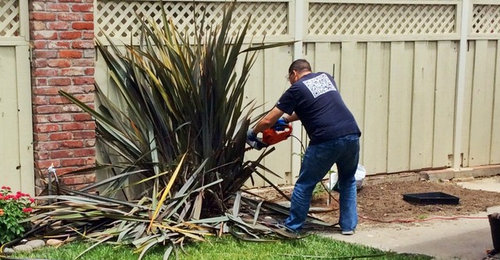
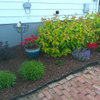
I presume this is a yucca of some sort, but who knows. All I know is how much I despise this beast of a plant, which came with the house. This house was originally built in the 50s so I have no idea which owner planted this what year.

It's enormous -- my guy here is 5' 10" so this is no small bush -- it's home to 40 million snails. I've just had it with disgusting snails! They're either not eating my weak sauce bait (where did the killer pellets go? Only weak stuff available now...) and continue hanging out on my containers and plants. Gross.

But apparently, if it's not the snails, it's the bush that plans to win. Digging and digging and digging, we can't seem to make a dent. He's now gone to Home Depot to buy a pick axe of sorts, lol.

How deep do these roots go? And are we (I use "we" loosely as I'm watching from the patio...) doing it wrong?


Comments (20)

  • 11 years ago

    Ok, now drench it with Round up and repeat as needed.

  • 11 years ago

    Maybe Phormium? Are you in California?

  • 11 years ago

    Sure looks like a phormium! New Zealand flax are hard to remove. I had a large one in my old garden that simply got too big - much like yours - and it took 3 people an entire day to dig it all out. The roots are similar to a very well established ornamental grass - thick and matted.

    If you want the remnants out of the way, digging it out is the only solution. And you are a bit restricted with access, so that complicates the issue. Otherwise, dousing with RoundUp or similar will work but leaves the remains to slowly decompose.


  • 11 years ago

    New Zealand flax as identified above.

  • 11 years ago

    Thanks guys. Glad to have it identified. There are a handful of plants I don't like that came with the house, but the rest are all aesthetically distasteful vs. this one is just a host to nasty snails and what I suspect are some kind of mealy bugs. To top it off, this big creature was taking up too much valuable (and really limited) real estate in my otherwise small garden space.

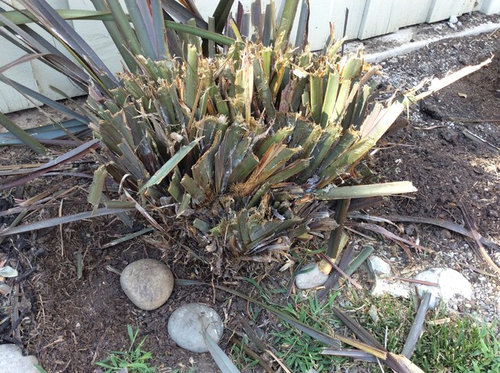
    It's out now but I suspect the BF chopped at the roots with a saw and axe....which leaves behind a crapload of remnants. Still took him half a day so I didn't have the heart to ask for more, lol. My reason for removal was to increase planting space for peppers and tomatoes, so Roundup is not an option at this time. Guess I'll wait and see how persistent it is.... New Zealand flax, huh?

    @Dave, yes -- I'm in Northern California about 45 mins south of Sac.

    @gardengal, did yours come back up?


    Thanks again!

  • 11 years ago

    No. We (i should say "they" as all I did was supervise :-)) got it all out. But it took most of the day and left the planting bed in shambles. The thing was a monster!


  • 11 years ago

    "Us," too! Lol :)

  • 11 years ago
    last modified: 11 years ago

    Yep, good ole Phormium tenax.
    Not getting this big in most of California unless irrigated of course, so arguably not really "water wise". Largest I've seen were in southern France and the CA Bay area, but they do get pretty big in the PNW too, especially the plain green form.
    A number of Cistus offerings have not proven as hardy as Sean's optimistic catalog copy would indicate, but his 'Lake Te Anu' collected-in-a-cold-part-of-NZ form survived the last 2 winters here, which are (hopefully) about as bad as 2 winters in a row could be here. (but not as bad as some single ones, like 1985) They weren't even very established, and although dying to roots, were quick to recover all things considered. Of course they are plain green, the variegated forms are too weak and sometimes even peter out by the end of summer here - surviving even a mild winter would be a stretch. They demand a maritime climate.
    Ahh but my point is, I'll be lucky if mine ever get half this big! It will take a rare stretch of 2-3 mild winters to see them bloom, but I expect it to happen once in a while.

  • 11 years ago
    last modified: 11 years ago

    As Dan with the pre Burpee Heronswood catalogs Sean seems to not understand the basis for the USDA zones (which I don't think either specified was what they were referring to - but unless a catalog or web site shows and describes their own map and rating system what else would it be?) and rates everything one zone too low - you can see Sean is doing this right off because he often gives a minimum temperature in his remarks. And I believe I saw Dan write somewhere that Heronswood was in USDA 7, which is wrong (the property is west of me, across Puget Sound and wouldn't be getting Zone 7 average low temperatures), probably the basis for a lot of his assessments (of plants the nursery was offering).

    So in both cases if something burns or freezes down at 10F we have them telling us it is hardy to Zone 7, and so on. I see this kind of apparently unwitting misrepresentation of individual plant hardiness in commercial literature all the time. Perhaps nobody doing this is trying to pull anything (certainly not these two passionate and dedicated plantsmen), instead they just don't fully understand what the USDA hardiness zones refer to.

  • 11 years ago

    From the 2000 Heronswood catalog (arguably the best and certainly the fattest!) discussion of zonal hardiness: " Indeed, even in our 5 acre garden, we have delineated a number of microzones that correspond to the USDA system's zone 6 through zone 8! Our hardiness ratings generally err on the side of safety, thus it may seem conservatively high. We suggest paying attention to plant's nativity as well as its assigned hardiness zone to assist you in predicting the overall chances of success in your garden." And he goes on to explain that factors other than just minimum low temperatures impact hardiness.

    The one removed from my old garden was a hybrid, 'Maori Chief' (syn. 'Rainbow Chief'), which was gorgeous shades of red, pink and orange and was easily 6'x4' when removed. And I just noticed flower stalks forming on a couple of red ones up the street from me. Of any year, this would be the one I'd expect them to produce blooms in the PNW.


  • 11 years ago
    last modified: 11 years ago

    One must include in the conversation of 'hardiness', just what hardiness means.

    Does this mean:

    1) plant can experience no damage whatsoever in zone x?'

    2) 'root hardy'? use as dieback annual.

    3) '..minor dieback can be expected in zone x sometimes?'

    4) 'Plant can survive many years in zone x, but ultimately can be killed in a bad winter. ',

    5) 'cosmetic damage on leaves can occur some years'.,

    6) plant will survive only with perfect siting..

    etc. etc.

    It gets really complicated.

  • 11 years ago

    For the coldest parts of Heronswood to line up with USDA 6 they would have to have average annual minimum temperatures of -10 to 0 degrees F. for the period of measurement the USDA uses - 15 years I think it is.

    This means that every year it gets cold enough to pull your 15 year average down to somewhere between -10 and 0. Or during a few years it gets so cold that the entire set of 15 figures is pulled down into that range.

    Really seems unlikely on that property.

    Him saying that part of the place was on par with Zone 6 and the fact that he thought his ratings of the plants were conservative merely serves to reinforce my previous statements. I'd be willing to bet if I asked him about he would say something like there was a low spot near one of the ponds where they think it once got down to 0F so part of the property equated to USDA 6 - this type of misinterpretation of the USDA zones appears to be highly prevalent.

    Another variable that should be mentioned when discussing reports of garden site conditions and hardiness zones is that quite a few people may have faulty thermometers. Ever look at a display of multiple examples of the same model at a store? They aren't always in agreement, that is for sure.


  • 11 years ago
    last modified: 11 years ago

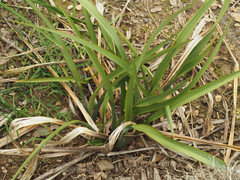
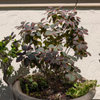
    Here is the regrowth I got, as of today, after complete annihilation of the tops by several dips to 1F, some with minimal snow cover, and weeks of below freezing weather...following a very similar winter from which they also had to recover.

    Would I call this a zone 7 plant? It is for me, since I merely want to possess it, but I don't know if I'd market it as such at my nursery. Anyone from a mild climate who expected something like the picture above would be disappointed. With a couple mild winters in a row, maybe I can hope for them to get some size and bloom, maybe not. I like it as it is...any plant from New Zealand is worth having in a garden here just for its rarity. The other that seems not to mind the climate is Podocarpus 'Red Tip'. It's possible some of the Carex could be grown but as a matter of policy I'd refuse to plant anything from that genus. Too weedy.

    A devil's advocate would logically point out that if they stay small like this, they are just an odd looking iris that doesn't flower LOL. I wouldn't disagree.

  • 11 years ago

    I expect that most people assume that a garden plant (that isn't an annual) they buy at a retail outlet in their area is always going to live through the winter, without incident - the majority of plants sold do not go to zonal denialists and other hobbyists who know what they are dealing with when a plant is marginal in their area. If the average customer - many of whom may perhaps not even think about plant hardiness when shopping for plants - has found out they are in Zone 8 the card hanging from a shrub that kills back at 10F shouldn't be saying it is hardy to Zone 7.


  • 11 years ago

    Sometimes it takes a chain rapped around the plant, the other end hooked to the back of a pickup.

  • 11 years ago
    last modified: 11 years ago

    Right, that was my point. Technically survival itself shouldn't be the basis of commercial hardiness zone ratings, rather normal development as a plant would experience in its native habitat. In most cases, anyhow. I have had back to back winters that stayed above 10F, so, we'll see what happens. So far this form doesn't start to show damage until < 10F temps.

  • 11 years ago

    I have taken out enormous Phormium - 8' tall or so and bigger across. Relative to the size of the plant, the root ball is not that large. When I say 'l', however, it is as Josephene suggested - we wrap a chain around the plant, hook the other end to whatever piece of equipment is closest or easiest to get close, and yank it out. The root ball is maybe 18" deep and not much wider than the plant is at the base. None have ever come back. My neighbor has hers cut down as low as possible every 2-3 years and they come back (after looking like hell for several months) rejuvenated. I have replaced almost all of my Phormium with Yucca and Cordyline, which tend to be better behaved.

  • 11 years ago

    Up here most of the yuccas that are grown in this area have the advantage of showy flowers and plant hardiness but except for the variegated cultivars are a little dull and inelegant. For us, although very frequently planted Cordyline australis is quite prone to heavy pathogenic spotting of the leaves - and freezes down periodically. Meanwhile the other cordylines on the market appear to be even less hardy. Whereas phormiums can be quite impressive, tall, lush and full with dramatic leaves and flowers.

    If you plant something where there isn't room for it it's not the fault of the plant.


  • 11 years ago

    The variegated yuccas are amongst the most reliable and showiest specimens in the garden. There are quite a few Cordylines that do not form trunks and work well; this is zone 9b, which is close to the OP's zone, so won't work everywhere. I agree that you have to site plants based on their expected size, but with Phormiums I have been disappointed (dismayed?) at how large they have grown. 'Dusky Chief', for example, which I planted extensively 8-10 years ago when San Marcos had it listed at 3-4 feet grew far larger and now San Marcos lists it at closer to 8 ft. Big difference. And variegated and colored Phormiums revert with abandon. As a very accomplished horticulturist friend of mine noted, 'if you have a Phormium that hasn't reverted, you just haven't had it long enough.' Chacun a son gout. That's what makes a garden!