Software
Houzz Logo Print
hzdeleted_21934719

Chaste Tree

11 years ago
last modified: 11 years ago

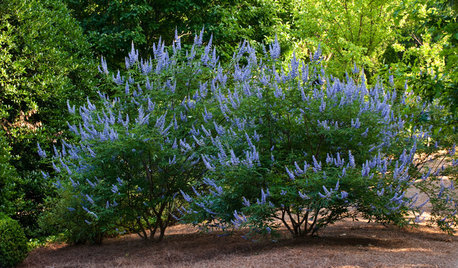
I just purchased a Chaste Tree (Vitex a gnus-castus), and would like to know if I can maintain this as a narrow shrub with regular pruning. (By this, I mean something 7-8 feet tall/four feet wide...which is now I try to keep the Butterfly bushes.) They kind of remind of Butterfly bushes (know they are not at all related), but Butterfly bushes do respond nicely to aggressive pruning. Also, does anyone know if they will be deciduous, semi-deciduous or evergreen for me. (My butterfly bushes are largely evergreen.) Also, is planting adjacent to a house an issue (about three feet away)? Thanks in advance.

Comments (14)

  • 11 years ago

    We have them all over the place here, and I have one. They are either allowed to grow out as a large to medium shrub, or trimmed so they grow into a tree. You might have a problem eventually with it 3 feet to your house.


  • 11 years ago

    Ken, this is NJ/Zone 7a.

  • 11 years ago

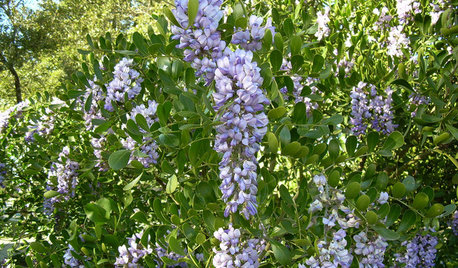
    This is a very aggressive grower and gets much woodier than a Buddleia (butterfly bush). They also have rather awkward branching that if you are going to allow it to attain size, needs to be dealt with. I would not pick this as an easy one to keep to the size/shape you desire. You can certainly coppice it annually or semi-annually, but that will make it much wider and shorter than your target size. It also may die back in winter in your zone, effectively coppicing itself. Here in zone 9b it is one of the very latest woody plants to leaf out in spring and has no noteworthy fall color. The flower color is remarkable; otherwise it does not have much to recommend it. I have quite a few because of that flower color!

  • 11 years ago
    last modified: 11 years ago

    It's actually one of my favorites. Besides the pretty purple flowers, it is very drought tolerant (extremely important in my area) and the bark becomes very textured and interesting looking as it matures.

    You do have to watch out for sucker babies at the base, and remove them if you don't want it to spread. I imagine in NJ it would grow bigger and spread further than in my desert location.

  • 11 years ago
    last modified: 11 years ago

    The location I WAS going to put it in is...extremely sunny, and hot (south side of house). But being that it seems to wanna get big and woody, may change those plans and put it out somewhere with more space and just hope it has some deer resistance. P.S., the pale lavender/gray flowers are stunning, I agree. Thanks for the responses.

  • 11 years ago

    i would have never considered NJ the sub tropics... lol ...

    note all those with experience.. are from 8 and 9 ...

    good luck ... cant really tell you how many plants i couldnt live with ... that i killed .. lol.. all you can do.. is experiment.. and hope for the best ...

    do you see them around locally ... thats usually my first clue.. of how well something will do in my area ....

    ken


  • 11 years ago

    I'm in northern NJ and after growing to 8 feet or so, the vitex in my yard died to the ground after the 2013/14 winter. It came right back from the roots, but last winter hammered it again, so I'm not counting on 8 feet again for a while. The amount of pruning to keep it tall and thin would be onerous. It does need to be coppiced for the maximum bloom, and it is, as someone said above, very late in leafing out. Like late May late.


  • 11 years ago
    last modified: 11 years ago

    I had to look up "coppice." You think this tree should be periodically cut down to ground level?

    I'm very doubtful about this -- I'm sure no one is doing that in my area, and we have thousands of these trees around town.

  • 11 years ago

    Lots of people coppice them. If you want to keep it as a shrub shape, and get max bloom as lisanti noted. I have about 20 on standards that are a pain in the neck to keep looking nice, as their natural branching structure is ungainly (loaded with crossed branches, duplicate branching) and they sucker like nobody's business. We have them out by our barns (we run an equine veterinary hospital) and I use them with crape myrtles to provide color in July-Sept when here in the SF Bay Area we are at our driest and brownest. Everyone always comments on the dramatic color of the Vitex flowers, but the crapes have much more fall color and much more winter interest. Both leaf out very late, but the pastures are still green through May so not a problem. I would not use a Vitex in a position of significance in a residential landscape. I'd use it as part of a shrub border or background of a perennial border, and I'd coppice it. One person's opinion, that's what makes gardening fun!

  • 11 years ago

    prune, yes. But cut down to the ground?


  • 11 years ago
    last modified: 11 years ago

    Severe pruning is recommended by a number of notable plant folks in Texas. Jerry Parsons is on the extreme end which agrees with what has been said above about coppicing - though it is from the perspective of a zone 8 or 9 growing season. Here's his summary statement, where "Texas Lilac Vitex" refers to a set of named selections/cultivars known to have good performance in the state:

    However, to some people, cutting is like killing. If you have that attitude, you will not enjoy the maximum floral display of the Texas Lilac Vitex* - only the spring bloom. The Texas Lilac Vitex* must be cut after EVERY bloom cycle, and cut back to the ground EVERY winter.

    Others recommend pruning tree forms back towards the trunk(s) much like "crape murder". Not uncommon to see them overgrown in locations where the landscape designers assumed regular severe pruning which was not maintained.

  • 11 years ago

    No, not to the ground, just pruned back HARD, so the tree will make lots of new growth, on which the blooms will appear.


  • 11 years ago

    Well, I decided to plant it in the sunny/hot front after all. Seemed to conform to the theme of that part of the garden (Mediterranean). So, it will be growing in the company of a bed of Opuntia cacti, a fig tree, one dwarf pomegranate, lavender and rosemary, Yuccas and Crape Myrtles (which I realize are NOT in fact Mediterranean), but seem to fit in nonetheless. Glad they can take some serious pruning but will not chop them to the ground but will be training them (I read that they can be espaliered as well). Thanks for all the thoughtful responses and have a terrific 4th!