

"Roseville Noisette"
"Roseville Noisette":
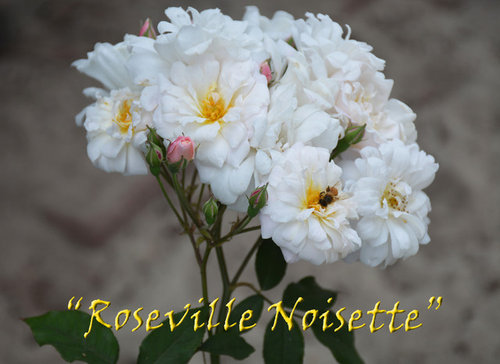
Found Rose; Dwarf Noisette; Might make 3 ft. if it's lucky. Continuous-blooming; disease-resistant. Very fragrant.
Comments (23)
 11 years ago
I like it very much! But here's a possibly stupid question: why is it a dwarf Noisette instead of a Polyantha? Or could it really be either, and the Noisette buds and fragrance won out in terms of how it got classed?
Always curious,
Virginia
jerijen
Original Author11 years agoIt's pretty clearly one of the sports/seedlings of 'Blush Noisette,' so you sorta have to call it a Noisette. It's one of many -- but the only one that stays small.
Related Professionals
Aiken Landscape Architects & Landscape Designers · Fredericksburg Landscape Architects & Landscape Designers · Virginia Beach Landscape Architects & Landscape Designers · Edison Landscape Architects & Landscape Designers · Saint George Landscape Architects & Landscape Designers · Tuscaloosa Landscape Contractors · Fayetteville Home Builders · Bowling Green Home Builders · Lafayette Home Builders · Columbia Home Builders · Middletown Home Builders · Middletown Home Builders · Mansfield Home Builders · Chico Home Builders · Amherstburg Home Builders- 11 years ago
Because polyanthas should be, by breeding, hybrids of multiflora where Noisettes should be hybrids of moschata. However, it's up to the breeder/introducer to classify it to whatever he/she desires and feels best fits it. Either from a marketing, exhibition or garden use perspective. But, if you're happier growing and calling it a poly, it's your garden and you may refer to it as whatever you wish.
- 11 years ago
Thanks, Kim- that was the answer I wanted. I knew about H. moschata for Noisettes, but it was the Multiflora ancestry for Polyanthas that I didn't know. So many things still to learn...
Virginia
jerijen
Original Author11 years agoAnd, Virginia -- This is a Found Rose. It's one of the ones that missed the DNA testing -- but I think it would have tested out as identical to 'Blush Noisette' -- as many/most of the Found Noisettes have.
And you are at liberty to think of it as whatever you wish, but you will find it on HelpMeFind as a Noisette. http://www.helpmefind.com/gardening/l.php?l=2.60770- 11 years ago
You're welcome, Virginia. I've just emailed you my article on Hybrid Musks, etc., explaining how many of them fit together.
- 11 years ago
This discussion reminds me of this:
Felicite et Perpetue is a cross between Rosa sempervirens and a noisette and is classified as a rambler.
Little White Pet, the dwarf sport of Felicite is called a polyantha.
Aimee Vibert, which is also a cross between R. sempervirens and a noisette (Champney's) is classed as a noisette. jerijen
Original Author11 years agoYou have to remember (as Kim said, above) that with known cultivars, the introducer got to pick what they were called. Sometimes, that made better economical sense than horticultural sense.
- 11 years ago
Yep, that's pretty much what I was getting at, that the breeder gets to call it whatever he/she wants.
- 11 years ago
Combined with the introducer. I can decide I want to classify a seedling something, but if you, as the person or company responsible for marketing the rose, whose money and labor are on the line, determine it is not a wise choice, your opinion is of equal, possibly greater weight in the decision.
 11 years ago
Some how I thought this was a small climber and started her in a pot with a plan on running her up a post. If she really stays that small, can she handle some heat? Could she deal with some shade? I will need to pick a different spot for her.
- 11 years ago
I think those of us in areas of extreme, intense UV and/or heat will need to rethink the question of whether roses can tolerate some shade. Even under the best of these conditions, MOST roses appreciated direct sun exposure up to six hours daily, with those of Moschata and multiflora ancestry demanding even less. I'm finding MANY of mixed ancestry not tolerating the extreme UV here along the coast. Foliage is burning/tanning; new growth stops completely; the plant looks "arthritic" and some even appear to express Downy Mildew coloration. But, when moved to the shade of the liquid ambers, those issues clear up and normal growth and foliage begin again. It isn't "heat" as we traditionally think of it as it hasn't exceeded 85 F officially, though standing in the direct sun, it gets HOT. The breeze has remained feeling "refrigerated". It must be the light/UV is simply too extreme, too intense to permit the foliage to do their functions properly. Moschata is an under story plant, germinating in the damp, cool, humus rich soil under the tree canopy and quickly throwing itself out into the open sun through the trees. Though performance may be a little slower in less direct sun and though they may experience a bit more mildew and spider mites in those conditions, they certainly shouldn't die from them.
- 11 years ago
At a garden tour of the local head of a rare fruit growers said that because we are so close to the ocean, we get a lot more reflected UV. You may be experiencing that in your garden.
I have a spot that will get some reflected heat plus west facing sun from noon on. Not as bad as the rest of the area, but I have left that area blank because I have a plan for the zone for the future. But I am so tired from "plans for the future" that I think I want to plant it now and let the future be a bit further out. I also am pulling up a plant in the front yard to day and have a couple of roses planned for it. A lot more shade since it is north facing and under a Jacaranda tree.
- 11 years ago
I should add, my 'Golden Celebration' body bag that I keep complaining I am ousting but never seem to find to do so, I put up one of the shade sails from Costco over it and Lady Hillingdon to cool a room on the house and those two roses. Guess who finally put out a long cane after only 5-6 years... (and it is all green not doc huey burgundy) I put up a couple more yesterday for the party but they may stay up til fall
- 11 years ago
I was over the first range of mountains from the ocean in Encino, so there was some real elevation separation there and the UV had dramatically increased over the past three years. It's even more extreme here, nine to ten miles in and only about 250' above sea level. There are some "hills" separating us but nothing compared to the difference between the "West Side" and the Valley side of the Santa Monica Mountains of the old house. I'm often having to use the maximum light compensation the camera offers just to get color in the photos rather than reflected "white". And, it isn't even "summer" yet!
jerijen
Original Author11 years agoI found out long ago that the "full day of sun" stricture was way wrong here. My Golden Celebrations get morning sun ONLY, and they thrive on that.
I had 3 Roseville Noisettes. One I put in the ground at the base of the wall. Heat killed it, and also killed a Jeri Jennings down there. Reve d'Or had all-day sun, and it's almost dead. We were fine until last summer's record-setting heatwave, and after than, some plants just didn't recover.
I put the other two RNs in 2 HUGE glazed pots, on the West side of the house. They get NO moning sun. They start getting sun at maybe 1 p.m., and get it until maybe 6 p.m., in summer, and those plants are thriving and blooming.
I wouldn't begin to advise someone who lived elsewhere, but I think all-day sun is difficult for MOST (not all) roses in MY conditions.
That said, Bishop Darlington's lower canes and roots are in shade most of the day, but the top of the plant explodes in bloom and foliage. So that works for him. It's frustrating, but it's almost individual plants.- 11 years ago
That's much like the long offered advice for Clematis, "feet in cool shade, tops in sun". But that is honestly good for very many plants and most roses, unless they're some desert dwellers such as Stellata or Hulthemia. With sun burn/scald and being cooked in these extremes, on severe issue we all have to watch is theFlathead Apple Borer. They look for the sunburned spots, lay eggs around them which hatch into the borers. They burrow into the canes and eat the cambium layer, working their way down to the crown of the plant. If it's budded and they reach the bud union, very often, that plant dies. The UC Davis article at the link deals mainly with trees, but it's the same for roses. I began battling these pests back in the late 80s and have seen their damage on roses for several decades now, up and down the state.
- 11 years agolast modified: 11 years ago
For a long time, I didn't even think about trying to grow roses here; we have so few spots that get full sun. But the UV is pretty intense here also, and I had already figured out that other plants that supposedly want full sun did not want our version of full sun...
If I hadn't actually seen some old roses growing in shady gardens hereabouts, I might still be rose-free.
I now have about 50 young rose plants, and they're doing quite well. A few haven't bloomed yet, but sometimes that's a maturity issue, so first they'll get some time, and then whoever seems to still be languishing will get a chance at one of the sunnier spots in the yard. I was thinking that I'd need to try a lot of plants to see which ones would be shade-tolerant enough for my conditions, but I'm increasingly suspicious that most roses can handle (or prefer?) at least some shade in our area.
Virginia
- 11 years ago
I have one flower bed that is in full, blazing Florida sun until the sun goes down. I have roses in other beds that were grown from cuttings from the full sun roses, so they are basically the exact same rose. The roses that are in beds that receive some relief from the afternoon sun, even though younger, are way larger than the full sun parent roses. For instance, there's a full sun Mrs. B.R. Cant that is only about three feet tall and just as wide. Her child in partial shade is close to six feet tall.
- 11 years ago
It really does seem counter intuitive, doesn't it? Too intense, extreme heat and sun can greatly stunt most plants, just as insufficient light can cause them to stretch to gather the levels they need.
- 11 years ago
It was a surprise to me, Kim, to see the difference in size. Although I had decided long ago that full sun recommendations for plants didn't mean Florida full sun, I didn't think it would apply to roses.
- 11 years ago
Many of the full sun recommendations we have, originated in Britain. That should tell us all we need to be able to translate it where we are.


User