Software
Houzz Logo Print
majormtn

Are these new roots going to continue to grow?

11 years ago
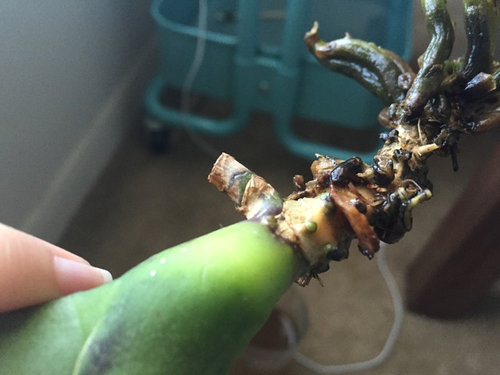
Hi Everyone!

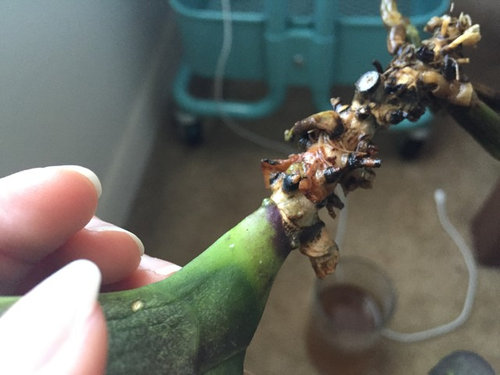
I have this orchid that has been sick for quite some time. It had started to get leathery wrinkled leaves and I was about to give up on it. However, it recently started to push out a new leaf and these new roots.

What's concerning me now is what's going on with the stem. Is it supposed to be dry looking like that towards the top of the the orchid? I've been keeping an eye on it and this "dry" surface appears to growing towards the top of the orchid. Is this normal? The way bottom roots still turn green when wet, but nothing appears to be growing in that area anymore. Is the bottom part dead? And if so, could this be some sort of rot?

I guess what I'm contemplating now is whether to cut off the "dry" sickly part of the orchid and let the bottom heal or attempt to apply something to the stem to stop this from developing? I got excited about the new roots when I started to see them, but I'm not sure if they'll stale and stop growing since this weird dry surface is starting to take over.

Does someone have any idea on what's going on here? Anything help is much appreciated!


Comments (8)

  • 11 years ago

    Where do you live?? Give more info as to where you live and what conditions this plant is growing in. What type of light?

    It appears to be a Phalaenopsis orchid. Looks like you lost most of the roots. You have some root buds starting. I wouldn't cut anything at this point. Those lower green roots could branch. They appear alive.

    Put the plant in a small pot with small wood chips and maybe some moss. Put it in a bright window (not direct sun) and leave it alone until you know if it makes new roots. Soak the bark before potting.

    Jane


  • 11 years ago

    Jane, Great suggestion for trying to revive this plant. Here is what I did when I had a greenhouse and came across a plant in this condition....And really had good success with the method.

    Take a large hand full of wet bark mix or Sphagnum Moss and put it in a plastic bread bag. (bread bag, because most have - or used to have - small holes in them - if it doesn't, punch a few in the bag) Put the plant on, not in the wet mix, tie the top, and hang it under the bench (or someplace out of the sunlight) out of the way. Check it periodically to see if the mix needs a bit more moisture, but basically leave it alone...Usually within a few months the plant will either have a new set of roots starting, or you will know it won't make it.......Most of mine made it, and I revived quite a few that way.

    Just another approach

    Bill

  • 11 years ago

    Great suggestions guys! I will give these methods a try.

    I live in San Antonio, Tx and I've recently placed the plant on the window sill (about 2-3 weeks). My window faces Northeast and gets a lot of morning sun.

    Do you guys know, however, what's going on with the stem? Is it just scabbing over the roots or does it appear to be some sort of rot?

  • 11 years ago

    I'm assuming its a Phalaenopsis, and guessing you are concerned about the black appearance of the root stubs on the old main stem of the plant. Now if that's not setting oneself up for a fall, I don't know what is.......☺☺(assuming and guessing in the same sentence....)

    I'm thinking the black is just the roots dying or already dead from a past case of root rot. So long as those roots or the main stem are not getting soft and mushy, I think you are ok. If you choose something like my bag method, you might want to keep an eye on the plant for the first few weeks and make sure this black is not turning into rot....soft mushy....

    If you are really alarmed about what is going on at the end of the stem, you could cut it off. In your first photo there is what appears to be an old bloom spike coming out of the side of the main stem. About an inch or so below that the main stem has what appears to be a narrow place before you get to the old dark root stumps at the end of the stem. That narrow place is where I would cut it off if you choose to do that. (Sterile sharp blade and apply fungicide to the entire stump)

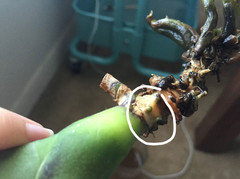
    I'll try to identify the same place on photo #2, The old bloom spike stub is now pointing down. Just a bit further down the stem is a piece of old root stub that comes out of the top of the stem and turns left toward the leaves. Just below that there is another white circular place that appears to be another old bloom spike on top of the stem. The cut point would be between the root stub and the white circular bloom spike stump.

    The cutting is your decision....unless, you decide on the bag method and see rot beginning...then cut the stem, apply more fungicide and consider another less humid way to re-root the plant.

    I always enjoyed these kinds of challenges, and never failed to learn something about growing orchids, and just how tough and resilient they really are.

    Bill

  • 11 years ago

    Thanks Bill for your thoughts on what's going on with my phal! The black doesn't concern me as much as what's going on with the base of the phal. This dry surface appears to be growing upward. When the new roots first started to appear, the area surrounding them was still green. A week later they are now surrounded by this dry surface. Hopefully this makes sense lol! You can see this happening better in the second photo above.

    I'll keep an eye on the roots to see if they continue to grow, but for some reason, I fear that the inside of the phal is dying and drying up and will not longer be able to use these new roots to take in water. I basically want to try to stop this process if this is in fact what's going on. I guess only time will tell. :(


  • 11 years ago

    Well that's good to hear! I'll give that method a try and see what happens! Thanks everyone :)

  • 11 years ago

    Follow Bills directions. I wouldn't worry about the brown part. You have healthy green root buds emerging. You don't want to damage those at all. This plant should be potted immediately. Do so gently to protect those root buds.

    You can try the bag method as many have had success with it. Since you live in Texas, I assume your temps are warm/hot and it might not be necessary to bag the plant. If you could pot and place the plant outdoors in a protected patio would be even better. These plants want warmth.

    Give it a try either way. Orchids are very forgiving and have a strong will to live. As Bill said, you will learn good lessons working with this plant.

    Good luck,
    Jane


Sponsored
Miller Woodworks
Average rating: 5 out of 5 stars23 Reviews
Franklin County's Trusted Custom Cabinetry Solutions