Software
Houzz Logo Print
sharon_markowiak

Russian Sage

11 years ago

I planted 3 Russian Sage Little Spire for the first time last summer. One plant is doing well, the other two grew to about 12 inches, the top leaves curled and turned gray. While they aren't dead, they aren't growing either. Any ideas as to what's going on here? They are all planted in the same area so it isn't the soil/sun/water conditions.

Comments (18)

  • 11 years ago
    last modified: 11 years ago

    Where did you buy these three plants? Those two could just be weaker plants. I purchased 4 Baptisia 'Australis' plants this past spring. They were all tall and spindly, so I cut them back a bit to encourage new growth. Three of them responded well, while the fourth one defoliated and died. If your two Little Spire Russian Sages are still alive I would just keep watering them and maybe give them a bit of fertilizer. If that doesn't work, you could also transplant them into pots to give them a more controlled environment until they are strong enough to plant back into the ground. I had to do this with one of my Rosy Glow Barberry shrubs that stopped growing. So far it is responding well and producing new growth. Perhaps next year I will be able to plant it back in the ground, but I will keep the pot handy just in case.

  • 11 years ago

    please post their picture

  • 11 years ago

    If your weather has been anything like ours, the last thing they need is more water. It may be that the roots are rotting. Is it possible the one healthy plant got planted in a slightly higher spot, so has better drainage? Of course, if you are out west in the terrible drought, ignore everything I've said.

    martha

  • 11 years ago

    I agree with docmom. Mine looked exactly like that when we were getting too much rain. I would avoid fertilizer & they don't do well in rich garden soil either. The stems should grow straight up, if they start curling like snakes or leaning over horizontally and sending up vertical side shoots, the plant is getting too much water. Mine look terrible this year, I cut them all back.

  • 11 years ago

    texasranger2, how are your lantanas doing so far this year? Most of mine are doing great, but a couple that are in a tiny bit less reflected sun are rather slow in growing. We've had a fairly cool summer so far, so I think that may be the reason.

  • 11 years ago

    Gorgeous, Tex.

  • 11 years ago

    What is the species name of the lantana with orange blooms and hooked thorns?

  • 11 years ago

    I wish I knew. I finally swiped a cutting from a plant up the street which I'd been noticing for a few years that was planted by a Russian Sage in a corner street planting. I was not someone's yard so no one to ask what it was or get permission. Yea, I'm bad that way. It was a pretty combination in a really tough hot spot. Anyway, I knew for sure it was hardy as all get out.

  • 11 years ago

    Oh, that's too bad about the species name. Would you post a photo of just that species of lantana? Perhaps I could research it and do some detective work and find out what it is?

  • 11 years ago
    last modified: 11 years ago

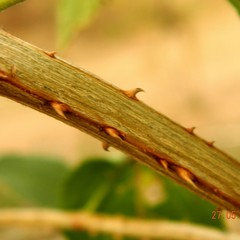
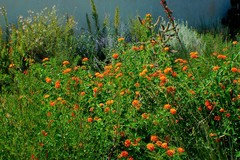
    Its the one in the photo above. I looked and that was the best picture I have of it. Its got definite claw shaped thorns on the stems, unlike most cultivars I have bought. Its wider than it is tall. I planted seeds of L. horrida and its different than that too, finer plant with smaller leaves and not a big seed producer like L. horrida. The horrida shuts down blooming but this one never does. No red in the flowers, solid orange, hope that helps.

  • 11 years ago

    Is it the plant in the very front with the tall spires, or is it the lower growing one behind the one in the front with the orange blooms?

  • 11 years ago

    the one with the orange blooms.

  • 11 years ago

    Yes, you can kind of see the thorns in your photo. I never realized lantana could have sharp thorns like a rose bush. That is very interesting. Are you sure it is a lantana? Does it have that pungent odor like a lantana does and the same type of leaves?

  • 11 years ago

    Here it is, shot today. The plant is a monster this year. you can see how crowded everything is due to the heavy rain we got in June and early July. Its rather distressing.


    The lantana is on the right side of the side walk, close to the wall, its crowding out the Flame Acanthus and Pink Yucca. I've trimmed it back twice and need to do it again. I may move it next year or start a new one elsewhere. Whatever, I need to thin that area out but maybe its just due to all the rain.

  • 11 years ago

    Okay, you're right. I found this BlogSpot (link below) that talks about it. I think the person who posted this blog would think you were crazy for growing lantana on purpose. LOL But it still doesn't tell me what the actual name is besides just Lantana Camara. :-(

    http://earthonthewing.blogspot.com/2011/09/alien-invasion.html

  • 11 years ago
    last modified: 11 years ago

    L. camara is the actual name. Only the commercially sold hybrids have made up names like 'Miss Huff', 'Dallas Red' or 'Carnival'.

    Wild Lantana horrida has orange/red flowers. Wild Lantana camara has pink/yellow flowers. They smell the same. Both are cold hardy. L. camara is hardy to zone 6. I am unsure about L. horrida but its probably that hardy as well. Both have thorns and produce lots of viable seeds.

    The common name for wild L. camara is 'Ham & Eggs'. Wild L. horrida is often called 'Bacon & Eggs' based on the different flower colors. There are six species indigenous to parts of the southern United States.

    ~~~~~~~~~~~~~~~~~~~~~~~~~~~~~~~~~~~~~~~~~~~~~~~~~~~~~~~~~~~~~~~~~~~~~~~~~~~~~~

    Most named hybrids are a mix of two South American species: L. camara & L. montevidensis. Lantana montevidensis is a trailing ground cover type with lavender flowers. Its tropical and not cold hardy at all which is why the hybrids are sold as annuals and don't survive winter. The hardier cultivars often have L. horrida (also called Lantana urticoides) in their lineage.

    ~~~~~~~~~~~~~~~~~~~~~~~~~~~~~~~~~~~~~~~~~~~~~~~~~~~~~~~~~~~~~~~~~~~~~~~~~~~~~

    I now think the orange one in the photo I posted above is L. horrida. L. horrida is a Texas native but L. camara isn't. Its considered an invasive pest all over the south.

    The 'Ham & Eggs' that I have is wild L. camara, people have grown them here in Oklahoma for as long as I can remember because they are so hardy and will grow in our dry heat. They were commonly grown on farms as ornamental plants. They aren't invasive here because of cold winters but further south both types stay evergreen and bloom all year.

    I read that L. horrida varies in leaf size, form etc in that site I posted above. I ordered seeds from Native American Seed and those plants have much bigger leaves and the plant has a wilder looking habit than the orange one I like so much that I posted in the pictures above which was started from a cutting from a plant growing up the street, I was disappointed in the plants I grew from seed I ordered.

    The orange I started from the cutting up the street obviously produces viable seed, I have a few baby volunteers I noticed. Its leading me to believe its L. horrida (which definitely has thorns) except I think this one happens to be a slightly different type than the ones I grew from the seeds I ordered.

    None of the cultivars I have purchased have thorns. BTW, I realize now that the one which wintered over in my hell strip is a Miss Huff. I'd forgotten what I planted, it happens around here.

    http://npsot.org/wp/story/2011/1801/