Software
Houzz Logo Print
mattttyb

Tomato seedlings not growing very fast?

11 years ago
last modified: 11 years ago
Hello everyone,

I am new to these forums, and to gardening for that matter.

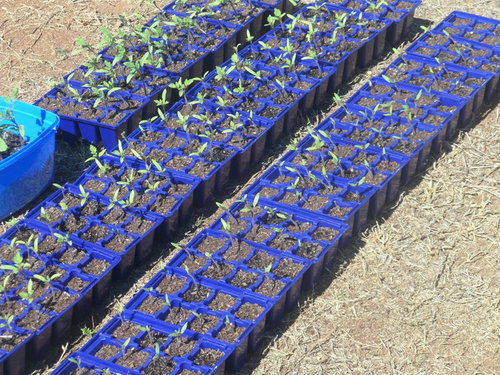
I planted these tomato seeds about 2.5 - 3 weeks ago in a specialized commercial potting mix designed for seedlings/seed growing. I wanted to know if they look healthy to you because they seem to be lagging behind based on images I've seen on the web for their age. I live in Darwin Australia so it is a tropical climate. We don't suffer from cold weather. They are out in the sun all day in a good spot (8 hours at least) and usually water them once or twice a day.

The ones on the left are Black Russians (black krim), the middle ones are Romas, and the ones to the right which to me don't look like they are doing very well at all are the Grosse Lisses.

Does something look wrong or would you say I'm worrying over nothing?

Many thanks for your time!

P.S - I was also wondering when potting these up to very small pots if I should stick with the seedling potting mix or should I switch over to a general potting mix or specialized tomato growing potting mix? and how many times would you repot a tomato plant burying the stem for a better root system before the final planting position? at this stage I was thinking of going from seedling tray to a small pot, and then to it's final position which will be a very very large container.


Sorry one more thing lol. If you had the choice, what would be the best way to grow the tomatoes? garden beds with top soil mixed with manure, potting mix, etc. Or big containers with potting mix? At this stage I'm leaning towards containers. I figure that it gives me more control if things go bad and the potting mix can be replenished. Please share your thoughts.

Comments (17)

  • 11 years ago

    What's the weather like down where you are right now? I think it is always hot in Darwin. Those seed starting pots will dry out very quickly in the sun/heat.

    I can't imagine growing tomatoes in pots in the Australia heat.... they would need to be very big pots.

  • 11 years ago

    During the day it reaches about 27c at the moment. But I've read online that it's apparently a common mistake that people over water their tomato seedlings?

  • 11 years ago

    <when potting these up to very small pots if I should stick with the seedling potting mix or should I switch over to a general potting mix or specialized tomato growing potting mix?>

    A general potting mix would be fine if you also supplement the nutrients they will need. Otherwise a specialized mix, assuming that means it already has nutrients added.

    <and how many times would you repot a tomato plant burying the stem for a better root system before the final planting position?>

    I generally do them twice but as long as you do it at least once to trigger the fibrous root development it's fine.

    <If you had the choice, what would be the best way to grow the tomatoes? garden beds with top soil mixed with manure, potting mix, etc. Or big containers with potting mix? >

    Oh garden beds most definitely. Successful container gardening has its own unique set of problems and increased costs. I do both and the work involved with the containers is 3x that needed by the gardens but the garden production is easily 3x that of the containers. And like Peter said, in your heat I'd be very reluctant to use containers. It is enough of a problem in my climate.

    As for your seedlings, all in all I think they look good. The ones on the top left - the Black Krim trays I think - need transplanting into their next larger cell size very soon. I would have already transplanted them. And I see some cells with more than one plant that will need to be separated.

    Good luck with your plants.

    Dave

    mattttyb thanked digdirt2
  • 11 years ago

    Thank you Dave & Peter. I will give strong consideration towards garden beds again. Would I be able to get away with planting tomatoes twice in the same spot before planting something different there and going back to tomatoes again? Ideally I'd like to pump out 2x worth of crops in the dry season, one after the other.


    Yes, the black krims are really pumping! I'm just disappointed the Grosse Lisse are lagging. Perhaps they just grow a lot slower, I'm not sure. I think next time I may experiment with different seeds and potting mix just to see what works best for them. This is all new to me so I have much to learn :)


    I will pot up the black krims very soon.


    Thanks for your help!

  • 11 years ago

    I haven't garden for too many seasons, but in my opinion it is possible to plant tomato in the same spot continuously if: you have healthy soil biology, a good surrounding ecosystem to control the pests and plants free of disease. One of my raised bed I put more leaves compost in and plants are noticeably growing better in it than my other beds. People are afraid of soil losing nutrient, but I don't think it's a problem if you put down mulch and compost which will break down over the season. If the soil is not healthy and all the tomato caught disease there maybe it's better to plant somewhere else.

    mattttyb thanked maxjohnson
  • 11 years ago

    Would I be able to get away with planting tomatoes twice in the same
    spot before planting something different there and going back to
    tomatoes again?

    ^^^^^^^^^^^^^^^^^^^^^^^

    I would say "SURE". unless you've experienced soil borne diseases.

    Plant rotation is not practical for most of us home gardeners. What I do is amend my beds with organic matter, compost, manure every season and just keep planting tomatoes in the same spot. Thing to know is that most tomato diseases ( in US at least) are airborne and rotation is not going to do anything to prevent fungal diseases.


    Sey

    mattttyb thanked Seysonn_ 8a-NC/HZ-7
  • 11 years ago
    last modified: 11 years ago

    So true about plant rotation. Most of us have limited space. Well hopefully all will go well with the garden beds. I'll make sure I amend the soil as well with compost, manure etc so that it hopefully remains in optimal condition. I don't think tomatoes do too well in the wet season here due to high temps and very high humidity + lots of rain. But I might try grow some as an experiment to see how they turn out. I would have to clone suckers though as this is the last month for sowing tomato seeds. Next year I will get them started first thing in May so then I can get some more seeds going by June and keep the tomatoes going for awhile :)

  • 11 years ago

    Way to go !

    Do you have pine bark mulch/nuggets ? They are the best amendment I have found to improve drainage in our wet PNW climate.

    f your garden beds are in-ground/flat, you can try to prevent any run off water from getting into them , by trneching around them. Framing and raising would be even better/ JMO

    Sey

    mattttyb thanked Seysonn_ 8a-NC/HZ-7
  • 11 years ago

    Not yet. But I'm going to order some when I order the top soil as well. It is a combination of chipped bark and forest material sourced through local tree choppers. From what I've read, mulching sounds like a must.


    Garden beds will be raised and will be about 30cm in height. I plan on putting cardboard down before the dirt to kill the grass and prevent weeds from coming through. This combined with mulch will hopefully go a long way to keep the weeds at bay.


    Thanks again for the help everyone :) I should be potting up most of my seedlings soon!

  • 11 years ago

    Matt,

    I meant to say chopped pine/ spruce .. bark ( small nuggets and/or crushed), NOT wood chips.

    Wood chips can trap the nutrients while composting. They are good for general landscaping but not for vegetable garden. A small amount of sap wood chips in the bark is ok. This happens when they shave the bark of the logs.


    Sey

  • 11 years ago
    last modified: 11 years ago

    Oh I see. Hmm. Would something like this be much better then to place in the beds? http://www.bunnings.com.au/richgro-40l-pine-bark-mulch_p2980119

    Also, I just potted up some of my seedlings. To my complete surprise, some of the root systems have pushed through the drainage holes and into the dirt underneath the container. Unfortunately when transplanting I've had to rip them from under the container. I transplanted them into plastic cups and then soaked them real good. They were in dry soil though for probably 10 - 15 minutes. Will they survive this process? (I did water the containers they came from about 30 mins prior) I really hope so, because it looks like the rest of my containers (most of them anyway) have done the same thing.

    Ahh the benefits of being a noob to this stuff. Lesson learnt. Next time I will put cardboard down underneath the containers or perhaps I will put all the trays on a trestle table. I was not expecting such vigorous root growth.

    I also decided to use some left over seedling starting mix when potting up some of these plants. Should they be fine with that for another 3 - 4 weeks before the final planting spot? or am I better off using general potting mix? thanks!


    P.S - this is what I used to start them off: http://www.bunnings.com.au/osmocote-25l-professional-seed-and-cutting-potting-mix_p2961489


  • 11 years ago

    I am using ground hardwood that has been allowed to compost a little and the plants seem to love it.

    I'm sure the seedlings will be fine.

  • 7 years ago

    I had the same issue of "frozen in time" seedlings with tomato, peppers and chilli, mine were frozen for 3 months with no growth and yet not showing any signs of decay either. i'm in WA and its quite hot and dry here. I did some research on internet and found out tips that seemed to have solved my problem, because i can see new growth in leaves .

    I think the roblem was that i was using the used potting soil which was supposed to feed the plants for only three months. So when i planted the seeds , they did come out but could not find enough nutrients to grow more. I transplanted half of them to new potting soil and half to the garden bed but situation was the same, still no growth.

    Those plants that i transplanted to new potting mix were doing ok, atleast they were not dying but those ones which i transplanted to garden bed died except 2 of them who survived.

    After my research i added NPK fretilizer with trace elements to the 2 survivor plants in the garden bed and a little to other plants in new potting mix. i waited for a week to see if it works, and it was because the plants did start to look to be on the healthier side. After 6 days i mixed some epsom salt in water and watered my tomato, pepper and chilli plants with it and that seemed to have worked like magic. I learnt that these plants need a lot of sun, nutrients and magnesium to grow happily and epsom salt with fertilizer provided just that. Hope this helps others

  • 7 years ago

    Check the date on this thread!


  • 7 years ago

    This is for anyone using search engine to find solution for this particular problem in future...i too found this problem and probable solutions through internet just recently no matter when they were posted...it helps...makes you feel you are not alone going through this disappointment (no growth in plants)

  • 7 years ago
    last modified: 7 years ago

    I'm guessing they just dry out too quickly, and/or need more shelter. They're in tiny containers for as much sun and heat as they're probably getting. If soil dries out too quickly, it may also dry out too much. Also, what are your night-time temperatures (if they're below 50-something degrees F. that might be why they're growing slowly)?

    I wouldn't recommend starting seeds in the open sun in containers like that, especially if it's very warm, arid, or windy. If it's warm enough, I'd recommend direct-seeding instead, in future. However, I'm not saying what you're doing is not doable, but I'd have a hard time imagining it working out very well in an arid and extra sunny climate, personally, especially in a seed-starting mix (which probably doesn't have enough nutrients to help the plants stand up to the sun).

    Growing in a greenhouse or indoors is totally different, as is direct-seeding. In a greenhouse, you have more humidity, less wind, fewer UV rays, etc. Indoors, you have much more temperate conditions. With direct-seeding, the plants have access to more nutrients, and the soil doesn't dry out as quickly. Seeding in larger containers may help (but the soil needs to be good for the conditions, and germination might not be ideal in such soil ).

    Edit: Woops. Didn't see how old this thread was, but maybe this can help someone.