

Soil test questions
Hello all, I have been lurking for a while and reading up on what to do with my lawn. I have recently (last weekend) started to try to go by the Bermuda Grass Bible. I applied some lesco Nitrogen fertilizer. They only had the 26-0-0 in stock which was 50% slow release. I wanted the 90% slow stuff but since I have some bare spots in my front yard I figured it could go ahead and use the 26-0-0 and it does seem to be helping with the coverage in the really bare spots. I want to know what the soil composition is so I decided to go ahead and get a soil sample, but I have a couple of questions. Is it OK to do the soil test so soon after applying the nitrogen? I was thinking it should be OK since we are really wanting to know what to do with the P and K but wanted to ask here first. Also, I was going to take a sample from my back and from my front yards and combine them, but when I took the samples there was a significant difference in the way they looked. Is that OK, or do I need to do them separately?
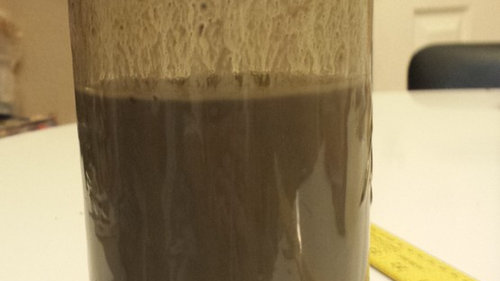
I also decided to do a soil jar test. I have always thought I have clay, but after reading on here it sounds like that might not be true. I live in the Dallas area (Wylie TX) and I have read multiple threads on here that end up with something other than clay, so here I go. When I did the jar test I didn't see much, if any, separation after 2 min. after 30 min I could see about 1/4" of clear on top with the rest still brown like in the 2 min picture below.
The soil is very compact so I am planning on trying to put some shampoo on it this weekend. I also plan to incorporate some organics in as well, but would like to get some some suggestions on what and how to apply with the regimen we glean from the soil tests. Anyway, like I said before, I applied 50 lbs of the 26-0-0 last weekend to the whole yard about 13000ft*ft. Thank you all for the great info on this forum!
Jeff
Comments (38)
 11 years ago
A soil test post-nitrogen is just fine, we don't care about nitrogen numbers (and Logan doesn't bother to report them).
With a significant visual difference between the front and back soil, I'd test them separately this first time. It's entirely possible that there's no appreciable difference, in which case we can combine them in the future. Or they can be balanced to match each other, in which case you can then combine them.
Or it could just be an organic matter difference causing a color change, in which case they really are identical except for the OM. That's easy to work with.
I think I see about 5% sand there, but it could be the white tabletop throwing me off. Regardless, it's 95%-100% silt, with no appreciable clay to speak of. In either case, that's a silt soil, which is actually a very nice place to be. Silt holds good water amounts, excellent resource amounts, and doesn't fight you like clay sometimes does.
You can actually start applying organic material before the test, it won't impact any chemical additions I recommend. OM is always on the "just fine" list of things, along with nitrogen-only fertilizers. If you hit your normal feeding date and still don't have the test back, go ahead and feed with your 26-0-0.
Related Professionals
Winston-Salem Landscape Architects & Landscape Designers · Georgetown Landscape Architects & Landscape Designers · Danville Landscape Architects & Landscape Designers · Gloucester Landscape Architects & Landscape Designers · Portland Landscape Architects & Landscape Designers · Fredericksburg Landscape Contractors · Duluth Landscape Contractors · Kingman Landscape Contractors · Reno Landscape Contractors · Emporia Home Builders · Pittsburg Home Builders · Winston-Salem Home Builders · Buffalo Home Builders · Huron Home Builders · Clovis Home BuildersJeffC
Original Author11 years agoThank you morpheuspa, I was hoping you would chime in! I think what you are seeing is the table top and the bottom of the jar. I guess that is good about the silt then. Ok, I will look into getting something this weekend for the OM. For the next application of Nitrogen I will probably go to a different JDL and get the 44-0-0 90% slow release.
For the test I will send separate for the front and back the to Logan labs. I had already mixed the dirt so I will collect them again tomorrow and send them out. I took the sample from the front yard in one of the patches that is bare, I wonder if it would be better to grab it from an area that has grass on it, or does it matter?
- 11 years ago
Get samples from lots of areas in the yard (maybe around 12) at the same depth and mix them in a container, then put two cups of it in a zip lock bag. It doesn't matter if it has grass on it or not. Remove any plant material.
JeffC
Original Author11 years agoI forgot to mention that I did put out some weed and feed back in early or mid May, so is it still ok to do the test, or do I need to wait longer?
- 11 years ago
Still OK! The Weed and Feed was mostly nitrogen, with some herbicides to kill weeds. I regularly dig my soil samples immediately after spraying weeds, so there's no problem.
The only things that would need to be mentioned in terms of applications are starter fertilizer, lime (any kind), and granular micronutrient applications.
And even there, I simply account for the application when I read the test and subtract out what you added. So just avoid the three things above and there won't be any surprises at all (which is easy; those three should only be applied with your soil test reading in hand anyway).
JeffC
Original Author11 years agogreat, thanks. I just got back from the feed store and picked up some alfalfa pellets. Going to apply them this evening or tomorrow. Also going to put some shampoo on since I can barely put a screwdriver in the ground...maybe a half inch or so. any suggestions on the order of the shampoo and alfalfa?
- 11 years ago
While it doesn't make any difference, putting down the alfalfa and then the shampoo will get the alfalfa pellets to expand and start to break apart.
But if you do it the other way around, no harm done at all.
For your first organic app, please limit the amount of alfalfa to 10 pounds per thousand square feet. More than that may smell as it decays until your shredding insects and other soil life are up to speed (which takes about a season).
JeffC
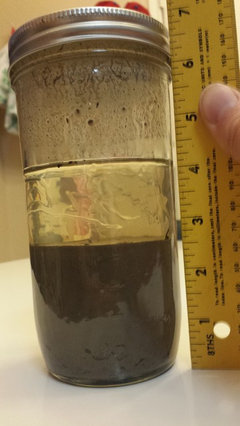
Original Author11 years agogreat, thanks for the advice. Since I didn't get to send the samples out today I am going to go ahead and run a jar test on the front yard stuff that looks different. just curious how different the make up is of it. here is the jar sample after about 20 hours:
- 11 years ago
There's definitely no fine clay in that soil, you could almost drink that water. Almost. If you can ignore the ten trillion bacteria in it, and the nematodes and the... :-) It's just settled a bit in the last 18 hours or so.
You can discard that sample, the test is over.
JeffC
Original Author11 years agooh, i wasn't supposed to drink that ;->
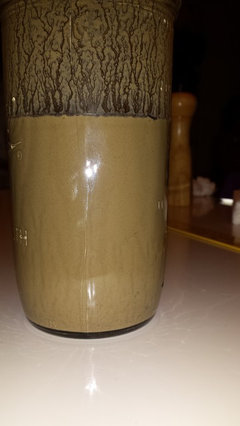
ok, here is the front yard sample that looked different, but looks very similar in the way it is breaking down. here is the 2 min pic.
- 11 years ago
Even if you drank it, you'd probably still be just fine. Not that I would, but... :-)
This soil is going to shape up somewhat differently. Again, barring a mis-read due to the light bounce from the flash and the white table, I'm seeing a significant sand line in this. I can definitely see embedded dark particles in the lighter golden brown fine sand.
And you're right, this soil is definitely different from the other stuff in color as well. I'd test it separately this time just to be sure.
Different soils on the same property aren't all that uncommon, we probably see two or three good examples per season (some in jar tests, some from soil tests where the homeowner knew the soils were significantly different and tested separately).
If we're lucky, the EC comes out the same and after any initial balancing you can roll the two together into one sample. If not, they may always need separate testing and treatment. Hopefully you have some idea of where the transfer from one soil to another is...
JeffC
Original Author11 years agoI got to thinking about this difference and it is possibly different because I have tilled the back where that first sample came from and there was never any sod laid there. The front however was graded by the builder and then sodded with cheap Bermuda grass. This house is about 14 years old.
- 11 years ago
Maybe, if the lower soil has a very different makeup from the top soil. That'll do it if you till and mix them.
Really, if the tests come back with similar EC (exchange capacity) readings, it won't matter at all. We'll balance them to match and work with them as a unit thereafter.
JeffC
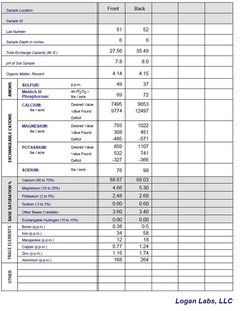
Original Author11 years agolast modified: 11 years agoOk, I got my test results back!!! While i was waiting I applied roughly 10lbs/1k sqft of Alfalfa pellets and about 3oz/1k sqft of shampoo. About 3 weeks ago (7/18/15) I applied 26-0-0. I can't wait for the feedback...and thanks in advance.
JeffC
Original Author11 years agowow, Morpheuspa, thank you for the detail. Your posts are very helpful and informative. I will have some questions after digging further into this, but for right now. I just have a couple.
1) So I shouldn't do anything else until 9/1 unless it is OM right? I was thinking about corn, soybean, or Milo in the next week or so, is that ok? I haven't checked the prices on anything other than the alfalfa pellets which was only $13 for a 50lb bag.
2) I have some weeds that i need to deal with. Mostly crabgrass and Dallasgrass...the crabgrass is pretty bad in the front yard and the fertilizer and alfalfa seem to have really greened that stuff up :). I have been keeping it mowed down to about 1.5 in so at least it keeps them from seeding out too bad. I would like to put some pre-emergent down but not sure when to do this. for the starter fertilizer is the lesco ok to go with?
I also applied more shampoo this evening...I can't wait to get this stuff started.
Oh yeah, I forgot to mention that I would like to put in a garden on the side of my house. will all the stuff above be ok for that area too?
Thank you again for the great details and giving me a good plan for getting my yard in good shape.
- 11 years ago
1) Organics are always OK and won't interfere with anything I've recommended above. Shampoo is also always OK. While the starter fertilizer will feed the lawn tolerably well through August 1, 2016 at the recommended rates, extra nitrogen delivered organically won't be a problem.
2) Pre-emergents can technically be applied at any time, but are best applied in August or September (just as temperatures start to fall off their highs) for fall-sprouting weeds and when soil temperatures rise toward 50 for spring-sprouting weeds. Up here, April 10th is about the average date in spring, and I use Prodiamine for six month protection--but still use the rest of my allowable yearly dose in early September to shield the lawn through December.
2a) Lesco starter is great if that's what you want to use. Brand really doesn't matter, I tend to recommend the cheapest per application that targets around 1 pound of P per thousand square feet. Lesco does that, and it is pretty cheap most of the time.
>>Oh yeah, I forgot to mention that I would like to put in a garden on the side of my house. will all the stuff above be ok for that area too?
In the recommended amounts, perfect! Most gardens will have demands that are at least at these levels (grass isn't a terribly demanding plant, overall).
For vegetable gardens and shrubs, these recommendations are usually identical. Although it depends on what you're growing.
In your pH and calcium levels, I don't recommend trying to grow most evergreens. They'll fight you. But if you did, these recommendations would be perfect.
For perennial flowers, these recommendations are OK but I'd probably like to kick the phosphorus up a bit further.
For annual flower gardens, I'd actually step up the starter recommendation. Even here, where P soil levels in an acidic soil are 200, annual gardens bloom better at 500-1000.
For a mixed garden, you tend to target either the most demanding or least tolerant. It depends.
Let me know and I'll figure something out for you. :-)
JeffC thanked User JeffC
Original Author11 years agook, I'll go ahead and put some more organics down before starting the prescribed materials.
for the garden I guess it would have been nice to say that it will be a vegetable garden.
I also noticed that you don't have me starting back up on the fertilizer until May. If the grass starts greening up earlier should I still wait until May to do the next round of fertilizer?
- 11 years ago
WOW
First of all, the 'jar test' is next to useless. It is highly qualitative, and tells you little about soil texture. Learn to texture soils by hand. It's easy and actually fun. You can find directions and a key many places (here, for example: http://www.savesfbay.org/sites/default/files/Soil%20Texture%20Feel%20Test.pdf). With the jar test, you're actually looking just as much at how flocculated or dispersed the soil is versus its texture. Flocculated soil will settle rapidly even if it's very clayey.
Second, NEVER put shampoo or soap on soil. Yes, these are wetting agents and will temporarily improve water infiltration, but they are high in sodium and will disperse soil, and damage soil structure.
Third, soil nitrogen tests ARE useful, but only in the very short term, because nitrogen levels and forms can change very rapidly.
Fourth, you have plenty of magnesium and potassium. The plant does not care about the ratio of these nutrients with calcium.
Lastly, don't put on copper or epsom salts. You're throwing away your money. And be careful with boron. You probably don't need it and you may cause more harm than good. Additional boron is rarely needed.
Good luck. JeffC
Original Author11 years agoI would think that the texture test is very subjective too. I actually tried this as well, but if you have never done this before then the point of reference is only the flow charts like you posted. From what I did, the answer was very similar to the jar test. Personally, I think saying that test is useless is not helpful at all. From what I have seen on here, Morpheuspa has helped a lot of people when they have done the jar test and the lab testing. It is hard to argue with results.
The shampoo I am using does not have sodium in it. If you are referring to Sodium Lauryl Sulfate, then that is not correct the shampoo i am using uses an ALS as the surfactant.
I have a bermuda grass lawn from what I understand loves nitrogen especially in the heat. I think all he was saying is that we will be plenty of nitrogen from the fertilizer i am putting in so we don't really need to focus on that.
can you please expand on your last paragraph? Why is it throwing away money and he said to be careful with the boron and how it is applied.
I appreciate all the comments, but would love to have more info as to why you say don't do this and that...I am new to this forum, and I don't know if there is some past issue between you two, but it sure seems like you came out just to be negative toward morpheuspa. From what I have seen by researching the posts is that he has helped a lot of individuals with great results.
thanks
- 11 years ago
If your grass greens before May 1st (and it probably will), it won't need feeding unless we're talking about greening up and growing strongly on April 1.
Play this one by ear, in other words. If it's green and growing on April Fool's Day, you can back the starter fertilizer to then, drop the second one in May, and return to nitrogen fertilization in June. The actual dates don't matter so much, the amount is all that really matters (and the time between to give some absorption period).
I do prefer to keep P applications out of summer. They're not particularly stressful, but any stress in hot (and usually drier) weather that can be avoided is a Good Thing.
>>From what I have seen by researching the posts is that he has helped a lot of individuals with great results.
Thanks!
JeffC thanked User JeffC
Original Author11 years agoHey Morpheuspa, I know you said you use Milorganite as the carrier for the boron and copper, but was wondering if i could use something else. I have over 13000 sq ft to cover so that would be 5 to 6 bags of it and the feed store i go to doesn't have it. I can get it from TSC but it is more expensive and I was wondering if I could use soy meal or corn meal which I can get in at 50lb bag at the feed store. Also, do you know what settings would be good for my scotts edgeguard dlx on the milorganite, corn, and soy?
- 11 years ago
I haven't experimented with soy or corn for boron application, but I doubt very strongly that they'll present too many issues. Certainly there's no chemical interaction, I'm only really worried about getting the borax to adhere to the particle.
Give it a try, it'll probably go fine. If it doesn't, it won't be a complete failure and at least some will go down on the soil. If you can figure out how much didn't go down, we can work from there!
Generally, one bag of soybean meal will go around 3,300 square feet (and feed well doing it). One bag of corn will go about the same (but is a poor feeding).
Settings vary. For soy, it would be about 8 for me on my EdgeGuard for either corn or soy, but I'd use a bag to test that and make absolutely, 100% certain you're not over-applying.
Over application of boron is a really, really, REALLY bad idea.
JeffC
Original Author11 years agoOk, I might just go with Milorganite, i have to double check the prices for cornmeal, the Soybean meal is going to be more expensive than Milo. I can also get cotton seed meal pretty cheap, is that very good for OM?
for the copper sulfate, should I go with powder or crystal? I am assuming I mix that into the OM/boron batch as well right?
- 11 years ago
Cottonseed meal is an excellent feeding, on par with soybean meal, and just as good for organics as soybean is. I'm a fan, in other words, of both soy and cottonseed. :-)
Go with the powder for the copper sulfate, and it can be mixed straight into the same batch as the boron.
JeffC
Original Author11 years agolast modified: 11 years agook, after looking at your recommendations I now see that you wanted the milorganite for its iron as well as the OM so I will just go with that.
I am going to need about 10 to 11 tbs of copper sulfate, do you have any idea how much that will weigh...just trying to figure out how much to buy.
for the potassium sulfate, do i need to mix that with an OM as well?
- 11 years ago
Dealer's choice. Your iron levels are terrible, but the rise is very slow anyway. If Milo is a challenge for you, it's not strictly necessary and you won't hear a word out of me if you use cottonseed meal instead.
10-11 Tbsp of copper sulfate at a density of 3.6 g/cm3 has a weight of just over 1 pound, so buy 2. You'll have plenty left over that you won't need.
For the potassium sulfate, application separately is better since the amounts are fairly large compared to the boron and copper. You can get a hand-held whirlygig spreader at most big box stores and use that. I apply by hand scattering, but you do have to be careful that the right amount is going down.
Like I mentioned in the test, your K amounts are arguably not even short (I do have a preference for slightly high amounts of K in soils to give the grass more heat and cold resistance and some extra disease resistance, but that's just a personal preference). So if some areas end up a bit trim, that's no big deal in this case. If some areas end up with a little extra, it isn't going to harm a thing. Just so long as it's in the ballpark.
JeffC
Original Author11 years agoI didn't realize that home depot carried milorganite. I can get that for $12.78/bag and the cottonseed meal is $16.50/50lb bag, so it is pretty much a wash on price.
JeffC
Original Author10 years agolast modified: 10 years agomorpheuspa, I know it has been a long time since I replied to this thread, but I missed the
"October 15: Apply 3 pounds of Epsom salt per thousand square feet. Apply 3 pounds of potassium sulfate per thousand square feet."
I was going to go ahead and apply it now both the epsom salt and the potassium sulfate, is that ok? If I do apply now, do I still go ahead and apply the 2nd round of salt on May 15 as stated in your guidance?
Also, I had asked about if the grass greens up earlier should I apply earlier. It is definitely green now and in full swing...some of the Bermuda never completely went dormant this season because it wasn't that cold here. You said"
"Play this one by ear, in other words. If it's green and growing on April Fool's Day, you can back the starter fertilizer to then, drop the second one in May, and return to nitrogen fertilization in June. The actual dates don't matter so much, the amount is all that really matters (and the time between to give some absorption period)."
When you said drop the second one in May, do you mean not to do the epsom salt on 5/15, or are you saying to apply starter on 4/1 and then don't put any more fertilizer down until June? If so, can you please let me know why that is because originally you had me doing starter for 5/1, 6/1, and 7/1.
thank you!
- 10 years ago
Thanks for the heads-up, I missed this!
You can drop the Epsom salt and potassium sulfate, although I'd do them separately and make sure it rains well (or you irrigate) at least once between them. It'll keep them from fighting over soil particles to adhere to. Which one you do first doesn't really matter, although personally, I'd drop the potassium first.
If you feed in April, drop the starter on or around 4/1, 5/1, and 6/1--or whatever the dates turn out to be, about a month apart. You can also move the Epsom salt back to whatever date is convenient for you, but again, let it rain or irrigate once between the starter and the Epsom salt. Phosphorus and magnesium won't fight much over soil particles, but I try not to stress things...
JeffC
Original Author10 years agoThanks....I already applied them all, so hopefully it won't hurt. One thing to note is that the potassium sulfate was a powder. I ordered it from the same place I ordered the copper sulfate. I put down what amounted to 3lb/1k-sqft but it was a powder so it kind of went where it wanted to. I guess we will see if it did any good when I do my next soil sample.
Speaking of soil sample, when do you recommend me doing my next test? My first test was done back in early August.
- 10 years ago
I'm sure it's fine. Potassium is one of those things it's really hard to mess up, and even if you do, it doesn't matter. Anything from 2% to 10% is fine and you didn't exceed that.
If you did the test in August, doing it sometime in late summer or early fall of this year would be great. Once it stabilizes, you can take some years off (by observation, my lawn and gardens are doing very well--so I skipped both last year and this year).
JeffC
Original Author10 years agook, sounds good. I can tell a huge difference in my soil from this time last year. Last year I could hardly dig into my soil it was so hard and there weren't any worms at all, except for the grubs :). Now pretty much anywhere i go in my lawn i can dig down and find earthworms. Also, I couldn't stick a screwdriver in my soil more than about 1/4 to 1/2", but now the screwdriver goes down to he base. I appreciate all the help from this forum!
JeffC
Original Author9 years agoOk, it is 6 months late, but I just sent my sample off to LL...will post the results here when I get them in!
 9 years ago
Hi Jeff, i am having the same problem as you had with hard soil. I see that you fixed it. Can you tell me what you attribute to the change?
JeffC
Original Author7 years agoI know this is a very late reply, but just now seeing it :)
I would say the shampoo and OM (mostly alfalfa pellets) are what made my lawn soften up.






User