

Repotting a Fiddle Leaf Fig - trouble finding substrates!
I am really glad I found this forum because I love my fiddle leaf fig and want it to survive for many years. Got it about a year ago and since then it has doubled in size with just a sunny, west-facing window, watering once a week and fertilizing once a month with a general house plant fertilizing foam (basically just nitrogen). I am a house plant novice so I have devoured many of Al's posts (I assume he needs no further introduction) on the subject of container gardening and I have come to realize it is ready (maybe overdue) for a repot. It stopped producing new leaves about two months ago and the bottom leaves started turning yellow and falling off. After searching this forum for advice, I decided to give it a good flush, and start fertilizing it with Foliage Pro 9-3-6. Within a week the last yellow-looking leaf greened up and there were new leaves at the top. Must mean there was a mineral deficiency that I've now corrected with the new fertilizer?
Now that it appears to be happy, I have been on the quest to repot using Al's formula for a gritty mix but I cannot find the three materials required anywhere here in Phoenix!!! I can get all three on Amazon for an outrageous price (best case scenario about $70 total for a 5 gallon repot). I think I can get the pine bark fines by chopping some unadulterated pine bark mulch through our mulching lawn mower. I am going to check a local farm supply store for an alternative to Gran-I-Grit --- poultry grit. But the Turface (calcined clay) has been especially elusive. SO..... last ditch effort before I buy it off Amazon for the outrageous price of $28/2gallons: Is this the same thing? Ikea ODLA I think the pebbles may be rather large for this application but maybe I could crush it before I use it? I can't tell if it's fired or calcined. If this isn't a good alternative, what else should I be looking for?
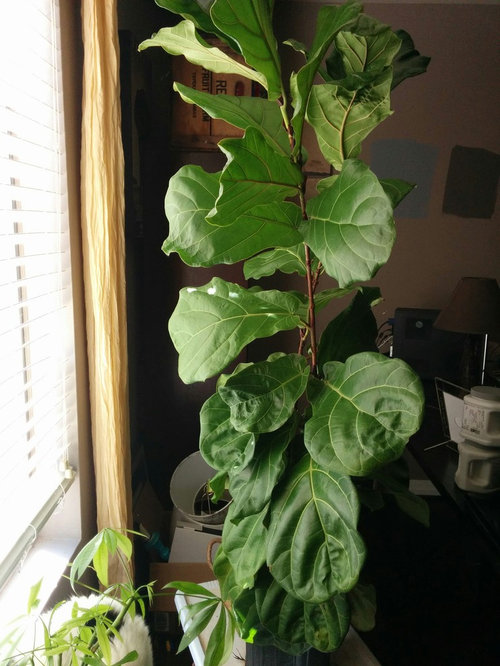
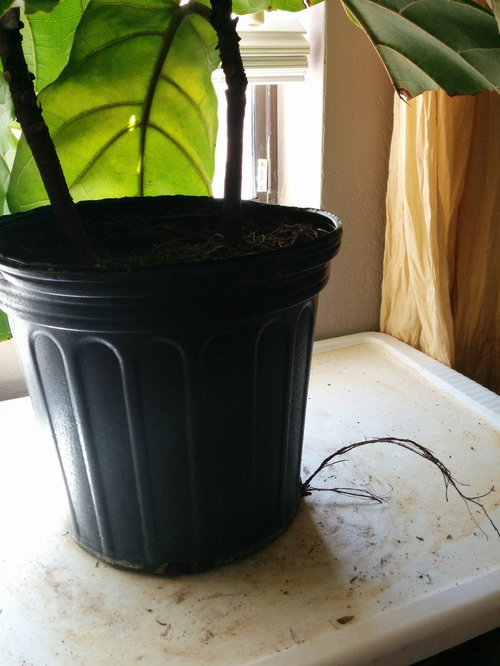
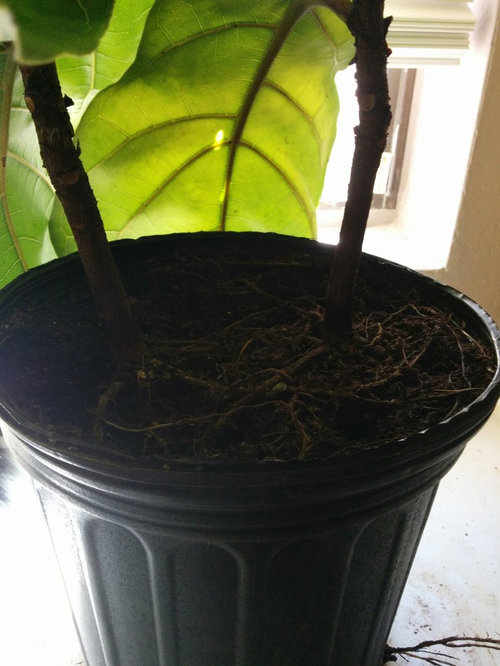
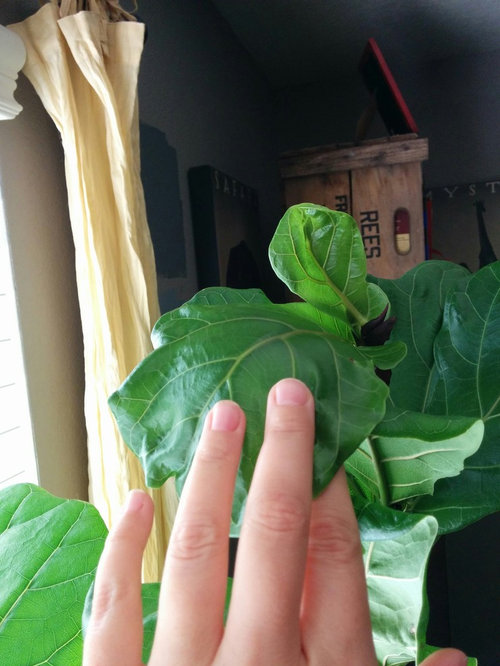
Any other tips for repotting my FLF are welcome! I plan to do a major root pruning and might (if the twin stalks are truly two separate trees) separate the two trunks and pot each separately. Good idea/bad idea? I think in another foot or so I'd like to see some branching but worry that the trunks aren't thick enough for that yet. Any way to encourage trunk thickening? I am hoping the branching occurs naturally once it's repotted and recovered but if it doesn't would it be ok to prune the tip to encourage branching? When should I attempt that? I've included photos of my plant, taken today, for reference. Thanks!
Comments (45)
 11 years ago
Turface MVP:
Simplot Partners
- Phoenix
(623) 879-0839
www.simplot.com
Horizon - Store & Corporate Offices
- Phoenix
(602) 276-7700
www.HorizonOnline.com
Any of the 13 Ewing Irrigation outlets in and surrounding Phoenix
and
I'm guessing the John Deere Landscapes outlets in the area would also be happy to help with Allsport - same as Turface MVP.
Don't forget to ask the sources you poll looking for grit whether they have MannaPro Poultry Grit.
If you have any orchid supply houses - especially wholesale outlets, they might have 1/8-1/4 fir bark.
Trunk thickening is directly related to the leaf surface area (photosynthesizing surface) of the plant - the more leaves (and light) the faster it thickens.
Plants that are repotted and heavily root-pruned often defoliate if they aren't pruned to balance the amount of foliage the roots can support, So chopping your trees back at repot time might be a good idea. It would also ensure branching.
Getting late in MI. That's all for now. I'll look forward to what you have to say.
Al
- Phoenix

rcates
Original Author11 years agolast modified: 11 years agoThanks so much! I checked a couple of Bonsai supply stores with no luck (which I thought was weird) and one place that claimed to sell tons of orchids but they didn't have any of that stuff either. Nice to have some numbers to call.
How much do you recommend I chop off the top when I repot? The plant/s are a little over four feet each right now. Do you also recommend removing some leaves near the bottom as well? Could I just remove leaves near the bottom, say, if I wanted my plant/s to get a little taller before I encourage branching? Do you recommend separating the two trunks if they're indeed two separate plants? Once I repot, should I move them to a shady spot for a week or two while they recover or leave them in the sunny (west-facing) window?
I have to tell you, I thought I was doing pretty well this last year since the FLF hadn't died on me and actually seemed to be thriving. After reading so many of your posts and taking your grower's philosophy to heart, I am sure I can do much better for this plant and I'm excited to try! Thanks!
Related Professionals
Huntsville Landscape Architects & Landscape Designers · Gainesville Landscape Architects & Landscape Designers · Greenville Landscape Architects & Landscape Designers · Rocky Mount Landscape Architects & Landscape Designers · Nashua Landscape Architects & Landscape Designers · Bowling Green Landscape Contractors · Oklahoma City Landscape Contractors · Spartanburg Landscape Contractors · Lake Havasu City Landscape Contractors · Hagerstown Home Builders · Elizabeth City Home Builders · Jackson Home Builders · Leominster Home Builders · Kalamazoo Home Builders · Janesville Home Builders- 11 years ago
Value your bottom leaves because they thicken the trunk. Think of your tree as a river flowing from top down and each leaf is a tributary to the rifer itself or the smaller creeks asnd streams (branches) that flow into the river. The more tributaries there are, the wider the river (thicker and stronger the trunk becomes. In bonsai, we continually restrain the top of the tree and encourage lots of branches on the lower trunk to fatten it and give it a tapered profile. For you, the reason is so the trunk can support the canopy. You won't have any trouble getting a new leader to grow once you prune the ht, and you might get some low branching. If it doesn't 'bug you', leave it to strengthen the tree. It then becomes a 'sacrifice branch' that you'll remove after it's none its job.
Any time you remove a meristem (growing branch tip) you encourage branching in the crotches of leaves behind the cut. The stimulus wanes with the distance the leaves are from the cut and varies by how much energy the tree has and is making when you make the cut. If you don't want a branch where one starts growing, simply rub off the new bud and it's done.
Whether you separate the trees is an esthetic choice & up to you. If the way the root mass is growing allows, you might be able to separate even if they are attached. If you keep them together, you should shorten them to different hts. The thickest trunk should be tallest, and the thinner trunk 1/2 -2/3 the ht of the taller. I would shorten the trees quite a bit at repot time to help ensure the plant doesn't shed all its leaves. That's not the catastrophe you might think, so don't worry about it - just make sure you take steps to keep all the roots wet while you repot.
If you can move them to dappled or open shade out of the wind, outdoors, that would be sweet. Otherwise, indoors in very bright & indirect light until they're pushing new growth is good. It will tolerate full indoor sun if you keep a fan on a timer at midday to interrupt the boundary layer of air surrounding leaves. This traps heat and is the real problem with direct sun - it's not the photo load.
I guess I never thought about having a philosophy, but I do try to avoid confusion by frequently stating that I always look at things from the plant's point of view and largely disregard what the grower wants. If I tell the grower what the plant wants and it doesn't fit the growers plan, he has the info to decide what compromises are to be made.
I often smile when I spend a good amount of time outlining the plant's needs, only to have the grower profoundly thank the giver of advice that lets him off the hook by telling him what he wanted to hear. Such is life. ;-)
Al
rcates
Original Author11 years agoExcellent! So then I'm thinking I will separate the two, and reduce each plant's height by about 1/3rd. Does that sound about right or should I do more? It's 105-110 degrees here by about 2pm and we've been sitting at about 25% humidity. Probably 10 degrees cooler in the shade. Just confirming that it's still the best idea to put the plant/s outside in the shade here in those conditions. I am thinking I could put them under our GIANT ficus trees out back. It would get direct morning sun until about 9am and the rest of the day would be dappled shade. Winds have been variable so I'd have to watch that. Most days there's a little breeze. Winds don't usually kick up unless a haboob or monsoon is rolling in.
After I repot, are there any special water conditions for recovery? Right now I stick my finger in and if it's dry down to about an inch and a half or two, I water. Ends up being about once every 8-10 days. I am perfectly willing to water more and expect I will with the gritty mix since it's designed to allow water and air to move more freely through the root system. But under recovery, does the plant need more water and Foliage Pro or should I use the same conditions (water when soil is dry down to about an inch and a half, fertilizing with every watering, which was once a week or so with it's original soil. I expect that to double or triple with the gritty mix.).
Could I propagate the two stalks I cut off into new plants? How should I go about that?
You're very kind to take the time to lay it all out for a novice. Much appreciated!
- 11 years ago
If it's that hot and humidity that low, outdoors isn't a good choice. After you repot, keep a visual picture of where the fine roots are in the pot (not so much the anchoring and transport type roots) and make sure the soil stays moist at all times where the roots are - even if you need to water daily until the trees are established. No fertilizer until you're sure the trees are pushing new growth. That indicates the roots have recovered enough to keep the canop[y supplied with water & nutrients.
You can propagate either tip cuttings or internodal cuttings. I do 95% of my propagating (and I do a lot of it) in the gritty mix - works great. You'll need a pot deep enough to bury 2 nodes and keep the top node moist and the bottom end of the cutting at least a couple of inches above the bottom of the pot. Also, take the cuttings with a sharp tool and clean up the edges of the cuttings with a very sharp tool. Ragged or crushed bark at the truncation point encourages rot and reduces odds of the cutting striking.
Al
- 11 years ago
Thank you rcates and Al! You both just helped my situation some from what I posted today (at least for supplies ). The ironic thing is I was at Horizon 30mins ago getting some landscape supplies and asking if they knew of a local nursery that specializes in houseplants (I saw Barkers closed - sad. Hope they just retired). I never thought they might have what I needed!
- 11 years agolast modified: 11 years ago
rcates - could you please post where you end up getting your supplies from? I'd be most grateful :)
And Al, 25% humidity is pretty high for here - it gets down to 3% in July before monsoon season starts ;)
rcates
Original Author11 years agoI'd be happy to post all the information I can here. Going to look for supplies Friday morning, I think. Will let you know how it goes.
Thanks for all the guidance! In addition to supplies, I'll post more about how things go as I get the FLFs repotted. Stay tuned!
rcates
Original Author11 years agoOne last question - My Foliage Pro is a liquid solution. The Gritty Mix calls for CRF. Should I look for a granular version or water the plant in with the liquid Foliage Pro?
- 11 years ago
CRF can work well, especially if you're forgetful of fertilizing or don't want to be tethered to a watering can full of fertigation solution every weekend. The drawback is when plants go heat dormant & need to have low fertility that allows them to take up water efficiently, CRFs are pumping out their strongest dosages you can't shut them off. I use CRFs on some plants that I'm really pushing (for more growth), but I don't use them on plants with foliage I want to keep looking nice. Like a well-developed bonsai.
It's your choice - all one way, all the other way, or a compromise ....... whatever suits your priorities best. Do pay attention to how different plants are treated so you know what works and what doesn't. The more attention you pay to detail and making sure you're actually observing what you think you're observing, the better off you'll be.
Al
- 11 years ago
You might find this discussion useful too :)
http://forums2.gardenweb.com/discussions/1390271/i-cant-find-pine-bark-fines
rcates
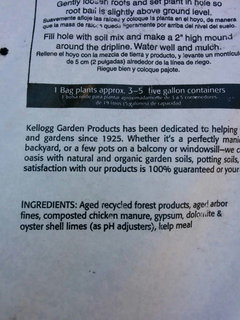
Original Author11 years agoStill working on procuring all the substrates for the Gritty Mix. 5:1:1. I got Manna Pro Poultry Grit in place of the Gran-I-Grit at Shoppers Supply. $10 for a 5lb bag. Wish there were bigger bags but oh well. I tried to go to Ewing for the Turface MVP but didn't get there before they closed Saturday so I'm heading out again this morning to pick some up. I am at a loss with the pines again - thought I'd just pick up a bag of pure mulch and shred it with my mulching mower but can't seem to find pure pine mulch even. Here are pictures of what I did find. Al, will any of these be a good substitute for the pine bark fines?The first is called N'Rich Soil Enriching Conditioner. These are the ingredients. My guess is it's not appropriate.
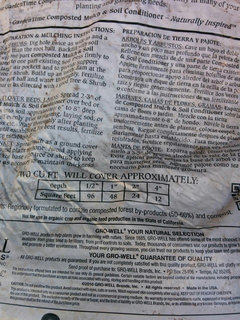
Then there's Garden Time Composted Mulch and Soil Conditioner:
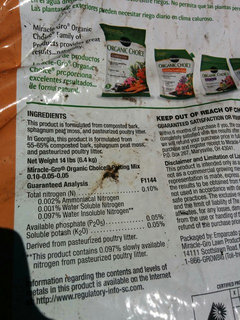
Then there's Miracle Gro Organic Potting Mix:
There's also a brand of Cactus and Palm soil:
I am thinking it's not a good choice due to the sand.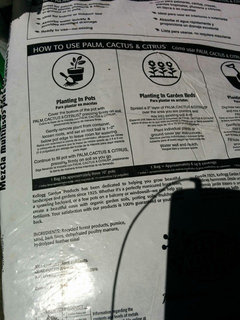
There was also shredded western red cedar which I could much up finer in the lawn mower. Or there was brown mulch which was 100% bark but it has a colorant in it. I assume the colorant wouldn't harm the plant since you can mulch with it but wanted to check. Do any of these hit the mark?
Finally, leaves at the base have started turning yellow again and dropping off.
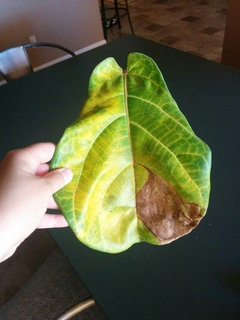
The brown spot was actually there when I bought the plant but stayed the same size until about four days ago. It quadrupled in size and then the whole leaf turned yellow and dropped off yesterday. Hoping to get this plant repotted before I lose it! Ah!
- 11 years ago
I'd probably leave the bark out of the mix before I'd use any of those products. Some of the biocompounds in the western red cedar (really not a true cedar, btw) are known to be allelopathic, so it's not a good choice unless you're growing a species of the Thuja genus. As long as you fertilize faithfully, you can get by with a soil made of screened Turface & poultry grit. I'd use a little less screened Turface than grit - maybe 3:2 or 4:3, favoring the grit. BTW, that's about what I'd expect to pay for a 50 lb bag of grit, so keep your nose in the wind for the grit and bark, both.
Al
- 11 years ago
rcates, per the link I posted above, I ended up putting Earthgrow bark in my mix (found it at Home Depot.
Did Ewing have the MVP? I tried John Deer and Horizon. JD no longer carries it, Horizon said they could get it, but they would have to ship it in from their Cali store and was not sure how long it would take to get it in.
 11 years ago
Where do you live? If this is an emergency, just mix what you have with a decent potting mix. You can do a major repot next spring if you are in the Northern Hemisphere.
Your plant looks healthy to me, just needs to be in a larger pot. Whatever you have been doing is working.
Jane- 11 years ago
It might be interesting to set our muse loose with the thought that a person can have ingredients on hand from which a perfectly serviceable medium CAN be made, yet might still mix them together in proportions that collectively levy severe limitations on plant vitality. Simply mixing a bunch of ingredients together with no consideration given to the likely outcome is more likely to elicit an, "Oh darn!" than a "Eureka".
Al
- 11 years ago
Kristin, I would mix 50% bark, with equal amounts potting mix with perlite mixed in. Or you could go straight potting mix with a bag of perlite mixed in. Perlite can be bought in the garden stores. I don't measure, I go by look and feel and the plant.
I have used Timberland bark which is sold in Walmart, purple bag. I don't screen anything just mix it up in a wheel barrow until I get what I want for the plant.
Your plant is lovely, you have a nice sunny window. The fig can be potted now and you can decide what you want to do in the spring...or you can just grow it in the potting soil and perlite. I'd hate to see you struggle to find ingredients when the tree should be put in a larger pot now.
Good luck!Jane
- 11 years ago
Kristin, I recently repotted a large Pachira. This is what I used.
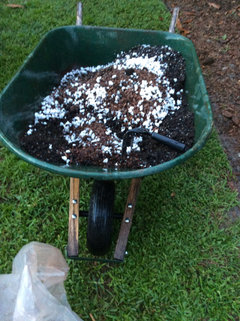
Potting mix, wood chips and perlite.
Tree after repotting. Did this last month. Bounced back and is making new growth. Only lost a few leaves.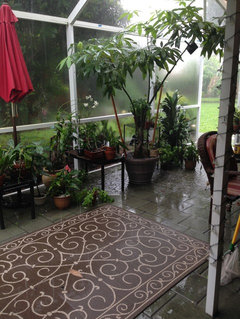
This tree was going in the pot in the photo. I should have repotted last year but never got to it.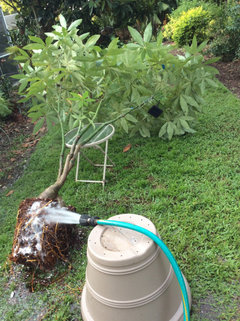
I don't know why the pictures got mixed around but it gives you an idea.
Good luck.Jane
- 11 years ago
Jane - I think your comments are to rcates? I have a ficus (in a separate post )
- 11 years ago
In soils, as it relates to aeration and drainage, there is something called a threshold. Simply put, it means that if there are enough fine soil particles to fill in all of what would be air spaces between the large particles, the medium produced has the same drainage/aeration properties as the fine ingredients w/o the coarse material. This would hold true in 50/50 mixtures + a small volume of perlite, and even hold true in mixtures of up to about 65% coarse particles + 10-15% peat. Because at those %s there are enough fine particles there are enough fine materials to entirely fill large pores between large particles with fine material, most of any potential advantage is lost. Aeration is the same as that in the fine material alone, drainage (flow through rate) is the same as that in the fine material alone, and the ht of the PWT is the same as it would be in the fine material alone. It's ONLY when the threshold has not been met, when the volume of fine material is insufficient to fill the spaces between the large particles that the planting begins to gain advantage in the areas of drainage, aeration, and reduction in the ht of the PWT.
The one small advantage that IS gained is in the fact that perlite is a closed cell material and holds no water internally. This means that there is a small reduction in the volume of perched water a soil can hold, owing to the fact that perlite within the perched water column takes up space that would otherwise be held by fine particles that hold more water than the perlite particles, but this is a small advantage when compared with soils that are a very large % (75%+) of chunky material (material larger than .100") + a small fraction of fine material (peat, other potting soils, sand, compost, composted forest products, coir, ....). This all goes back to the thought that a person can have ingredients on hand from which a perfectly serviceable medium CAN be made, yet might still mix them together in proportions that collectively levy severe limitations on plant vitality.
It would seem that if you already have all the ingredients necessary to make a productive soil that allows you to water correctly without having to suffer soggy soil consequences on hand, one might as well mix them at ratios that ensure there will actually be an advantage in including the coarse material.
If we start with a gallon of pudding or Miracle Grow soil and add a handful of bark and perlite, how much improvement is there in drainage and aeration? None. 2 handfuls? None. 10 handfuls? None. 20 handfuls? None. It's only when there is so much coarse material that there is no longer enough pudding to fill in the air spaces between the particles (the threshold) that we begin to gain advantage. This is a very easy concept to visualize in the mind's eye.
Al
- 11 years ago
I'm so sorry Kristin. I thought it was all the same person!
I guess my potting advice would work for a fig as well. I have three which I decided to put in the ground last year. They grew well for me in the same mix.
Again, I'm sorry for my confusion,Jane
rcates
Original Author11 years agoUnfortunately, all Walmarts around here are not shipping and not carrying the purple bag of pine mulch. Seems like a good alternative. Think I'll end up shoveling out the exorbitant amount of money to buy pine bark fines online. And YES! Ewing had Turface. Got a 50lb bag for $13, I think? The Manna Pro Grit was at Shoppers Supply in Gilbert ($10 for a 5lb bag, about $5 cheaper than Amazon but still pricey, I thought). A short drive, all highway, from my neighborhood. I have a money tree to repot as well so I think I'll just bite the bullet and hit up Amazon for the fines. Booo! I'm really committed to having these plants a long time so I didn't want to use a potting mix (even an amended one) after reading so many of Al's posts on container gardening using his Gritty Mix Recipe. So Amazon here I come and the search continues for a local alternative! Will post photos of before and after the repot.
- 11 years ago
Do keep your eyes peeled for something more reasonable in price (bark and grit). I'm sure there must be feed stores that carry grit in 50 lb bags for less than the price of the Turface.
Wishing you well - let me know if you think there is any other way I might help.
Al
rcates
Original Author10 years agoIt's been a long time since I posted here but wanted to catch up and close out this post. I ended up getting the Turface at Ewing, the Manna Pro at Shoppers and I ordered bark fines on Amazon. I am in Phoenix and by the time I got around to mixing the soil and re-potting the plants, it was the second week in November. Actually a decent time to plant because the temps are moderate. So I moved the plant outside and got to work. What an interesting experience! I turned th eplant on it's side and removed the pot. There was a large pocket of blue-green balls (what I assume to be slow-release fertilizer) in about the center of the pot, so no wonder the plant pushed new growth for so long before crashing and burning. It was totally root-bound and some of the roots just disintegrated as I rinsed off the old soil. I pruned roots with sharp scissors and used the hose to keep the roots wet and wash away the old soil until all that was left was a nice clean trail of decent looking roots that I could run my fingers through like hair. There were indeed two separate plants and they split easily once the soil was rinsed away. I cut about 40% off the top of each and put the cuttings and the newly trimmed plants all in gritty mix in their own pots ( so one plant became four!). I have to tell you, I was skeptical about this mix - it is VERY loose! I didn't know how my plants would even stand up in it. And it greatly increased frequency of watering (from every 10 days to every 3). But once the root balls were buried and the cuttings put in as far as Al recommended, they seemed relatively secure. I have only watered and left them in a sunny window in a northwest facing room. I lost no additional leaves on these plants as the weeks have gone by and I am happy to report that today (less than six weeks later) both of the old plants have begun to push new growth! There's one new leaf on one plant and TWO on the other! So today's watering included some FoliagePro as well. . The cuttings seem dicey. I gave up on one last week. The leaves all looked dry and all but one had fallen off. However, when I plucked it from the pot, I COULD SEE NEW ROOTS! So then I decided to leave the other one alone. I keep watering it and all but two leaves have fallen off (I think it started with six) but if it's growing new roots like the other plant, I assume this is a transitional stage. Maybe it can only sustain a couple of leaves until it grows more roots. Will report on that down the road. I am elated that I didn't screw things up and that my plants appear to be recovering nicely! Even texted my husband to let him know my black thumb was looking greener today. :) Thank you Al, for all your guidance. Here are some photos of the process

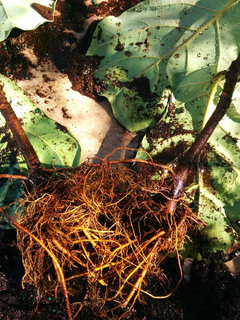


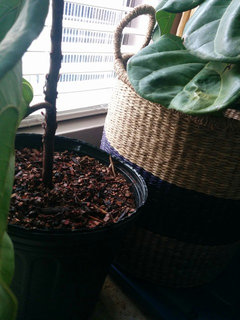
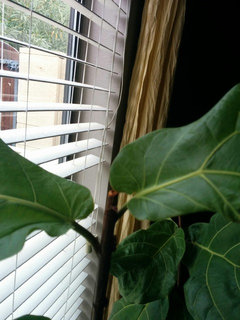
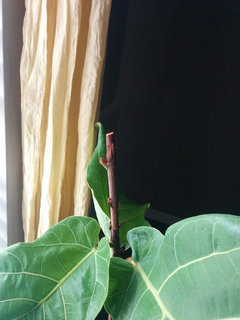
- 10 years ago
Everything looks good! Strong work! I'm glad for you! Hopefully others following your thread will also see that sometimes taking a step backward before you push forward ends up being the more productive approach. I remember how hard it was at first for me to chop trees back as a regular part of producing respectable bonsai - after working hard to ensure all that healthy growth. For you, it would be even harder to take the advice of "someone you don't know on the internet" and whack your 'precious' in half. But the reason you didn't lose any leaves was because you reduced the number of leaves the roots had to support. As you start approaching the vernal equinox, you'll REALLY be glad you took control of your plant's vitality. The best is yet to come, which is why I hope you're not done with the thread for good. Hopefully, you'll stop back and share how well your tree's are doing come June.
Did we talk about what to do when you stuck the cuttings? Did you reduce the leaf surface and have 2-3 nodes below the soil and 2 leaves (with reduced surface areas) above the soil?
Wishing you a Happy Holiday Season and a prosperous New Year.
Al
rcates
Original Author10 years agoWe did talk about what to do with the cuttings. I put 3 nodes below the surface of the substrate. I did not take off any leaves, though (above the surface, that is - I took off the ones below to allow three nodes to go into the substrate). The one surviving cutting has just one leaf left (the other one fell off yesterday) but it looks good so far. No browning or drying out. I have it under an opaque skylight in a different part of the house. Wondering if it's not getting enough sun. Thoughts?
- 10 years ago
If the volume of foliage/ leaf surface area is so large the cutting is unable to move enough water to keep the foliage hydrated, the plant will shed the leaves. My usual tactic is to reduce the surface area of the leaves, and thus reduce the amount of water loss via the process of transpiration, so the plant doesn't shed the leaves in a drought response. I figure a leaf retained and producing food at a reduced rate is better than a leaf detached.
It's also possible that, if there was a significant reduction in the cuttings photo load from where it was initially, that the reduction in light might have played a part in the loss of the leaf.
I'd just stay the course now, and see what happens with the cuttings. If some roots have formed and the cutting has enough reserve energy to push new growth, you'll be ok. If the cutting is LOW on energy reserves and current photosynthate production limited by low light or lack of photosynthesizing surface area, it's probable that the cutting will soon lose viability. Also, if your cutting has a significant amount of green tissues in the stem, it retains some ability to carry on photosynthesis in those tissues, so that's counted as a +.
Not a ficus, but you can see how I cut just below a node and reduced this Ruellia b's leaf surface.
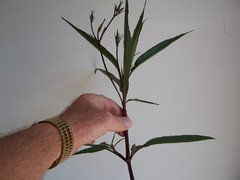
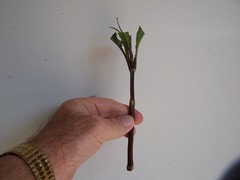
Al rcates
Original Author10 years agoI see. I don't recall you mentioning cutting the leaves but I think I did everything else correctly. The stem is still very green so I expect it will be ok. I moved the cutting to a sunnier location so I guess we'll just see what happens. I did notice this today on the FLF base replants:
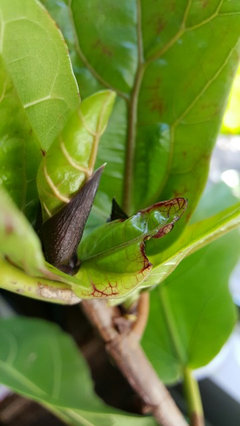
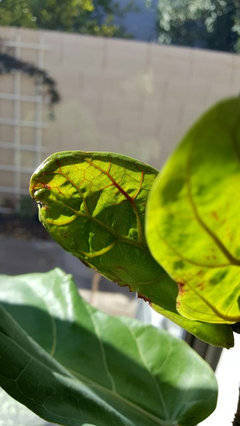
A couple of the new leaves have red, wilty rims. What do you think that indicates? All of the new leaves have red splotches throughout the leaves but only those two appear to be deteriorating at the edges. Too much sun? Right now they get a couple of hours or so of direct sun through that window but it's in the 50;s during the day ere temperature wise. 70 or so in the house. And I keep the overhead fan in that room running on low. Any guesses?
- 10 years ago
It's known that chill does cause the reddish/brown spotting in lyrata. Also, it's not unusual for leaf margins of lyrata to be damaged while the leaf is unfurling if humidity is low. Is that a potential cause of the marginal damage?
Al
rcates
Original Author10 years agoThey're next to an old window that is probably leaky, so it's a good guess. As they've gotten bigger, the rusty color seems to have diminished. More good news! The cutting sprouted a new leaf this week! I've begun fertilizing with each watering. I now have THREE thriving fiddle leaf figs. Can't wait to see what they do as the days grow longer. Thanks so much for all the guidance. I now have so much confidence that I'm going to tackle vegetable gardening here in the desert next. Ha! Wish me luck!
rcates
Original Author10 years agoOk I'm back. I now have little black gnats crawling around in the soil of two of the FLF's I replanted. How do I get rid of those?
 10 years ago
They're probably fungus gnats (harmless but annoying). They're attracted to organic matter in the soil.
Rob
rcates thanked halocline- 10 years ago
If I remember correctly, you're using a version of the gritty mix? How did you make it? It's unusual that you'd have gnats in such a fast draining soil.
Al
rcates thanked tapla (mid-Michigan, USDA z5b-6a) rcates
Original Author10 years agoI made it per a recipe I found in one of your posts: 1 part pine bark fines (they were from a bonsai shop on Amazon and were pre-screened), 1 part Turface (I admit I only rinsed this part through a spaghetti strainer, I did not screen it with a gardener's screen - I don't have one), and one part Poultry Grit. I use Foliage Pro 3-6-9 at each watering so I did not use gypsum or CRF. I water when the top inch - inch and a half of the soil of my pots is dried out which is tending to be about three days after the last watering. There is no standing water in the trays underneath any of them. I have three FLF now: one in an "air pot" made of cloth set inside a basket (it was one of the orginal plants) and two that are in plastic planters with holes at the bottoms (one was an original plant and the other is a rooted cutting). The gnats are in the two plants in the plastic planters. Should I transfer the two affected plants into air pots? Wait longer to water? I am assuming these gnats are attracted to rotten water? Should I flush them and leave them outside? It's highs in the low sixties and lows in the low forties right now here in Phoenix. Thoughts?
- 10 years ago
I'd wait longer to water and make sure there is no standing water in the collection saucers. It's too cold outdoors at the temps you noted. In spite of what they tolerate, they prefer temps of 70-85*, start to pout below 65*, and really don't like it below 60*. Use a wooden dowel rod (1/4 or 5/16" from any hardware store) sharpened in a pencil sharpener and stuck deep (all the way to the bottom) into the pot as a 'tell' If it comes out dirty or moist, withhold water until it comes out clean & dry or almost dry. If after a couple of weeks the gnats persist, you can try mosquito dunks, but I think easing up on the hand that rocks the watering can should do the trick.
Al
rcates
Original Author10 years agoWaited a total of 6 days (instead of 3) between the last watering and the one I gave the plants yesterday. The gnats already seem to be less prevalent. I guess the gritty mix hasn't increased my watering frequency so much after all. :) Got two more new leaves on one of the original plants. Woo hoo! Thanks again for the advice, everyone!
- 10 years ago
This was a very interesting read. I was searching the net re potting mix for fiddle leaf fig. I just bought four plants from Home Depot (two in each planter). I have a few follow up questions.
1. Type of mix: I don't mind spending money and I have Prime on Amazon. Anyone can please recommend the type of bark and potting mix I should get? I understand it would be a 50% bark and 50% potting mix with or without perlite.
- Poultry grit: What does that poultry grit do? I found it on Amazon but I can't see in the posts what to do with it...
3. Plant separation: I need to separate the two plants that are planted together in each pot. Any suggestion how? I am afraid if I wash the roots of all the dirt, it will be too stressful for the plants. Any advice?
- Rocks at the bottom of the plant. What rocks should I get? The youtube videos I watched were all by a woman in Australia, so none of the products she recommended could be found here... she did mention sea kelp is really nice for fiddle leaf fig.
Thank you so much for your help with this. I live in Boston so I think it is a good time to separate and replant those now.
- 10 years ago
Ok, to save everyone's time, I finally found above how to mix the three ingredients, so #1 is answered. But what does poultry grid do? I watched many youtube videos on FLF and the recommended mix was 50% bark and 50% premium potting mix. Would that be just as good?
Do you put a 2 inch layer of rocks at the bottom? Please recommend what rocks. I went to Home Depot and was lost as to what size to get... Currently, mine are in a 9" pots. Two per pot. Need to separate them and put each in its own pot. Should I start with 9" still? Because it will still be lots of room around the roots since one plant only takes 1/2 of the current pot? Thank you!
- 10 years ago
Wait!!! There is no soil at all in the potting mix? I just looked all the ingredients in detail on Amazon: Bark + Turface MVP + grit. Wow... Is that right? The plants I got clearly were planted in soil and looked like they were striving. Do I need to fertilizer it at every watering because of this turf mix? Sorry I have so many questions.
- 10 years ago
I received your off-forum message & sent you a link you should read & gain an understanding of. In doing so, I think all of your questions and some you didn't yet know you had will be answered.
Here is a link to the info I suggested you read: Click me and I'll take you there, straight away!
Al
- 10 years ago
Hello, I purchased Turface MVP, 1/4" bark fines, and poultry grit. I have a few follow up questions:
1. When you say mix it 1:1:1, does this mean by volume or by weight? I assume volume, but I wanted to confirm.
2. When you water FLF, the videos I saw showing emptying two water bottles every three weeks or so and letting it all go through the bottom. Is that what you would recommend as well? This would indicate I would need to water it in the bath tub every time I water, which is fine, my plants are under two feet now.
3. I currently have two plants in one pot, do you recommend I wash their roots of soil completely before separating and repotting?
4. I saw some posts that suggested that terra cotta pots were best to wicker of excess moisture. However, I could not find any that looked nice. Would plastic pot be ok?
5. I live in Boston so my FLF will be always inside. Any adjustments I need to make to the 1:1:1 ratio due to this?
Thank you! - 10 years ago
1) By volume2) An entire book could be written about how to water. The best way to water is:
Add enough water to ensure the entire soil mass is moist/damp. Wait a few minutes, around 10, and water again so at least 15-20% of the total volume of water applied exits the pot. The pot should not rest in the effluent because this provides a pathway for the salts you flushed from the soil to make their way back into the pot. With a pathway back into the pot, the level of dissolved solids (salts) in the soil solution quickly reaches a state of isotonicity (balance) with the level of dissolved solids in the effluent, negating your efforts to flush the soil. I set my pots up on pieces of plastic channel so they are well above any effluent that drains into the saucer. The water in the collection saucer usually evaporates within a day or two, but how quickly that occurs depends on factors like RH, air movement, and temps.
3) It depends on the plant. Some plants get divided & repotted, but for most plants I like to repot in an appropriate month (usually June) by bare-rooting, root pruning, and transplanting into an appropriate soil. For my own purposes, I consider an appropriate soil to be one I can water to beyond saturation - so I'm flushing the soil of accumulating dissolved solids (mineral salts) each time I water, w/o my having to worry about root rot or depressed root function over long periods (days) because the soil tends to remain soggy interminably.
4) The worse your soil is, the more advantage pots made of unglazed clay or other gas permeable materials provide. Soils like these
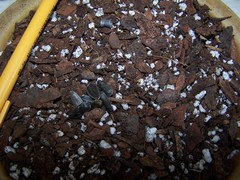
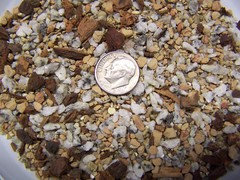
already have excellent gas exchange due to meritable air porosity, so the advantage in using gas permeable pots is reduced, but not absent.
5) The 1:1:1 ratio should serve you well indoors/Boston. Because my focus is primarily on bonsai, I grow a lot of plants in small soil volumes. I generally water on a 4 -5 day rotation, but I have a half dozen plants I water lightly after 3 days, then again on the 4th or 5th day. Last week, RH was very high, and the heating system didn't run much, so the interval was stretched to 6 days - same this week, it appears. The fast draining soils are a big help to me in that they allow me to water on a schedule instead of on a plant by plant basis. I enjoy nurturing and doing creative things with plants, but the thought of having to keep track of a watering program on a plant by plant basis isn't appealing to me.
I noticed that you're 'following'. I appreciate that - thank you.
Al











halocline