Software
Houzz Logo Print
weirdcatlady

Help me escape the Dead Zone . . .

11 years ago
last modified: 11 years ago
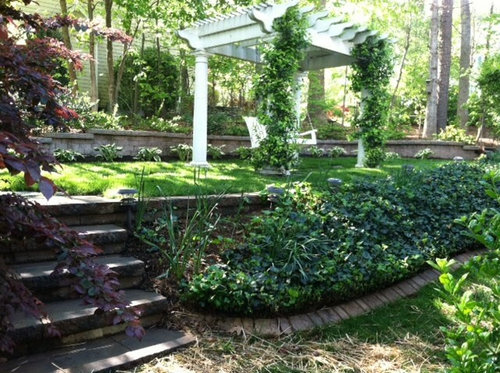
I am wondering if there is a very small shade-tolerant shrub that might grow in a particularly troublesome spot in my back garden. As you can see in the photo, the area gets mottled sunlight throughout the day, though we have removed two trees since this photo was taken, so it gets a little more sun than this picture would indicate.

In the past, the grass edging up to the concrete retaining wall would die out in mid spring, so we installed a planter bed, first attempting hostas. The soil here is sandy and moderately alkaline, but was ammended with rich soil and chicken manure before hosta installation. They did not thrive and few returned. We then tried impatiens with no luck, and the last two years, liriope. The liriope (as well as some test areas of mondo grass) will not thrive. I have heard that sometimes the proximity of oak trees will cause this, though I am not sure. I really thought that, of all things, liriope would survive.

I think it is a long shot, but having found good counsel here in the past, I thought I would ask if anyone had any ideas. The people who mow the lawn keep saying it is a dead zone, and that the entire terrace should simply be mulched. It is true that even the grass will thin in the heat of summer, but this is the Raleigh area and that is just how grass grows. We do irrigate when necessary, and there is a drip line in this particular bed. If it helps, above the wall we have blondie euonymus and skip holly, which are doing reasonably well but are too large to put below the wall.

We are going to dig it out and amend the bed in October and make one more attempt to grow something in this space. I thought I would ask here about a shrub, but would also consider a groundcover. I like pachysandra but I think it would need a more acidic situation? Thanks in advance for any insight, and apologies for the long post.

Comments (15)

  • 11 years ago

    upper wall or lower wall ..


    upper wall seem to be south of the abutting garden bed ... meaning it shades that part most of the day ... but even saying that.. that is rather bright shade ... and should not limit any shade plant ...


    there is no reason.. hosta should not have thrived there.. and i wonder about the manure you used.. was it well aged.. or raw ...


    i dont know about how much soil you should be digging out.. and replacing.. when dealing with a wall foundation.. do keep that in mind ...


    BTW.. do hosta thrive in your area ... they do have certain cold dormancy issues ... and you might not get cold enough.. long enough .... you might want to ask this issue in the hosta forum....


    ken

  • 11 years ago
    last modified: 11 years ago

    Hosta should have no problem in a Zone 7b. In fact, I believe NC has a nursery specializing in all sorts of Hosta (common and exotic). Not sure what you mean by a "dead zone". We're not talking toxic waste here, after all (I hope!).

    I can suggest some plants for shade and dry but not sure how they will do in very alkaline soils as my soil tends toward acid. But you can try Pachysandra, Vinca minor, FERNS, Japanese Forest Grass (and maybe some of the other more shade tolerant ornamental grasses such as Japanese Blood Grass, Sure that others can suggest others. Good luck!

  • 11 years ago

    If you are having problems with plants that are little more than nice looking weeds, you have a problem. You really do have to figure out what the problem is before you can find a solution. Killing things with kindness may be at the top of my guess list. Reasonably alkaline soil isn't a deal-breaker for most plants, aside from the usual suspects like azaleas. I don't know if you are hitting summer heat issues. The farthest south I've lived is D. C., and hostas and pachysandra did fine there. I am somewhat suspicious of the irrigation. I am way past the point of believing that the best thing for a garden in the east is to turn the irrigation OFF and keep it OFF. It is much too easy to overwater with an irrigation system, and that can cause all sorts of problems. In this case, the wall should have drainage, which probably ends up somewhere in that bed. The amendments are also something that may be causing more harm than good. Either by holding too much water, or by burning with too much fertilizer.

  • 11 years ago

    Ferns and hydrangea are two I had not considered. The new dwarf hydrangea (name escapes me) might be small enough to try. I love pachysandra though I have only one bed of it, so limited experience. Thank you for those thoughts.

    Yes, I definitely have a problem, no question. Further info that might help chose the next victim: The long edge of the bed faces northeast and gets very slightly dappled morning sun in places from about 11AM until 1PM. The soil was ammended in 2012 for the hostas. (The same amendments were used in planter beds that abutted the house and did wonderfully for Encores, impatiens, and begonias, and still seems to.) The irrigation on that zone is run manually when it gets dry, and set to an automatic Sunday-Wednesday-Friday cycle only in July-August. We also have a rain censor. The bed is definitely not too wet, but might possibly be too dry, though we do watch it carefully. Summer heat here can be devastating.

    Any other ideas welcome. Thank you all so much for your thoughts.

  • 11 years ago

    Are you looking more for a ground cover or a shrub (or both)?

  • 11 years ago

    Anywhere I've been on the east coast, high heat goes along with very high humidity. Plants need relatively little water under those conditions because evaporation is almost nothing during the day, and there are very heavy dews at night. It's when the heat drops, and the humidity goes with it that everything turns crispy. It is also when everybody stops watering.

    Also, hree times a week sounds like an awful lot of water. How big are the emitters, how long are they on at a time, and how far are they spread apart? Basically, convert the irrigation information to gallons per sq ft per week.


    You are going to have to do a lot of fast talking to persuade me that too much water over the winter isn't what killed the hostas. That's a hard condition for a lot of plants. Since my usual method of transplanting both hosta and liriope is to dig it up during a summer heat wave, plop it in the ground, and come back about six months later and see if it survived, dryness obviously isn't one of my top ten choices.

  • 11 years ago

    If you've already done this, ignore the suggestion, but the first and most obvious step would be to have the soil tested by whatever state or county agency does this. If the soil test indicates no problems, the speculation about winter wet, irrigation, etc. can begin.

  • 11 years ago

    Thanks for the suggestion, akaM. Yes, our soil testing was performed at NC State. But you remind me it is probably time to repeat it when we redo the bed this fall. I am sure the concrete wall leaches into the soil, affecting the ph. We are going to take down the wall, at least partway, and inspect the barrier cloth to see of perhaps sand is intruding when it rains. Then dig it out, amend, pray, and replant . . . something. Perhaps several things, just to see if anything can survive.


    So far as too much moisture, I do not recall what the winter of 2012-2013 brought us while the hostas were dormant. (We cannot irrigate from mid October through late March, and don't need to.) The slope and the sand generally ensure good drainage there. When the hostas were put in, I checked them every other day with the usually reliable finger-in-the-dirt test. Based on my past experience with hostas, all seemed as it should be. But the plants put out very little new growth and were beset by everything but plague and voles. First slugs, which we managed. Then rabbits nibbled down two, so we began spraying with IMG rabbit spray. Periodically I would find a hosta crushed in the mornings, as if a dog had rolled around in it. (We have never seen deer tracks on our property.) it was as if they attracted trouble. It was discouraging, and out of about 18, 6 returned in the spring. Those did not thrive, so I tore them out in June.


    The impatiens I planted there in a few test areas did not grow. At. All. This, despite the fact that they were growing lushly in the same amendments in beds not 30 feet away. But those beds had more shade, so I threw in the towel on impatiens. The liriope went in in May of 2014. By fall, three were dead. In January, the lawn service sheered them to 6" as they do with all the liriope, but perhaps they ought not have since they were clearly weak. One more died after flushing this spring. I replaced the four, and now three more are looking dreadful. The soil, if anything, looks dry and sandy. My irrigation tech just did a routine inspection of the heads and emitters this morning and said the line was emitting fine.


    I am not trying to talk anyone into believing anything, but for what it is worth, we have ordinary 1-gallon emitters set every 30 inches, running for 20 minutes three mornings a week at 2AM in a bed that averages 24" wide. Beyond that, the math of the thing escapes me. But that is the level of drip we use on all the perimeter beds -- lorapetalum, ivy, holly, Encores, a row of privet, a few roses and goshkis, and three low-lying chindo viburnum. Everything looks fine. I've been gardening almost 40 years, and have never seen a shrub, flower or vegetable I could not coax to thriving, but this bed has been hard. Yes, cursed. I keep thinking there must be something that will survive -- shrub, annual, groundcover -- but the lawn service just shrugs now. My irrigation mechanic just did a routine inspection all the lines and heads this morning, and was completely without ideas or fixes.


    Ugh. Having just recited this, I DO feel like leaving it to the mulch . . . In any case, I know no plant is "bulletproof" but I will still gladly take any last-ditch plant ideas anyone cares to throw my way. Thanks, and forgive the droning.

  • 11 years ago

    How about evergreen Holly fern?

    There's an interesting variegated pachysandra that might brighten up that area.

    Is erosion an issue?

  • 11 years ago

    What your irrigation is doing is the equivalent of pouring a cup and a third of water on a spot 3 times a week. Evenly spread out over the area it is supposed to be covering, each time is the equivalent of about 0.1 inches of rainfall, or 0.3 inches a week. However, in sandy soil, the water doesn't spread out, but goes pretty much straight down. Unless a plant happens to be placed right next to an emitter, it probably isn't getting much irrigation at all. That is assuming that the irrigation guy is checking to make sure none of the emitters are clogged.

  • 11 years ago

    MizLizzie: With your many years of gardening experience, you are no doubt the best judge of what is happening here. Some questions that occur to me, however, have to do with the way in which all of the various plantings have died. Have the hosta, impatiens, lirope succumbed in the same basic way? What's left of the roots after the tops have died out? Do the leaves show any significant pattern of discoloration or spotting? Was the pattern of very little new growth in the hostas repeated with the other attempts? Do the dying plants look as if they are victims of drought or something less obvious? I guess I am returning to the notion that despite the various amendments added and the prior testing, the soil itself would seem to be the most likely source of your troubles, really dating back to time when the area was in grass. So-called dead zones can be a result of something buried. A large quantity of leftover concrete from the construction of the wall comes to mind, but doesn't really seem capable - even if it exists - of continuing to produce such dramatic results.

  • 11 years ago

    Okay, akaM, you've got me thinking outside the box now. The entire terrace area was bulldozed back to the tree line when the house was built 20 years ago. We bought the house 90% complete so didn't see it before grading, but it looks like our whole street was done this way. A wooded hillside just bulldozed back, no replacement of topsoil. It took 6-10 years for most folks to get a half-decent lawn.

    I wonder what the builder might have pushed back into that tree line. I have heard horror stories in this neighborhood. We also found 3 of our 5 porch footers had no concrete in them when we built a screened in porch. Heck, maybe they dumped it up there and dozed it over. We once found a pile of something -- rebar, IIRC -- buried near the street when putting in a bed out front.

    i looked closely this morning, and there is also more sand in the top 3" of soil than I think there should be for a bed so thoroughly amended. I think it is coming from the sandy natural area behind the wall. Well. We will disassemble it and see what is behind it. Then dig VERY deep this time. To answer your question, the hostas and the impatiens just didn't grow. Just sat there, mostly, looking pretty much as they did in their pots. The liriope grows a bit, then turns brown on its outer blades first and dies slowly inward. Roots on it look okay, but not terribly deep. I am sorry, I can't recall what the others looked like.

    Dave, I will research the holly fern. Having thought about it, I will definitely put in some pachysandra if we can get a good ph reading. Variegated, for sure. Interestingly, we have to constantly cut back the ivy and the jessamine which are just a few feet from the wall. Grows like a jungle.

    Thanks for everyone's insights. I will report back after digging in the fall.

  • 11 years ago

    have you considered hellebores (aka christmas or lenten rose)? I have them growing in dry shade, moist shade and areas that are fairly sunny for part of the day with dry soil. they don't seem to care. they are evergreen here and bloom for a long period. there are many beautiful cultivars available from specialty nurseries.

  • 11 years ago

    Hellebores! Only my latest addiction. Did not realize that were dry tolerant (have started a collection under a tree..., knew about shade tolerance), so glad to know they are dry tolerant too.