Software
Houzz Logo Print
swatkat_gw

Washingtonia is dying?

11 years ago

Hello. 2 years later from my post here, this spring I've also changed the pot to a larger one. The soil used was also special soil for palm trees. The plant grew ok, and as last year, when the outside temperatures were well above 15 grd, Celsius at night, I moved the pot on an open terrace, with some direct sun especially in the morning and in the late afternoon - on last year's spot.

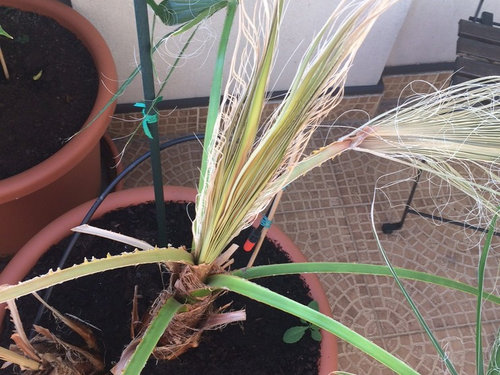
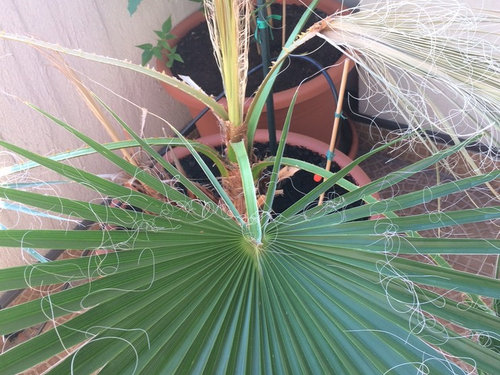
Starting late June the smaller plant dried and now the larger one is dying. New leaves are dried and yellow, as seen in the pics. All this year's leaves are almost dried. We had in the past month some scorching sun, but it's a palm tree that's supposed to love the sun. I've fertilized the plant once/month, with a special palm tree fertilizer.

I water the pot twice per week with a Gardena automated system (microdrip), 3 minutes/session.

What could be the problem and can the tree be saved? Thanks

The pics are a from last week and by now the new leaves from the centre are even more dried.


Comments (5)

  • 11 years ago

    Lots of potential issues; the sun is not one of them, btw. (Mine are in full sun, all day, and temps this week have been in the low 100's in the growing area; sorry I cant't think in terms of Celsius)

    The first think I have to ask is about your soil..., it looks very heavy (i.e., peaty). In other words moisture retentive. I know you said it's a special palm soil, but I am very skeptical about commercially prepared ready-to-use mixes (again, my experience is that they are too peaty). I am not at all familiar with your system of watering. But almost all palms (there are exceptions), like being flooded with water then allowed to dry somewhat between watering. Keep in mind, I cannot give you a time schedule for watering as this depends on heat and sun and wind, and soil, etc.... Also, when you do water, dry not to wet the crown of the plant. Your Washingtonia has at least some filifera in it (could be a 'filibusta' hybrid). I try to work a generous amount of perlite and coarse sand in my palm soils. Most palms demand excellent drainage (which means an oxygenated root system). I would remove the dead foliage. Now is it just the picture, or is the center spear also dried out and dying? Gently tug on it and see if it pulls out. If it does (maybe even if it doesn't), you can pour some Hydrogen peroxide into the center of the crown and an anti-fungal. Yes, it IS possible for a palm to recover even if the center has had some damage. One of my three Queen palms had center spear loss and is coming back..., slowly. I have also seen recovery on Phoenix date palms. However, if there is damage to the inner palm 'bud', the palm will die. Sometimes COLD will cause the rotting but your temps sounded reasonable. However, if they were outside and were exposed to prolonged WET in combination with coolness, that would do it too. (This is not as much an issue if you have warm/hot conditions and too much rain. I would not go crazy over it though. (Here, this species is very inexpensive and easily available through mail order; even pretty fast from SEED, btw) Good luck!


  • 11 years ago

    Thanks for the reply. Yes, the center spear is also dried. I just tried to tug and is firmly into position.

    About the soil: you may be right, I just assumed that the soil would be ok, especially that the same type was used from the beginning when I bought the palm (3 years ago). The watering reflects somehow your suggestions, as between the cycles the soil gets dried at the surface. However, during May this year, after putting the pot outside, we had quite a rainy weather for a couple of weeks to almost the entire May.. maybe all that moisture caused the problem.

    I usually don'y go crazy but this palm grew on me quite fond as when I had taken it it was on sale being somewhat damaged (and after a year - see my 2013 post - it revigorated quite good.

    Will see what is to happen until the autumn.

    Thanks again for the reply

  • 11 years ago
    last modified: 11 years ago

    I have several in 32 gallon tubs. Both W. filifera, W. robusta are terrific palms! Which, by the way, get little respect in California as they are so common to be considered WEEDS. But their growth rate is terrific and they are generally healthy palms. There is a big misconception about palms that are native to semi-arid to desert areas. People want to treat them as desert cacti or succulents. What they don't understand is that Washingtonia depends on subsurface water..., like with Phoenix Date palms. It may seem that they are growing in desert aridity..., but their feet are in the water (to paraphrase the Arab proverb; head in the sun, feet in the water).

    I still think your soil is too heavy. I have lost palms in the summer due to excessive moisture (and my summers are HOT), and a heavy soil does not help. Don't despair, live and LEARN. Good luck!

  • 11 years ago

    Thanks. Will not despair, that's life. About the soil, this may be a problem, on my next palm will try to maka a "home-made mixture" - any ideas about how? - as the packed soil, even in specific for palms, may not be such a good choice...

  • 11 years ago

    Many of the home-made mixes are just too peaty (at least here in the States). And peat resists BOTH DRYING, AND MOISTENING (but it's light and cheap so I guess that's why it's sold that way). So, if peat is wet, it wants to stay wet, but if it dries out (and bakes in the sun outside), well, good luck trying to moisten it again! I have bought both regular mixes and those intended for citrus and palms and/or cacti..., they all seem like mostly peat moss to me!

    Palms prefer a humus-based mix that has good drainage. So I buy from the big home improvement stores, humus (which often is frequently sold mixed with some peat), and then add coarse sand (construction kind is fine, so I leave the garden division and and go to construction supplies), then I add perlite. If I have orchid mix around, I'll add that too. Don't feel bad. I think most of the problems people experience with plants (in general) nowadays are from these awful mixes. Peat is not evil in and of itself, but once it dominates the mix, it becomes so!

Sponsored