Software
Houzz Logo Print
tlbean2004

Does having different shrubs with different colored flowers look tacky

11 years ago

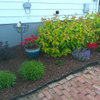
I have a dwarf holly planted in against the front of my house and i recently planted 2 red knock out roses next to it.

I am now considering planting a lace cap hydrangea and a gumpo white azalea next to the roses and maybe a boxwood at the end. Do you think this will be ok or will the different flowers with different colors blooming at the same time look bad?

Comments (12)

  • 11 years ago

    tl bean,

    No, it won't look bad. It'll look nice. Just buy a lace cap in a color that would go with the red knock outs. Some color with red, not pink. The knock outs will bloom almost the whole spring and summer and fall, so you will have red for 3 seasons, just a thought. Mabey a green lace cap, or even a light blue would go with the dark red, but not pink.

    Do you have acidic soil? Just wondering, cause the azalea will really prefer it, but will probably be fine if it's not.


  • 11 years ago

    Im not sure what kind of soil i have. The hydrangea i saw at home depot is supposed to bloom blue or pinkish red depending on the acidity actually so i guess i should find out what kind i have. lol

  • 11 years ago

    tlbean,

    What you could do is, buy the hydrangea you want, and then if it blooms pink, you jut put down some fast acting lime in the soil, not too much, and water it in good, or even put a little in when you plant it, and you should get blue blooms. Fast acting lime is for blue blooms, sulfur is for pink blooms. I just planted a hydrangea for my daughter, and it had gorgeous pink blooms and she wanted to keep it pink. We have acidic soil, so I added the lime for her. But our soil is acidic, so if you want blue blooms, and your plant blooms pink, just add the lime, and the blooms should blue up for you.

    You can get fast acting lime at any Home Depo or Lowes. I think even Walmart has it.


  • 11 years ago

    I am sorry tine, I was confused, Gardengal is absolutely right. If your soil is basic, it will bloom pink. If you have acidic soil, your blooms will most likely be blue. I got it wrong and mixed up. Our soil is acidic, so if the hydrangea is affected by soil PH to determine bloom color, which is what you stated you are buying, and you don't like the particular color it is blooming, you can go to a nursery and ask how to change it to your prefered color.

    In any case, good luck with your plants, it'll look beautiful!

  • 11 years ago

    i dont have time to read the list ... but do keep in mind.. they most likley.. will not all bloom at the same moment in time....


    and an experienced gardener actually uses that.. to spread a flowering show.. over a season ....


    rather than choosing for a one week period ... and then nothign for the rest of the summer ...


    for me.. Hs are rather late srping ... and shoot their wad... before the roses hit their prime later in june... as an e.g. .... but then i am in a lot colder zone ...


    ken

  • 11 years ago
    last modified: 11 years ago

    A little red and a little white together can look spotty, due to the contrast in color - you might want to put red near one end and white toward the other, with compatible shades of pink between. This is a lot easier to do if you are working with cherry red (bluish red) rather than tomato red (orange- or yellowish red). If the Knockout are the common one sold simply as Knockout it has a lot of pink in it and would probably go okay with blue, pink or purple hydrangeas. The basic routine with these latter is that pink ones turn blue in acidic soils and red ones turn purple, with white ones remaining white. If you can grow azaleas then hydrangeas may tend to be mostly blue or purple after they have been in your ground for awhile, even if they were pink or red when purchased.

    If there is room you should plant multiples of the smaller shrubs like the box and Satsuki azaleas so these don't look like dots next to the bigger leaved plants - small leaves produce a fine texture visually, with it taking more units of fine texture to balance the coarse visual effect produced by even one larger leaved plant.

    Another point about shrub groupings as that deciduous shrubs do not have the appearance of solidity of evergreen ones and are therefore best placed toward the back or center of plantings, with evergreen kinds flanking them and occupying the outsides and ends.

  • 11 years ago
    last modified: 11 years ago

    In a word, yes.

    A good landscape architect would never recommend this. But it's your yard. Do what you want.

    It's not so much that you will have different colors of flowers blooming at the same time; it's that you will have different varieties planted with no thought to interesting structure or design.

    For true curb-appeal (if that is what you want -- again, it's up to you), you would plant in groupings for smaller plants, and consider the forms, shapes, textures, and colors of plants, how they contrast with each other 365 days a year (not just when they bloom), the relationship of the plants to the house, creating a focal point or points, considering plants that work better as hedges, barriers, ground covers, in sweeping beds or as solitary specimens -- all that to embellish the home rather than take away from it.

  • 11 years ago

    I have a small front yard so i dont really have room to plant multiples of any one thing. Especially room to plant things in front of other plants.

    I might take out 1 of the 2 knock out roses so i can have something else in the mix. Im thinking about a Peony.

  • 11 years ago
    last modified: 11 years ago

    "In a word, yes.
    A good landscape architect would never recommend this."

    I have to disagree with this :-) Color - as in flower color - is approached differently in the garden based on client wishes. Landscape design recognizes multiple types of color schemes and all have validity: monochromatic, analogous, complimentary, primary, pastel and riotous. 'Riotous' is closest to the color scheme being considered here and is seen in many designed landscapes, like the mixed perennial borders at Great Dixter. Even Japanese style gardens, highly designed and planned landscapes, will use shrubs and trees with multiple flower colors together (think flowering azaleas), as flowering is not the basis of the design. The form and layout is. As one landscape design text states: "There is no right or wrong when it comes to color in the garden. Color choices are a matter of personal taste."

    To be honest, designers seldom take flower color into consideration when planning a design - unless they are designing a perennial border. The reason for that is flowers tend to be very transitory and so color derived from flowers tends to be very fleeting. As mentioned above, the primary concern is given to plant shape and form and foliage color and texture. Flowers are considered an added bonus but not the major design issue.

    Most shrubs have a rather short bloom cycle and it is unusual for all the flowering shrubs in a landscape to be in bloom at the same time....another reason why flower color is very tertiary to the design process. If the client or homeowner does favor a shrub with an extended bloom season - like the Knockout roses - then selecting another flowering shrub that compliments/accents/contrasts with their coloring is always a good idea. But what that color should be is a personal choice, nothing necessarily governed by design rules.

    There are definitely design considerations to be made when considering a planting area, especially one that is adjacent to an entry. Scale, balance, a more or less uniform year round appearance and the shape, form, texture and foliage color as mentioned above. It is usually considered best to limit the number of plant choices involved and plant at least smaller specimens in multiples. Too many single plant choices (without repeating) just makes the design look busy and lack cohesion. And if you have a limited pallet with suitable repetition, then it is very unlikely that you will have too many potentially distracting flower colors at any given time.

  • 11 years ago
    last modified: 11 years ago

    gardengal:

    That is why I said this:

    'It's not so much that you will have different colors of flowers blooming at the same time; it's that you will have different varieties planted with no thought to interesting structure or design.'

    We seem to be in agreement. You just said it better. :-)

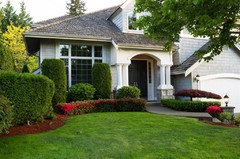
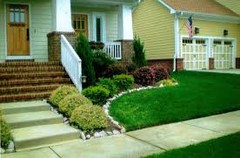
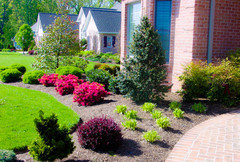
    In those photo examples I posted, note that what look like azaleas are all the same color. There are groups of three or a long low 'hedge'. A designer would never plant three azaleas in a row of three different colors in that situation, unless the owner specifically asks for it. Same with a hedge of azaleas. That isn't to say that the garden can't be less formal.

    Those photos that I posted still have quite a bit of variety in plant species and forms despite limited space in a few instances.

  • 11 years ago
    last modified: 11 years ago

    Those photos that I posted still have quite a bit of variety in plant species and forms

    A variety of form which is destroyed by the out-of-context formal shearing. As for not paying attention to flower colors of woody plants a lack of harmony at flowering time is exactly why the most fully realized designs coordinate flower colors - as well as plant forms, leaf textures and flower shapes whether the plants are woody or not - and why so many plantings don't seem to come off well.

    I call it "random planting", the effect created being one of unplanned disorganization - as though everything was chosen on impulse at a retail garden center.

    Which is often the case.

    Lloyd was specifically interested in plants in "active mixtures" (at Great Dixter) and pointed this out, because otherwise it is not everyone's cup of tea (to uphold the British context).

Sponsored
NME Builders LLC
Average rating: 5 out of 5 stars2 Reviews
Remodeling Company in New Albany, Ohio